


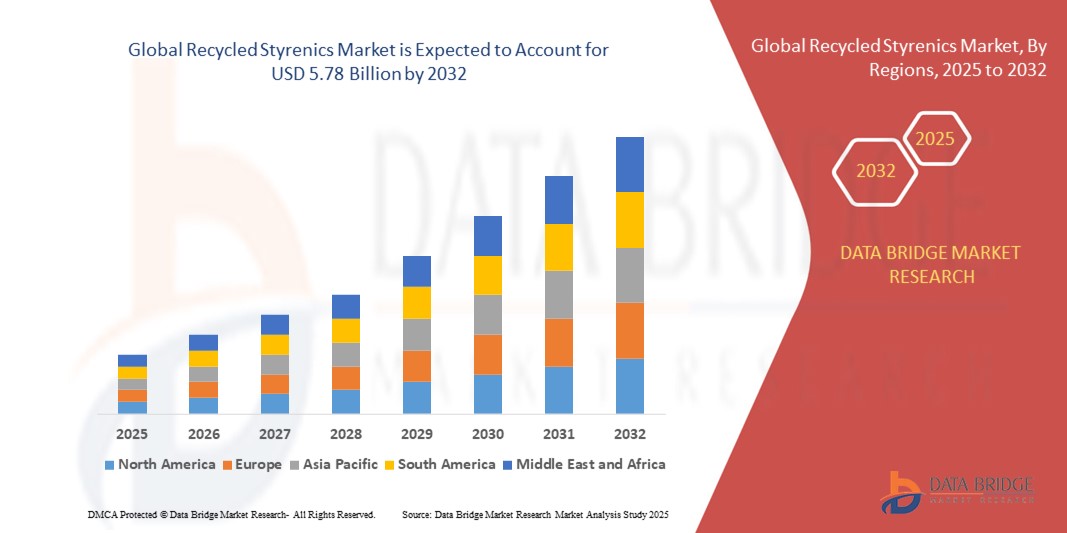
Recycled Styrenics Market Size
- The global recycled styrenics market size was valued at USD 3.88 billion in 2024 and is expected to reach USD 5.78 billion by 2032, at a CAGR of 5.1% during the forecast period
- The market growth is largely fuelled by the increasing focus on sustainability and circular economy initiatives, rising consumer demand for eco-friendly packaging, and regulatory support for plastic recycling
- Growing adoption of recycled styrenics in packaging, automotive, and construction applications, coupled with advancements in recycling technologies, is further driving market expansion
Recycled Styrenics Market Analysis
- The market is witnessing innovations in mechanical and chemical recycling processes, improving the quality and applicability of recycled styrenic materials across various industries
- Increased corporate sustainability commitments and consumer preference for products with lower environmental impact are boosting demand for recycled styrenics globally
- Asia-Pacific dominated the recycled styrenics market with the largest revenue share of 37.8% in 2024, driven by rapid industrialization, rising urbanization, and increasing government initiatives promoting sustainable materials
- North America region is expected to witness the highest growth rate in the global recycled styrenics market, driven by the rising adoption of recycled materials in packaging and automotive industries, growing environmental awareness, and technological advancements in polystyrene and ABS recycling. The presence of major market players and supportive policies for sustainable material usage further strengthen the region’s growth prospects
- The rPS segment dominated the market with the largest revenue share in 2024, driven by its widespread use in packaging, disposable consumer products, and insulation applications. Its cost-effectiveness, recyclability, and compatibility with existing manufacturing processes make rPS a preferred choice for companies aiming to reduce environmental impact and production costs
Report Scope and Recycled Styrenics Market Segmentation
|
Attributes |
Recycled Styrenics Key Market Insights |
|
Segments Covered |
|
|
Countries Covered |
North America
Europe
Asia-Pacific
Middle East and Africa
South America
|
|
Key Market Players |
|
|
Market Opportunities |
• Expansion Of Recycling Infrastructure In Emerging Economies |
|
Value Added Data Infosets |
In addition to the insights on market scenarios such as market value, growth rate, segmentation, geographical coverage, and major players, the market reports curated by the Data Bridge Market Research also include import export analysis, production capacity overview, production consumption analysis, price trend analysis, climate change scenario, supply chain analysis, value chain analysis, raw material/consumables overview, vendor selection criteria, PESTLE Analysis, Porter Analysis, and regulatory framework. |
Recycled Styrenics Market Trends
Increasing Adoption of Recycled Materials in Plastic Manufacturing
- The growing emphasis on sustainability and circular economy practices is driving the adoption of recycled styrenics in manufacturing processes. Incorporating recycled polystyrene and other styrenic materials reduces environmental impact, lowers raw material costs, and supports eco-friendly product initiatives. This trend is particularly pronounced in packaging and consumer goods industries, where regulatory and consumer pressures are high
- The demand for high-quality recycled styrenics is accelerating the development of advanced recycling technologies, including chemical and mechanical recycling methods. These innovations enhance material properties, allowing recycled products to match the performance of virgin styrenics in applications such as automotive components, electronics, and household goods
- Manufacturers are increasingly leveraging recycled styrenics to meet corporate sustainability goals and reduce carbon footprints. The versatility of recycled styrenics in diverse applications—from rigid packaging to insulation materials—supports wider adoption across multiple industries
- For instance, in 2023, several European packaging firms reported a significant increase in the use of recycled polystyrene for food containers and disposable packaging, improving environmental compliance while maintaining product quality
- While recycled styrenics are gaining traction, market growth depends on the availability of high-quality feedstock, technological advancements in recycling, and supportive regulatory frameworks to encourage sustainable material use
Recycled Styrenics Market Dynamics
Driver
Rising Environmental Concerns and Government Regulations Promoting Recycling
• The increasing awareness of plastic pollution and stringent government regulations on single-use plastics are compelling manufacturers to adopt recycled styrenics. Policies encouraging material recovery and eco-friendly packaging solutions are expanding the market for recycled polymers
• Consumer demand for sustainable products is driving brands to incorporate recycled content in packaging, electronics, and automotive components. This shift is boosting the use of recycled styrenics as companies strive to meet eco-labeling and sustainability commitments
• Investment in advanced recycling infrastructure and public-private partnerships is supporting the efficient collection and processing of styrenic waste. Initiatives such as extended producer responsibility (EPR) programs are ensuring a steady supply of recyclable materials for industrial use
• For instance, in 2022, several North American electronics manufacturers started using recycled polystyrene in device housings, aligning with regulatory compliance and reducing material costs
• While environmental awareness and regulatory support drive adoption, challenges in feedstock quality, recycling efficiency, and supply chain logistics remain important considerations for sustained market growth
Restraint/Challenge
Limited Availability of High-Quality Recycled Feedstock and High Processing Costs
• The scarcity of consistent, high-quality recycled styrenic materials restricts market expansion. Variability in recovered plastics can affect performance, limiting their use in high-end applications. Manufacturers often rely on costly sorting and purification processes to meet quality standards.
• Processing and recycling costs remain high, particularly for chemical recycling methods, making recycled styrenics less competitive than virgin materials in certain applications. High energy consumption and specialized equipment requirements further limit adoption, especially among small and medium-sized enterprises.
• Inadequate recycling infrastructure in developing regions hampers access to recycled feedstock, leading to dependency on virgin styrenics and restricting market penetration. Supply chain inefficiencies and lack of regulatory enforcement exacerbate the challenge.
• For instance, in 2023, several Asian manufacturers reported difficulties in sourcing sufficient post-consumer polystyrene with uniform quality, affecting production schedules and product consistency.
• While the recycled styrenics market is growing, addressing feedstock quality, cost efficiency, and regional infrastructure gaps is critical for achieving wider adoption and realizing the full environmental and economic benefits.
Recycled Styrenics Market Scope
The market is segmented on the basis of type and application.
- By Type
On the basis of type, the recycled styrenics market is segmented into Recycled Polystyrene (rPS) and Recycled Acrylonitrile Butadiene Styrene (rABS). The rPS segment dominated the market with the largest revenue share in 2024, driven by its widespread use in packaging, disposable consumer products, and insulation applications. Its cost-effectiveness, recyclability, and compatibility with existing manufacturing processes make rPS a preferred choice for companies aiming to reduce environmental impact and production costs.
The rABS segment is expected to witness the fastest growth rate from 2025 to 2032, fueled by rising adoption in automotive, electronics, and electrical (E&E) applications. rABS offers improved mechanical strength, heat resistance, and versatility, making it suitable for high-performance components. Growing demand for sustainable, high-quality plastics in automotive interiors, consumer electronics, and industrial applications is supporting the accelerated adoption of rABS materials.
- By Application
On the basis of application, the recycled styrenics market is segmented into Packaging, Automotive, and Electronics & Electrical (E&E). The Packaging segment held the largest market revenue share in 2024, attributed to the high volume use of recycled polystyrene in food containers, disposable packaging, and consumer goods. Manufacturers are increasingly integrating recycled materials into packaging solutions to meet regulatory mandates and sustainability targets.
The Automotive segment is expected to witness the fastest growth rate from 2025 to 2032, driven by the automotive industry’s emphasis on lightweight, eco-friendly, and cost-effective materials. Recycled styrenics, particularly rABS, are used in interior components, dashboards, and under-the-hood applications, enabling automakers to reduce environmental impact while maintaining performance standards.
Recycled Styrenics Market Regional Analysis
• Asia-Pacific dominated the recycled styrenics market with the largest revenue share of 37.8% in 2024, driven by rapid industrialization, rising urbanization, and increasing government initiatives promoting sustainable materials
• Manufacturers and end-users across packaging, automotive, and electronics sectors are prioritizing recycled styrenics to meet sustainability goals and comply with environmental regulations
• The widespread adoption is further supported by growing consumer awareness, expanding recycling infrastructure, and cost-effective availability of rPS and rABS, positioning Asia-Pacific as the leading market globally
China Recycled Styrenics Market Insight
The China recycled styrenics market accounted for the largest revenue share in Asia-Pacific in 2024, fueled by the country’s industrial expansion, government incentives for sustainable plastics, and growing demand from packaging and automotive sectors. China’s strong domestic recycling capabilities, coupled with a wide availability of post-consumer and post-industrial styrenics, facilitate large-scale adoption of rPS and rABS. Urbanization and e-commerce growth are driving packaging needs, further increasing demand for recycled materials. Moreover, local manufacturers are investing in advanced sorting and processing technologies to improve the quality of recycled styrenics. Partnerships between recycling companies and end-users in automotive and electronics industries are boosting market utilization. The push for smart and green manufacturing practices continues to strengthen China’s position in the global recycled styrenics market.
Japan Recycled Styrenics Market Insight
The Japan recycled styrenics market is expected to witness the fastest growth rate from 2025 to 2032 due to high environmental awareness, stringent regulations on plastic waste, and adoption of recycled materials in automotive and electronics applications. The government’s focus on achieving carbon neutrality by promoting circular economy practices has accelerated the uptake of rPS and rABS. Industrial players are incorporating recycled styrenics into high-performance products while maintaining quality and safety standards. Advanced recycling technologies, including chemical recycling, are enhancing the recovery and usability of styrenic materials. Consumer demand for eco-friendly electronics packaging and automotive components further supports market expansion. Collaboration between local manufacturers and global brands ensures consistent supply and quality of recycled plastics. Japan’s strategic policies and technological advancements continue to drive sustainable growth of the market.
North America Recycled Styrenics Market Insight
North America is expected to witness the fastest growth rate from 2025 to 2032, supported by well-established recycling infrastructure, strict environmental regulations, and high demand from automotive and packaging sectors. The U.S. dominates the regional market with advanced recycling technologies, high-quality rPS and rABS production, and active collaborations between manufacturers and recyclers. Consumer demand for sustainable and recyclable packaging, coupled with corporate sustainability initiatives, is propelling market growth. The availability of post-consumer styrenics from collection programs provides a consistent feedstock for industrial applications. In addition, government policies promoting eco-friendly materials and reduced landfill usage support adoption of recycled plastics. The North American market is expected to continue expanding due to technological innovations and increasing regulatory pressure to implement circular economy solutions.
U.S. Recycled Styrenics Market Insight
The U.S. recycled styrenics market is expected to witness the fastest growth rate from 2025 to 2032, driven by high demand from the packaging, automotive, and electronics sectors. Advanced recycling infrastructure, coupled with strict environmental regulations, supports efficient collection and processing of rPS and rABS. Manufacturers are increasingly integrating recycled styrenics into high-performance applications while maintaining product quality and safety standards. Consumer awareness and corporate sustainability initiatives are encouraging the adoption of eco-friendly materials across multiple industries. In addition, collaboration between recyclers and end-users ensures a consistent supply of high-quality recycled plastics. Technological innovations in chemical and mechanical recycling, along with government incentives, continue to bolster market growth in the U.S., making it a key player in the global recycled styrenics landscape.
Europe Recycled Styrenics Market Insight
Europe is expected to witness the fastest growth rate from 2025 to 2032 due to regulatory frameworks promoting circular economy practices, strong consumer preference for sustainable packaging, and industrial adoption of recycled plastics in automotive and electronics sectors. Countries such as Germany, the U.K., and France are key contributors, leveraging high-quality rPS and rABS in production. European manufacturers are increasingly investing in chemical recycling and advanced sorting techniques to improve material recovery rates. The push for sustainable supply chains and eco-labeling initiatives is encouraging adoption across industries. Automotive and electronics manufacturers are collaborating with recyclers to ensure a stable supply of recycled styrenics. In addition, rising public awareness about environmental conservation and governmental subsidies for recycling infrastructure further bolster the market.
U.K. Recycled Styrenics Market Insight
The U.K. recycled styrenics market is expected to witness the fastest growth rate from 2025 to 2032, driven by government-backed initiatives to reduce plastic waste and encourage recycling. The adoption of recycled styrenics in packaging and electronics manufacturing is increasing, supported by strong regulations on plastic usage. Manufacturers are focusing on high-quality rPS and rABS to meet the performance requirements of industrial applications. Initiatives such as producer responsibility programs and eco-friendly labeling are promoting the use of recycled materials. The market benefits from efficient logistics and a well-organized recycling ecosystem. Collaboration between local recyclers and international brands helps maintain a consistent feedstock for industrial use. Overall, the U.K. is positioning itself as a hub for sustainable styrenic solutions in Europe.
Germany Recycled Styrenics Market Insight
The Germany recycled styrenics market is expected to witness the fastest growth rate from 2025 to 2032 due to strong environmental regulations, industrial demand from automotive and electronics sectors, and a robust domestic recycling ecosystem. German manufacturers are investing in both mechanical and chemical recycling technologies to enhance the quality and performance of rPS and rABS. The push for green manufacturing, coupled with stringent packaging and automotive sustainability standards, supports market adoption. Partnerships between recyclers and end-users ensure a stable supply of recycled materials. Consumer preference for sustainable products and government incentives for circular economy practices further strengthen market growth. Germany’s strategic focus on environmental responsibility and technological innovation continues to drive the regional market forward.
Recycled Styrenics Market Share
The recycled styrenics industry is primarily led by well-established companies, including:
- BASF SE (Germany)
- LG Chem Ltd. (South Korea)
- Trinseo LLC (U.S.)
- AmSty (U.S.)
- ALPLA (Austria)
- Chevron Corporation (U.S.)
- Eni S.p.A. (Italy)
- INEOS Styrolution (Germany)
- MBA Polymers (U.K.)
- SABIC (Saudi Arabia)
Latest Developments in Global Recycled Styrenics Market
- In January 2025, INEOS Styrolution unveiled a groundbreaking mechanical recycling technology for polystyrene, designed to convert post-consumer polystyrene waste into high-quality recyclates suitable for food contact applications. This innovation achieves a purity level previously attainable only with PET bottle recyclates, enabling safer and more sustainable reuse of polystyrene. By enhancing the circularity of polystyrene products, the technology reduces environmental impact and supports regulatory compliance for food-grade applications. It was recognized as a finalist for the "Product Technology Innovation of the Year" at the 2025 Plastics Recycling Awards Europe, highlighting its potential to drive industry adoption. The development is expected to strengthen market confidence in recycled styrenics and promote wider implementation across packaging and consumer goods sectors.

- Interactive Data Analysis Dashboard
- Company Analysis Dashboard for high growth potential opportunities
- Research Analyst Access for customization & queries
- Competitor Analysis with Interactive dashboard
- Latest News, Updates & Trend analysis
- Harness the Power of Benchmark Analysis for Comprehensive Competitor Tracking
Global Recycled Styrenics Market, Supply Chain Analysis and Ecosystem Framework
To support market growth and help clients navigate the impact of geopolitical shifts, DBMR has integrated in-depth supply chain analysis into its Global Recycled Styrenics Market research reports. This addition empowers clients to respond effectively to global changes affecting their industries. The supply chain analysis section includes detailed insights such as Global Recycled Styrenics Market consumption and production by country, price trend analysis, the impact of tariffs and geopolitical developments, and import and export trends by country and HSN code. It also highlights major suppliers with data on production capacity and company profiles, as well as key importers and exporters. In addition to research, DBMR offers specialized supply chain consulting services backed by over a decade of experience, providing solutions like supplier discovery, supplier risk assessment, price trend analysis, impact evaluation of inflation and trade route changes, and comprehensive market trend analysis.
Data collection and base year analysis are done using data collection modules with large sample sizes. The stage includes obtaining market information or related data through various sources and strategies. It includes examining and planning all the data acquired from the past in advance. It likewise envelops the examination of information inconsistencies seen across different information sources. The market data is analysed and estimated using market statistical and coherent models. Also, market share analysis and key trend analysis are the major success factors in the market report. To know more, please request an analyst call or drop down your inquiry.
The key research methodology used by DBMR research team is data triangulation which involves data mining, analysis of the impact of data variables on the market and primary (industry expert) validation. Data models include Vendor Positioning Grid, Market Time Line Analysis, Market Overview and Guide, Company Positioning Grid, Patent Analysis, Pricing Analysis, Company Market Share Analysis, Standards of Measurement, Global versus Regional and Vendor Share Analysis. To know more about the research methodology, drop in an inquiry to speak to our industry experts.
Data Bridge Market Research is a leader in advanced formative research. We take pride in servicing our existing and new customers with data and analysis that match and suits their goal. The report can be customized to include price trend analysis of target brands understanding the market for additional countries (ask for the list of countries), clinical trial results data, literature review, refurbished market and product base analysis. Market analysis of target competitors can be analyzed from technology-based analysis to market portfolio strategies. We can add as many competitors that you require data about in the format and data style you are looking for. Our team of analysts can also provide you data in crude raw excel files pivot tables (Fact book) or can assist you in creating presentations from the data sets available in the report.













