


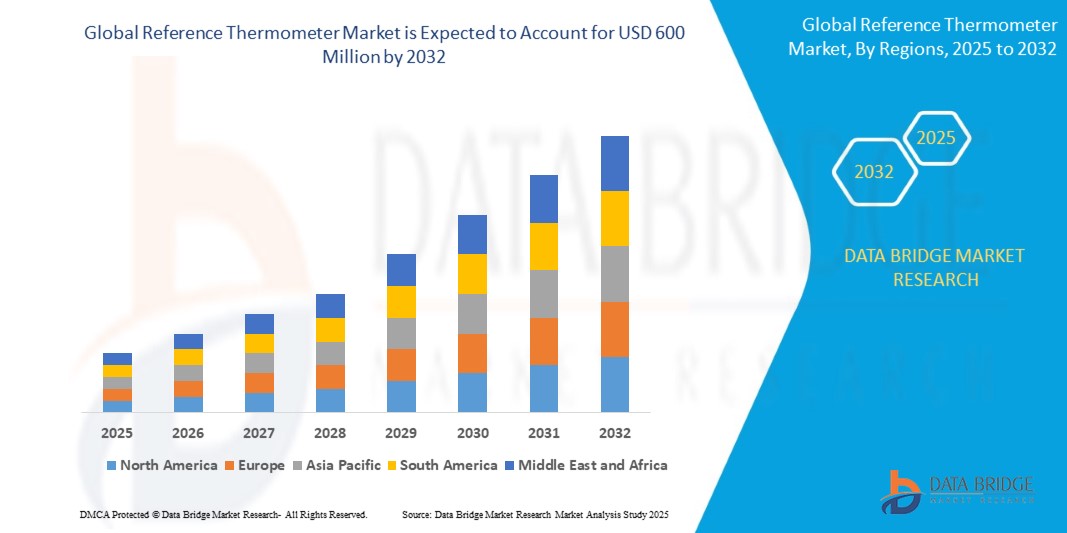
Reference Thermometer Market Size
- The Global Reference Thermometer Market Size was valued at USD 400 Million in 2024 and is expected to reach USD 600 Million by 2032, at a CAGR of 6% during the forecast period
- The growth of the Global Reference Thermometer Market is fueled by Expansion of Calibration and Metrology Laboratories, Increasing Regulatory and Quality Compliance Requirements and Advancements in Sensor and Thermometry Technology
Reference Thermometer Market Analysis
The Global Reference Thermometer Market is experiencing consistent growth due to the increasing emphasis on precision, compliance, and safety across various high-value industries. Reference thermometers are essential tools used for calibrating other thermometers and temperature sensors, ensuring accurate temperature readings in critical processes. One of the primary growth drivers is the tightening of global regulatory standards—particularly in the pharmaceutical, biotechnology, food & beverage, and healthcare sectors—which demand traceable and accurate temperature measurement to meet quality assurance and safety requirements. Agencies such as the FDA, WHO, EMA, and ISO require validated temperature measurement systems in processes such as drug manufacturing, vaccine storage, sterilization, and clinical diagnostics. As a result, demand for high-precision instruments like platinum resistance thermometers (PRTs) and digital reference thermometers has surged.
Technological advancements are also propelling market growth. Modern reference thermometers feature digital displays, wireless connectivity, automated data logging, and cloud-based monitoring, making them more user-friendly and adaptable to Industry 4.0 environments. These innovations enable real-time monitoring and remote calibration, which are especially critical in high-stakes applications like cold chain logistics, bioprocess monitoring, and aerospace testing. The shift from analog to digital systems is accelerating, particularly in developed regions, contributing to overall market value expansion.
Furthermore, the increasing number of calibration and metrology laboratories worldwide—particularly in developing economies like India, Brazil, and parts of Southeast Asia—is expanding the customer base for reference thermometers. As governments and private organizations invest in national quality infrastructure, including calibration labs and testing facilities, the need for reliable temperature reference devices is growing. Additionally, the rise in R&D activities across the chemical, energy, and automotive sectors has created new demand for laboratory-grade thermometers capable of delivering highly stable and repeatable measurements under extreme conditions.
Report Scope and Reference Thermometer Market Segmentation
|
Attributes |
Reference Thermometer Market Insights |
|
Segments Covered |
|
|
Countries Covered |
North America
Europe
Asia-Pacific
Middle East and Africa
South America
|
|
Key Market Players |
|
|
Market Opportunities |
|
|
Value Added Data Infosets |
In addition to the insights on market scenarios such as market value, growth rate, segmentation, geographical coverage, and major players, the market reports curated by the Data Bridge Market Research also include in-depth expert analysis, pricing analysis, brand share analysis, consumer survey, demography analysis, supply chain analysis, value chain analysis, raw material/consumables overview, vendor selection criteria, PESTLE Analysis, Porter Analysis, and regulatory framework. |
Reference Thermometer Market Trends
“Innovation and Integration: Advancing Precision Through Smart Technologies”
- A significant and accelerating trend in the Global Reference Thermometer Market is the integration of smart technologies, including wireless connectivity (Bluetooth, Wi-Fi), IoT compatibility, and cloud-based monitoring platforms, into advanced reference thermometer systems. These upgrades enable real-time data access, remote calibration, and automated logging, improving usability across industrial, laboratory, and healthcare environments.
- Manufacturers are focusing on developing low-drift, digital thermometers with self-diagnostics and AI-driven predictive maintenance capabilities, enhancing reliability and reducing manual intervention.
- Increasing use of infrared and contactless reference thermometers is gaining traction, especially in pharmaceutical cold chain logistics, food safety, and clinical diagnostics where hygiene and non-invasiveness are critical.
- The convergence of Industry 4.0, edge computing, and precision metrology is reshaping calibration processes, making them faster, smarter, and more efficient.
Reference Thermometer Market Dynamics
Driver
“Rising Demand for Precision, Regulatory Compliance, and Digital Transformation”
- The global push for quality assurance, process validation, and regulatory compliance (e.g., FDA, GMP, ISO 17025) across industries such as pharmaceuticals, food & beverage, and healthcare is driving demand for highly accurate reference thermometers.
- Rapid growth in pharma R&D, vaccine manufacturing, and clinical trials post-COVID-19 has accelerated the need for temperature-sensitive calibration instruments.
- Increasing deployment of calibration and metrology labs in emerging economies is expanding market access and demand.
- Technological advancements in digital sensors, miniaturization, and automated calibration tools are making reference thermometers more accessible and versatile.
- The expansion of smart factories, bioprocess monitoring, and cold chain logistics requires robust and reliable reference temperature monitoring systems.
Restraint/Challenge
“High Cost, Technical Complexity, and Limited Awareness in Developing Regions”
- High initial costs associated with precision reference thermometers, especially those used in metrology labs and pharmaceutical calibration, remain a barrier for small and medium enterprises.
- Technical complexity in calibration processes, sensor drift issues, and the requirement for skilled personnel to operate and maintain these devices can limit adoption in cost-sensitive and resource-constrained markets.
- Lack of awareness and limited infrastructure in some developing countries hinder the adoption of advanced calibration standards and equipment.
- Fragmented regulatory frameworks across regions may delay standardization and global interoperability of calibration protocols.
- In industrial settings, harsh environmental conditions, vibration, and interference can affect the accuracy and performance of reference thermometers, requiring additional protective measures or specialized equipment.
Reference Thermometer Market Scope
The market is segmented on the basis of Product Type, Measurement Technique and Application
|
Segmentation |
Sub-Segmentation |
|
By Product Type |
|
|
By Measurement Technique |
|
|
By Application |
|
- By Product Type
By product type, the market comprises digital reference thermometers, glass thermometers, platinum resistance thermometers (PRTs), thermocouples, and infrared thermometers. Digital reference thermometers are witnessing rapid adoption due to their enhanced accuracy, ease of integration with digital systems, and data logging capabilities, making them popular in pharmaceutical and calibration laboratory environments. Glass thermometers, while traditional and cost-effective, are gradually being replaced by more advanced options but still find usage in educational and some laboratory settings. Platinum resistance thermometers remain the preferred choice for high-precision applications such as aerospace, pharmaceuticals, and national metrology institutes due to their exceptional stability and repeatability. Thermocouples, known for their robustness and wide temperature range, are widely used in industrial sectors like energy and oil & gas, where durability in harsh conditions is crucial. Infrared thermometers, which offer non-contact measurement, are increasingly adopted in sectors such as food safety, healthcare, and cold chain logistics due to hygiene and speed advantages.
- By Measurement Technique
Based on measurement technique, the market is divided into contact and non-contact thermometers. Contact thermometers, requiring direct contact with the medium, are widely used in laboratory and industrial calibration owing to their accuracy. Non-contact thermometers, on the other hand, are gaining momentum for applications where speed, safety, and hygiene are paramount, such as in healthcare and food processing industries.
- By Application
In terms of application, calibration laboratories constitute the largest segment, relying heavily on high-precision reference thermometers for sensor calibration and quality assurance. The pharmaceutical and biotechnology industries are key drivers, demanding stringent temperature validation for drug manufacturing, vaccine storage, and clinical trials. The food and beverage sector uses reference thermometers to maintain safety and quality during processing, storage, and transportation, often favoring infrared and non-contact devices. Healthcare and clinical laboratories employ these instruments for diagnostic calibration and sterilization monitoring. Additionally, the oil and gas sector depends on robust thermocouples and PRTs to monitor extreme temperature conditions during exploration and refining. The energy and power generation industry also utilizes precise thermometry for turbine monitoring, battery testing, and environmental control across both renewable and conventional power plants. This segmentation highlights the diverse technological applications and critical role of reference thermometers across multiple industries globally.
Reference Thermometer Market Regional Analysis
- North America holds a significant share in the market, supported by its well-established calibration laboratories, advanced pharmaceutical and biotech sectors, and widespread adoption of Industry 4.0 technologies. The region benefits from stringent regulatory standards such as FDA and ISO, which mandate frequent and precise temperature calibration, thereby fueling demand for high-accuracy reference thermometers. The presence of key market players and ongoing investments in smart manufacturing and healthcare infrastructure further bolster growth in this region.
- In Europe, the market is propelled by strong emphasis on quality control across pharmaceutical manufacturing, food safety, and energy sectors. Countries like Germany, France, and the UK lead in adopting advanced metrology equipment, supported by comprehensive regulatory requirements including the European Medicines Agency (EMA) guidelines. The increasing focus on environmental sustainability and energy-efficient processes in Europe is also driving demand for precision temperature monitoring solutions.
- The Asia-Pacific region is emerging as the fastest-growing market due to rapid industrialization, expansion of pharmaceutical manufacturing, and growing investments in calibration laboratories. Countries such as China, India, Japan, and South Korea are witnessing increased adoption of reference thermometers, driven by government initiatives to improve quality standards and infrastructure development. The rising number of biotech startups and expanding food processing industries in these countries also contribute to robust market growth.
- In the Middle East & Africa, the market growth is moderate but promising, supported by ongoing infrastructure development in oil & gas, energy, and healthcare sectors. Increased awareness about calibration and quality compliance is encouraging adoption, especially in the UAE, Saudi Arabia, and South Africa. However, limited metrology infrastructure in some areas poses challenges.
- Latin America is witnessing steady growth, with Brazil and Mexico leading the adoption of reference thermometers, particularly in pharmaceuticals, food & beverage, and energy sectors. Growing investments in healthcare infrastructure and industrial automation are expected to drive demand further, despite economic and regulatory hurdles.
North America Reference Thermometer Market Insight
The North America Reference Thermometer Market is one of the most mature and technologically advanced globally, driven primarily by the region’s strong pharmaceutical, biotechnology, healthcare, and industrial sectors. The United States and Canada lead this market, benefiting from stringent regulatory frameworks such as the FDA and ISO standards, which enforce rigorous temperature calibration and monitoring protocols. This regulatory landscape ensures consistent demand for high-precision reference thermometers used in calibration laboratories, clinical research facilities, and pharmaceutical manufacturing plants. Technological innovation is a hallmark of the North American market, with manufacturers focusing on digital, wireless, and IoT-enabled thermometers that offer real-time data monitoring, remote access, and enhanced accuracy.
Moreover, the ongoing shift towards Industry 4.0 and smart manufacturing is accelerating the adoption of automated calibration solutions, integrating reference thermometers with cloud-based platforms and AI-powered analytics to improve operational efficiency and compliance. The rise in biopharmaceutical research, vaccine development, and cold chain logistics post-pandemic has further heightened the demand for reliable temperature measurement devices. Additionally, the presence of numerous key industry players and calibration service providers in the region fosters competitive innovation and product development.
Europe Reference Thermometer Market Insight
The Europe Reference Thermometer Market is characterized by steady growth fueled by stringent regulatory requirements, well-established pharmaceutical and biotechnology industries, and increasing emphasis on food safety and energy efficiency. Key countries such as Germany, France, the UK, and Switzerland lead the market, driven by rigorous quality control standards mandated by regulatory bodies like the European Medicines Agency (EMA) and compliance with ISO 17025 for calibration laboratories. These regulations necessitate precise temperature monitoring and frequent calibration, supporting strong demand for high-accuracy reference thermometers.
Technological innovation is prominent in the region, with manufacturers focusing on advanced digital and platinum resistance thermometers that offer enhanced stability and traceability. The integration of IoT and cloud-based monitoring systems is gaining traction, improving real-time data accessibility and predictive maintenance in pharmaceutical manufacturing, food processing, and energy sectors. Additionally, Europe’s focus on sustainability and renewable energy is driving demand for precise temperature measurements in power generation and environmental monitoring applications.
Asia Pacific Reference Thermometer Market Insight
The Asia Pacific Reference Thermometer Market is experiencing rapid growth, driven by accelerating industrialization, expanding pharmaceutical and biotechnology sectors, and increasing investments in calibration infrastructure across emerging economies such as China, India, Japan, and South Korea. The region is witnessing rising demand for high-precision temperature measurement devices, propelled by growing quality standards and regulatory requirements aligned with global benchmarks like ISO 17025. The pharmaceutical industry, especially in China and India, is a major growth driver, as these countries expand their manufacturing capabilities and clinical research activities.
In addition, the food and beverage industry’s expansion and increasing emphasis on food safety protocols are boosting the adoption of both contact and non-contact reference thermometers. Technological advancements such as digital thermometers with IoT integration and wireless capabilities are gaining popularity, facilitating real-time monitoring and automated calibration processes.
Middle East and Africa Reference Thermometer Market Insight
The Middle East and Africa (MEA) Reference Thermometer Market is showing moderate but promising growth, supported by ongoing industrial expansion and increasing emphasis on quality control and regulatory compliance across various sectors. Key countries such as the United Arab Emirates, Saudi Arabia, South Africa, and Nigeria are driving demand through investments in oil & gas, healthcare, pharmaceuticals, and food processing industries. The region’s growing focus on infrastructure development and modernization in energy and manufacturing sectors is encouraging the adoption of precise temperature measurement tools like platinum resistance thermometers and thermocouples.
Despite the positive outlook, the MEA market faces challenges including limited metrology infrastructure, a shortage of skilled calibration professionals, and inconsistent regulatory enforcement in some countries, which may slow adoption rates. Additionally, high costs associated with advanced reference thermometers can be a barrier for smaller enterprises and emerging industries. However, increasing awareness of the importance of calibration and temperature monitoring, coupled with government initiatives aimed at enhancing industrial standards and healthcare services, is expected to gradually expand the market. Overall, MEA represents a region with significant potential, particularly as more industries adopt global best practices and invest in modern temperature measurement technologies
Latin America Reference Thermometer Market Insight
The Latin America Reference Thermometer Market is witnessing steady growth, driven primarily by expanding pharmaceutical manufacturing, food and beverage processing, and energy sectors in countries such as Brazil, Mexico, and Argentina. Increasing investments in healthcare infrastructure and rising awareness regarding quality control and calibration standards are propelling demand for precise and reliable reference thermometers. The region’s regulatory landscape is evolving, with greater alignment towards international standards like ISO 17025, which encourages the adoption of advanced temperature measurement devices in calibration laboratories and industrial applications.
Digital and platinum resistance thermometers are increasingly preferred due to their accuracy and ease of integration with modern monitoring systems. The food industry’s focus on safety and quality, along with growing cold chain logistics, further supports market expansion. However, economic fluctuations, limited access to advanced calibration facilities in certain areas, and budget constraints for smaller manufacturers pose challenges to market growth. Despite these hurdles, Latin America presents significant opportunities, especially as industries modernize and regulatory frameworks strengthen, paving the way for enhanced adoption of high-precision reference thermometer technologies.
Reference Thermometer Market Share
The Reference Thermometer Industry is primarily led by well-established companies, including:
- Fluke Calibration
- AMETEK (Jofra)
- WIKA
- Isotech
- Anton Paar
- ThermoProbe
- Labfacility
- Accurate Sensors Technologies (AST)
- OMEGA Engineering
- Dostmann electronic GmbH
Latest Developments in Global Reference Thermometer Market
- From 2022 onwards, the Global Reference Thermometer Market witnessed significant advancements, beginning with the introduction of next-generation digital thermometers offering enhanced accuracy and user-friendly interfaces. During this period, manufacturers expanded their portfolios, particularly focusing on platinum resistance thermometers with improved thermal stability, while early adoption of wireless-enabled devices began in select industrial and pharmaceutical sectors.
- In 2023, the demand for non-contact infrared thermometers surged, largely driven by healthcare and food safety concerns following the pandemic. This year also saw growing integration of IoT connectivity features, allowing real-time remote monitoring and data logging. Regulatory bodies updated calibration standards like ISO 17025, pushing manufacturers to ensure compliance through product enhancements.
- By 2024, major market players launched cloud-based platforms integrated with reference thermometers to facilitate predictive maintenance and streamlined compliance reporting. Sustainability became a key focus, prompting development of energy-efficient devices using eco-friendly materials. Additionally, strategic partnerships and expansions in emerging regions such as Asia Pacific and Latin America helped manufacturers tap into new growth opportunities.
- Moving into 2025, ongoing developments include the integration of AI-driven data analytics with thermometer systems to improve predictive calibration and fault detection. The market is also seeing a rise in customized solutions tailored to pharmaceutical cold chain management and healthcare screening needs. Consolidation through acquisitions and collaborations continues to strengthen technology portfolios and expand global reach, shaping a dynamic and innovation-driven market landscape.

- Interactive Data Analysis Dashboard
- Company Analysis Dashboard for high growth potential opportunities
- Research Analyst Access for customization & queries
- Competitor Analysis with Interactive dashboard
- Latest News, Updates & Trend analysis
- Harness the Power of Benchmark Analysis for Comprehensive Competitor Tracking
Global Reference Thermometer Market, Supply Chain Analysis and Ecosystem Framework
To support market growth and help clients navigate the impact of geopolitical shifts, DBMR has integrated in-depth supply chain analysis into its Global Reference Thermometer Market research reports. This addition empowers clients to respond effectively to global changes affecting their industries. The supply chain analysis section includes detailed insights such as Global Reference Thermometer Market consumption and production by country, price trend analysis, the impact of tariffs and geopolitical developments, and import and export trends by country and HSN code. It also highlights major suppliers with data on production capacity and company profiles, as well as key importers and exporters. In addition to research, DBMR offers specialized supply chain consulting services backed by over a decade of experience, providing solutions like supplier discovery, supplier risk assessment, price trend analysis, impact evaluation of inflation and trade route changes, and comprehensive market trend analysis.
Data collection and base year analysis are done using data collection modules with large sample sizes. The stage includes obtaining market information or related data through various sources and strategies. It includes examining and planning all the data acquired from the past in advance. It likewise envelops the examination of information inconsistencies seen across different information sources. The market data is analysed and estimated using market statistical and coherent models. Also, market share analysis and key trend analysis are the major success factors in the market report. To know more, please request an analyst call or drop down your inquiry.
The key research methodology used by DBMR research team is data triangulation which involves data mining, analysis of the impact of data variables on the market and primary (industry expert) validation. Data models include Vendor Positioning Grid, Market Time Line Analysis, Market Overview and Guide, Company Positioning Grid, Patent Analysis, Pricing Analysis, Company Market Share Analysis, Standards of Measurement, Global versus Regional and Vendor Share Analysis. To know more about the research methodology, drop in an inquiry to speak to our industry experts.
Data Bridge Market Research is a leader in advanced formative research. We take pride in servicing our existing and new customers with data and analysis that match and suits their goal. The report can be customized to include price trend analysis of target brands understanding the market for additional countries (ask for the list of countries), clinical trial results data, literature review, refurbished market and product base analysis. Market analysis of target competitors can be analyzed from technology-based analysis to market portfolio strategies. We can add as many competitors that you require data about in the format and data style you are looking for. Our team of analysts can also provide you data in crude raw excel files pivot tables (Fact book) or can assist you in creating presentations from the data sets available in the report.













