What is the Refillable Beauty & Personal Care Products Market Size and Growth Rate?
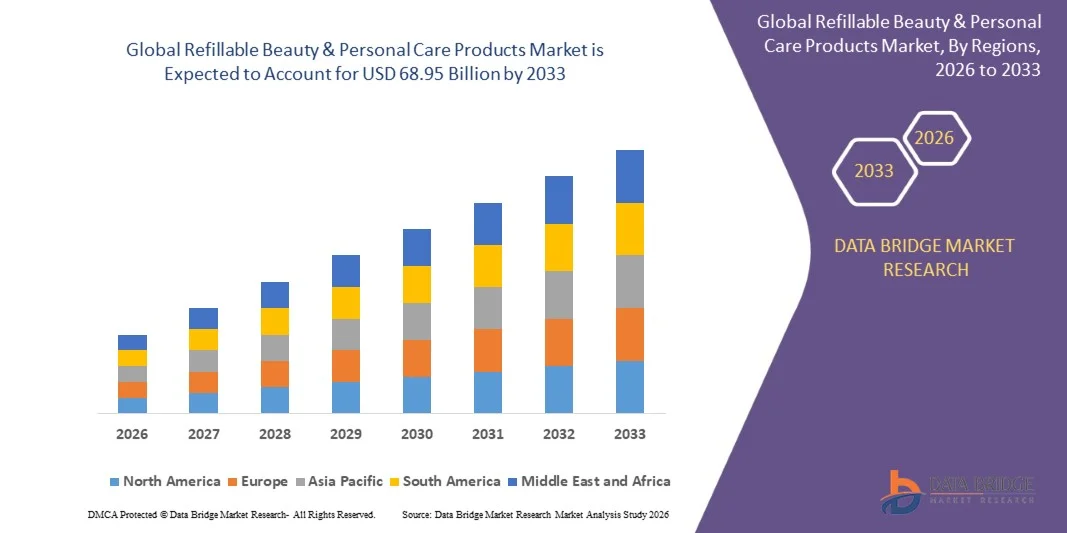
- As per Data Bridge Market Research analysis, the refillable beauty & personal care products market was valued at USD 30.80 billion in 2025 and is projected to reach USD 68.95 billion by 2033, growing at a CAGR of 10.60% from 2026 to 2033.
- The market is witnessing robust growth due to increasing consumer preference for sustainable and eco-friendly beauty solutions, rising adoption of refillable packaging to reduce plastic waste, and growing demand for premium skincare, haircare, and fragrance products. Beauty brands are increasingly introducing refillable product lines and reusable packaging formats to support circular economy initiatives and strengthen consumer loyalty.
- Rising government regulations on packaging waste, expanding corporate sustainability commitments, increasing availability of refill stations and refill subscription models, and continuous innovations in durable and recyclable packaging materials are further driving market expansion. In addition, growing environmental awareness among consumers and the rapid expansion of e-commerce channels are expected to accelerate the adoption of refillable beauty & personal care products throughout the forecast period.
Market Size & Forecast
- Market Value (2025): USD 30.80 Billion
- Expected Market Value (2033): USD 68.95 Billion
- Forecast CAGR (2026–2033): 10.60%
- Leading Region in 2025: North America
- Fastest Growing Region: Asia-Pacific
What are the Major Takeaways of the Feed Testing Market?
- North America dominated the refillable beauty & personal care products market with the largest revenue share in 2025, supported by high consumer spending on premium beauty products, growing awareness of sustainable packaging, and the strong presence of leading global beauty and personal care manufacturers across the U.S. and Canada.
- Asia-Pacific refillable beauty & personal care products market is expected to witness the fastest growth during the forecast period from 2026 to 2033, driven by rising consumer awareness of sustainable beauty practices, increasing disposable incomes, rapid urbanization, and expanding demand for environmentally friendly personal care products across countries such as China, Japan, South Korea, India, and Australia.
- The skin care segment held the largest market revenue share in 2025, driven by strong consumer demand for premium skincare products, increasing adoption of refillable packaging for creams, serums, and lotions, and growing sustainability initiatives by leading beauty brands. The rising preference for reusable packaging and environmentally responsible purchasing has further strengthened the dominance of this segment.
- The fragrances segment is expected to witness the fastest growth during the forecast period from 2026 to 2033. Growth is supported by the expanding availability of refillable perfume bottles, increasing consumer demand for luxury and sustainable fragrance solutions, and continuous product innovation by premium brands.
- The bottles segment held the largest market revenue share in 2025, driven by their widespread use across skincare, haircare, and personal care products, ease of refilling, durability, and strong consumer familiarity. The increasing adoption of reusable bottles by both premium and mass-market beauty brands has further reinforced the segment's market leadership.
- The online segment is expected to witness the fastest growth during the forecast period from 2026 to 2033. Growth is supported by the rapid expansion of e-commerce platforms, increasing adoption of direct-to-consumer sales channels, growing popularity of refill subscription programs, and rising consumer preference for convenient shopping experiences.
Report Scope and Refillable Beauty & Personal Care Products Market Segmentation
|
Attributes |
Refillable Beauty & Personal Care Products Key Market Insights |
|
Segments Covered |
|
|
Countries Covered |
North America
Europe
Asia-Pacific
Middle East and Africa
South America
|
|
Key Market Players |
|
|
Market Opportunities |
|
|
Value Added Data Infosets |
In addition to the insights on market scenarios such as market value, growth rate, segmentation, geographical coverage, and major players, the market reports curated by the Data Bridge Market Research also include in-depth expert analysis, pricing analysis, brand share analysis, consumer survey, demography analysis, supply chain analysis, value chain analysis, raw material/consumables overview, vendor selection criteria, PESTLE Analysis, Porter Analysis, and regulatory framework. |
What is the Key Trend in the Refillable Beauty & Personal Care Products Market?
- Global beauty conglomerates are increasingly building refillable formats into their core product portfolios across multiple divisions and brands, rather than treating refills as a limited pilot or single-brand experiment, reflecting a company-wide shift toward circular packaging as a mainstream commercial strategy.
- The key trend shaping the market is major beauty companies scaling refillable packaging across dozens of brands simultaneously while running consumer education campaigns to close the gap between environmental awareness and actual refill adoption, since surveys continue to show many consumers are aware refillable options exist but have not yet purchased one. This dual focus on expanding refillable SKUs while actively driving consumer behavior change reflects the industry's recognition that packaging innovation alone isn't enough to shift purchasing habits.
- For Instance, 16 Jun 2026, L'Oréal launched its third #JoinTheRefillMovement campaign on World Refill Day 2026, bringing together four divisions, 18 brands, and 28 products across its beauty and personal care portfolio, with the campaign specifically designed to close consumer knowledge gaps around refillable packaging. The company reported that its refillable product options increased 3.7 times between 2019 and 2025, with the multi-brand campaign building on two previous years of the initiative to continue expanding awareness and adoption of refill formats across its global brand portfolio.
- As major beauty conglomerates continue scaling refillable packaging across multiple brands while simultaneously investing in consumer education to close the awareness-to-action gap, refillable formats are expected to keep expanding from a sustainability add-on toward a mainstream, company-wide packaging strategy across the global beauty and personal care industry.
What are the Key Drivers of the Refillable Beauty & Personal Care Products Market?
- The European Union has enacted comprehensive new packaging legislation that directly mandates reuse and refill options for certain product categories, creating a binding regulatory timeline that beauty and personal care manufacturers must comply with to continue selling in the EU market.
- A key driver of the refillable beauty and personal care products market is new government regulation requiring packaging to be recyclable, minimally wasteful, and, for certain products, available in reusable or refillable formats, forcing manufacturers to redesign packaging systems well ahead of enforcement deadlines. This regulatory mandate is pushing beauty brands to move refill infrastructure from a voluntary sustainability initiative to a core compliance requirement for continued EU market access.
- For Instance, The European Union's Packaging and Packaging Waste Regulation (PPWR) 2025/40 entered into force on February 11, 2025, and will generally apply from August 12, 2026, covering all packaging and packaging waste regardless of material or origin. According to the European Commission, the regulation sets requirements for the manufacturing, composition, and reusable or recoverable nature of all packaging placed on the EU market, with the explicit aim of minimizing packaging waste, lowering the use of primary raw materials, and fostering the transition to a circular, sustainable economy, directly affecting cosmetics and personal care brand-owners who must now ensure their packaging systems, including refill formats, meet these binding requirements.
- As binding EU packaging regulation continues to push reuse and refill requirements into law rather than leaving them as voluntary sustainability commitments, regulatory compliance is expected to remain a key driver accelerating the adoption of refillable formats across the global beauty and personal care industry.
Which Factors are Challenging the Refillable Beauty & Personal Care Products Market?
- Despite strong sustainability momentum, refillable beauty formats continue to face real-world adoption barriers tied to convenience, e-commerce compatibility, and consumer perception, particularly since much of global beauty retail has shifted online, where in-store refill stations offer little practical value.
- The central challenge weighing on the market is that in-store refill stations, while a visible sustainability symbol, have limited potential in an e-commerce-driven beauty market, since consumers who shop online cannot easily access physical refill counters. This is pushing brands to shift focus toward refills that are identical in size and shape to original product packaging so they can be shipped and sold through standard e-commerce channels, rather than relying on physical refill infrastructure alone.
- For Instance, July 14, 2025, According to Beauty Packaging, market analyst John Nelson of Smithers noted that Japan remains the most mature market for refillable packs, valued at USD 237 million in 2024, while other regions still offer far more growth potential; excluding Japan, the global refillable pack market was worth just USD 14 million in 2019 but is projected to reach USD 152 million in 2024. Nelson explained that in-store refill stations have seen some growth but face limited potential in an e-commerce market, adding that the most promising area of growth is instead in designing refills identical in size to the original product that fit into the same base unit, a concept major brand owners have already worked on with suppliers, particularly in premium skincare lines.
- Until refillable beauty formats become as convenient and accessible as traditional packaged products across both physical retail and e-commerce channels, consumer adoption barriers related to convenience, purchasing habits, and refill accessibility are expected to remain a key challenge limiting broader market penetration.
How is the Refillable Beauty & Personal Care Products Market Segmented?
The refillable beauty & personal care products market is segmented on the basis of product type, packaging type, and distribution channel
- By Product Type
On the basis of product type, the refillable beauty & personal care products market is segmented into skin care, hair care, fragrances, color cosmetics, bath & body care, and oral care. The skin care segment held the largest market revenue share in 2025, driven by strong consumer demand for premium skincare products, increasing adoption of refillable packaging for creams, serums, and lotions, and growing sustainability initiatives by leading beauty brands. The rising preference for reusable packaging and environmentally responsible purchasing has further strengthened the dominance of this segment.
The fragrances segment is expected to witness the fastest growth during the forecast period from 2026 to 2033. Growth is supported by the expanding availability of refillable perfume bottles, increasing consumer demand for luxury and sustainable fragrance solutions, and continuous product innovation by premium brands. The growing adoption of refill stations and refill subscription programs is further expected to accelerate the growth of the fragrances segment throughout the forecast period.
- By Packaging Type
On the basis of packaging type, the refillable beauty & personal care products market is segmented into bottles, jars, pouches, cartridges & pods, compacts & cases, and others. The bottles segment held the largest market revenue share in 2025, driven by their widespread use across skincare, haircare, and personal care products, ease of refilling, durability, and strong consumer familiarity. The increasing adoption of reusable bottles by both premium and mass-market beauty brands has further reinforced the segment's market leadership.
The cartridges & pods segment is expected to witness the fastest growth during the forecast period from 2026 to 2033. Growth is supported by increasing demand for low-waste packaging solutions, continuous innovation in modular refill systems, and rising adoption of compact refill formats for skincare, cosmetics, and fragrance products. The growing focus on reducing packaging material consumption and enhancing consumer convenience is further expected to accelerate the growth of this segment throughout the forecast period.
- By Distribution Channel
On the basis of distribution channel, the refillable beauty & personal care products market is segmented into supermarkets & hypermarkets, specialty stores, brand-owned stores, online, and others. The specialty stores segment held the largest market revenue share in 2025, driven by their extensive portfolio of premium beauty products, personalized customer experience, and increasing availability of refill stations and exclusive refillable product lines. The strong presence of luxury and sustainable beauty brands in specialty retail has further strengthened the dominance of this segment.
The online segment is expected to witness the fastest growth during the forecast period from 2026 to 2033. Growth is supported by the rapid expansion of e-commerce platforms, increasing adoption of direct-to-consumer sales channels, growing popularity of refill subscription programs, and rising consumer preference for convenient shopping experiences. The availability of a wider range of refillable products and attractive digital promotions is further expected to accelerate the growth of this segment throughout the forecast period.
Which Region Holds the Largest Share of the Refillable Beauty & Personal Care Products Market?
- North America dominated the refillable beauty & personal care products market with the largest revenue share in 2025, supported by high consumer spending on premium beauty products, growing awareness of sustainable packaging, and the strong presence of leading global beauty and personal care manufacturers across the U.S. and Canada. The region's increasing adoption of refillable skincare, fragrance, and personal care products, along with expanding retail availability, continues to drive market growth.
- The region also benefits from well-established retail and e-commerce networks, rising investments in circular packaging solutions, and favorable sustainability initiatives encouraging reusable packaging adoption. Continuous product innovation, strong brand loyalty, and increasing collaborations between beauty brands and retailers further reinforce North America's leading position in the global refillable beauty & personal care products market.
U.S. Refillable Beauty & Personal Care Products Market Insight
The U.S. dominated the refillable beauty & personal care products market with the largest revenue share in 2025, due to increasing consumer demand for environmentally responsible beauty products, rising preference for reusable packaging solutions, and growing adoption of refillable skincare, fragrance, and haircare products. Manufacturers are continuously expanding their refillable product portfolios and investing in innovative packaging technologies to meet evolving consumer expectations. In addition, the rapid growth of direct-to-consumer channels, expanding refill subscription programs, and increasing corporate sustainability commitments are further supporting market expansion.
Asia-Pacific Refillable Beauty & Personal Care Products Market Insight
The Asia-Pacific refillable beauty & personal care products market is expected to witness the fastest growth during the forecast period from 2026 to 2033, driven by rising consumer awareness of sustainable beauty practices, increasing disposable incomes, rapid urbanization, and expanding demand for environmentally friendly personal care products across countries such as China, Japan, South Korea, India, and Australia. The growing adoption of refillable skincare, haircare, and fragrance products is encouraging manufacturers to expand their sustainable product portfolios.
In addition, increasing investments in recyclable packaging technologies, the rapid expansion of e-commerce platforms, and supportive government initiatives promoting waste reduction and circular economy practices are fueling market growth. Rising collaborations between beauty brands and retailers to introduce refill stations and reusable packaging solutions are further expected to strengthen Asia-Pacific's position as the fastest-growing regional market during the forecast period.
Japan Refillable Beauty & Personal Care Products Market Insight
The Japan refillable beauty & personal care products market is expected to witness the fastest growth during the forecast period from 2026 to 2033 due to strong consumer preference for premium and sustainable beauty products, increasing adoption of refillable skincare and cosmetic packaging, and growing environmental awareness. Manufacturers are continuously introducing innovative refill systems and recyclable packaging solutions to meet evolving consumer expectations. Furthermore, government sustainability initiatives and Japan's emphasis on resource efficiency and circular economy practices continue to support market expansion.
China Refillable Beauty & Personal Care Products Market Insight
The China dominated the refillable beauty & personal care products market with the largest revenue share in 2025, driven by increasing consumer demand for sustainable beauty products, rising disposable incomes, and the rapid expansion of premium skincare and cosmetics consumption. Growing investments in eco-friendly packaging technologies, increasing availability of refillable products through online and offline retail channels, and rising environmental awareness are accelerating market growth. In addition, supportive government policies promoting sustainable manufacturing and reduced plastic waste are positioning China as one of the fastest-growing markets for refillable beauty & personal care products globally.
Europe Refillable Beauty & Personal Care Products Market Insight
The Europe refillable beauty & personal care products market is expected to witness the fastest growth during the forecast period from 2026 to 2033, driven by stringent environmental regulations, strong consumer preference for sustainable packaging, and increasing adoption of circular economy practices across the beauty industry. Rising demand for refillable skincare, fragrance, haircare, and cosmetic products, coupled with continuous innovation in reusable and recyclable packaging solutions, is supporting market expansion. Furthermore, the presence of leading beauty brands and ambitious plastic waste reduction targets continue to strengthen the adoption of refillable beauty products across the region.
Germany Refillable Beauty & Personal Care Products Market Insight
The Germany refillable beauty & personal care products market is expected to witness the fastest growth during the forecast period from 2026 to 2033 due to the country's strong sustainability initiatives, increasing consumer demand for environmentally responsible beauty products, and widespread adoption of refillable packaging across premium skincare and cosmetics. Growing investments in recyclable packaging technologies, continuous product innovation, and rising availability of refillable beauty products through retail and e-commerce channels are contributing significantly to market growth. In addition, Germany's strong focus on resource efficiency and circular economy practices continues to support the long-term adoption of refillable beauty & personal care solutions.
U.K. Refillable Beauty & Personal Care Products Market Insight
The U.K. refillable beauty & personal care products market is expected to witness the fastest growth during the forecast period from 2026 to 2033 owing to increasing consumer preference for sustainable beauty products, growing adoption of refillable packaging solutions, and rising environmental awareness. Expanding availability of refillable skincare, fragrance, and personal care products through specialty stores, brand-owned outlets, and online retail channels is supporting continued market growth. Moreover, ongoing sustainability initiatives, investments in circular packaging innovations, and strong demand for low-waste beauty solutions are further driving the adoption of refillable beauty & personal care products across the country.
Which are the Top Companies in Refillable Beauty & Personal Care Products Market?
The refillable beauty & personal care products industry is primarily led by well-established companies, including:
- L'Oréal S.A. (France)
- Unilever PLC (U.K.)
- The Estée Lauder Companies Inc. (U.S.)
- Beiersdorf AG (Germany)
- Shiseido Company, Limited (Japan)
- Kao Corporation (Japan)
- Coty Inc. (U.S.)
- L'Occitane International S.A. (Luxembourg)
- Puig S.L. (Spain)
- Amorepacific Corporation (South Korea)
- Chanel Limited (U.K.)
- Clarins Groupe (France)
- Natura &Co Holding S.A. (Brazil)
- Oriflame Holding AG (Switzerland)

- Interactive Data Analysis Dashboard
- Company Analysis Dashboard for high growth potential opportunities
- Research Analyst Access for customization & queries
- Competitor Analysis with Interactive dashboard
- Latest News, Updates & Trend analysis
- Harness the Power of Benchmark Analysis for Comprehensive Competitor Tracking
Data collection and base year analysis are done using data collection modules with large sample sizes. The stage includes obtaining market information or related data through various sources and strategies. It includes examining and planning all the data acquired from the past in advance. It likewise envelops the examination of information inconsistencies seen across different information sources. The market data is analysed and estimated using market statistical and coherent models. Also, market share analysis and key trend analysis are the major success factors in the market report. To know more, please request an analyst call or drop down your inquiry.
The key research methodology used by DBMR research team is data triangulation which involves data mining, analysis of the impact of data variables on the market and primary (industry expert) validation. Data models include Vendor Positioning Grid, Market Time Line Analysis, Market Overview and Guide, Company Positioning Grid, Patent Analysis, Pricing Analysis, Company Market Share Analysis, Standards of Measurement, Global versus Regional and Vendor Share Analysis. To know more about the research methodology, drop in an inquiry to speak to our industry experts.
Data Bridge Market Research is a leader in advanced formative research. We take pride in servicing our existing and new customers with data and analysis that match and suits their goal. The report can be customized to include price trend analysis of target brands understanding the market for additional countries (ask for the list of countries), clinical trial results data, literature review, refurbished market and product base analysis. Market analysis of target competitors can be analyzed from technology-based analysis to market portfolio strategies. We can add as many competitors that you require data about in the format and data style you are looking for. Our team of analysts can also provide you data in crude raw excel files pivot tables (Fact book) or can assist you in creating presentations from the data sets available in the report.