What is the Refillable Household Cleaning Systems Market Size and Growth Rate?
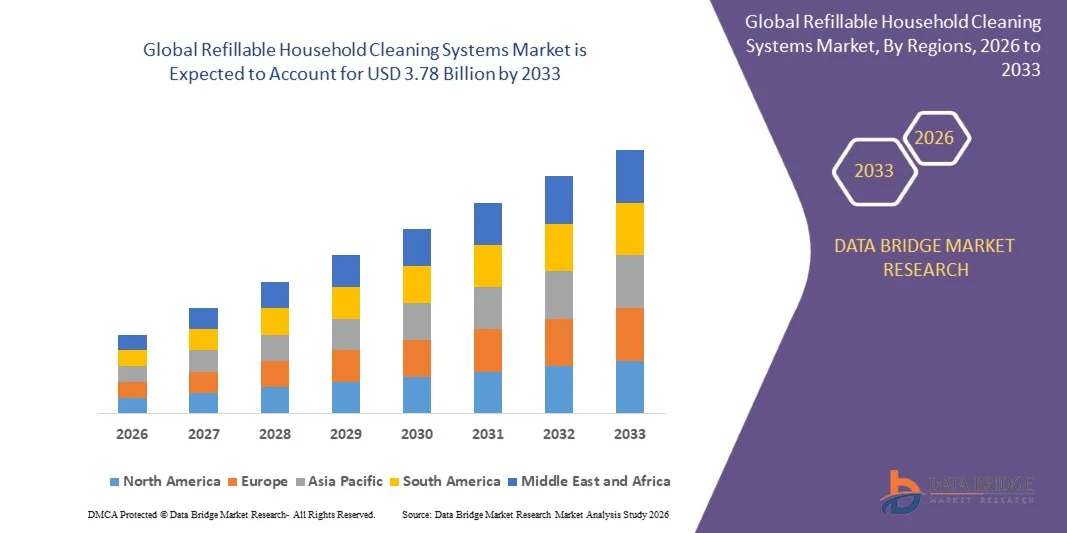
- As per Data Bridge Market Research analysis, the refillable household cleaning systems market was valued at USD 1.75 billion in 2025 and is projected to reach USD 3.78 billion by 2033, growing at a CAGR of 10.1% from 2026 to 2033, across household and commercial cleaning applications.
- The market is experiencing rapid growth driven by rising demand for plastic-free packaging, increasing adoption of concentrated refill formats, and expanding applications across kitchens, bathrooms, laundry, living spaces, hospitality venues, offices, and institutional buildings worldwide.
- The increasing shift toward waste reduction, reusable packaging, and lightweight concentrated formulas, combined with growing regulatory support for refill and reuse, is supporting market adoption. Refillable household cleaning systems are being used across surface sprays, laundry, dishwashing, and hand soap routines, offering consumers reusable bottles, tablets, pouches, and concentrates that lower plastic use within modern household cleaning and sustainable packaging programs.
Market Size & Forecast
- Global Market Value (2025): USD 1.75 Billion
- Expected Market Value (2033): USD 3.78 Billion
- Forecast CAGR (2026–2033): 10.1%
- Leading Region in 2025: North America
- Fastest Growing Region: Asia-Pacific
What are the Major Takeaways of the Refillable Household Cleaning Systems Market?
- North America dominated the refillable household cleaning systems market with the largest revenue share of 37.60% in 2025, supported by strong direct-to-consumer brands, expanding retail listings, and high consumer awareness of plastic waste across the region and major urban markets.
- Asia-Pacific is expected to be the fastest-growing region at a CAGR of 12.40% from 2026 to 2033, fueled by rising urban households, expanding e-commerce, and growing interest in sustainable home care across emerging cities.
- The surface cleaners segment led the market with a 44.8% share in 2025, driven by frequent use and repeat refill purchases across households.
- Laundry care is the fastest-growing product type, projected to register a CAGR of 12.3%, reflecting the surge in demand for plastic-free detergent tablets and concentrated powders.
- The refill pouches segment dominated the refill format category with a 39.2% revenue share in 2025, led by compatibility with existing liquid production and familiar consumer use.
- Kitchen and dining accounted for 38.9% of the market share in 2025, preferred by increasing demand for dishwashing and countertop cleaning in busy households.
- The offices and commercial spaces segment is the fastest-growing end-user category, with a CAGR of 11.9%, driven by increasing sustainability goals and waste targets.
Report Scope and Refillable Household Cleaning Systems Market Segmentation
|
Attributes |
Refillable Household Cleaning Systems Key Market Insights |
|
Segments Covered |
|
|
Countries Covered |
North America
Europe
Asia-Pacific
Middle East and Africa
South America
|
|
Key Market Players |
|
|
Market Opportunities |
|
|
Value Added Data Infosets |
In addition to the insights on market scenarios such as market value, growth rate, segmentation, geographical coverage, and major players, the market reports curated by the Data Bridge Market Research also include in-depth expert analysis, pricing analysis, brand share analysis, consumer survey, demography analysis, supply chain analysis, value chain analysis, raw material/consumables overview, vendor selection criteria, PESTLE Analysis, Porter Analysis, and regulatory framework. |
What is the Key Trend in the Refillable Household Cleaning Systems Market?
- Brands are increasingly shifting toward concentrated, lightweight refill formats such as tablets, powders, and pouches, combining reusable bottles, compostable packaging, and simple dilution steps to reduce plastic, transport weight, and household waste across regions.
- For instance, in May 2025, Blueland expanded into more than 1,800 Target doors with nine products and Target-exclusive scents, supported by its first 360-degree brand campaign, showing refill systems moving from direct-to-consumer channels into mainstream retail aisles and reaching a much wider customer base.
- Product ranges are broadening from surface sprays to laundry, dishwasher, and hand soap categories, as brands extend refill systems into higher-frequency purchases.
- Large consumer goods companies such as Unilever, Procter & Gamble, Henkel, Clorox, and SC Johnson are also investing in concentrated products and sustainable packaging, increasing competition and raising consumer awareness of refill options.
- For instance, in August 2026, according to Simplify, Blueland extended its tablet system into laundry with PowerDuo Laundry Tablets, moving the refill model into a higher-frequency household category, while noting that larger brands copying tablets and competing for shelf space could pressure smaller refill specialists, which have built differentiation through tablet patents and design.
- As regulation, retailer support, and consumer awareness continue to expand, refillable cleaning systems are expected to evolve from niche eco products into mainstream household purchases across regions across regions worldwide.
What are the Key Drivers of the Refillable Household Cleaning Systems Market?
- Growing concern about plastic waste and rising interest in reusable packaging are encouraging households to adopt refill systems that remove single-use bottles from routine cleaning and everyday household chores.
- For instance, in August 2026, according to the Lithuanian Ministry of Environment, the EU Packaging and Packaging Waste Regulation began applying on 12 August 2026, requiring businesses offering refill options to provide clear refill rules and ensure refill stations meet requirements, creating a clearer framework for refill systems.
- Concentrated formats reduce shipping weight and packaging volume, lowering transport emissions and costs while making refill systems attractive for online retail and subscription models and direct delivery.
- For instance, in January 2020, according to PYMNTS, Blueland’s founder noted that mailing a cleaning spray might cost about USD 6, while a cleaning tablet equivalent to a full bottle could cost only 20 to 25 cents to send, making refills well suited to e-commerce.
- With retailers expanding listings and brands launching new refill products, availability and convenience are improving, helping households switch from conventional bottles to reusable containers and concentrated refills.
What Factors Are Challenging the Growth of the Refillable Household Cleaning Systems Market?
- Refill systems require consumers to change habits, store reusable containers, and trust concentrated formulas, while higher upfront starter-kit prices can limit adoption among price-sensitive households and renters.
- For instance, in May 2025, according to Causeartist, refill systems are constrained by behavior change, because reconstituting tablets is a habit shift and first-time retail packaging must teach the system in seconds on a crowded aisle where consumers compare many alternatives.
- Performance expectations are high, and consumers may hesitate if refills appear less effective, fragrance options are limited, or mixing steps seem inconvenient compared with ready-to-use bottles and familiar brands.
- Large brands can copy refill formats and use scale and shelf space to compete, while smaller refill brands face higher customer acquisition costs, distribution challenges, and legal or marketing disputes over claims.
- For instance, in 2026, according to USB Certification, the EU packaging regulation applying from 12 August 2026 may require declarations of conformity and test evidence, and packaging without them may be rejected at the border, adding documentation, testing, and compliance work for brands and importers, while harmonised labels follow from August 2028 and reuse targets apply from 2030.
- The combination of habit change, starter-kit costs, intense competition, and packaging compliance requirements can constrain expansion among small brands, particularly where conventional cleaners remain cheaper and easier to find in everyday retail stores.
How is the Refillable Household Cleaning Systems Market Segmented?
The refillable household cleaning systems market is segmented on the basis of product, refill format, application, and end user across regions.
- By Product
On the basis of product, the refillable household cleaning systems market is segmented into surface cleaners, laundry care, dishwashing, and others. The surface cleaners segment dominated the market with 44.8% share in 2025, supported by frequent use and repeat refill purchases. Surface cleaners offer an easy entry point for refill systems because users already spray and wipe several times a week. They are widely used across kitchens, bathrooms, and living areas. Improvements in tablet chemistry, scents, and bottle design are further strengthening demand. Integration with subscription programs also enables convenient replenishment across households and reducing repeat trips to stores.
The laundry care segment is projected to register the fastest growth at a CAGR of 12.3% from 2026 to 2033, driven by increasing demand for plastic-free detergent tablets and concentrated powders. Laundry is a high-frequency category with large packaging volumes, creating strong waste reduction potential. Their applications include everyday washing, stain removal, and travel-friendly dosing. Increasing launches from refill brands, such as Blueland’s PowerDuo Laundry Tablets in August 2026, are creating additional demand across households and retailers. Improvements in dissolvability and fragrance are enhancing performance. Lightweight shipping, compostable paper packaging, and subscription delivery are also expanding commercial use, although consumers still compare price and cleaning performance with conventional detergents.
- By Refill Format
On the basis of refill format, the refillable household cleaning systems market is segmented into refill pouches, tablets & powders, and concentrates & capsules. The refill pouches segment dominated the market with 39.2% share in 2025, supported by compatibility with existing liquid manufacturing and easy consumer adoption. Pouches offer a balanced combination of familiar use, lower plastic content, and low switching effort for households. Their availability across large brands and retailers expands the potential customer base. Consumers pour pouch refills into reusable bottles and dispensers. The format also benefits from established filling lines and shelf-ready packaging and retailer distribution.
The tablets and powders segment is projected to register the fastest growth at a CAGR of 13.1% from 2026 to 2033, supported by increasing adoption of lightweight, plastic-free, and low-shipping-weight formats. Tablets are dissolved in tap water inside reusable bottles, eliminating shipped water and reducing packaging. Brands are increasingly using compostable paper pouches and tins. Companies are developing patented tablet chemistry for sprays, dish soap, and laundry. Lower freight costs and carbon-neutral shipping claims further strengthen the segment’s attractiveness. Consumer education remains an important consideration for expansion, since reconstituting tablets is a small habit shift for many households.
- By Application
On the basis of application, the refillable household cleaning systems market is segmented into kitchen & dining, bathroom & toilet, living spaces & floors, and others. The kitchen and dining segment dominated the application category with 38.9% share in 2025, supported by increasing demand for dishwashing and countertop cleaning. Dish soap, dishwasher tablets, and multi-surface sprays are used daily and generate repeat purchases. Plastic reduction goals are increasing the use of refill options. Growth in subscription and online purchasing further strengthens demand. Households are also seeking products that combine cleaning performance, safe ingredients, and attractive reusable containers for visible kitchen use and everyday convenience.
The living spaces and floors segment is projected to register the fastest growth at a CAGR of 10.8% from 2026 to 2033, driven by increasing interest in multi-purpose cleaners, floor cleaners, and glass sprays. Refill concentrates can be diluted for different surfaces and stored compactly. Consumers in North America, Europe, and Asia-Pacific are experimenting with refill systems for whole-home cleaning. Rising availability in major retailers is creating additional opportunities, including national chains that now stock tablet-based sprays. Reusable bottles with clear instructions make these systems particularly approachable. Supportive sustainability campaigns and lower shipping weight can further improve adoption across regions and household sizes.
- By End User
On the basis of end user, the refillable household cleaning systems market is segmented into urban households, suburban & rural households, hotels & hospitality, offices & commercial spaces, and others. The urban households segment dominated the end-user category with 46.5% share in 2025, supported by increasing online shopping and sustainability awareness. Urban consumers value compact storage, lightweight shipping, and attractive reusable bottles. The segment includes apartments, shared housing, and small households. Increasing e-commerce adoption is creating further opportunities. Price, convenience, and ease of use remain important considerations in purchase decisions, especially for apartment dwellers, shared households, and small studios that benefit from compact refill supplies and easy storage.
The offices and commercial spaces segment is projected to register the fastest growth at CAGR of 11.9% from 2026 to 2033, driven by increasing corporate sustainability goals, workplace wellness programs, and demand for lower-waste cleaning supplies. Facilities teams can buy concentrates in bulk and refill bottles across multiple floors. Suppliers are expanding commercial refill programs and dispensing solutions. Closer collaboration between brands and facility managers is accelerating adoption of refill stations. Packaging regulation is further supporting demand. Cost, training, and supply reliability remain important considerations for deployment, particularly where cleaning crews must follow standardized dilution procedures.
Which Region Holds the Largest Share of the Refillable Household Cleaning Systems Market?
- North America dominated the refillable household cleaning systems market with the largest revenue share of 37.60% in 2025, supported by strong direct-to-consumer brands, expanding retail listings, and high consumer awareness of plastic waste across the region and major urban markets.
- The region also benefits from active direct-to-consumer brands, growing retail partnerships, and strong consumer interest in sustainable home care, along with rising online sales. Increasing product launches, retailer support, and sustainability commitments, including national retail expansion by refill brands, continue to strengthen North America’s position in the global market.
U.S. Refillable Household Cleaning Systems Market Insight
The U.S. refillable household cleaning systems market is witnessing consistent growth due to rising investments in refill brands, retail expansion, and tablet-based formats. Consumers, retailers, and brands are increasingly focusing on plastic reduction. Moreover, expanding listings at national retailers and continued launches across laundry and dish care, supported by strong online sales and brand marketing, are further contributing to market growth in the U.S., particularly among younger and environmentally conscious households.
Canada Refillable Household Cleaning Systems Market Insight
Canada’s refillable household cleaning systems market is gaining momentum as consumers increasingly prioritize sustainability, convenience, and reduced plastic waste. Demand is rising for reusable spray bottles, concentrated cleaning liquids, dissolvable tablets, and refill pouches. E-commerce and subscription models offer opportunities for recurring revenue and customer retention. However, higher upfront costs, refill accessibility, and consumer habits remain challenges. Brands emphasizing affordability, cleaning effectiveness, transparent environmental claims, and convenient distribution are well-positioned to capture emerging opportunities and strengthen competitiveness across Canada.
Asia-Pacific Refillable Household Cleaning Systems Market Insight
The Asia-Pacific refillable household cleaning systems market is expected to witness rapid growth, driven by rising urban households, expanding e-commerce, and increasing interest in sustainable home care across countries such as Japan, China, India, and Australia. Growing environmental awareness, packaged goods consumption, and online retail are supporting regional market expansion. In addition, the region’s well-established refill pouch habits and increasing brand investments are accelerating demand for refill systems, particularly among younger urban consumers and sustainability-minded families.
China Refillable Household Cleaning Systems Market Insight
China’s refillable household cleaning systems market is gaining traction as consumers increasingly seek convenient, cost-effective, and sustainable cleaning solutions. Demand for concentrated cleaning liquids, refill pouches, dissolvable tablets, and reusable spray bottles is supported by expanding e-commerce and growing environmental awareness. Domestic manufacturers benefit from established production capabilities and extensive digital distribution networks. However, price sensitivity, consumer education, and packaging recyclability remain challenges. Affordable refill formats, effective formulations, and convenient replenishment models present significant opportunities for market expansion.
Japan Refillable Household Cleaning Systems Market Insight
The Japan refillable household cleaning systems market is expanding steadily due to the country’s long-standing refill pouch habits, compact living spaces, and strong focus on household hygiene. Consumers, retailers, and manufacturers are increasingly utilizing refill packaging. Continuous advancements in concentrated formulas, convenient refill designs, and eco-friendly packaging, along with Japan’s focus on quality and cleanliness, are further driving market growth in the country, supported by strong domestic brands and widespread retail availability.
Which are the Top Companies in Refillable Household Cleaning Systems Market?
The refillable household cleaning systems industry is primarily led by well-established companies, including:
- Unilever PLC (U.K.)
- The Procter & Gamble Company (U.S.)
- Henkel AG & Co. KGaA (Germany)
- S. C. Johnson & Son, Inc. (U.S.)
- The Clorox Company (U.S.)
- Reckitt Benckiser Group plc (U.K.)
- Colgate-Palmolive Company (U.S.)
- Church & Dwight Co., Inc. (U.S.)
- Kao Corporation (Japan)
- Lion Corporation (Japan)
- Werner & Mertz GmbH (Germany)
- Blueland (One Home Brands) (U.S.)
- Grove Collaborative Holdings, Inc. (U.S.)
- Cleancult (U.S.)
- Smol Limited (U.K.)
- Bio-D Company Ltd. (U.K.)
- Dropps (U.S.)
- Amway Corporation (U.S.)
- Ecolab Inc. (U.S.)
- Seventh Generation, Inc. (U.S.)
What are Latest Developments in Refillable Household Cleaning Systems Market?
- In August 2026, Blueland extended its tablet-based refill system into laundry with PowerDuo Laundry Tablets, moving the refill model into a higher-frequency household category and strengthening its portfolio of plastic-free cleaning products as larger brands also expand concentrated and sustainable packaging offerings, according to company information, as the brand continues to build a broader range of home care tablets and reusable containers.
- In August 2026, the European Packaging and Packaging Waste Regulation began applying across the EU from 12 August 2026, introducing obligations for reuse and refill systems, including clear information on refill rules and refill station requirements, while the Commission published a second edition of its frequently asked questions on 1 August 2026, with refill rules for hospitality following in 2027 and reuse targets set for 2030.
- In May 2025, Blueland announced expansion into more than 1,800 Target stores with nine products and Target-exclusive scents, along with its first 360-degree brand campaign, marking a major retail step for tablet-based cleaning refills and for plastic-free cleaning products in mainstream household aisles, after years of growth through its own online store, subscription programs, and social media marketing.
- In 2024, Blueland announced its expansion into Whole Foods with refillable hand soap, a set that includes a glass refillable bottle and plastic-free refill tablets, extending the company’s tablet-based refill system into natural grocery retail and personal care adjacent categories, while its overall products had helped divert more than one billion single-use plastic bottles.
- Interactive Data Analysis Dashboard
- Company Analysis Dashboard for high growth potential opportunities
- Research Analyst Access for customization & queries
- Competitor Analysis with Interactive dashboard
- Latest News, Updates & Trend analysis
- Harness the Power of Benchmark Analysis for Comprehensive Competitor Tracking
Data collection and base year analysis are done using data collection modules with large sample sizes. The stage includes obtaining market information or related data through various sources and strategies. It includes examining and planning all the data acquired from the past in advance. It likewise envelops the examination of information inconsistencies seen across different information sources. The market data is analysed and estimated using market statistical and coherent models. Also, market share analysis and key trend analysis are the major success factors in the market report. To know more, please request an analyst call or drop down your inquiry.
The key research methodology used by DBMR research team is data triangulation which involves data mining, analysis of the impact of data variables on the market and primary (industry expert) validation. Data models include Vendor Positioning Grid, Market Time Line Analysis, Market Overview and Guide, Company Positioning Grid, Patent Analysis, Pricing Analysis, Company Market Share Analysis, Standards of Measurement, Global versus Regional and Vendor Share Analysis. To know more about the research methodology, drop in an inquiry to speak to our industry experts.
Data Bridge Market Research is a leader in advanced formative research. We take pride in servicing our existing and new customers with data and analysis that match and suits their goal. The report can be customized to include price trend analysis of target brands understanding the market for additional countries (ask for the list of countries), clinical trial results data, literature review, refurbished market and product base analysis. Market analysis of target competitors can be analyzed from technology-based analysis to market portfolio strategies. We can add as many competitors that you require data about in the format and data style you are looking for. Our team of analysts can also provide you data in crude raw excel files pivot tables (Fact book) or can assist you in creating presentations from the data sets available in the report.