What is the Refillable Packaging Dispensing Systems Market Size and Growth Rate?
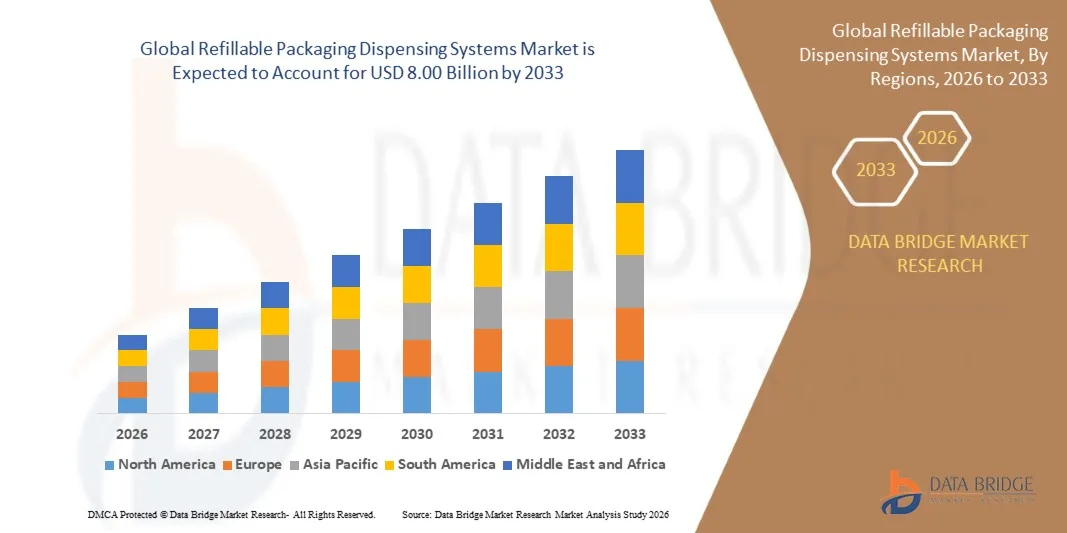
- As per Data Bridge Market Research analysis, the refillable packaging dispensing systems market was valued at USD 5.10 billion in 2025 and is projected to reach USD 8.00 billion by 2033, growing at a CAGR of 9.10% from 2026 to 2033.
- The market is experiencing consistent growth driven by rising demand for eco-friendly packaging, advancements in pump and metered-dose dispensing technologies, and expanding applications across cosmetics, personal care, household products, and pharmaceutical packaging.
- Increasing concerns over single-use plastic waste, combined with stricter packaging sustainability requirements and corporate commitments to circular economy practices, are encouraging manufacturers to adopt refillable dispensing systems. Refillable pumps, airless dispensers, and precision-dosing mechanisms are helping brands improve product usability, reduce packaging waste, and support repeated container use. However, higher initial costs, refill infrastructure requirements, and compatibility challenges remain barriers to widespread adoption.
Market Size & Forecast
- Global Market Value (2025): USD 5.10 Billion
- Expected Market Value (2033): USD 8.00 Billion
- Forecast CAGR (2026–2033): 9.10%
- Leading Region in 2025: North America
- Fastest Growing Region: Asia Pacific
What are the Major Takeaways of the Refillable Packaging Dispensing Systems Market?
- North America dominated the refillable packaging dispensing systems market with the largest revenue share of 33.9% in 2025, supported by established consumer goods industries and growing demand for sustainable packaging solutions.
- Asia-Pacific is expected to be the fastest-growing region at a CAGR of 6.98% from 2026 to 2033, fueled by expanding manufacturing capacity, urbanization, and rising adoption of refillable packaging solutions across China, India, and Japan.
- The pumps and pump dispensers segment led the market with a 60% share in 2025, driven by convenient operation, precise product dispensing, and widespread use in refillable cosmetics, skincare, and personal care packaging.
- Airless dispensing systems are the fastest-growing product type, projected to register a CAGR of 6.7%, reflecting the surge in demand for hygienic dispensing, protection of sensitive formulations, reduced product waste, and sustainable refillable packaging solutions across cosmetics and personal care applications.
- The mechanical pump systems segment dominated the dispensing mechanism category with a 48% revenue share in 2025, led by their precise and consistent dispensing performance, ease of use, cost-effectiveness, and widespread adoption in cosmetics, skincare, and personal care packaging.
- Plastic accounted for 55% of the market share in 2025, preferred by its lightweight structure, durability, cost-effectiveness, design flexibility, and compatibility with refillable dispensing mechanisms across cosmetics, personal care, and household cleaning applications.
- The pharmaceuticals and healthcare segment is the fastest-growing application category, with a CAGR of 7.0%, driven by increasing demand for precise dosing, hygienic dispensing, contamination prevention, and secure packaging of sensitive medications and healthcare formulations.
Report Scope and Refillable Packaging Dispensing Systems Market Segmentation
|
Attributes |
Refillable Packaging Dispensing Systems Key Market Insights |
|
Segments Covered |
|
|
Countries Covered |
North America
Europe
Asia-Pacific
Middle East and Africa
South America
|
|
Key Market Players |
|
|
Market Opportunities |
|
|
Value Added Data Infosets |
In addition to the insights on market scenarios such as market value, growth rate, segmentation, geographical coverage, and major players, the market reports curated by the Data Bridge Market Research also include import export analysis, production capacity overview, production consumption analysis, price trend analysis, climate change scenario, supply chain analysis, value chain analysis, raw material/consumables overview, vendor selection criteria, PESTLE Analysis, Porter Analysis, and regulatory framework. |
What is the Key Trend in the Refillable Packaging Dispensing Systems Market?
- Packaging manufacturers are increasingly developing refillable dispensing systems that combine reusable containers with replaceable pumps, airless dispensers, and compatible refill pouches to reduce packaging waste while maintaining product convenience.
- For instance, in January 2025, Aptar Beauty introduced Nomad Refill, a 10 ml fragrance spray that can be refilled directly from a perfume bottle in less than five seconds, highlighting the trend toward convenient, reusable dispensing formats
- These systems are gaining traction in cosmetics, skincare, and personal care applications, where brands seek durable packaging formats that support repeated use and preserve product quality.
- Refillable dispensing technologies also enable brands to improve material efficiency through lightweight designs, recyclable components, and dispensing mechanisms compatible with multiple refill formats.
- For instance, in May 2025, Shiseido announced the extension of its LiquiForm technology to pump dispenser containers, reporting approximately 56% lower plastic use and 48% lower CO₂ emissions compared with its existing containers, reflecting the trend toward resource-efficient dispensing packaging.
- Manufacturers are focusing on consumer-friendly designs that simplify refilling, minimize leakage, and improve dosing accuracy without compromising the premium appearance of product packaging.
What are the Key Drivers of the Refillable Packaging Dispensing Systems Market?
- The growing environmental concerns and the need to reduce single-use packaging waste are encouraging manufacturers to develop refillable dispensing systems that extend container lifecycles and support circular packaging models.
- For instance, in February 2025, the European Commission announced that the Packaging and Packaging Waste Regulation had entered into force, promoting reuse and refill systems as alternatives to single-use packaging and encouraging more circular use of packaging materials.
- Regulatory initiatives promoting reuse, recyclability, and waste prevention are increasing demand for durable containers, compatible dispensing pumps, and refill-ready packaging formats across consumer goods industries.
- Cosmetics, personal care, and household cleaning brands are adopting refillable systems to improve packaging efficiency, encourage repeat purchases, and offer consumers convenient alternatives to replacing entire product containers.
- For instance, in January 2025, Aptar Beauty introduced its Advance Collection of all-plastic dispensing pumps, designed to improve recyclability through polypropylene and polyethylene construction while maintaining dispensing performance. This innovation supports manufacturers' efforts to adopt more sustainable packaging components
- Technological advancements in pump design, airless dispensing, material compatibility, and refill-pouch integration are helping manufacturers improve dosing accuracy, product protection, and ease of use.
What Factors are Challenging the Growth of the Refillable Packaging Dispensing Systems Market?
- Refillable dispensing systems can require higher upfront investment in durable containers, specialized pumps, compatible refill formats, and manufacturing equipment compared with conventional single-use packaging.
- For instance, in May 2026, a study published in Cleaner and Responsible Consumption examined barriers to replacing single-use packaging with refill-based business models in the U.K. and Vietnam. The research identified low profit margins, hygiene concerns, allergies, and difficulties maintaining customer engagement as obstacles to scaling refill systems.
- Compatibility challenges involving product viscosity, chemical formulations, seals, and dispensing components can complicate product development and increase testing requirements for manufacturers.
- Limited refill infrastructure, inconsistent consumer participation, and reverse-logistics requirements can make collection, cleaning, inspection, and redistribution difficult to scale across markets.
- For instance, in January 2025, an article published in Resources, Conservation and Recycling examined consumer preferences for reusable packaging systems and identified the importance of convenience, ease of use, and communicating environmental benefits. These findings highlight the challenges of encouraging consumers to adopt refillable packaging consistently
- Manufacturers must also maintain hygiene, product safety, reliable dispensing performance, and packaging durability throughout repeated use, increasing operational complexity for certain applications.
How is the Refillable Packaging Dispensing Systems Market Segmented?
The refillable packaging dispensing systems market is segmented on the basis of product type, dispensing mechanism, material type, and application.
- By Product Type
On the basis of product type, the refillable packaging dispensing systems market is segmented into pumps and pump dispensers, trigger sprayers, lotion and cream dispensers, foaming dispensers, airless dispensing systems, dropper dispensers, aerosol-free dispensing systems, and other refillable dispensing products. The pumps and pump dispensers segment is expected to dominate the market, accounting for 60% share in 2025 of the narrower refillable airless packaging systems market. These systems support controlled dispensing across cosmetics, skincare, and personal care products. Their compatibility with reusable bottles and replaceable cartridges supports repeated use. Pump dispensers are available in multiple configurations to accommodate different product viscosities and dispensing requirements. Their ease of use and familiar operation make them suitable for mass-market and premium products.
The airless dispensing systems segment is projected to register the fastest growth at a CAGR of 6.7% from 2026 to 2033, based on the broader refillable airless packaging system market. These systems limit air exposure and help protect sensitive cosmetic and skincare formulations. Refillable designs allow consumers to retain the outer container while replacing the inner cartridge. Improvements in pump engineering and refill compatibility are broadening their applications. Demand for hygienic dispensing and reduced product residue further supports adoption. Premium skincare and selected pharmaceutical applications are expected to contribute to growth.
- By Dispensing Mechanism
On the basis of dispensing mechanism, the refillable packaging dispensing systems market is segmented into manual dispensing systems, mechanical pump systems, metered-dose dispensing systems, airless dispensing mechanisms, pressurized dispensing systems, and sensor-based and automatic dispensing systems. The mechanical pump systems segment is expected to dominate the market, with an estimated share of 48% in 2025, using the broader airless packaging market's pump-system share as a reference. These systems provide reliable dispensing through repeated mechanical actuation. Their designs accommodate liquids, lotions, creams, and other formulations. Mechanical pumps are widely compatible with refillable bottles and replaceable cartridges. Their relatively simple operation reduces dependence on electronic components and power supplies. Demand across cosmetics, personal care, and household products supports their importance in refillable dispensing applications.
The metered-dose dispensing systems segment is expected to experience strong growth, with an estimated CAGR of 7.0% from 2026 to 2033. These systems deliver controlled quantities of product per actuation, helping improve dosing consistency and reduce waste. They are useful in premium skincare, pharmaceutical formulations, and specialized personal care products. Advances in pump engineering are improving dose precision and reliability. Compatibility with refillable containers can combine product efficiency with reduced packaging consumption. Growing demand for hygienic and controlled dispensing is expected to support adoption.
- By Material Type
On the basis of material type, the refillable packaging dispensing systems market is segmented into plastic, glass, metal, silicone and elastomers, and other materials. The plastic segment is expected to dominate the market, accounting for 55% share in 2025 of the refillable airless packaging systems market. Plastic offers lightweight construction, durability, and flexibility in manufacturing dispensing components. Materials such as polypropylene and polyethylene are used in pump housings, closures, bottles, and cartridges. Their versatility supports compatibility with various consumer product formulations. Refillable plastic containers can reduce the need to replace the complete package when designed for repeated use. Developments in recyclable and mono-material components further support the segment's position.
The bio-based materials segment is expected to register the fastest growth, at an estimated CAGR of 7.3% from 2026 to 2033, based on the broader refillable airless packaging systems market. These materials are attracting interest as brands seek alternatives to conventional fossil-based packaging materials. Bio-based polymers can be incorporated into selected bottles, closures, and dispensing components, subject to performance and compatibility requirements. Improvements in material processing are expanding their potential packaging applications. Sustainability commitments and interest in renewable feedstocks are encouraging manufacturers to explore these solutions. Commercial adoption will depend on cost, durability, availability, and end-of-life infrastructure.
- By Application
On the basis of application, the refillable packaging dispensing systems market is segmented into cosmetics and skincare, haircare products, personal hygiene products, household cleaning products, food and beverages, pharmaceuticals and healthcare, industrial and chemical products, and other applications. The cosmetics and skincare segment is expected to dominate the market, with personal care applications accounting for 48.7% share in 2025 of the broader refillable airless packaging systems market. Skincare products such as moisturizers, serums, lotions, and facial treatments frequently use pump and airless dispensing systems. Refillable containers allow consumers to replenish products without replacing the entire package. Airless designs can help protect sensitive formulations when properly engineered. Premium beauty brands are increasingly exploring reusable packaging to improve consumer experience and support sustainability objectives. These factors reinforce the importance of cosmetics and skincare applications.
The pharmaceuticals and healthcare segment is expected to register the fastest growth, at an estimated CAGR of 7.0% from 2026 to 2033, based on the broader refillable airless packaging systems market. Pharmaceutical products can require controlled dispensing, protection against contamination, and consistent product delivery. Airless and metered-dose formats may support selected topical treatments and sensitive formulations. Advances in dispensing design are improving dose control and product protection. Growing demand for convenient packaging and accurate application is creating opportunities for specialized dispensing solutions. However, adoption depends on product-specific regulatory, hygiene, stability, and compatibility requirements.
Which Region Holds the Largest Share of the Refillable Packaging Dispensing Systems Market?
- North America dominated the refillable packaging dispensing systems market with the largest revenue share of 33.9% in 2025, supported by established consumer goods industries and growing demand for sustainable packaging solutions.
- The region also benefits from growing consumer awareness of packaging waste, investments in refillable product designs, and demand for convenient, hygienic dispensing systems across beauty, personal care, household cleaning, and healthcare applications. Increasing emphasis on packaging circularity and recyclable materials continues to support regional market growth.
U.S. Refillable Packaging Dispensing Systems Market Insight
The U.S. refillable packaging dispensing systems market is witnessing strong growth due to rising demand for sustainable packaging solutions, increasing investments in reusable dispensing technologies, and growing adoption across cosmetics, personal care, and household cleaning products. The country’s established consumer goods industry, along with increasing demand for convenient, hygienic, and durable dispensing systems, is driving market expansion. In addition, growing emphasis on reducing packaging waste and improving product usability is accelerating adoption among manufacturers and retailers.
Asia-Pacific Refillable Packaging Dispensing Systems Market Insight
The Asia-Pacific refillable packaging dispensing systems market is expected to witness rapid growth, driven by increasing urbanization, expanding consumer goods production, and rising demand for sustainable packaging solutions across countries such as China, India, and Japan. Growing awareness regarding plastic waste, rising adoption of refillable personal care products, and increasing demand for affordable and convenient packaging formats are supporting regional market expansion. In addition, the growing presence of cosmetics, household products, and packaging manufacturers is accelerating the adoption of refillable dispensing systems across consumer markets.
Japan Refillable Packaging Dispensing Systems Market Insight
The Japan refillable packaging dispensing systems market is witnessing consistent growth due to rising investments in sustainable packaging technologies, product innovation, and waste reduction initiatives. Cosmetics manufacturers, personal care brands, and household product companies are increasingly adopting refillable dispensers to improve product convenience, reduce packaging consumption, and enhance consumer experience. Moreover, increasing integration of durable dispensing mechanisms and the country’s focus on resource efficiency and environmentally responsible packaging are further contributing to market growth.
China Refillable Packaging Dispensing Systems Market Insight
The China refillable packaging dispensing systems market is growing rapidly, driven by expanding consumer goods manufacturing, rising demand for cosmetics and personal care products, and increasing focus on sustainable packaging practices. Growing adoption of refillable pumps, lotion dispensers, and airless dispensing systems across beauty, household cleaning, and healthcare applications is significantly boosting market demand. In addition, rising environmental awareness, expanding e-commerce distribution, and continuous packaging innovation are positioning China as an important growth market for refillable dispensing systems.
U.K. Refillable Packaging Dispensing Systems Market Insight
The U.K. refillable packaging dispensing systems market is experiencing steady growth, supported by rising adoption of reusable packaging formats, increasing demand for sustainable personal care products, and growing interest in refill-based retail models. Investments in innovative dispensing technologies and demand for convenient, hygienic packaging solutions are contributing to market growth. Furthermore, increasing focus on packaging waste reduction, recyclable materials, and circular economy practices is encouraging manufacturers to expand refillable dispensing options across cosmetics, household cleaning, and consumer goods applications.
Germany Refillable Packaging Dispensing Systems Market Insight
The Germany refillable packaging dispensing systems market is expanding steadily due to the country’s strong packaging manufacturing base, advanced engineering capabilities, and increasing adoption of sustainable packaging technologies. Cosmetics companies, household product manufacturers, and packaging suppliers are increasingly utilizing refillable dispensing systems to reduce material waste and improve product functionality. Continuous advancements in reusable dispenser designs, material compatibility, and recycling-oriented packaging, along with strong emphasis on resource efficiency and environmental responsibility, are further driving market growth in Germany.
Which are the Top Companies in Refillable Packaging Dispensing Systems Market?
The refillable packaging dispensing systems industry is primarily led by well-established companies, including:
- AptarGroup, Inc. (U.S.)
- Silgan Holdings Inc. (U.S.)
- TriMas Corporation (U.S.)
- ALPLA Werke Alwin Lehner GmbH & Co KG (Austria)
- LUMSON S.p.A. (Italy)
- Quadpack Industries, S.A. (Spain)
- Frapak Packaging B.V. (Netherlands)
- Hangzhou Sun-Rain Pack Co., Ltd. (China)
- Zhejiang Sun-Rain Industrial Co., Ltd. (China)
- Raepak Ltd (U.K.)
- Rieke Corporation (U.S.)
- Berry Global, Inc. (U.S.)
- HCP Packaging (Hong Kong)
- Yonwoo Co., Ltd. (South Korea)
- Libo Cosmetics Company, Ltd. (Taiwan)
- Berlin Packaging (U.S.)
- Weener Plastics Group B.V. (Netherlands)
- Virospack S.L.U. (Spain)
- RPC Bramlage GmbH (Germany)
- Coster Tecnologie Speciali S.p.A. (Italy)
What are Latest Developments in Refillable Packaging Dispensing Systems Market?
- In May 2025, Shiseido announced the expansion of its LiquiForm® technology to pump dispenser containers, advancing sustainable packaging for cosmetics. The technology combines bottle molding and filling into one process and enables approximately 56% less plastic use and 48% lower CO₂ emissions compared with the previous containers. This development highlights efforts to improve dispensing functionality while reducing packaging waste
- In September 2024, Silgan Dispensing Systems launched its ReVive™ 1.4cc fully recyclable dispenser at Luxe Pack Monaco. The all-plastic refill system uses the company’s patented LifeCycle™ Technology and expands its sustainable dispensing portfolio for fragrance, beauty, and personal care applications. The launch reflects growing industry demand for refillable systems that combine dispensing performance with improved recyclability
- In October 2023, Silgan Dispensing Systems introduced Replay™, an all-plastic refillable solution within its Pirouette™ fragrance packaging collection. Featuring the company’s patented LifeCycle™ Technology, the system enables consumers to refill fragrance bottles while retaining the original packaging. Its quick-refill design supports convenience and sustainability, strengthening the availability of refillable dispensing solutions in the fragrance market.
- In February 2022, Mondi and Henkel partnered to introduce a recyclable mono-material refill pouch for Pril dishwashing liquid. The packaging solution allows consumers to refill reusable pump dispenser bottles and reduces plastic use by 70% compared with replacing rigid plastic bottles. Launched in Germany, the initiative demonstrated how refill pouches and reusable dispensing containers can work together to reduce packaging material consumption
- In July 2021, TriMas Packaging, through its Rieke business, announced the commercialization of its Mono™-2e dispenser pump, a fully recyclable pump made from a single polymer-grade resin. The design eliminates the need to separate different materials during recycling and supports packaging applications across beauty, personal care, and other consumer markets. This development underscored the industry’s focus on simplifying dispenser construction and improving compatibility with recycling systems.

- Interactive Data Analysis Dashboard
- Company Analysis Dashboard for high growth potential opportunities
- Research Analyst Access for customization & queries
- Competitor Analysis with Interactive dashboard
- Latest News, Updates & Trend analysis
- Harness the Power of Benchmark Analysis for Comprehensive Competitor Tracking
Global Refillable Packaging Dispensing Systems Market, Supply Chain Analysis and Ecosystem Framework
To support market growth and help clients navigate the impact of geopolitical shifts, DBMR has integrated in-depth supply chain analysis into its Global Refillable Packaging Dispensing Systems Market research reports. This addition empowers clients to respond effectively to global changes affecting their industries. The supply chain analysis section includes detailed insights such as Global Refillable Packaging Dispensing Systems Market consumption and production by country, price trend analysis, the impact of tariffs and geopolitical developments, and import and export trends by country and HSN code. It also highlights major suppliers with data on production capacity and company profiles, as well as key importers and exporters. In addition to research, DBMR offers specialized supply chain consulting services backed by over a decade of experience, providing solutions like supplier discovery, supplier risk assessment, price trend analysis, impact evaluation of inflation and trade route changes, and comprehensive market trend analysis.
Data collection and base year analysis are done using data collection modules with large sample sizes. The stage includes obtaining market information or related data through various sources and strategies. It includes examining and planning all the data acquired from the past in advance. It likewise envelops the examination of information inconsistencies seen across different information sources. The market data is analysed and estimated using market statistical and coherent models. Also, market share analysis and key trend analysis are the major success factors in the market report. To know more, please request an analyst call or drop down your inquiry.
The key research methodology used by DBMR research team is data triangulation which involves data mining, analysis of the impact of data variables on the market and primary (industry expert) validation. Data models include Vendor Positioning Grid, Market Time Line Analysis, Market Overview and Guide, Company Positioning Grid, Patent Analysis, Pricing Analysis, Company Market Share Analysis, Standards of Measurement, Global versus Regional and Vendor Share Analysis. To know more about the research methodology, drop in an inquiry to speak to our industry experts.
Data Bridge Market Research is a leader in advanced formative research. We take pride in servicing our existing and new customers with data and analysis that match and suits their goal. The report can be customized to include price trend analysis of target brands understanding the market for additional countries (ask for the list of countries), clinical trial results data, literature review, refurbished market and product base analysis. Market analysis of target competitors can be analyzed from technology-based analysis to market portfolio strategies. We can add as many competitors that you require data about in the format and data style you are looking for. Our team of analysts can also provide you data in crude raw excel files pivot tables (Fact book) or can assist you in creating presentations from the data sets available in the report.