


Refrigerated Transport Market Size
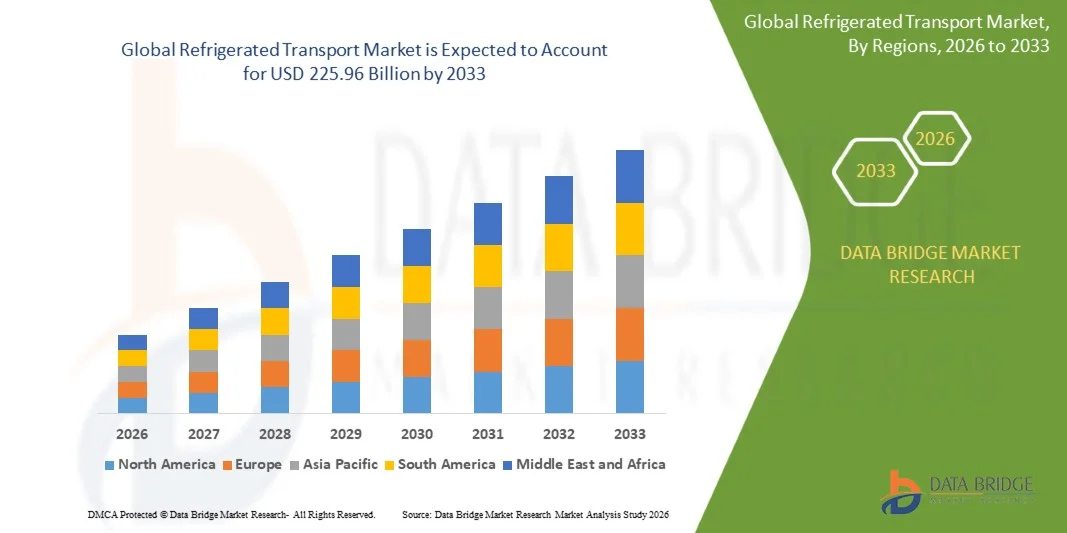
- The global refrigerated transport market size was valued at USD 139.44 billion in 2025 and is expected to reach USD 225.96 billion by 2033, at a CAGR of 6.22% during the forecast period
- The market growth is largely fuelled by the rising demand for temperature-sensitive food products, pharmaceuticals, and biologics, which require reliable cold chain logistics to maintain product quality and safety
- Increasing globalization of food trade and expansion of organized retail and e-commerce grocery delivery services are further strengthening demand for refrigerated transport solutions
Refrigerated Transport Market Analysis
- The refrigerated transport market is witnessing strong transformation due to rapid advancements in cold chain technologies such as real-time temperature monitoring and IoT-enabled tracking systems
- Growing urbanization and changing consumer lifestyles are increasing consumption of frozen and processed food, thereby boosting demand for efficient refrigerated logistics networks
- North America dominated the refrigerated transport market with the largest revenue share in 2025, driven by strong demand for temperature-controlled logistics across food, pharmaceutical, and chemical industries. The region benefits from advanced cold chain infrastructure, high penetration of refrigerated fleets, and strict regulatory standards for food safety and drug distribution.
- Asia-Pacific region is expected to witness the highest growth rate in the global refrigerated transport market, driven by rapid urbanization, rising disposable incomes, and expanding cold chain infrastructure. Increasing demand for perishable food products, pharmaceuticals, and e-commerce grocery delivery services is further accelerating market expansion across key countries such as China, India, and Japan.
- The Chilled Food Products segment held the largest market revenue share in 2025 driven by rising consumption of dairy, fresh produce, beverages, and ready-to-eat meals that require controlled temperature during transportation. Strong demand from supermarkets, convenience stores, and online grocery platforms further supports segment dominance. Increasing consumer preference for fresh and minimally processed food products is also boosting adoption of chilled logistics solutions
Report Scope and Refrigerated Transport Market Segmentation
|
Attributes |
Refrigerated Transport Key Market Insights |
|
Segments Covered |
|
|
Countries Covered |
North America
Europe
Asia-Pacific
Middle East and Africa
South America
|
|
Key Market Players |
• Nestle (Switzerland) |
|
Market Opportunities |
• Expansion Of Cold Chain Logistics Infrastructure |
|
Value Added Data Infosets |
In addition to the insights on market scenarios such as market value, growth rate, segmentation, geographical coverage, and major players, the market reports curated by the Data Bridge Market Research also include in-depth expert analysis, pricing analysis, brand share analysis, consumer survey, demography analysis, supply chain analysis, value chain analysis, raw material/consumables overview, vendor selection criteria, PESTLE Analysis, Porter Analysis, and regulatory framework. |
Refrigerated Transport Market Trends
“Rising Demand For Temperature-Sensitive Logistics And Cold Chain Expansion”
• The growing need for reliable temperature-controlled logistics is significantly shaping the refrigerated transport market, as industries such as food, pharmaceuticals, and chemicals increasingly depend on uninterrupted cold chain systems. Refrigerated transport solutions are gaining traction due to their ability to preserve product quality, extend shelf life, and reduce spoilage across long-distance distribution networks. This trend is strengthening adoption across both developed and emerging economies, encouraging logistics providers to expand fleet capabilities and invest in advanced refrigeration technologies
• Increasing consumption of frozen and processed food products, coupled with rapid expansion of organized retail and online grocery platforms, has accelerated demand for refrigerated transport services. Urban consumers are increasingly relying on convenient food delivery systems, which require robust cold chain infrastructure. This has also encouraged collaboration between logistics companies and retail chains to ensure efficient last-mile refrigerated delivery solutions
• Growing pharmaceutical and biotechnology industries are influencing demand for highly controlled temperature transport, especially for vaccines, biologics, and specialty drugs. Strict regulatory requirements for storage and distribution are pushing companies to adopt advanced refrigerated transport systems equipped with real-time monitoring and traceability features. This is further driving investments in smart cold chain logistics solutions
• For instance, in 2025, DHL in Germany and Americold in the U.S. expanded their refrigerated logistics networks by integrating IoT-enabled tracking and energy-efficient refrigerated fleets for pharmaceutical and food distribution. These expansions were introduced to meet rising demand for secure cold chain services, improving delivery efficiency and reducing product loss across global supply chains
• While demand for refrigerated transport is increasing, sustained market growth depends on fuel efficiency improvements, infrastructure development, and adoption of sustainable refrigeration technologies. Companies are also focusing on reducing carbon emissions and enhancing operational efficiency through electric and hybrid refrigerated transport systems
Refrigerated Transport Market Dynamics
Driver
“Growing Demand For Cold Chain Distribution Across Food And Pharmaceutical Industries”
• Rising global consumption of perishable food products is a major driver for the refrigerated transport market, as consumers increasingly demand fresh, frozen, and processed food items. This is encouraging food manufacturers and retailers to strengthen cold chain logistics networks to maintain product quality and safety throughout transportation
• Expanding pharmaceutical production and vaccine distribution is significantly boosting demand for temperature-controlled transport solutions. Refrigerated vehicles ensure product integrity during long-distance shipping, particularly for temperature-sensitive biologics and life-saving medicines
• Rapid growth of e-commerce grocery platforms and online food delivery services is further accelerating demand for efficient refrigerated transport systems. Companies are investing in advanced fleet management and cold storage integration to improve delivery speed and reduce spoilage risks
• For instance, in 2024, FedEx in the U.S. and Kuehne + Nagel in Switzerland expanded their cold chain logistics operations to support increasing demand from pharmaceutical and fresh food sectors. These expansions enhanced global distribution capabilities and improved reliability of temperature-sensitive shipments
• Although demand is increasing, sustained growth depends on infrastructure modernization, fleet electrification, and improved energy efficiency in refrigerated transport systems. Investment in advanced monitoring technologies and sustainable refrigeration solutions will be key to long-term market expansion
Restraint/Challenge
“High Operational Costs And Infrastructure Limitations In Cold Chain Logistics”
• The high cost of refrigerated transport operations remains a key challenge for market growth, driven by expensive refrigeration equipment, fuel consumption, and maintenance requirements. These costs often limit adoption among small and medium-sized logistics providers
• Limited cold chain infrastructure in developing regions restricts efficient refrigerated transport, leading to product losses and inefficiencies in distribution networks. Inadequate storage facilities and weak transportation networks further hinder market expansion
• Energy consumption and environmental concerns also pose challenges, as traditional refrigerated systems rely heavily on fossil fuels, increasing operational costs and carbon emissions. Regulatory pressure is pushing companies to adopt greener alternatives, but implementation remains expensive
• For instance, in 2024, logistics operators in Southeast Asia and parts of Africa reported challenges in maintaining continuous cold chain operations for dairy and pharmaceutical products due to unreliable infrastructure and high energy costs. These issues led to increased spoilage rates and reduced supply chain efficiency
• Addressing these challenges will require investment in cold chain infrastructure, adoption of energy-efficient technologies, and expansion of sustainable refrigerated transport solutions. Collaboration between governments and private logistics providers will be essential to improve accessibility and reduce operational barriers globally
Refrigerated Transport Market Scope
The market is segmented on the basis of type, mode of transport, temperature, and technology.
• By Application
On the basis of application, the refrigerated transport market is segmented into Chilled Food Products and Frozen Food Products. The Chilled Food Products segment held the largest market revenue share in 2025 driven by rising consumption of dairy, fresh produce, beverages, and ready-to-eat meals that require controlled temperature during transportation. Strong demand from supermarkets, convenience stores, and online grocery platforms further supports segment dominance. Increasing consumer preference for fresh and minimally processed food products is also boosting adoption of chilled logistics solutions.
The Frozen Food Products segment is expected to witness the fastest growth rate from 2026 to 2033, driven by growing demand for long shelf-life food items, frozen meat, seafood, and bakery products. Expanding organized retail and foodservice industries are further strengthening cold chain requirements. Rising urbanization and changing dietary habits are In addition supporting increased consumption of frozen food products globally.
• By Mode of Transport
On the basis of mode of transport, the market is segmented into Refrigerated Road Transport, Refrigerated Sea Transport, Refrigerated Rail Transport, and Refrigerated Air Transport. The Refrigerated Road Transport segment held the largest market revenue share in 2025 driven by its flexibility, wide accessibility, and strong last-mile delivery capabilities. It is widely used for domestic distribution of perishable goods across retail, foodservice, and pharmaceutical sectors. Strong integration with cold storage hubs further enhances its efficiency and adoption.
The Refrigerated Air Transport segment is expected to witness the fastest growth rate from 2026 to 2033, driven by rising demand for rapid delivery of high-value perishables such as pharmaceuticals, vaccines, and premium food products. Air transport ensures minimal transit time and maintains strict temperature control, making it highly suitable for international trade. Expanding global supply chains and increasing time-sensitive shipments are further supporting segment growth.
• By Temperature
On the basis of temperature, the market is segmented into Single-Temperature and Multi-Temperature. The Single-Temperature segment held the largest market revenue share in 2025 driven by its extensive use in transporting uniform temperature-sensitive goods such as frozen food and pharmaceuticals. It offers operational simplicity, cost efficiency, and ease of fleet management for logistics providers. Strong demand from standardized cold chain operations further supports its dominance.
The Multi-Temperature segment is expected to witness the fastest growth rate from 2026 to 2033, driven by increasing demand for transporting mixed perishable goods in a single shipment. It allows efficient distribution of different temperature-sensitive products simultaneously, reducing logistics costs and improving delivery efficiency. Rising adoption in retail and e-commerce grocery delivery services is further accelerating segment growth.
• By Technology
On the basis of technology, the market is segmented into Vapor Compression Systems and Cryogenic Systems. The Vapor Compression Systems segment held the largest market revenue share in 2025 driven by its widespread use in commercial refrigerated transport vehicles due to reliability and energy efficiency. It is commonly used across food and beverage logistics as well as pharmaceutical transportation. Continuous technological improvements in cooling efficiency further support its strong market position.
The Cryogenic Systems segment is expected to witness the fastest growth rate from 2026 to 2033, driven by increasing demand for ultra-low temperature transport of vaccines, biologics, and high-value pharmaceuticals. These systems offer rapid cooling and consistent temperature maintenance without reliance on traditional refrigerants. Growing focus on sustainable and low-emission cooling technologies is further accelerating adoption.
Refrigerated Transport Market Regional Analysis
• North America dominated the refrigerated transport market with the largest revenue share in 2025, driven by strong demand for temperature-controlled logistics across food, pharmaceutical, and chemical industries. The region benefits from advanced cold chain infrastructure, high penetration of refrigerated fleets, and strict regulatory standards for food safety and drug distribution.
• Consumers and industries in the region highly value reliability, real-time temperature monitoring, and efficient last-mile delivery solutions that ensure product integrity throughout the supply chain.
• This widespread adoption is further supported by high consumption of frozen and processed foods, strong pharmaceutical distribution networks, and advanced logistics technologies, establishing refrigerated transport as a critical component of regional supply chains.
U.S. Refrigerated Transport Market Insight
The U.S. refrigerated transport market captured the largest revenue share in 2025 within North America, fueled by strong expansion of cold chain logistics for food retail, e-commerce grocery delivery, and pharmaceutical distribution. Companies are increasingly adopting IoT-enabled refrigerated vehicles and advanced fleet management systems to ensure real-time monitoring and product safety. The growing demand for vaccines, biologics, and fresh food products further propels market growth. Moreover, the presence of large logistics providers and continuous investment in cold chain infrastructure significantly contribute to market expansion.
Europe Refrigerated Transport Market Insight
The Europe refrigerated transport market is expected to witness the fastest growth rate from 2026 to 2033, primarily driven by stringent food safety regulations, rising demand for fresh and organic food products, and expansion of pharmaceutical logistics. The region is also focusing on reducing carbon emissions through adoption of electric and energy-efficient refrigerated transport systems. Increasing cross-border trade of perishable goods and strong retail networks are further supporting market growth across major European economies.
U.K. Refrigerated Transport Market Insight
The U.K. refrigerated transport market is expected to witness strong growth from 2026 to 2033, driven by rising demand for online grocery delivery, restaurant supply chains, and pharmaceutical logistics. Growing concerns regarding food quality and safety are encouraging investments in advanced cold chain systems. In addition, expansion of e-commerce platforms and last-mile refrigerated delivery services is significantly boosting market demand.
Germany Refrigerated Transport Market Insight
The Germany refrigerated transport market is expected to witness significant growth from 2026 to 2033, fueled by strong industrial base, advanced logistics infrastructure, and high demand for temperature-controlled pharmaceuticals and food products. The country’s focus on sustainability is also driving adoption of energy-efficient refrigerated transport technologies. Increasing export of processed foods and chemicals further supports market expansion.
Asia-Pacific Refrigerated Transport Market Insight
The Asia-Pacific refrigerated transport market is expected to witness the fastest growth rate from 2026 to 2033, driven by rapid urbanization, rising disposable incomes, and expanding cold chain infrastructure. Growing demand for frozen food, dairy products, and pharmaceuticals in countries such as China, India, and Japan is significantly boosting market growth. Increasing investments in logistics modernization and e-commerce expansion are further supporting regional adoption.
Japan Refrigerated Transport Market Insight
The Japan refrigerated transport market is expected to witness steady growth from 2026 to 2033 due to high demand for fresh food distribution, advanced logistics systems, and strong pharmaceutical supply chains. The country’s focus on precision logistics and food safety standards is driving adoption of advanced refrigerated transport solutions. Increasing aging population and healthcare needs are also supporting pharmaceutical cold chain demand.
China Refrigerated Transport Market Insight
The China refrigerated transport market accounted for the largest market revenue share in Asia-Pacific in 2025, attributed to rapid urbanization, strong growth in e-commerce grocery delivery, and expanding food and pharmaceutical industries. Government support for cold chain infrastructure development is significantly boosting market penetration. In addition, rising demand for frozen food products and increasing exports of perishable goods are key factors driving market growth.
Refrigerated Transport Market Share
The Refrigerated Transport industry is primarily led by well-established companies, including:
• Nestle (Switzerland)
• Tyson Foods (U.S.)
• General Mills (U.S.)
• Smithfield Foods (U.S.)
• Kellogg Company (U.S.)
• Conagra Brands (U.S.)
• Kerry Group plc (Ireland)
• Kapsch TrafficCom (Austria)
• Gemalto NV (Netherlands)
• Thales Group (France)
• Alstom (France)
• MSR-Traffic (Germany)
• Cubic Corporation (U.S.)
• WS Atkins PLC (U.K.)
• Cisco Systems, Inc. (U.S.)
• Accenture (Ireland)
• Del Monte Pacific (Singapore)
• Aryzta (Switzerland)
• Associated British Foods (U.K.)
• Kraft Heinz Company (U.S.)
• Unilever (U.K./Netherlands)
• McCain Foods Limited (Canada)
• Iceland Foods Ltd. (U.K.)
• Samworth Brothers Limited (U.K.)
Latest Developments in Global Refrigerated Transport Market
- In September 2023, Mitsubishi Heavy Industries Thermal Systems, product launch development, launched the TEJ35GAM electric-driven transport refrigeration unit designed for small and mid-size trucks, enabling automatic switching between plug-in charging and battery operation based on vehicle usage. This development is expected to improve energy efficiency, reduce emissions, and enhance sustainability in refrigerated transport operations. It also supports modernization of cold chain logistics by addressing environmental concerns and improving operational flexibility
- In April 2023, Kodiak Robotics and C.R. England, partnership and pilot development, initiated a pilot program for autonomous refrigerated freight transportation of Tyson Foods products between Dallas and San Antonio, Texas, with safety drivers onboard during initial testing. This initiative is expected to enhance efficiency, reduce driver dependency, and improve long-haul refrigerated logistics safety. It also supports the integration of autonomous technology into cold chain transportation networks, potentially transforming future freight operations
- In September 2022, XTL Group, acquisition development, acquired Quebec-based Transport Savoie to expand its refrigerated transport capabilities and strengthen cross-border logistics operations across the eastern U.S. This acquisition added nearly 40 power units to its fleet and improved service coverage for consumer packaged goods and temperature-sensitive shipments. It is expected to enhance fleet capacity, improve operational efficiency, and strengthen XTL Group’s position in the North American refrigerated transport market

- Interactive Data Analysis Dashboard
- Company Analysis Dashboard for high growth potential opportunities
- Research Analyst Access for customization & queries
- Competitor Analysis with Interactive dashboard
- Latest News, Updates & Trend analysis
- Harness the Power of Benchmark Analysis for Comprehensive Competitor Tracking
Global Refrigerated Transport Market, Supply Chain Analysis and Ecosystem Framework
To support market growth and help clients navigate the impact of geopolitical shifts, DBMR has integrated in-depth supply chain analysis into its Global Refrigerated Transport Market research reports. This addition empowers clients to respond effectively to global changes affecting their industries. The supply chain analysis section includes detailed insights such as Global Refrigerated Transport Market consumption and production by country, price trend analysis, the impact of tariffs and geopolitical developments, and import and export trends by country and HSN code. It also highlights major suppliers with data on production capacity and company profiles, as well as key importers and exporters. In addition to research, DBMR offers specialized supply chain consulting services backed by over a decade of experience, providing solutions like supplier discovery, supplier risk assessment, price trend analysis, impact evaluation of inflation and trade route changes, and comprehensive market trend analysis.
Data collection and base year analysis are done using data collection modules with large sample sizes. The stage includes obtaining market information or related data through various sources and strategies. It includes examining and planning all the data acquired from the past in advance. It likewise envelops the examination of information inconsistencies seen across different information sources. The market data is analysed and estimated using market statistical and coherent models. Also, market share analysis and key trend analysis are the major success factors in the market report. To know more, please request an analyst call or drop down your inquiry.
The key research methodology used by DBMR research team is data triangulation which involves data mining, analysis of the impact of data variables on the market and primary (industry expert) validation. Data models include Vendor Positioning Grid, Market Time Line Analysis, Market Overview and Guide, Company Positioning Grid, Patent Analysis, Pricing Analysis, Company Market Share Analysis, Standards of Measurement, Global versus Regional and Vendor Share Analysis. To know more about the research methodology, drop in an inquiry to speak to our industry experts.
Data Bridge Market Research is a leader in advanced formative research. We take pride in servicing our existing and new customers with data and analysis that match and suits their goal. The report can be customized to include price trend analysis of target brands understanding the market for additional countries (ask for the list of countries), clinical trial results data, literature review, refurbished market and product base analysis. Market analysis of target competitors can be analyzed from technology-based analysis to market portfolio strategies. We can add as many competitors that you require data about in the format and data style you are looking for. Our team of analysts can also provide you data in crude raw excel files pivot tables (Fact book) or can assist you in creating presentations from the data sets available in the report.













