


Global Refrigerated Vending Machine Market Size
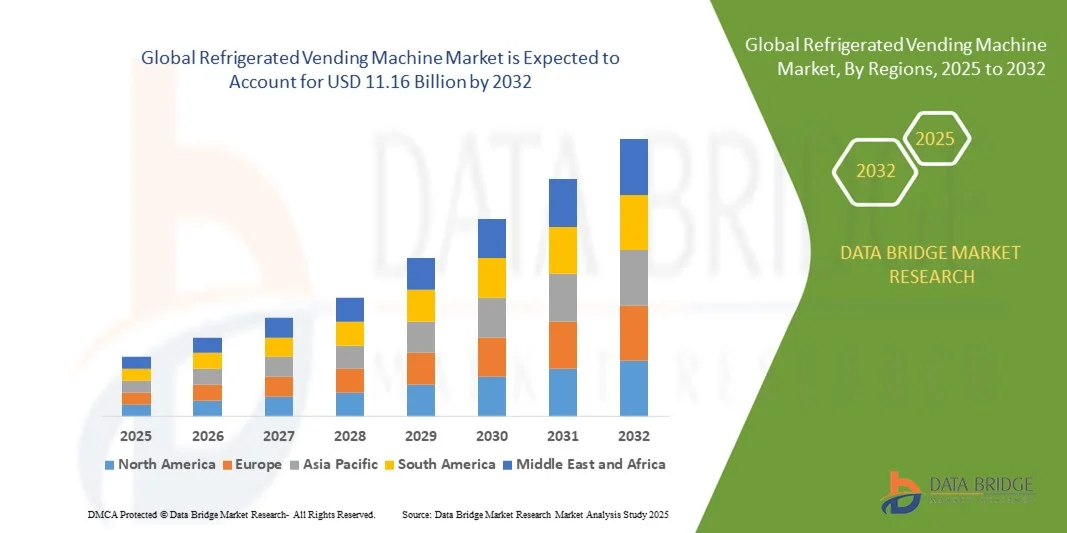
- The global Refrigerated Vending Machine Market size was valued at USD 6.5billion in 2024 and is projected to reach USD 11.16 billion by 2032, growing at a CAGR of 7.00% during the forecast period.
- The market expansion is primarily driven by increasing demand for convenient, on-the-go fresh food and beverage solutions, coupled with advancements in refrigeration technology and IoT-enabled vending machines.
- Additionally, the rising preference for automated retail solutions in workplaces, public spaces, and commercial establishments is fueling the adoption of smart refrigerated vending machines. These factors collectively are propelling market growth and establishing automated, temperature-controlled vending as a key trend in modern retail.
Global Refrigerated Vending Machine Market Analysis
- Refrigerated vending machines, providing temperature-controlled automated retail solutions for food and beverages, are becoming essential in modern retail and workplace environments due to their convenience, product freshness, and integration with cashless and IoT-enabled payment systems.
- The increasing demand for refrigerated vending machines is primarily driven by growing consumer preference for on-the-go fresh food and beverages, rising adoption of automated retail solutions, and advancements in smart refrigeration and connectivity technologies.
- North America dominated the Global Refrigerated Vending Machine Market with the largest revenue share of 32.2% in 2024, supported by high disposable incomes, early adoption of automated retail solutions, and a strong presence of key industry players, with the U.S. witnessing significant deployment of smart vending machines in workplaces, schools, and public spaces, driven by innovations in IoT-enabled features and cashless payment integration.
- Asia-Pacific is expected to be the fastest-growing region in the Global Refrigerated Vending Machine Market during the forecast period due to increasing urbanization, rising disposable incomes, and growing awareness of convenience-driven retail solutions.
- The supermarket and hypermarket segment dominated the market with the largest revenue share of 38.5% in 2024, driven by the high volume of daily foot traffic, increasing consumer demand for fresh and ready-to-eat products, and the convenience of automated self-service options.
Report Scope and Global Refrigerated Vending Machine Market Segmentation
|
Attributes |
Refrigerated Vending Machine Key Market Insights |
|
Segments Covered |
|
|
Countries Covered |
North America
Europe
Asia-Pacific
Middle East and Africa
South America
|
|
Key Market Players |
|
|
Market Opportunities |
|
|
Value Added Data Infosets |
In addition to the insights on market scenarios such as market value, growth rate, segmentation, geographical coverage, and major players, the market reports curated by the Data Bridge Market Research also include in-depth expert analysis, pricing analysis, brand share analysis, consumer survey, demography analysis, supply chain analysis, value chain analysis, raw material/consumables overview, vendor selection criteria, PESTLE Analysis, Porter Analysis, and regulatory framework. |
Global Refrigerated Vending Machine Market Trends
Enhanced Convenience Through AI and IoT-Enabled Vending
- A significant and accelerating trend in the global Refrigerated Vending Machine Market is the increasing integration of artificial intelligence (AI) and IoT-enabled systems, allowing machines to optimize inventory, monitor product freshness, and provide a more personalized user experience.
- For instance, Crane Merchandising Systems’ smart vending machines use AI-powered analytics to recommend popular items based on purchase history and local demand patterns. Similarly, Azkoyen’s connected vending solutions can remotely track stock levels and temperature conditions, reducing maintenance downtime and ensuring product quality.
- AI integration in refrigerated vending machines enables features such as predictive restocking, dynamic pricing based on demand, and real-time monitoring of machine performance. Some Fuji Electric models use AI to optimize energy consumption while maintaining precise cooling, improving efficiency and reducing operational costs.
- The seamless integration of these vending machines with mobile apps and IoT platforms facilitates cashless payments, loyalty programs, and remote management, allowing operators to control multiple machines from a single interface. Customers can enjoy faster, more convenient transactions and personalized promotions.
- This trend toward intelligent, connected, and automated vending systems is reshaping expectations for convenience and service in public and commercial spaces. Consequently, companies such as Seaga and SandenVendo are developing AI-enabled refrigerated vending machines with predictive inventory management, energy optimization, and remote monitoring capabilities.
- The demand for AI- and IoT-integrated refrigerated vending machines is growing rapidly across workplaces, schools, hospitals, and urban public spaces, as consumers and operators increasingly prioritize efficiency, freshness, and seamless user experiences.
Global Refrigerated Vending Machine Market Dynamics
Driver
Growing Need Due to Convenience, Freshness, and Automated Retail Adoption
- The increasing consumer preference for on-the-go fresh food and beverages, combined with the rising adoption of automated retail solutions in workplaces, schools, hospitals, and public spaces, is a significant driver for the growing demand for refrigerated vending machines.
- For instance, in 2024, Crane Merchandising Systems launched AI-enabled smart vending machines capable of monitoring stock levels, optimizing product placement, and providing personalized recommendations based on purchasing patterns. Such innovations by key companies are expected to drive market growth during the forecast period.
- As consumers prioritize convenience and access to fresh products, refrigerated vending machines offer features such as temperature-controlled storage, cashless payment systems, and real-time inventory monitoring, providing a compelling alternative to traditional vending and retail options.
- Furthermore, the rising popularity of smart retail solutions and IoT-connected devices is making refrigerated vending machines an integral component of automated retail ecosystems, allowing seamless integration with mobile apps, loyalty programs, and centralized machine management platforms.
- The convenience of contactless payments, remote inventory management for operators, and personalized promotions for consumers are key factors propelling the adoption of refrigerated vending machines in both commercial and public sectors. The trend toward automated, user-friendly, and smart vending solutions further contributes to market expansion.
Restraint/Challenge
Concerns Regarding Maintenance Costs and Technology Adoption
- Concerns surrounding operational and maintenance costs, as well as the complexity of integrating advanced technology, pose significant challenges to broader market penetration. Refrigerated vending machines require regular maintenance, temperature monitoring, and sometimes technical support for IoT or AI-enabled features, which can be perceived as a barrier by smaller operators.
- For instance, some high-tech vending machines with AI-based inventory tracking and remote monitoring systems may require specialized servicing, making upfront investments and ongoing operational costs higher than traditional vending solutions.
- Addressing these concerns through reliable remote diagnostics, modular maintenance designs, and comprehensive customer support is crucial for increasing adoption. Companies such as Azkoyen and Seaga emphasize ease of service, energy efficiency, and user-friendly interfaces in their marketing to reassure potential buyers.
- Additionally, the relatively high initial investment for smart refrigerated vending machines compared to traditional machines can deter adoption in price-sensitive regions or by small business operators. While more basic automated vending machines have become affordable, advanced models with AI, IoT connectivity, and energy-efficient refrigeration often come with a premium price.
- Overcoming these challenges through cost-effective solutions, operator training, and robust after-sales support will be vital for sustaining market growth and accelerating adoption across diverse sectors.
Global Refrigerated Vending Machine Market Scope
Refrigerated vending machine market is segmented on the basis of retail channel, application and end-user.
- By Retail Channel
On the basis of retail channel, the Global Refrigerated Vending Machine Market is segmented into supermarkets, hypermarkets, convenience stores, and online retail. The supermarket and hypermarket segment dominated the market with the largest revenue share of 38.5% in 2024, driven by the high volume of daily foot traffic, increasing consumer demand for fresh and ready-to-eat products, and the convenience of automated self-service options. Supermarkets and hypermarkets benefit from deploying refrigerated vending machines in high-traffic zones to offer snacks, beverages, and perishable items without increasing staff workload. The segment also sees steady growth due to the integration of cashless payment solutions, IoT-based inventory monitoring, and AI-driven product recommendations that enhance customer satisfaction.
The convenience store segment is anticipated to witness the fastest CAGR of 22.1% from 2025 to 2032, fueled by rapid urbanization, rising disposable incomes, and the increasing consumer preference for on-the-go food and beverage options.
- By Application
On the basis of application, the Global Refrigerated Vending Machine Market is segmented into food service, food and beverage distribution, food and beverage retail, and other applications. The food and beverage retail segment held the largest market revenue share of 41.2% in 2024, owing to the increasing consumer demand for fresh, ready-to-consume items and the adoption of automated vending solutions in high-footfall areas such as shopping malls, airports, and corporate spaces. Refrigerated vending machines in this segment allow retailers to extend service hours, reduce labor costs, and offer a diverse product range while maintaining freshness.
The food service segment is expected to witness the fastest CAGR of 23.0% from 2025 to 2032, driven by restaurants, cafes, and cafeterias adopting smart vending solutions to deliver convenience, personalized options, and contactless transactions, particularly in urban centers with time-conscious consumers.
- By End-User
On the basis of end-user, the Global Refrigerated Vending Machine Market is segmented into the food processing industry, food service industry, full-service restaurants and hotels, quick service restaurants (QSRs), and catering services. The quick service restaurant (QSR) segment dominated the market with the largest revenue share of 39.7% in 2024, driven by the need for high-volume, on-the-go food and beverage solutions. QSRs increasingly rely on refrigerated vending machines to supplement traditional counters, offer 24/7 access, and maintain food safety and freshness.
The catering services segment is expected to witness the fastest CAGR of 24.2% from 2025 to 2032, fueled by growing demand for automated, portable, and temperature-controlled food dispensing solutions for corporate events, outdoor functions, and institutional catering, where efficiency, hygiene, and convenience are critical factors.
Global Refrigerated Vending Machine Market Regional Analysis
- North America dominated the Global Refrigerated Vending Machine Market with the largest revenue share of 32.2% in 2024, driven by the growing adoption of automated retail solutions and the increasing demand for fresh, on-the-go food and beverage options.
- Consumers and businesses in the region highly value the convenience, energy efficiency, and advanced technology features offered by smart and connected refrigerated vending machines, including cashless payment systems, IoT-based inventory monitoring, and AI-driven product recommendations.
- This widespread adoption is further supported by high disposable incomes, a technology-savvy population, and the growing preference for automated and contactless retail solutions, establishing refrigerated vending machines as a favored option across supermarkets, corporate spaces, educational institutions, and public venues.
U.S. Refrigerated Vending Machine Market Insight
The U.S. refrigerated vending machine market captured the largest revenue share of 81% in 2024 within North America, fueled by the rapid adoption of automated retail solutions and the growing demand for fresh, on-the-go food and beverage options. Consumers and businesses increasingly prioritize convenience, hygiene, and 24/7 accessibility, driving the installation of smart and connected refrigerated vending machines. The expanding trend of cashless payments, mobile app integration, and IoT-enabled inventory monitoring further propels market growth. Moreover, the growing presence of supermarkets, corporate offices, universities, and healthcare facilities adopting automated vending solutions contributes significantly to market expansion.
Europe Refrigerated Vending Machine Market Insight
The Europe refrigerated vending machine market is projected to expand at a substantial CAGR throughout the forecast period, primarily driven by increasing urbanization, rising disposable incomes, and the demand for fresh and convenient food options. Stringent food safety and hygiene regulations encourage the adoption of smart vending machines with temperature-controlled storage. European consumers and businesses are also drawn to the efficiency, energy-saving features, and automation offered by modern vending solutions. The market is witnessing growth across commercial spaces, corporate offices, and public institutions, with machines being incorporated into both new facilities and retrofit projects.
U.K. Refrigerated Vending Machine Market Insight
The U.K. refrigerated vending machine market is anticipated to grow at a noteworthy CAGR during the forecast period, driven by rising consumer demand for convenient access to fresh food and beverages, as well as the increasing adoption of smart retail technologies. Concerns regarding food safety, hygiene, and contactless transactions are encouraging both commercial and residential installations. The U.K.’s strong e-commerce infrastructure and focus on automated retail solutions are expected to continue stimulating market growth, particularly in supermarkets, offices, and educational institutions.
Germany Refrigerated Vending Machine Market Insight
The Germany refrigerated vending machine market is expected to expand at a considerable CAGR during the forecast period, fueled by high consumer awareness of food safety, hygiene, and convenience. Germany’s well-developed retail and commercial infrastructure, combined with a preference for energy-efficient and technologically advanced solutions, promotes the adoption of smart vending machines. The integration of machines with cashless payment systems, IoT-enabled monitoring, and AI-driven inventory management is increasingly prevalent, supporting both commercial and public deployments.
Asia-Pacific Refrigerated Vending Machine Market Insight
The Asia-Pacific refrigerated vending machine market is poised to grow at the fastest CAGR of 24% from 2025 to 2032, driven by rapid urbanization, increasing disposable incomes, and technological advancements in countries such as China, Japan, India, and South Korea. The region’s growing preference for convenient, on-the-go fresh food options, coupled with government initiatives supporting digitalization and smart retail infrastructure, is accelerating adoption. Smart and connected vending machines are gaining traction across supermarkets, corporate offices, hospitals, and universities, with affordable and locally manufactured options expanding accessibility.
Japan Refrigerated Vending Machine Market Insight
The Japan refrigerated vending machine market is gaining momentum due to high consumer demand for convenience, food safety, and hygienic automated solutions. Japan’s tech-savvy population and dense urban centers encourage widespread deployment of smart vending machines in workplaces, schools, and public areas. Integration with cashless payments, mobile applications, and IoT-based inventory monitoring is driving market growth. Additionally, Japan’s aging population is fueling demand for easy-to-use and reliable vending solutions, particularly in residential and commercial settings.
China Refrigerated Vending Machine Market Insight
The China refrigerated vending machine market accounted for the largest market revenue share in Asia-Pacific in 2024, attributed to rapid urbanization, a growing middle class, and high technological adoption. Smart vending machines are increasingly deployed in residential complexes, commercial offices, and public spaces, offering fresh food and beverages with cashless payment options and real-time inventory management. Government initiatives promoting smart cities, coupled with domestic manufacturing capabilities and cost-effective solutions, are key factors propelling market growth in China.
Global Refrigerated Vending Machine Market Share
The Refrigerated Vending Machine industry is primarily led by well-established companies, including:
• Coca-Cola Company (U.S.)
• PepsiCo (U.S.)
• Nestlé (Switzerland)
• SandenVendo (Japan)
• Crane Merchandising Systems (U.S.)
• Fuji Electric (Japan)
• Azkoyen Group (Spain)
• Wittern Group (Germany)
• Royal Vendors (U.S.)
• Vendo (U.S.)
• N&W Global Vending (Italy)
• Jofemar (Spain)
• Sielaff GmbH (Germany)
• Fastcorp Vending (U.S.)
• Seaga Manufacturing (U.S.)
• Evoca Group (Italy)
• Bianchi Industry (Italy)
• SandenVendo (Japan)
• Vendo Company (U.S.)
• Automated Merchandising Systems (U.S.)
What are the Recent Developments in Global Refrigerated Vending Machine Market?
- In April 2023, Coca-Cola Company, a global leader in beverage solutions, launched a strategic initiative in South Africa to expand its network of smart refrigerated vending machines, aimed at providing convenient access to chilled beverages in both residential and commercial locations. This initiative emphasizes Coca-Cola’s commitment to delivering innovative, reliable, and technologically advanced vending solutions tailored to regional market needs. By leveraging its global expertise and state-of-the-art machines, Coca-Cola is strengthening its position in the rapidly growing Global Refrigerated Vending Machine Market.
- In March 2023, PepsiCo, a multinational food and beverage corporation, introduced its next-generation refrigerated vending machine equipped with IoT-enabled monitoring, cashless payment systems, and real-time inventory tracking, specifically designed for schools, offices, and commercial settings. This launch reflects PepsiCo’s dedication to enhancing operational efficiency, user convenience, and product availability through smart vending technology.
- In March 2023, Nestlé deployed its smart refrigerated vending machines as part of the Bengaluru Fresh Food Initiative, aimed at delivering safe, chilled snacks and beverages across urban centers. The initiative incorporates IoT temperature monitoring and predictive restocking systems, highlighting Nestlé’s focus on safety, freshness, and customer convenience while expanding its market presence.
- In February 2023, SandenVendo, a leading global vending solutions provider, announced a partnership with the Chesapeake Bay and Rivers Association to implement smart refrigerated vending machines in public spaces and corporate offices. The collaboration is designed to improve accessibility, convenience, and operational efficiency for operators while promoting innovative automated retail solutions across the region.
- In January 2023, Crane Merchandising Systems, a top provider of automated retail technology, unveiled its smart refrigerated vending machine at the NAHB International Builders’ Show (IBS) 2023. Featuring Wi-Fi connectivity, cashless payment integration, and remote monitoring capabilities, the system allows operators to manage stock, track sales, and optimize operations efficiently, showcasing Crane’s commitment to advancing convenience, reliability, and innovation in the Global Refrigerated Vending Machine Market.

- Interactive Data Analysis Dashboard
- Company Analysis Dashboard for high growth potential opportunities
- Research Analyst Access for customization & queries
- Competitor Analysis with Interactive dashboard
- Latest News, Updates & Trend analysis
- Harness the Power of Benchmark Analysis for Comprehensive Competitor Tracking
Global Refrigerated Vending Machine Market, Supply Chain Analysis and Ecosystem Framework
To support market growth and help clients navigate the impact of geopolitical shifts, DBMR has integrated in-depth supply chain analysis into its Global Refrigerated Vending Machine Market research reports. This addition empowers clients to respond effectively to global changes affecting their industries. The supply chain analysis section includes detailed insights such as Global Refrigerated Vending Machine Market consumption and production by country, price trend analysis, the impact of tariffs and geopolitical developments, and import and export trends by country and HSN code. It also highlights major suppliers with data on production capacity and company profiles, as well as key importers and exporters. In addition to research, DBMR offers specialized supply chain consulting services backed by over a decade of experience, providing solutions like supplier discovery, supplier risk assessment, price trend analysis, impact evaluation of inflation and trade route changes, and comprehensive market trend analysis.
Data collection and base year analysis are done using data collection modules with large sample sizes. The stage includes obtaining market information or related data through various sources and strategies. It includes examining and planning all the data acquired from the past in advance. It likewise envelops the examination of information inconsistencies seen across different information sources. The market data is analysed and estimated using market statistical and coherent models. Also, market share analysis and key trend analysis are the major success factors in the market report. To know more, please request an analyst call or drop down your inquiry.
The key research methodology used by DBMR research team is data triangulation which involves data mining, analysis of the impact of data variables on the market and primary (industry expert) validation. Data models include Vendor Positioning Grid, Market Time Line Analysis, Market Overview and Guide, Company Positioning Grid, Patent Analysis, Pricing Analysis, Company Market Share Analysis, Standards of Measurement, Global versus Regional and Vendor Share Analysis. To know more about the research methodology, drop in an inquiry to speak to our industry experts.
Data Bridge Market Research is a leader in advanced formative research. We take pride in servicing our existing and new customers with data and analysis that match and suits their goal. The report can be customized to include price trend analysis of target brands understanding the market for additional countries (ask for the list of countries), clinical trial results data, literature review, refurbished market and product base analysis. Market analysis of target competitors can be analyzed from technology-based analysis to market portfolio strategies. We can add as many competitors that you require data about in the format and data style you are looking for. Our team of analysts can also provide you data in crude raw excel files pivot tables (Fact book) or can assist you in creating presentations from the data sets available in the report.













