


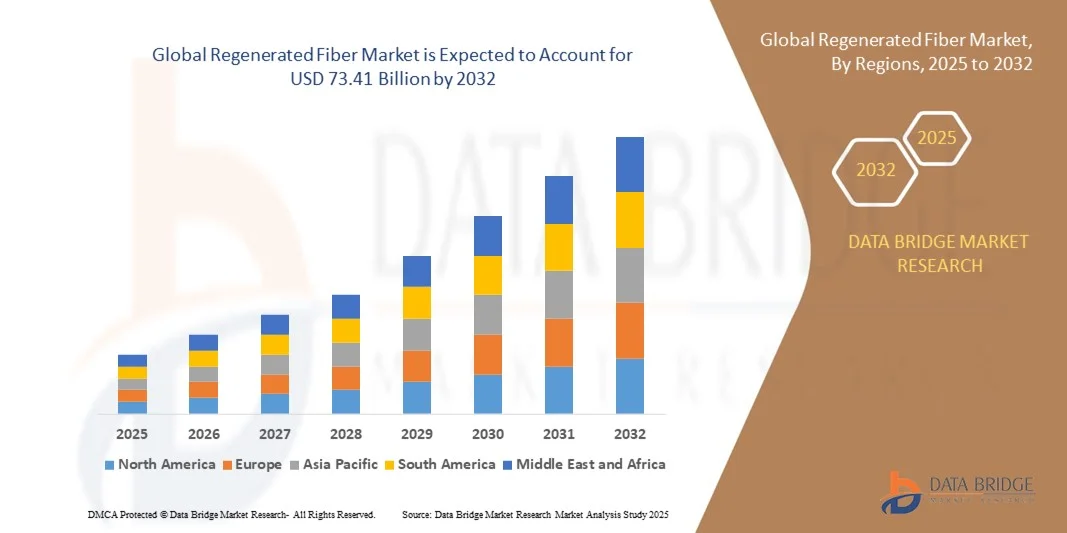
What is the Global Regenerated Fiber Market Size and Growth Rate?
- The global regenerated fiber market size was valued at USD 46.76 billion in 2024 and is expected to reach USD 73.41 billion by 2032, at a CAGR of 5.8% during the forecast period
- The increase in demand for textile goods from developed and developing nations acts as one of the major factors driving the growth of regenerated fiber market
- The increase in the concerns regarding the harmful impacts of using synthetic fibers on the environment and rise in the relevance of the clothing sector owning to the technological advancements in eco fiber textiles offering antimicrobial, insulating, highly breathable, hypoallergenic, and UV resistant, among other absorbent characteristics accelerate the market growth
What are the Major Takeaways of Regenerated Fiber Market?
- The high focus on developing effective work processes, restructuring their businesses, and investing in niche products, and regulations imposed on the manufacturing along with disposal of synthetic sources of fiber production across the economies further influence the market
- In addition, change in lifestyle, rapid urbanization, surge in disposable income, and growing online fashion sector positively affect the regenerated fiber market. Furthermore, shift in preference toward bio-based alternatives, such as organic cotton, hemp, and other sources of eco fibers
- Asia-Pacific dominated the regenerated fiber market with the largest revenue share of 39.54% in 2024, driven by rapid urbanization, increasing disposable incomes, and strong adoption of sustainable fibers in textiles and industrial applications
- North America is poised to grow at the fastest CAGR of 12.25% during 2025–2032, driven by rising awareness of sustainable fabrics, growing textile and industrial manufacturing sectors, and increasing demand for eco-friendly apparel and automotive components
- The Rayon segment dominated the market with the largest revenue share of 42.5% in 2024, owing to its widespread adoption in textiles and apparel due to its soft feel, breathability, and cost-effectiveness
Report Scope and Regenerated Fiber Market Segmentation
|
Attributes |
Regenerated Fiber Key Market Insights |
|
Segments Covered |
|
|
Countries Covered |
North America
Europe
Asia-Pacific
Middle East and Africa
South America
|
|
Key Market Players |
|
|
Market Opportunities |
|
|
Value Added Data Infosets |
In addition to the insights on market scenarios such as market value, growth rate, segmentation, geographical coverage, and major players, the market reports curated by the Data Bridge Market Research also include in-depth expert analysis, pricing analysis, brand share analysis, consumer survey, demography analysis, supply chain analysis, value chain analysis, raw material/consumables overview, vendor selection criteria, PESTLE Analysis, Porter Analysis, and regulatory framework. |
What is the Key Trend in the Regenerated Fiber Market?
Rising Sustainability and Eco-Friendly Production Practices
- A key trend shaping the global regenerated fiber market is the growing focus on sustainable and environmentally friendly production processes. Manufacturers are increasingly adopting closed-loop systems, using recycled materials, and reducing water and energy consumption in fiber production to minimize environmental impact.
- For instance, companies such as TENCEL have pioneered Lyocell fibers made from sustainably sourced wood pulp using eco-conscious production techniques, catering to environmentally aware consumers. Similarly, Birla Cellulose emphasizes bio-based fibers that reduce carbon footprint while maintaining product performance.
- Sustainable innovation also includes the development of fibers with biodegradable or recyclable properties, supporting circular economy principles and meeting stringent environmental regulations globally.
- This shift towards eco-friendly regenerated fibers is enhancing brand reputation and appealing to conscious consumers, especially in the apparel, home textiles, and industrial applications.
- Companies are investing in R&D to create high-performance fibers using fewer chemicals and energy, aligning with sustainability goals.
- The adoption of sustainable production practices is expected to continue driving growth, as both manufacturers and consumers prioritize eco-conscious choices in textile and nonwoven applications
What are the Key Drivers of Regenerated Fiber Market?
- Increasing consumer awareness about environmental sustainability and ethical sourcing is a primary driver boosting demand for regenerated fibers. Shoppers are seeking eco-friendly alternatives to conventional synthetic fibers, creating a preference for Lyocell, viscose, and modal products
- In addition, rising applications of regenerated fibers across textiles, apparel, home furnishings, and industrial sectors are driving market expansion, as these fibers offer superior softness, moisture absorption, and durability compared to synthetic alternatives
- Innovations in bio-based and recycled feedstocks are enabling manufacturers to meet stringent regulations and sustainability certifications, attracting brand partnerships and collaborations
- The growing focus on circular economy models encourages the use of regenerated fibers from post-consumer waste, reducing landfill pressures and promoting responsible consumption
- Manufacturers are also responding to increasing fashion industry demands for high-quality, sustainable materials with consistent performance, ensuring compatibility with dyeing, finishing, and textile machinery
- Overall, these factors are propelling the global regenerated fiber market forward, providing sustainable growth opportunities for manufacturers, brands, and end-users alike
Which Factor is Challenging the Growth of the Regenerated Fiber Market?
- High production costs of regenerated fibers compared to conventional synthetic fibers remain a significant challenge, limiting adoption, especially in price-sensitive regions. Advanced processing, eco-friendly solvents, and raw material sourcing contribute to higher costs
- Inconsistent quality and performance variations across different suppliers can also hinder widespread use, as textile manufacturers require uniformity in fiber strength, elongation, and moisture management for mass production
- Environmental regulations, while driving sustainability, impose compliance burdens on small and medium-scale producers, adding operational complexity and investment requirements
- Supply chain limitations, including sourcing of sustainable wood pulp or recycled materials, can affect timely production and availability of regenerated fibers
- Educating consumers and manufacturers on the benefits of regenerated fibers versus conventional alternatives remains crucial to enhance market penetration
- Overcoming these challenges through process optimization, cost reduction strategies, and expanded awareness of environmental benefits is essential for the continued growth of the regenerated fiber market
How is the Regenerated Fiber Market Segmented?
The market is segmented on the basis of type and application.
- By Type
On the basis of type, the regenerated fiber market is segmented into Rayon, Acetate, Cellulose, and Lyocell. The Rayon segment dominated the market with the largest revenue share of 42.5% in 2024, owing to its widespread adoption in textiles and apparel due to its soft feel, breathability, and cost-effectiveness. Rayon fibers are extensively used in clothing, home textiles, and industrial fabrics, and their versatility in blending with other fibers further fuels demand. Manufacturers also favor Rayon for its ease of dyeing and finishing, which allows a broad range of product designs.
The Lyocell segment is expected to witness the fastest CAGR of 22.3% from 2025 to 2032, driven by rising consumer preference for sustainable, eco-friendly fibers. Lyocell offers superior moisture absorption, biodegradability, and strength, making it increasingly popular in fashion, personal care products, and high-performance technical textiles.
- By Application
On the basis of application, the regenerated fiber market is segmented into Needle-punched Fabrics, Geotextiles, Automotive, Wadding, and Water & Oil Filtration. The Needle-punched Fabrics segment accounted for the largest revenue share of 38.9% in 2024, owing to its extensive use in nonwoven textiles for industrial, construction, and apparel applications. Its high durability, flexibility, and adaptability make it a preferred choice across multiple sectors.
The Automotive segment is expected to register the fastest CAGR of 21.8% from 2025 to 2032, fueled by the growing use of regenerated fibers in interior upholstery, insulation, and lightweight composites to meet sustainability regulations and enhance fuel efficiency. The rising demand for eco-friendly and high-performance materials in automotive manufacturing is driving innovation and adoption of regenerated fiber solutions in this sector.
Which Region Holds the Largest Share of the Regenerated Fiber Market?
- Asia-Pacific dominated the regenerated fiber market with the largest revenue share of 39.54% in 2024, driven by rapid urbanization, increasing disposable incomes, and strong adoption of sustainable fibers in textiles and industrial applications
- Consumers and manufacturers in the region highly value the versatility, eco-friendliness, and high performance of regenerated fibers, supporting their widespread adoption across apparel, automotive, and nonwoven segments
- The growth is further reinforced by government initiatives promoting sustainable textiles, a robust manufacturing base, and a large skilled workforce, establishing regenerated fibers as a key material for both domestic and export markets
China Regenerated Fiber Market Insight
The China Regenerated Fiber market accounted for the largest revenue share in Asia-Pacific in 2024, driven by strong domestic textile manufacturing, rapid urbanization, and high rates of technological adoption. China’s focus on sustainable and innovative fiber solutions, along with the expansion of industrial applications in automotive, filtration, and home textiles, is propelling market growth. Increasing investments in eco-friendly fibers and high-quality production facilities further reinforce China’s leadership in the regional market.
Japan Regenerated Fiber Market Insight
The Japan Regenerated Fiber market is growing steadily due to the country’s advanced textile technology, high demand for sustainable fibers, and preference for high-quality materials in apparel and industrial applications. Japanese manufacturers increasingly integrate regenerated fibers into high-performance fabrics, nonwovens, and technical textiles, driven by consumer demand for durable and eco-conscious products. The country’s aging population is also supporting demand for comfortable and easy-care fabrics, fostering further adoption.
Which Region is the Fastest Growing Region in the Regenerated Fiber Market?
North America is poised to grow at the fastest CAGR of 12.25% during 2025–2032, driven by rising awareness of sustainable fabrics, growing textile and industrial manufacturing sectors, and increasing demand for eco-friendly apparel and automotive components. The U.S. and Canada are investing in advanced fiber production and recycling technologies, while consumer preference for sustainable and high-performance textiles accelerates market adoption.
U.S. Regenerated Fiber Market Insight
The U.S. Regenerated Fiber market is expanding rapidly due to growing demand for sustainable fabrics in fashion, home textiles, and industrial applications. Manufacturers are integrating fibers such as Lyocell and Rayon into high-performance textiles, driven by environmental regulations and consumer preferences for eco-friendly products. Investment in R&D and the adoption of innovative fiber processing technologies are further boosting market growth.
Canada Regenerated Fiber Market Insight
The Canada Regenerated Fiber market is witnessing steady growth, fueled by the increasing use of eco-friendly textiles in apparel and industrial sectors. Growing consumer awareness of sustainability and the adoption of advanced fiber blends for comfort, durability, and performance are key factors driving the market. Government initiatives supporting green manufacturing also contribute to market expansion.
Which are the Top Companies in Regenerated Fiber Market?
The regenerated fiber industry is primarily led by well-established companies, including:
- Aquafil S.p.A. (Italy)
- AWA PAPER & TECHNOLOGICAL COMPANY, Inc (U.S.)
- Polyfiber Industries (U.S.)
- Fabric Master (U.S.)
- China Bambro Textile Co., Ltd. (China)
- TENCEL (Austria)
- MITTAL INTERNATIONAL (UAE)
- Birla Cellulose (India)
- A R Industries (India)
- Mitsubishi Chemical Corporation (Japan)
- Fibrezone India (India)
- JELU-WERK (Germany)
- Sakshi Chem Sciences Private Limited (India)
- International Paper (U.S.)
- N.U. Patel & Company (India)
- Daiwabo Co., Ltd. (Japan)
- kayavlon (India)
- Acelon Chemicals & Fiber Corporation (Philippines)
- CHONBANG Co., Ltd (South Korea)
- LENZING AG (Austria)
What are the Recent Developments in Global Regenerated Fiber Market?
- In June 2025, the Hong Kong Research Institute of Textiles and Apparel (HKRITA) and Seiko Epson Corporation successfully developed a new regenerated cellulose fibre with a silk-such as sheen from waste cotton fabric through an innovative production process, integrating Epson’s proprietary Dry Fibre Technology with HKRITA’s fibre-dissolving technology, marking a significant advancement in sustainable fiber innovation
- In October 2024, Birla Cellulose, part of Grasim Industries Limited and one of the world’s leading Man-Made Cellulosic Fibre (MMCF) producers, formed a long-term strategic partnership with Circ, a US-based textile-to-textile recycling innovator, to accelerate the scaling of recycled fibers in the textiles sector, agreeing to purchase up to 5,000 tons of Circ’s pulp per year for five years, highlighting a strong commitment to sustainability
- In October 2024, The Lenzing Group, a leading supplier of regenerated cellulose fibers for textile and nonwoven industries, announced the acquisition of a minority share in TreeToTextile AB, joining existing investors including H&M Group, Inter IKEA Group, Stora Enso, and LSCS Invest, reinforcing its position in the sustainable fiber ecosystem
- In May 2021, The Lenzing Group completed and commissioned an air purification and sulfur recycling plant at its Lenzing site with an investment of over USD 55 million, enabling the reduction of 15,000 tons of CO2 emissions annually and showcasing its commitment to environmental sustainability
- In June 2020, Liva, a brand from Birla Cellulose under Grasim Industries Ltd, launched antimicrobial fibers designed to kill viruses and bacteria while inhibiting growth to maintain long-term freshness and hygiene of fabrics, enhancing the functional value of regenerated fibers in textiles

- Interactive Data Analysis Dashboard
- Company Analysis Dashboard for high growth potential opportunities
- Research Analyst Access for customization & queries
- Competitor Analysis with Interactive dashboard
- Latest News, Updates & Trend analysis
- Harness the Power of Benchmark Analysis for Comprehensive Competitor Tracking
Global Regenerated Fiber Market, Supply Chain Analysis and Ecosystem Framework
To support market growth and help clients navigate the impact of geopolitical shifts, DBMR has integrated in-depth supply chain analysis into its Global Regenerated Fiber Market research reports. This addition empowers clients to respond effectively to global changes affecting their industries. The supply chain analysis section includes detailed insights such as Global Regenerated Fiber Market consumption and production by country, price trend analysis, the impact of tariffs and geopolitical developments, and import and export trends by country and HSN code. It also highlights major suppliers with data on production capacity and company profiles, as well as key importers and exporters. In addition to research, DBMR offers specialized supply chain consulting services backed by over a decade of experience, providing solutions like supplier discovery, supplier risk assessment, price trend analysis, impact evaluation of inflation and trade route changes, and comprehensive market trend analysis.
Data collection and base year analysis are done using data collection modules with large sample sizes. The stage includes obtaining market information or related data through various sources and strategies. It includes examining and planning all the data acquired from the past in advance. It likewise envelops the examination of information inconsistencies seen across different information sources. The market data is analysed and estimated using market statistical and coherent models. Also, market share analysis and key trend analysis are the major success factors in the market report. To know more, please request an analyst call or drop down your inquiry.
The key research methodology used by DBMR research team is data triangulation which involves data mining, analysis of the impact of data variables on the market and primary (industry expert) validation. Data models include Vendor Positioning Grid, Market Time Line Analysis, Market Overview and Guide, Company Positioning Grid, Patent Analysis, Pricing Analysis, Company Market Share Analysis, Standards of Measurement, Global versus Regional and Vendor Share Analysis. To know more about the research methodology, drop in an inquiry to speak to our industry experts.
Data Bridge Market Research is a leader in advanced formative research. We take pride in servicing our existing and new customers with data and analysis that match and suits their goal. The report can be customized to include price trend analysis of target brands understanding the market for additional countries (ask for the list of countries), clinical trial results data, literature review, refurbished market and product base analysis. Market analysis of target competitors can be analyzed from technology-based analysis to market portfolio strategies. We can add as many competitors that you require data about in the format and data style you are looking for. Our team of analysts can also provide you data in crude raw excel files pivot tables (Fact book) or can assist you in creating presentations from the data sets available in the report.













