


What is the Rehabilitation Robots Market Size and Growth Rate?
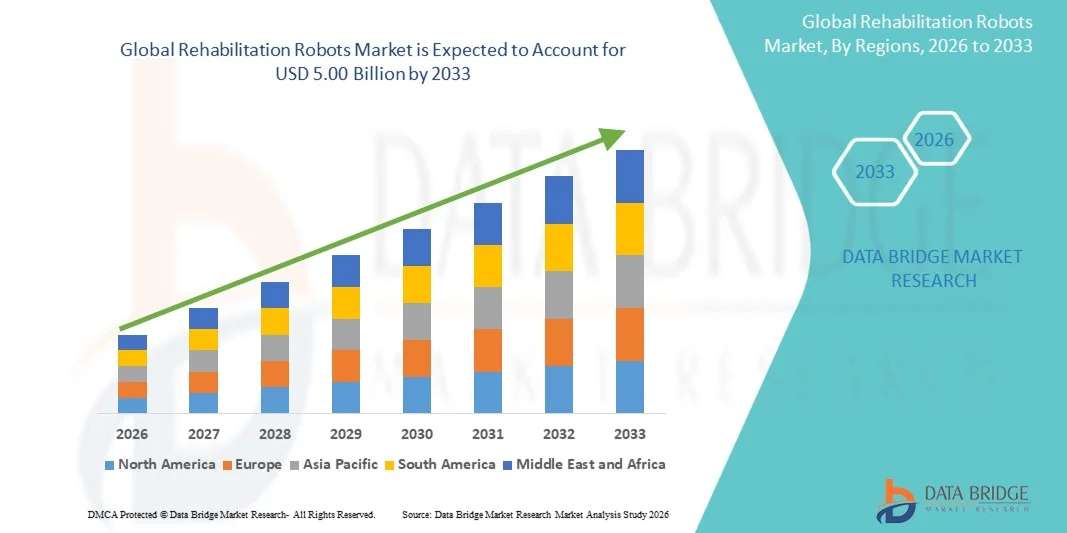
- As per Data Bridge Market Research analysis the rehabilitation robots market was valued at USD 1.47 billion in 2025 and is projected to reach USD 5.00 billion by 2033, growing at a CAGR of 16.50% from 2026 to 2033.
- The market is experiencing rapid growth driven by rising demand for advanced rehabilitation solutions, increasing adoption of robotic-assisted therapy, and technological advancements in exoskeletons, wearable robots, and robotic rehabilitation systems.
- The growing prevalence of neurological and mobility disorders, combined with increasing demand for personalized rehabilitation and improved functional recovery, is compelling hospitals, rehabilitation centers, and healthcare providers to adopt robotic technologies.
Market Size & Forecast
- Market Value (2025): USD 1.47 Billion
- Expected Market Value (2033): USD 5.00 Billion
- Forecast CAGR (2026–2033): 16.50%
- Leading Region in 2025: North America
- Fastest Growing Region: Asia-Pacific
What are the Major Takeaways of the Rehabilitation Robots Market?
- North America dominated the rehabilitation robots market with the largest revenue share in 2025, supported by advanced healthcare infrastructure, increasing adoption of robotic-assisted rehabilitation, and growing demand for technology-driven physical therapy.
- Asia-Pacific rehabilitation robots market is expected to witness the fastest growth rate from 2026 to 2033, supported by expanding healthcare infrastructure, increasing prevalence of mobility disorders, and rising adoption of advanced rehabilitation technologies across China, Japan, and India.
- The therapeutic robots segment held the largest market revenue share in 2025, driven by their widespread use in gait training, neurological rehabilitation, and physical therapy applications. Therapeutic robots are preferred due to their ability to provide repetitive, intensive, and controlled rehabilitation exercises while enabling therapists to monitor patient progress and adjust treatment programs.
- The exoskeleton robots segment is projected to register the fastest growth from 2026 to 2033, driven by increasing demand for robotic solutions that support mobility and walking rehabilitation among patients with lower-limb impairments. Rising adoption of wearable robotic technologies and advancements in lightweight, sensor-based exoskeleton systems are accelerating segment expansion.
- The lower body segment held the largest market revenue share in 2025, driven by the widespread adoption of robotic gait-training and mobility rehabilitation systems. Lower-body rehabilitation robots are preferred due to their ability to support walking, balance, and repetitive movement training for patients recovering from neurological injuries and mobility disorders.
- The upper body segment is projected to register the fastest growth from 2026 to 2033, driven by increasing demand for robotic-assisted rehabilitation for patients with stroke, spinal cord injuries, and other upper-limb impairments. Rising adoption of robotic arm and hand therapy systems, combined with advancements in motion tracking and patient-specific assistance, is accelerating segment expansion.
Report Scope and Rehabilitation Robots Market Segmentation
|
Attributes |
Rehabilitation Robots Key Market Insights |
|
Segments Covered |
|
|
Countries Covered |
North America
Europe
Asia-Pacific
Middle East and Africa
South America
|
|
Key Market Players |
|
|
Market Opportunities |
|
|
Value Added Data Infosets |
In addition to the insights on market scenarios such as market value, growth rate, segmentation, geographical coverage, and major players, the market reports curated by the Data Bridge Market Research also include depth expert analysis, patient epidemiology, pipeline analysis, pricing analysis, and regulatory framework. |
What is the Key Trend in the Rehabilitation Robots Market?
- Rehabilitation centers are increasingly adopting robotic-assisted therapy to deliver high-intensity, repetitive, and personalized rehabilitation while improving therapy efficiency and patient engagement.
- For instance, Hocoma's Lokomat provides robot-assisted gait therapy with adjustable patient-specific training parameters and virtual reality-based exercises, enabling intensive and individualized walking rehabilitation.
- Robotic systems are also increasingly incorporating objective movement tracking and performance assessment, allowing therapists to monitor patient progress and adjust rehabilitation programs according to individual needs.
- For instance, Hocoma's ArmeoPower uses robotic arm assistance, adjustable support, and objective assessments of range of motion, forces, and movement quality to support upper-limb rehabilitation.
- The growing focus on personalized therapy, repetitive training, and measurable rehabilitation outcomes is expected to accelerate adoption of robotic rehabilitation technologies across hospitals and specialized rehabilitation centers.
What are the Key Drivers of the Rehabilitation Robots Market?
- The increasing prevalence of neurological and mobility disorders is significantly increasing demand for rehabilitation robots capable of providing intensive gait, balance, and upper-limb therapy while reducing the physical burden on therapists.
- For instance, Hocoma's rehabilitation portfolio includes Lokomat for intensive gait training, ArmeoPower for early arm and hand rehabilitation, and ErigoPro for early patient mobilization, demonstrating the expanding use of robotic technologies across different stages of rehabilitation.
- Hospitals and rehabilitation facilities are integrating robotic systems to increase therapy intensity, support more repetitions, and provide standardized treatment programs while enabling therapists to focus on patient-specific care.
- For instance, Hocoma states that Lokomat enables highly intensive and individualized gait training while reducing the need for therapists to manually support patients during walking exercises.
- With healthcare providers increasingly prioritizing intensive, personalized, and technology-assisted rehabilitation, the adoption of robotic systems is expected to remain a major growth driver for the rehabilitation robots market.
Which Factors are Challenging the Growth of the Rehabilitation Robots Market?
- Advanced rehabilitation robots require significant upfront investment due to the integration of robotic actuators, sensors, patient-support systems, software, and specialized rehabilitation infrastructure.
- These high costs can limit adoption among smaller rehabilitation clinics, hospitals, and healthcare facilities with constrained capital budgets, particularly in emerging and price-sensitive markets.
- For instance, Hocoma's Lokomat is a sophisticated robotic gait-training platform that combines a driven gait orthosis, treadmill-based therapy, adjustable patient interfaces, feedback systems, and personalized training programs, illustrating the technological complexity of advanced rehabilitation robots.
- In addition, healthcare providers require trained therapists and appropriate clinical integration to use robotic systems effectively, while space requirements and ongoing technical support can add to implementation costs.
- The high capital investment, specialized training requirements, infrastructure needs, and maintenance costs continue to restrict widespread adoption, particularly among smaller healthcare organizations, despite increasing demand for technology-assisted rehabilitation.
How is the Rehabilitation Robots Market Segmented?
The market is segmented on the basis of type, extremity, and end user.
- By Type
On the basis of type, the rehabilitation robots market is segmented into therapeutic robots, exoskeleton robots, assistive robots, and others. The therapeutic robots segment held the largest market revenue share in 2025, driven by their widespread use in gait training, neurological rehabilitation, and physical therapy applications. Therapeutic robots are preferred due to their ability to provide repetitive, intensive, and controlled rehabilitation exercises while enabling therapists to monitor patient progress and adjust treatment programs.
The exoskeleton robots segment is projected to register the fastest growth from 2026 to 2033, driven by increasing demand for robotic solutions that support mobility and walking rehabilitation among patients with lower-limb impairments. Rising adoption of wearable robotic technologies and advancements in lightweight, sensor-based exoskeleton systems are accelerating segment expansion.
- By Extremity
On the basis of extremity, the rehabilitation robots market is segmented into upper body and lower body. The lower body segment held the largest market revenue share in 2025, driven by the widespread adoption of robotic gait-training and mobility rehabilitation systems. Lower-body rehabilitation robots are preferred due to their ability to support walking, balance, and repetitive movement training for patients recovering from neurological injuries and mobility disorders.
The upper body segment is projected to register the fastest growth from 2026 to 2033, driven by increasing demand for robotic-assisted rehabilitation for patients with stroke, spinal cord injuries, and other upper-limb impairments. Rising adoption of robotic arm and hand therapy systems, combined with advancements in motion tracking and patient-specific assistance, is accelerating segment expansion.
- By End User
On the basis of end user, the rehabilitation robots market is segmented into rehabilitation centers, hospitals, and others. The hospitals segment held the largest market revenue share in 2025, driven by the high volume of patients requiring neurological, orthopedic, and post-surgical rehabilitation. Hospitals are increasingly adopting rehabilitation robots to provide intensive therapy, improve treatment efficiency, and support standardized rehabilitation programs.
The rehabilitation centers segment is projected to register the fastest growth from 2026 to 2033, driven by increasing demand for specialized rehabilitation services and technology-assisted therapy. Rising investments in advanced rehabilitation infrastructure and growing preference for personalized, repetitive, and data-driven rehabilitation programs are accelerating segment expansion.
Which Region Holds the Largest Share of the Rehabilitation Robots Market?
- North America dominated the rehabilitation robots market with the largest revenue share in 2025, supported by advanced healthcare infrastructure, increasing adoption of robotic-assisted rehabilitation, and growing demand for technology-driven physical therapy.
- Hospitals and rehabilitation centers across the region are increasingly adopting robotic systems for gait training, mobility recovery, and upper-limb rehabilitation. High healthcare expenditure, strong presence of medical technology companies, and increasing awareness of personalized rehabilitation are further establishing North America as a major market for rehabilitation robots.
U.S. Rehabilitation Robots Market Insight
U.S. rehabilitation robots market captured the largest revenue share in 2025 within North America, fueled by increasing adoption of advanced rehabilitation technologies and growing demand for intensive, personalized therapy. Healthcare providers are increasingly integrating exoskeletons, therapeutic robots, and robotic gait-training systems to support patients recovering from stroke, spinal cord injuries, and mobility disorders. Moreover, rising healthcare investments, technological advancements, and the growing focus on improving rehabilitation outcomes are significantly contributing to market expansion.
Europe Rehabilitation Robots Market Insight
Europe rehabilitation robots market is expected to witness the fastest growth rate from 2026 to 2033, primarily driven by increasing prevalence of neurological and mobility disorders and growing adoption of advanced rehabilitation technologies. The region's well-developed healthcare infrastructure and increasing focus on patient-centered care are fostering demand for robotic-assisted therapy. Furthermore, rising investments in rehabilitation facilities and increasing adoption of exoskeleton and therapeutic robotic systems across hospitals and specialized centers are supporting market growth.
U.K. Rehabilitation Robots Market Insight
U.K. rehabilitation robots market is expected to witness the fastest growth rate from 2026 to 2033, driven by increasing demand for advanced rehabilitation services and growing adoption of robotic-assisted therapy. Hospitals and rehabilitation centers are increasingly using robotic technologies to provide intensive and repetitive therapy for patients with neurological and mobility impairments. In addition, the country's focus on healthcare modernization, digital technologies, and improving patient rehabilitation outcomes is expected to continue stimulating market growth.
Germany Rehabilitation Robots Market Insight
Germany rehabilitation robots market is expected to witness the fastest growth rate from 2026 to 2033, fueled by advanced healthcare infrastructure, strong medical technology capabilities, and increasing demand for innovative rehabilitation solutions. German hospitals and rehabilitation centers are increasingly adopting robotic systems for gait training, upper-limb therapy, and mobility recovery. The country's emphasis on technological innovation, high-quality healthcare, and personalized rehabilitation promotes the adoption of advanced robotic rehabilitation technologies.
Asia-Pacific Rehabilitation Robots Market Insight
The Asia-Pacific rehabilitation robots market is expected to witness the fastest growth rate from 2026 to 2033, supported by expanding healthcare infrastructure, increasing prevalence of mobility disorders, and rising adoption of advanced rehabilitation technologies across China, Japan, and India. Growing healthcare expenditure and increasing awareness of robotic-assisted therapy are encouraging hospitals and rehabilitation centers to invest in advanced robotic systems. Furthermore, the modernization of healthcare facilities and increasing demand for efficient and personalized rehabilitation solutions are expanding adoption across the region.
Japan Rehabilitation Robots Market Insight
Japan rehabilitation robots market is expected to witness the fastest growth rate from 2026 to 2033 due to the country's aging population, advanced healthcare system, and strong focus on robotics and automation. Japanese healthcare facilities are increasingly adopting rehabilitation robots to support mobility recovery, gait training, and physical therapy for elderly and mobility-impaired patients. Moreover, the country's technological expertise and increasing demand for solutions that address rehabilitation needs associated with an aging population are supporting market growth.
China Rehabilitation Robots Market Insight
China rehabilitation robots market accounted for the largest market revenue share in Asia Pacific in 2025, attributed to expanding healthcare infrastructure, increasing prevalence of neurological and mobility disorders, and growing investments in medical robotics. Hospitals and rehabilitation centers are increasingly adopting robotic-assisted therapy systems to improve rehabilitation efficiency and support patient recovery. Furthermore, rising healthcare expenditure, government support for medical technology development, and increasing availability of domestic robotic solutions are key factors propelling the rehabilitation robots market in China.
Which are the Top Companies in Rehabilitation Robots Market?
The rehabilitation robots industry is primarily led by well-established companies, including:
- CYBERDYNE INC. (Japan)
- Lifeward, Inc. (U.S.)
- Rex Bionics Ltd. (U.K.)
- Hocoma AG (Switzerland)
- Life Science Robotics ApS (Denmark)
- Rehab-Robotics Company Limited (Hong Kong)
- Ekso Bionics Holdings, Inc. (U.S.)
- Tyromotion GmbH (Austria)
- BIONIK Laboratories Corp. (Canada)
- Fourier Intelligence Pte. Ltd. (Singapore)
- Myomo, Inc. (U.S.)
- Wandercraft (France)
- Ottobock SE & Co. KGaA (Germany)
- Reha Technology AG (Switzerland)
- Kinova Inc. (Canada)
What are Latest Developments in Rehabilitation Robots Market?
- In December 2023, Motusium and Curexo announced a strategic partnership to support the expansion of Curexo’s Morning Walk robotic gait rehabilitation system in the U.S. market. The collaboration aimed to strengthen market access for robotic rehabilitation technology and expand treatment options for patients requiring gait recovery.
- In September 2023, BIONIK Laboratories received a patent from the U.S. Patent and Trademark Office for an innovative rehabilitation technology designed to provide positioning and guidance during upper-extremity rehabilitation. The technology is expected to support more controlled and targeted therapy for patients undergoing arm and hand rehabilitation.
- In April 2023, Harmonic Bionics launched its Harmony SHR robotic rehabilitation system after receiving FDA registration. The system is designed to support upper-extremity rehabilitation by providing robotic assistance and enabling clinicians to deliver structured, intensive therapy.
- In 2022, Ekso Bionics Holdings, Inc. received U.S. FDA 510(k) clearance to market its EksoNR robotic exoskeleton for rehabilitation of patients with multiple sclerosis. The clearance expanded the system's clinical applications and strengthened the adoption of robotic exoskeleton technology for neurological rehabilitation.

- Interactive Data Analysis Dashboard
- Company Analysis Dashboard for high growth potential opportunities
- Research Analyst Access for customization & queries
- Competitor Analysis with Interactive dashboard
- Latest News, Updates & Trend analysis
- Harness the Power of Benchmark Analysis for Comprehensive Competitor Tracking
Data collection and base year analysis are done using data collection modules with large sample sizes. The stage includes obtaining market information or related data through various sources and strategies. It includes examining and planning all the data acquired from the past in advance. It likewise envelops the examination of information inconsistencies seen across different information sources. The market data is analysed and estimated using market statistical and coherent models. Also, market share analysis and key trend analysis are the major success factors in the market report. To know more, please request an analyst call or drop down your inquiry.
The key research methodology used by DBMR research team is data triangulation which involves data mining, analysis of the impact of data variables on the market and primary (industry expert) validation. Data models include Vendor Positioning Grid, Market Time Line Analysis, Market Overview and Guide, Company Positioning Grid, Patent Analysis, Pricing Analysis, Company Market Share Analysis, Standards of Measurement, Global versus Regional and Vendor Share Analysis. To know more about the research methodology, drop in an inquiry to speak to our industry experts.
Data Bridge Market Research is a leader in advanced formative research. We take pride in servicing our existing and new customers with data and analysis that match and suits their goal. The report can be customized to include price trend analysis of target brands understanding the market for additional countries (ask for the list of countries), clinical trial results data, literature review, refurbished market and product base analysis. Market analysis of target competitors can be analyzed from technology-based analysis to market portfolio strategies. We can add as many competitors that you require data about in the format and data style you are looking for. Our team of analysts can also provide you data in crude raw excel files pivot tables (Fact book) or can assist you in creating presentations from the data sets available in the report.













