


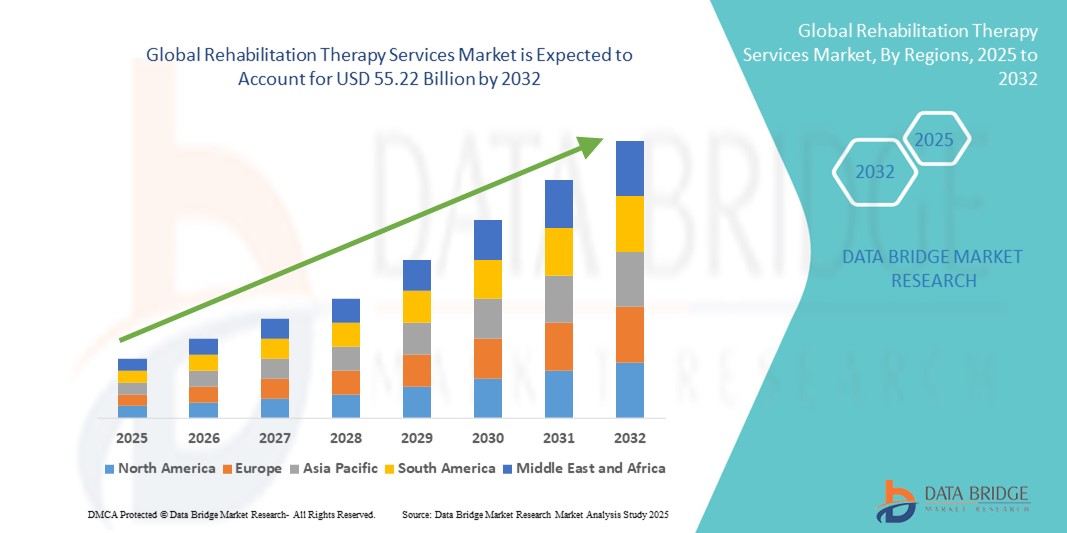
Rehabilitation Therapy Services Market Size
- The global rehabilitation therapy services market size was valued at USD 29.39 billion in 2024 and is expected to reach USD 55.22 billion by 2032, at a CAGR of 8.20% during the forecast period
- The market growth is largely fueled by the increasing awareness of the benefits of rehabilitation therapy and advancements in treatment methodologies, leading to greater adoption across various healthcare settings
- Furthermore, rising demand for personalized patient care, improved recovery outcomes, and integration of technology such as tele-rehabilitation and wearable devices are driving the expansion of Rehabilitation Therapy Services. These factors are accelerating the uptake of rehabilitation solutions, thereby significantly boosting the industry's growth in both residential and clinical environments
Rehabilitation Therapy Services Market Analysis
- Rehabilitation therapy services encompass a broad range of treatments aimed at improving patients' functional abilities and quality of life, with growing adoption across hospitals, outpatient clinics, and home care settings. Increasing awareness of chronic disease management and the rise in geriatric populations are key drivers of this market globally
- The escalating demand for rehabilitation therapy services is primarily fueled by the increasing prevalence of musculoskeletal disorders, neurological conditions, and post-operative recovery needs, alongside advancements in technology-enabled therapy solutions such as tele-rehabilitation and AI-assisted therapy devices
- North America dominated the rehabilitation therapy services market with the largest revenue share of 38.7% in 2024, characterized by early adoption of advanced therapy technologies, high healthcare expenditure, and a well-established network of rehabilitation centers. The U.S. leads in incorporating innovative therapy models, including virtual rehabilitation and robotic-assisted therapy, contributing to market growth
- Asia-Pacific is expected to be the fastest growing region in the rehabilitation therapy services market during the forecast period, registering a CAGR of 11.8%, driven by rapid urbanization, increasing healthcare infrastructure investments, and rising disposable incomes in countries such as China, India, and Japan
- The Direct Channel dominated the rehabilitation therapy services market with a market share of 72.5% in 2024, as many patients continue to prefer face-to-face therapy sessions that allow for personalized interaction, hands-on treatment, and immediate professional guidance
Report Scope and Rehabilitation Therapy Services Market Segmentation
|
Attributes |
Rehabilitation Therapy Services Key Market Insights |
|
Segments Covered |
|
|
Countries Covered |
North America
Europe
Asia-Pacific
Middle East and Africa
South America
|
|
Key Market Players |
|
|
Market Opportunities |
|
|
Value Added Data Infosets |
In addition to the insights on market scenarios such as market value, growth rate, segmentation, geographical coverage, and major players, the market reports curated by the Data Bridge Market Research also include in-depth expert analysis, pricing analysis, brand share analysis, consumer survey, demography analysis, supply chain analysis, value chain analysis, raw material/consumables overview, vendor selection criteria, PESTLE Analysis, Porter Analysis, and regulatory framework. |
Rehabilitation Therapy Services Market Trends
Emerging Trends and Innovations in the Global Rehabilitation Therapy Services Market
- A notable and growing trend in the global rehabilitation therapy services market is the increasing adoption of technology-driven solutions aimed at enhancing patient outcomes and therapy efficiency. These include advanced robotic-assisted therapy devices, virtual reality rehabilitation platforms, and tele-rehabilitation services that provide remote access to personalized care
- The integration of wearable sensors and motion-tracking technologies is enabling therapists to monitor patient progress more accurately and tailor treatment plans in real time. These innovations help improve recovery rates and patient engagement during rehabilitation programs
- Rehabilitation Therapy Services are also benefiting from the rise of home-based care models, where patients receive therapy in the comfort of their homes supported by remote monitoring and virtual consultations. This approach is particularly valuable for elderly and mobility-impaired individuals, reducing hospital visits and associated costs
- Healthcare providers and rehabilitation centers are increasingly focusing on multidisciplinary care approaches, combining physical therapy, occupational therapy, and speech therapy to offer comprehensive rehabilitation programs. This holistic care model supports better functional recovery and quality of life for patients
- The growing prevalence of chronic diseases, orthopedic injuries, neurological disorders, and post-surgical rehabilitation needs continues to drive demand for Rehabilitation Therapy Services worldwide. In addition, increased government initiatives to improve access to rehabilitation care and rising healthcare expenditure are further propelling market growth
- Companies in this market are investing in research and development to introduce innovative therapy techniques, digital platforms for patient management, and customized rehabilitation programs, thereby enhancing service delivery and expanding their market reach across both developed and emerging economies
Rehabilitation Therapy Services Market Dynamics
Driver
Growing Need Due to Rising Health Awareness and Increasing Rehabilitation Demand
- The increasing prevalence of chronic diseases, disabilities, and injuries, along with rising awareness about the benefits of rehabilitation therapies, is a significant driver for the growing demand for rehabilitation therapy services globally
- For instance, in April 2024, key industry players launched innovative tele-rehabilitation platforms, enhancing remote patient access to physical and cognitive therapy services. Such advancements are expected to drive substantial growth in the Rehabilitation Therapy Services market during the forecast period
- As patients and healthcare providers seek effective recovery solutions, rehabilitation therapies offer critical support for improving patient mobility, managing pain, and enhancing quality of life after surgeries or injuries
- Furthermore, the rising geriatric population and increasing incidence of neurological and orthopedic disorders are pushing demand across both outpatient and inpatient rehabilitation services
- The convenience of telehealth consultations, personalized therapy programs, and integration of AI-driven monitoring tools are key factors propelling the adoption of rehabilitation therapies in diverse healthcare settings. The expansion of insurance coverage and government support for rehabilitation care also contribute to market growth
Restraint/Challenge
Limited Accessibility and High Treatment Costs
- Limited access to rehabilitation services remains a major barrier to the widespread adoption and utilization of these critical healthcare solutions, especially in rural and underserved regions. Many of these areas suffer from inadequate healthcare infrastructure, which significantly restricts the availability of quality rehabilitation care. Compounding this challenge is the shortage of trained and skilled therapists, which further limits patient access to effective treatment programs
- Moreover, the relatively high costs associated with comprehensive rehabilitation programs and advanced therapy equipment present additional obstacles, particularly for price-sensitive patients and healthcare providers in developing countries. These financial barriers prevent many individuals from receiving the full benefits of rehabilitation services, hindering overall market growth
- To address these issues, significant investments are needed to expand the network of therapy centers, improve healthcare infrastructure, and enhance the training and availability of rehabilitation professionals. Developing cost-effective and scalable rehabilitation solutions that meet the diverse needs of patients will be crucial in making these services more accessible
- In addition, increasing funding from both public and private sectors, combined with awareness campaigns to educate communities about the benefits and importance of rehabilitation, will play a pivotal role in overcoming current market constraints and ensuring sustainable growth
- Encouragingly, the gradual integration of technology-enabled therapy options, such as tele-rehabilitation platforms and mobile health applications, offers promising new avenues. These innovations have the potential to improve both accessibility and affordability by allowing patients to receive care remotely, thereby bridging gaps in service delivery and expanding the reach of rehabilitation therapy to previously underserved populations
Rehabilitation Therapy Services Market Scope
The market is segmented on the basis of service, age group, service type, application, service category model, end user and service channel.
- By Service
On the basis of service, the global rehabilitation therapy services market is segmented into rehabilitation therapy services, speech therapy, occupational therapy, respiratory therapy, cognitive behavioral therapy, and others. The rehabilitation therapy services segment commanded the largest revenue share of 38.5% in 2024, primarily driven by the rising number of patients requiring physical rehabilitation following surgeries, injuries, and chronic health conditions. The increasing focus on improving mobility and quality of life is fueling demand for these services globally.
The speech therapy segment is projected to experience the fastest CAGR of 11.8% from 2025 to 2032, attributed to heightened awareness of speech and communication disorders, especially among children and elderly populations, alongside the expansion of specialized speech therapy clinics and teletherapy options.
- By Age Group
On the basis of age group, the market is segmented into elderly, pediatrics, and adults. The adult segment held the dominant position, accounting for 54.7% of the market share in 2024. This strong presence is largely due to the high prevalence of rehabilitation needs within the working-age population, which often faces injuries from accidents, chronic lifestyle-related diseases, and the necessity for post-operative recovery care. Adults typically seek rehabilitation services to regain mobility, functionality, and quality of life following such health events, thereby driving significant demand in this segment.
Conversely, the Elderly segment is anticipated to experience the fastest growth throughout the forecast period, registering a robust CAGR of 10.6% through 2032. This accelerated expansion is propelled by the increasing global aging population, which is leading to a surge in age-related health conditions that require specialized rehabilitation support.
- By Service Type
On the basis of service type, the market is segmented into outpatient rehabilitation services and inpatient rehabilitation services. In 2024, Outpatient rehabilitation services commanded a significant market share of 62.3%, reflecting a strong preference among patients and healthcare providers for treatment options that offer greater flexibility and cost efficiency. This service type allows patients to access necessary rehabilitation therapies without the need for hospital admission, enabling them to maintain their daily routines and reduce overall healthcare expenses. The growing inclination towards outpatient services is further bolstered by technological innovations such as tele-rehabilitation platforms, remote patient monitoring systems, and mobile health applications. These advancements facilitate convenient, personalized care delivery directly in patients’ homes, making rehabilitation more accessible, especially for those with mobility challenges or residing in remote areas. As a result, the Outpatient Rehabilitation Services segment is projected to experience the fastest growth, with a robust CAGR of 12.4% anticipated from 2025 to 2032. This upward trajectory underscores the increasing shift in the rehabilitation landscape towards more patient-centric, technology-enabled outpatient care models that improve treatment adherence and clinical outcomes.
- By Application
On the basis of application, the market includes orthopedic rehabilitation therapy services, neurological rehabilitation therapy services, cardiological rehabilitation therapy services, pulmonary rehabilitation therapy services, palliative care, sports related injuries, integumentary rehabilitation therapy services, pelvic care, and others. Orthopedic rehabilitation therapy services accounted for the largest revenue share of 29.6% in 2024, driven by the prevalence of musculoskeletal disorders, fractures, and joint replacement surgeries.
Neurological Rehabilitation Therapy Services are expected to witness the fastest CAGR of 13.1% during the forecast period, largely due to increasing cases of stroke, traumatic brain injury, spinal cord injury, and neurodegenerative diseases that necessitate intensive rehabilitation support.
- By Service Category
On the basis of service category, the market is segmented into hospital services, physician services, industrial services, and employer services. Hospital services held a dominant market share of 45.9% in 2024, benefiting significantly from the establishment of comprehensive rehabilitation units within hospital environments. These units leverage multidisciplinary care teams that provide integrated treatment plans, enhancing patient outcomes for complex rehabilitation needs. Hospitals also have the advantage of advanced medical infrastructure and skilled healthcare professionals, making them a preferred choice for intensive rehabilitation.
In contrast, employer services are anticipated to achieve the fastest growth with a CAGR of 9.7% from 2025 to 2032. This growth is driven by increasing corporate focus on employee wellness programs, injury prevention measures, and rehabilitation support aimed at reducing absenteeism and improving workplace productivity, highlighting the rising importance of occupational health in the corporate sector.
- By Model
On the basis of model, the market is segmented into manual and conventional. The conventional model held the largest market share of 68.4% in 2024, underscoring the ongoing preference for traditional, therapist-led rehabilitation programs that rely heavily on hands-on treatment methods. These conventional approaches remain foundational due to their proven effectiveness and the trusted role therapists play in guiding patient recovery.
Meanwhile, the manual model segment is projected to grow at a CAGR of 10.2%, driven by the increasing adoption of personalized therapy devices, assistive technologies, and manual therapy techniques. This growth reflects a rising trend toward more customized and patient-specific care, where technological advancements are integrated with manual interventions to improve therapeutic outcomes and patient satisfaction.
- By End User
On the basis of end user, the market consists of hospitals, skilled nursing facilities, home health, private practices, sports and fitness facility centers, rehabilitation centers, and others. Hospitals accounted for the largest revenue share of 39.7% in 2024, due to their extensive infrastructure, highly skilled medical staff, and capability to handle complex rehabilitation cases that require multidisciplinary coordination and comprehensive care.
The home health segment is expected to witness the fastest growth, registering a CAGR of 12.9% during the forecast period. This growth is propelled by the growing demand for convenient and personalized in-home rehabilitation services. Furthermore, the integration of remote patient monitoring and telehealth technologies in home health settings enhances care delivery by enabling continuous supervision and timely therapy adjustments, reducing the need for frequent hospital visits and improving patient comfort.
- By Service Channel
On the basis of service channel, the market is segmented into direct channel and online channel. The direct channel held a dominant revenue share of 72.5% in 2024, as many patients continue to prefer face-to-face therapy sessions that allow for personalized interaction, hands-on treatment, and immediate professional guidance.
However, the online channel is anticipated to experience the fastest growth, with a projected CAGR of 14.3% from 2025 to 2032. This rapid expansion is driven by the widespread adoption of telehealth platforms, virtual consultations, and digital therapy programs that extend the reach of rehabilitation services beyond traditional clinical settings. The convenience, accessibility, and cost-effectiveness offered by online channels are making virtual rehabilitation an increasingly popular option, especially for patients in remote areas or with mobility challenges.
Rehabilitation Therapy Services Market Regional Analysis
- North America dominated the rehabilitation therapy services market with the largest revenue share of 38.7% in 2024, driven by increasing healthcare expenditure, growing prevalence of chronic diseases, and rising awareness about rehabilitation therapies. The region benefits from well-established healthcare infrastructure and a high number of rehabilitation centers catering to diverse patient needs
- Consumers in the region increasingly seek comprehensive rehabilitation services, supported by advanced technology adoption and growing demand for personalized care programs
- This widespread adoption is further supported by a robust insurance framework, availability of skilled healthcare professionals, and a strong focus on improving patient outcomes, establishing North America as a key market for rehabilitation therapy services across both inpatient and outpatient settings
U.S. Rehabilitation Therapy Services Market Insight
The U.S. rehabilitation therapy services market captured the largest revenue share of 77% in 2024 within North America, fueled by the increasing incidence of musculoskeletal disorders, neurological conditions, and sports-related injuries. The expansion of outpatient rehabilitation centers and integration of tele-rehabilitation solutions have further propelled market growth. In addition, government initiatives supporting rehabilitation for aging populations and increased funding for physical and occupational therapy programs contribute significantly to the industry’s advancement.
Europe Rehabilitation Therapy Services Market Insight
The Europe rehabilitation therapy services market is projected to expand at a substantial CAGR throughout the forecast period, primarily driven by increasing prevalence of chronic diseases, aging populations, and enhanced healthcare infrastructure investments. European countries such as Germany, France, Italy, and the U.K. are witnessing increased adoption of rehabilitation services, supported by government healthcare policies focused on improving quality of life and reducing hospital readmissions. The region is also benefiting from growing awareness of rehabilitation's role in post-acute care and preventive health.
U.K. Rehabilitation Therapy Services Market Insight
The U.K. rehabilitation therapy services market is anticipated to grow at a noteworthy CAGR during the forecast period, driven by increasing government funding for rehabilitation programs and a rising focus on managing long-term disabilities. The country’s comprehensive healthcare system promotes the use of both inpatient and outpatient rehabilitation services, while public awareness campaigns and the rise in chronic health conditions support market expansion.
Germany Rehabilitation Therapy Services Market Insight
The Germany rehabilitation therapy services market is expected to expand at a considerable CAGR during the forecast period, fueled by an aging population and government initiatives aimed at enhancing rehabilitation care quality. Germany’s advanced healthcare infrastructure, along with increasing adoption of technology-enabled therapy methods, supports the demand for physical, occupational, and respiratory therapy services in both hospital and outpatient settings. The country’s emphasis on sustainable healthcare and patient-centered approaches promotes ongoing market growth.
Asia-Pacific Rehabilitation Therapy Services Market Insight
The Asia-Pacific rehabilitation therapy services market is poised to grow at the fastest CAGR of 11.8% during the forecast period of 2025 to 2032, driven by rapid urbanization, increasing healthcare investments, and rising incidence of lifestyle-related diseases in countries such as China, Japan, and India. The expanding healthcare infrastructure, growing awareness of rehabilitation benefits, and government initiatives supporting digital health technologies are accelerating service adoption. Furthermore, increased accessibility to rehabilitation services in semi-urban and rural areas is expected to bolster market expansion across the region.
Japan Rehabilitation Therapy Services Market Insight
The Japan rehabilitation therapy services market is gaining momentum due to the country’s aging population and high healthcare standards. Growing demand for rehabilitative care related to stroke, musculoskeletal disorders, and neurodegenerative diseases is driving market growth. In addition, Japan’s integration of advanced technologies in therapy delivery and emphasis on outpatient rehabilitation services further support the sector’s expansion.
China Rehabilitation Therapy Services Market Insight
The China rehabilitation therapy services market accounted for the largest market revenue share in Asia Pacific in 2024, attributed to the country’s expanding healthcare infrastructure, increasing government focus on post-acute care, and rapid urbanization. The rising prevalence of chronic diseases and injuries, combined with growing public awareness about rehabilitation, is fostering demand. Strong government initiatives aimed at improving rehabilitation access and quality, alongside increasing numbers of specialized rehabilitation centers, are key factors propelling the market in China.
Rehabilitation Therapy Services Market Share
The Rehabilitation Therapy Services industry is primarily led by well-established companies, including:
- Smart Speech Therapy (U.S.)
- Therapy Solutions (U.S.)
- Benchmark Therapies (U.S.)
- Speed Pathology (Australia)
- Priory (U.K.)
- Bellefleur Physiotherapy (Canada)
- SuVitas (India)
- LifeStance Health Inc. (U.S.)
- FYZICAL (U.S.)
- Sutter Health (U.S.)
- Bon Secours Health System, Inc. (U.S.)
- ApoKos Rehab Pvt Ltd. (India)
- Banner Health (U.S.)
- Spectrum Physio (India)
- Select Medical Corporation (U.S.)
- Lifespan Physical Therapy Services (U.S.)
- nMotion Physical Therapy (U.S.)
- CORA Health Services, Inc. (U.S.)
- Athletico Physical Therapy (U.S.)
- fullmotionpt (U.S.)
Latest Developments in Global Rehabilitation Therapy Services Market
- In May 2024, Philips showcased clinically proven technology to improve stroke and cardiac care at the Heart Rhythm Society (HRS) 2024 conference in Boston. The company highlighted advancements in electrophysiology, image-guided therapy, and cardiology to enhance patient outcomes
- In May 2024, Humana's Go365 program continued to promote healthy lifestyles by rewarding members for completing healthy activities. The program encourages physical, nutritional, emotional, and financial wellness, aiming to improve overall well-being
- In July 2023, the World Health Organization (WHO) hosted the 3rd Global Rehabilitation 2030 Meeting at its headquarters in Geneva, Switzerland, from 10–11 July 2023. The event brought together in-person and virtual participants from across the globe, including senior officials, rehabilitation leaders, service user groups, NGOs, civil society, funding bodies, international professional associations, research institutions, and representatives from WHO, other United Nations agencies, and multilateral organizations
- In October 2021, Sutter Health and Landed together announced a pilot programme to extend Landed's homeownership aid programme to the healthcare industry. Through down payment help and other house buying services, the programme has made homeownership more widely accessible during the past five years. This has aided the company's business expansion

- Interactive Data Analysis Dashboard
- Company Analysis Dashboard for high growth potential opportunities
- Research Analyst Access for customization & queries
- Competitor Analysis with Interactive dashboard
- Latest News, Updates & Trend analysis
- Harness the Power of Benchmark Analysis for Comprehensive Competitor Tracking
Data collection and base year analysis are done using data collection modules with large sample sizes. The stage includes obtaining market information or related data through various sources and strategies. It includes examining and planning all the data acquired from the past in advance. It likewise envelops the examination of information inconsistencies seen across different information sources. The market data is analysed and estimated using market statistical and coherent models. Also, market share analysis and key trend analysis are the major success factors in the market report. To know more, please request an analyst call or drop down your inquiry.
The key research methodology used by DBMR research team is data triangulation which involves data mining, analysis of the impact of data variables on the market and primary (industry expert) validation. Data models include Vendor Positioning Grid, Market Time Line Analysis, Market Overview and Guide, Company Positioning Grid, Patent Analysis, Pricing Analysis, Company Market Share Analysis, Standards of Measurement, Global versus Regional and Vendor Share Analysis. To know more about the research methodology, drop in an inquiry to speak to our industry experts.
Data Bridge Market Research is a leader in advanced formative research. We take pride in servicing our existing and new customers with data and analysis that match and suits their goal. The report can be customized to include price trend analysis of target brands understanding the market for additional countries (ask for the list of countries), clinical trial results data, literature review, refurbished market and product base analysis. Market analysis of target competitors can be analyzed from technology-based analysis to market portfolio strategies. We can add as many competitors that you require data about in the format and data style you are looking for. Our team of analysts can also provide you data in crude raw excel files pivot tables (Fact book) or can assist you in creating presentations from the data sets available in the report.













