


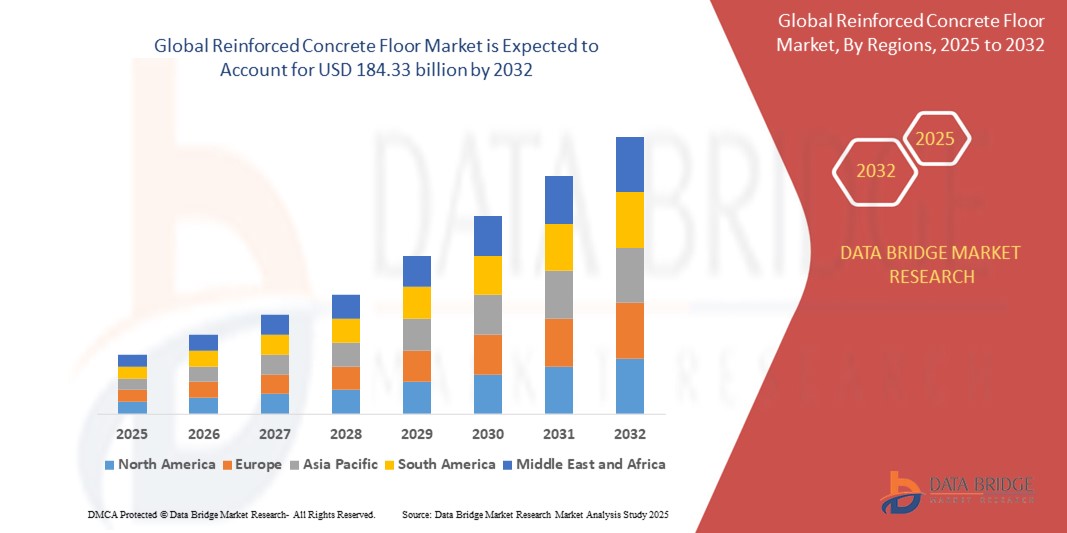
Reinforced Concrete Floor Market Size
- The global reinforced concrete floor market was valued at USD 120.11 billion in 2024 and is expected to reach USD 184.33 billion by 2032
- During the forecast period of 2025 to 2032 the market is likely to grow at a CAGR of 5.5%, primarily driven by the increasing demand for sustainable, durable, and cost-effective flooring solutions in both commercial and residential sectors
- This growth is driven by factors such as rapid urbanization, growth in construction activities, the rising need for infrastructure development, and the benefits of reinforced concrete floors in terms of safety, strength, and fire resistance
Reinforced Concrete Floor Market Analysis
- Reinforced concrete floors are widely used in construction due to their strength, durability, and fire resistance. They are essential components in various types of buildings, providing stable foundations and long-lasting floors that can withstand heavy loads
- The demand for reinforced concrete floors is significantly driven by the growing construction industry, particularly in emerging markets. Urbanization and a surge in both residential and commercial projects are propelling this demand
- The Asia Pacific region stands out as one of the dominant regions, driven by rapid urbanization and increasing infrastructure development in countries like China, India, and Southeast Asia
- For instance, countries like China and India are investing heavily in urban development and infrastructure projects, leading to an increased demand for reinforced concrete floors in residential buildings, commercial establishments, and industrial facilities
- Globally, reinforced concrete floors are considered one of the most crucial components in construction, especially in high-rise buildings, industrial warehouses, and commercial complexes, playing a vital role in ensuring structural integrity and safety. These floors are preferred for their versatility, longevity, and ability to handle high traffic and heavy loads
Report Scope and Reinforced Concrete Floor Market Segmentation
|
Attributes |
Reinforced Concrete Floor Key Market Insights |
|
Segments Covered |
|
|
Countries Covered |
North America
Europe
Asia-Pacific
Middle East and Africa
South America
|
|
Key Market Players |
|
|
Market Opportunities |
|
|
Value Added Data Infosets |
In addition to the insights on market scenarios such as market value, growth rate, segmentation, geographical coverage, and major players, the market reports curated by the Data Bridge Market Research also include import export analysis, production capacity overview, production consumption analysis, price trend analysis, climate change scenario, supply chain analysis, value chain analysis, raw material/consumables overview, vendor selection criteria, PESTLE Analysis, Porter Analysis, and regulatory framework. |
Reinforced Concrete Floor Market Trends
“Integration of Sustainable Practices and Advanced Materials”
- One prominent trend in the global reinforced concrete floor market is the increasing integration of sustainable practices and the use of advanced materials
- These innovations are driving the development of more environmentally friendly and efficient flooring solutions, such as low-carbon concrete and recycled aggregates, to reduce the overall environmental footprint of construction projects
- For instance, the use of high-performance concrete mixtures that require fewer raw materials and less energy during production is gaining traction, helping to lower greenhouse gas emissions and reduce waste
- In addition, the adoption of advanced reinforcement techniques, such as fiber-reinforced concrete, is enhancing the strength and durability of floors while also lowering material costs and increasing the lifespan of the floors
- This trend is reshaping construction practices, promoting long-term sustainability, reducing environmental impact, and driving the demand for innovative, eco-friendly reinforced concrete flooring solutions
Reinforced Concrete Floor Market Dynamics
Driver
“Growing Demand for High-Performance Construction Materials”
- The increasing demand for reinforced concrete floors is driven by the growing need for high-performance, durable construction materials in both residential and commercial buildings
- Reinforced concrete floors offer strength, durability, and flexibility, making them a preferred choice for construction projects requiring robust and reliable flooring solutions
- As urbanization continues to rise globally, the need for multi-story buildings, commercial complexes, and infrastructure projects has increased, further contributing to the demand for reinforced concrete floors
- The ongoing trend toward sustainability in construction is also a key driver, as reinforced concrete floors offer energy efficiency, longevity, and reduced maintenance costs, aligning with green building practices
- The rise in renovation projects and the increasing focus on enhancing building safety standards are fueling the demand for reinforced concrete floors, which provide better structural integrity and earthquake resistance
For instance,
- In December 2023, Cemex, a global leader in building materials, launched an advanced sustainable concrete technology aimed at reducing the carbon footprint of reinforced concrete floors. This development addresses both the demand for high-strength floors and the growing focus on eco-friendly construction materials
- In September 2022, LafargeHolcim introduced a new line of reinforced concrete solutions for residential and commercial buildings in Asia Pacific, aimed at enhancing the strength and durability of multi-story buildings while reducing construction costs
- In June 2021, the European Union approved a major infrastructure project in Italy involving reinforced concrete floors, ensuring both energy efficiency and seismic safety in high-rise buildings located in earthquake-prone areas
- These factual developments and product launches illustrate how the market for reinforced concrete floors is expanding, driven by technological advancements and growing construction demands
Opportunity
“Enhancing Reinforced Concrete Floors with Smart Technology Integration”
- The integration of smart technologies in reinforced concrete floors can enhance durability, monitor structural health, and improve performance in real-time, enabling building owners to make more informed decisions regarding maintenance and safety
- Advanced sensors embedded in reinforced concrete floors can track stress, vibration, and temperature, providing real-time data to detect potential structural issues before they become critical, improving the safety and longevity of buildings
- In addition, smart concrete can aid in monitoring environmental conditions, such as moisture levels, that may affect the integrity of the flooring, allowing for better decision-making in both construction and maintenance
For instance,
- In March 2024, HeidelbergCement introduced a new line of smart concrete that integrates IoT sensors capable of monitoring the structural health of buildings, including reinforced concrete floors. This technology enables real-time data collection on load-bearing capacities and early detection of potential cracks or failures, enhancing building safety
- In July 2023, LafargeHolcim launched smart reinforced concrete for infrastructure projects in North America, allowing construction teams to assess floor stability and maintenance needs through continuous data streaming from embedded sensors. This development provides a proactive approach to managing long-term structural integrity
- In November 2022, Cementos Argos partnered with Technological University of Bogotá to develop an innovative reinforced concrete flooring system that incorporates self-healing materials and sensors to enhance durability and reduce maintenance costs for high-rise buildings
- These advancements in smart technology and sensor integration are poised to revolutionize the reinforced concrete floor market, providing new opportunities for improving structural performance and safety across various construction projects
Restraint/Challenge
“High Raw Material and Production Costs Affecting Market Growth”
- The high cost of raw materials, including cement, steel reinforcement, and additives, significantly impacts the production cost of reinforced concrete floors, creating a barrier for widespread market adoption, especially in cost-sensitive regions
- The manufacturing and transportation costs of these materials can increase depending on geographic location, leading to higher overall costs for construction projects that use reinforced concrete floors
- In addition, fluctuations in raw material prices, driven by global supply chain issues or geopolitical instability, can further strain the budget of construction firms, particularly in developing markets
For instance,
- In January 2025, China National Building Material Group Corporation (CNBM) reported that rising prices for steel and cement, essential components in reinforced concrete production, have contributed to increased production costs. This challenge affects the pricing of reinforced concrete products and slows market growth in developing countries with limited budgets for construction
- In October 2023, a report by The European Concrete Industry (ECI) highlighted that the cost of raw materials, particularly steel, which is integral to reinforced concrete floors, surged due to global supply chain disruptions, raising the cost of construction and limiting investment in infrastructure projects
- In September 2022, LafargeHolcim addressed the rising costs of reinforced concrete production in North America, indicating that the increasing cost of raw materials has impacted the ability of smaller construction companies to use high-quality reinforced concrete for large-scale projects, which could slow down market growth in the region
- This challenge of high raw material and production costs restricts the growth potential of the global reinforced concrete floor market, particularly affecting smaller construction firms and projects in cost-sensitive
Reinforced Concrete Floor Market Scope
The market is segmented on the basis of type, application, construction method, and end-user.
|
Segmentation |
Sub-Segmentation |
|
By Type |
|
|
By Application |
|
|
By Construction Method |
|
|
By End-User |
|
Reinforced Concrete Floor Market Regional Analysis
“North America is the Dominant Region in the Reinforced Concrete Floor Market”
- North America leads the reinforced concrete floor market, supported by advanced construction infrastructure, a high rate of adoption of innovative construction technologies, and a strong presence of key industry players
- The U.S. holds a significant share due to the growing demand for high-strength concrete solutions, increased investments in commercial construction, and the focus on sustainable building practices
- The availability of government incentives and funding for infrastructure projects, along with a growing trend toward urbanization and smart cities, further strengthens market growth in the region
- In addition, the increasing demand for high-rise buildings, industrial projects, and renovation of aging infrastructure is driving the market expansion, as reinforced concrete floors provide the required durability and structural integrity for these projects
“Asia-Pacific is Projected to Register the Highest Growth Rate”
- The Asia-Pacific region is expected to experience the highest growth rate in the reinforced concrete floor market, driven by rapid urbanization, growing construction activities, and increasing demand for high-performance building materials
- Countries like China, India, and Japan are emerging as key markets due to their large-scale infrastructure development, increasing demand for residential, commercial, and industrial buildings, and the need for durable flooring solutions in high-rise structures
- China, with its massive construction boom, continues to dominate the region’s market, with extensive investments in smart cities, green buildings, and infrastructure projects. The country’s urban expansion and the increasing adoption of reinforced concrete in both residential and commercial construction drive the demand
- India, with its rapidly growing urban population, continues to see a rise in multi-story buildings, especially in metros and tier-2 cities, requiring reinforced concrete floors for their strength and stability. Additionally, the government's initiatives to improve infrastructure and housing further contribute to market growth
- Japan, known for its technological advancements and focus on earthquake-resistant building materials, has a significant demand for high-quality reinforced concrete floors in both residential and commercial projects, especially in regions prone to seismic activity
Reinforced Concrete Floor Market Share
The market competitive landscape provides details by competitor. Details included are company overview, company financials, revenue generated, market potential, investment in research and development, new market initiatives, global presence, production sites and facilities, production capacities, company strengths and weaknesses, product launch, product width and breadth, application dominance. The above data points provided are only related to the companies' focus related to market.
The Major Market Leaders Operating in the Market Are:
- LafargeHolcim (Switzerland)
- CEMEX S.A.B. de C.V. (Mexico)
- HeidelbergCement AG (Germany)
- CRH plc (Ireland)
- China National Building Material Company Limited (CNBM) (China)
- Votorantim Cimentos (Brazil)
- Taiheiyo Cement Corporation (Japan)
- Buzzi Unicem S.p.A. (Italy)
- UltraTech Cement Ltd. (India)
- Anhui Conch Cement Company Limited (China)
- Shandong Shanshui Cement Group Limited (China)
- China Resources Cement Holdings Limited (China)
- Italcementi Group (Italy)
- Aditya Birla Group (India)
- Martin Marietta Materials, Inc. (U.S.)
- Vicat Group (France)
- James Hardie Industries plc (Ireland)
- Sumitomo Osaka Cement Co., Ltd. (Japan)
- Dyckerhoff AG (Germany)
- Fletcher Building Limited (New Zealand)
Latest Developments in Global Reinforced Concrete Floor Market
- In August 2023, HMG Paints Ltd., a UK-based paint manufacturer, introduced HydroPro Floor Paint, a water-based floor paint featuring a cross-linking formulation. This product provides exceptional durability and a superior finish for both internal and external applications, addressing the increasing demand for sustainable and high-performance flooring solutions
- In June 2023, PPG Industries expanded its concrete coating portfolio by introducing integrated systems that include primers, base coats, and topcoats, specifically designed for environments requiring electrostatic protection. These coatings are ideal for equipment, mechanical rooms, and applications that demand high performance and quick return to service, meeting the need for specialized flooring solutions in industrial settings
- In September 2022, PPG Industries Inc. launched a new series of surface temperature-limiting concrete floor coatings and stains incorporating cool surface technology. These coatings can lower surface temperatures by up to 20%, improving comfort and safety on various surfaces, including concrete, wood patios, porches, and pool decks, demonstrating the company's commitment to innovation and user-focused solutions
- In January 2022, Seal for Life Industries, a global industrial coating platform, acquired Mascoat Ltd. and Verdia, Inc., thereby expanding its portfolio of protective sealing and coating solutions. Mascoat specializes in thermal insulation coatings, while Verdia offers polyurethane concrete flooring systems, including epoxies and polyaspartic solutions. This acquisition strengthens Seal for Life's ability to provide comprehensive infrastructure protection

- Interactive Data Analysis Dashboard
- Company Analysis Dashboard for high growth potential opportunities
- Research Analyst Access for customization & queries
- Competitor Analysis with Interactive dashboard
- Latest News, Updates & Trend analysis
- Harness the Power of Benchmark Analysis for Comprehensive Competitor Tracking
Global Reinforced Concrete Floor Market, Supply Chain Analysis and Ecosystem Framework
To support market growth and help clients navigate the impact of geopolitical shifts, DBMR has integrated in-depth supply chain analysis into its Global Reinforced Concrete Floor Market research reports. This addition empowers clients to respond effectively to global changes affecting their industries. The supply chain analysis section includes detailed insights such as Global Reinforced Concrete Floor Market consumption and production by country, price trend analysis, the impact of tariffs and geopolitical developments, and import and export trends by country and HSN code. It also highlights major suppliers with data on production capacity and company profiles, as well as key importers and exporters. In addition to research, DBMR offers specialized supply chain consulting services backed by over a decade of experience, providing solutions like supplier discovery, supplier risk assessment, price trend analysis, impact evaluation of inflation and trade route changes, and comprehensive market trend analysis.
Data collection and base year analysis are done using data collection modules with large sample sizes. The stage includes obtaining market information or related data through various sources and strategies. It includes examining and planning all the data acquired from the past in advance. It likewise envelops the examination of information inconsistencies seen across different information sources. The market data is analysed and estimated using market statistical and coherent models. Also, market share analysis and key trend analysis are the major success factors in the market report. To know more, please request an analyst call or drop down your inquiry.
The key research methodology used by DBMR research team is data triangulation which involves data mining, analysis of the impact of data variables on the market and primary (industry expert) validation. Data models include Vendor Positioning Grid, Market Time Line Analysis, Market Overview and Guide, Company Positioning Grid, Patent Analysis, Pricing Analysis, Company Market Share Analysis, Standards of Measurement, Global versus Regional and Vendor Share Analysis. To know more about the research methodology, drop in an inquiry to speak to our industry experts.
Data Bridge Market Research is a leader in advanced formative research. We take pride in servicing our existing and new customers with data and analysis that match and suits their goal. The report can be customized to include price trend analysis of target brands understanding the market for additional countries (ask for the list of countries), clinical trial results data, literature review, refurbished market and product base analysis. Market analysis of target competitors can be analyzed from technology-based analysis to market portfolio strategies. We can add as many competitors that you require data about in the format and data style you are looking for. Our team of analysts can also provide you data in crude raw excel files pivot tables (Fact book) or can assist you in creating presentations from the data sets available in the report.













