


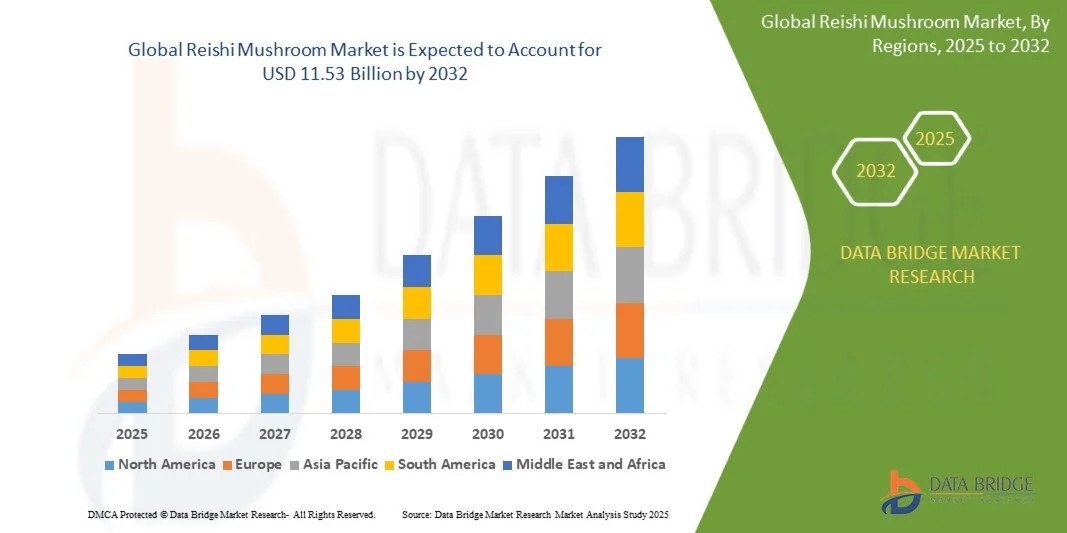
Reishi Mushroom Market Size
- The global reishi mushroom market size was valued at USD 5.73 billion in 2024 and is expected to reach USD 11.53 billion by 2032, at a CAGR of 9.14% during the forecast period
- The market growth is largely fueled by the increasing consumer awareness and adoption of natural health supplements and functional foods, with Reishi mushrooms gaining popularity for their immune-boosting, stress-relieving, and adaptogenic properties
- Furthermore, rising demand for wellness-focused beverages, nutraceuticals, and dietary supplements that incorporate Reishi mushrooms is driving product innovation by key market players, thereby significantly accelerating the market’s expansion
Reishi Mushroom Market Analysis
- Reishi mushrooms, known for their therapeutic properties and use in traditional medicine, are becoming essential ingredients in pharmaceutical, nutraceutical, cosmetic, and personal care products due to their bioactive compounds and health benefits
- The escalating demand for Reishi mushrooms is primarily driven by the growing focus on preventive healthcare, increased interest in organic and natural ingredients, and the rising trend of functional foods and beverages across global markets
- Asia-Pacific dominated the reishi mushroom market with a share of 40.1% in 2024, due to rising consumer awareness of functional foods, traditional medicine practices, and the growing adoption of nutraceuticals
- North America is expected to be the fastest growing region in the reishi mushroom market during the forecast period due to rising demand for natural health supplements and the shift towards preventive healthcare
- Cultivated segment dominated the market with a market share of 74.1% in 2024, due to scalable farming practices, consistent quality, and higher accessibility. Cultivation ensures a steady supply of bioactive compounds such as triterpenes and polysaccharides, making it ideal for large-scale nutraceutical and pharmaceutical applications
Report Scope and Reishi Mushroom Market Segmentation
|
Attributes |
Reishi Mushroom Key Market Insights |
|
Segments Covered |
|
|
Countries Covered |
North America
Europe
Asia-Pacific
Middle East and Africa
South America
|
|
Key Market Players |
|
|
Market Opportunities |
|
|
Value Added Data Infosets |
In addition to the insights on market scenarios such as market value, growth rate, segmentation, geographical coverage, and major players, the market reports curated by the Data Bridge Market Research also include in-depth expert analysis, pricing analysis, brand share analysis, consumer survey, demography analysis, supply chain analysis, value chain analysis, raw material/consumables overview, vendor selection criteria, PESTLE Analysis, Porter Analysis, and regulatory framework. |
Reishi Mushroom Market Trends
“Rising Demand for Functional Foods and Supplements”
- The global reishi mushroom market is expanding rapidly due to the rising popularity of functional foods and nutraceuticals that support overall wellness. Known for their adaptogenic and immune-boosting properties, reishi mushrooms are increasingly incorporated into dietary supplements, beverages, and fortified food products to meet the growing consumer focus on natural health solutions
- For instance, companies such as Orgain, Inc. and Nammex (North American Medicinal Mushroom Extracts) have introduced reishi-infused powders, gummies, and drink blends formulated to enhance immunity and vitality. These product introductions highlight how leading players are capitalizing on the trend toward preventive health management and clean-label formulations
- The integration of reishi mushrooms into functional foods aligns with the global shift toward holistic nutrition, where consumers prioritize organic and plant-derived ingredients. The growing acceptance of botanical adaptogens in modern diets is encouraging food technologists and manufacturers to innovate across mainstream categories such as cereals, snacks, and wellness drinks
- Rising consumer education about the health benefits of bioactive compounds such as polysaccharides, triterpenes, and antioxidants present in reishi mushrooms is driving adoption. Such compounds are recognized for promoting immune balance, stress reduction, and healthy aging, thereby supporting long-term market growth
- The surge in e-commerce and personalized nutrition platforms is also accelerating access to reishi-based functional products. Digital health brands and subscription models are creating direct-to-consumer pathways that enable frequent product updates and targeted wellness formulations
- As the demand for natural bioactive ingredients continues to grow, reishi mushrooms are positioned as a premium functional ingredient bridging traditional herbal medicine and modern nutrition. This transition toward integrative wellness is expected to define future opportunities across the global health and supplement industries
Reishi Mushroom Market Dynamics
Driver
“Rising Consumer Focus on Immunity and Wellness”
- The increasing awareness of immune health and holistic wellness is acting as a major driver for reishi mushroom adoption. Consumers are actively seeking functional ingredients that strengthen immunity, reduce stress, and support long-term vitality through natural and evidence-based sources
- For instance, Gaia Herbs and Host Defense Mushrooms have expanded their product lines featuring reishi capsules and tinctures emphasizing immune system enhancement. These developments showcase how supplement manufacturers are leveraging consumer demand for natural solutions to strengthen immunity and mental resilience
- The rising prevalence of lifestyle-related disorders, combined with concerns over post-pandemic health, has intensified interest in immunity-centered nutrition. This demand is fostering innovation across functional supplements and beverage categories where reishi extracts serve as key adaptogenic ingredients
- Integration of reishi mushroom extracts in daily consumables such as coffee blends, protein powders, and wellness teas is enhancing convenience and encouraging wider adoption. These products cater to health-conscious consumers seeking simplified formats for daily immune support
- As wellness becomes a mainstream lifestyle priority, reishi mushrooms are evolving into a core ingredient for both preventive and restorative health products. The continual alignment of consumer behavior with natural immunity enhancement will sustain the long-term expansion of the reishi mushroom market
Restraint/Challenge
“Lack of Standardization and Quality Control”
- The absence of strict quality control and standardized extraction processes poses a significant challenge to the global reishi mushroom industry. Variations in cultivation methods, species identification, and bioactive compound concentrations impact product consistency and efficacy
- For instance, smaller regional producers in Asia and Latin America often face inconsistencies in triterpene levels and polysaccharide content, leading to uneven performance in final product formulations. Such disparities create difficulties for manufacturers in maintaining consumer trust and product reliability
- Limited regulatory frameworks for mushroom-based supplements further complicate the establishment of verified quality benchmarks. The lack of globally accepted testing protocols hinders product validation, slowing the pace of market certification and cross-border trade
- Challenges in maintaining quality during large-scale processing and drying can lead to degradation of active compounds. Producers must invest in specialized equipment and standardized cultivation environments to ensure potency and safety of reishi-based products
- Improving quality assurance through traceable sourcing, third-party testing, and process transparency will be crucial for strengthening market credibility. Establishing international standardization will ensure consistent quality and boost consumer confidence, paving the way for sustainable market expansion of reishi mushroom products worldwide
Reishi Mushroom Market Scope
The market is segmented on the basis of species, type, form, end use, and nature.
- By Species
On the basis of species, the reishi mushroom market is segmented into Ganoderma lucidum, Ganoderma sinensis, Ganoderma tsugae, and Others. The Ganoderma lucidum segment dominated the market with the largest revenue share of 62.5% in 2024, attributed to its well-documented medicinal properties and widespread use in both traditional and modern health supplements. Its global recognition as the "king of mushrooms" drives significant demand across pharmaceuticals, nutraceuticals, and functional foods.
The Ganoderma tsugae segment is anticipated to grow at the fastest CAGR from 2025 to 2032, driven by increasing awareness of its antioxidant and immune-boosting properties. Research-backed evidence supporting its role in reducing inflammation and combating oxidative stress is encouraging wider adoption. As consumer interest in diverse medicinal mushroom species grows, demand for tsugae-based products is expected to rise, particularly in North America and Asia.
- By Type
On the basis of type, the reishi mushroom market is segmented into Cultivated and Wild. The Cultivated segment dominated the market with the largest revenue share of 74.1% in 2024, driven by scalable farming practices, consistent quality, and higher accessibility. Cultivation ensures a steady supply of bioactive compounds such as triterpenes and polysaccharides, making it ideal for large-scale nutraceutical and pharmaceutical applications.
The Wild segment is projected to grow at the fastest CAGR from 2025 to 2032, fueled by increasing consumer preference for natural, unprocessed, and high-potency mushroom varieties. Wild-harvested Reishi mushrooms are often perceived as more authentic and medicinally potent, attracting premium pricing in niche markets. Although limited availability and seasonal harvesting remain challenges, rising demand for rare, wild-sourced products is expected to significantly boost this segment.
- By Form
On the basis of form, the reishi mushroom market is segmented into Liquid and Powder. The Powder segment dominated with the largest revenue share of 68.4% in 2024, supported by its versatility in product formulations including capsules, tablets, teas, and functional foods. Powdered extracts offer longer shelf life, ease of use, and precise dosage, making them highly popular in the nutraceutical and dietary supplement industries.
The Liquid segment is anticipated to grow at the fastest CAGR during 2025 to 2032, driven by increasing consumer preference for convenient formats such as tinctures, ready-to-drink beverages, and liquid extracts. Liquids offer higher bioavailability and faster absorption, appealing to health-conscious consumers seeking quick and effective results. The rising trend of functional beverages globally further strengthens the growth potential of this segment.
- By End Use
On the basis of end use, the reishi mushroom market is segmented into Pharmaceutical, Nutraceutical and Dietary Supplements, Cosmetics, and Personal Care. The Nutraceutical and Dietary Supplements segment dominated the market with the largest revenue share of 57.3% in 2024, propelled by rising health consciousness and the growing demand for immunity-boosting and stress-reducing supplements. Capsules, powders, and fortified beverages containing Reishi mushroom extracts are widely consumed across global markets.
The Cosmetics and Personal Care segment is forecasted to register the fastest CAGR from 2025 to 2032, driven by the rising adoption of natural and anti-aging ingredients in skincare. Reishi mushroom extracts are valued for their antioxidant, anti-inflammatory, and skin-repairing properties, making them a popular ingredient in serums, creams, and lotions. With the clean beauty trend accelerating, the cosmetic applications of Reishi mushrooms are expected to expand rapidly.
- By Nature
On the basis of nature, the reishi mushroom market is segmented into Organic and Conventional. The Conventional segment held the largest revenue share of 64.8% in 2024, attributed to large-scale production and lower costs, which make conventional Reishi mushrooms more accessible to the mass market. Their widespread use in dietary supplements and traditional formulations drives continued demand.
The Organic segment is projected to grow at the fastest CAGR from 2025 to 2032, supported by increasing consumer preference for chemical-free, sustainably grown products. Health-conscious buyers are increasingly choosing certified organic mushrooms due to their perceived purity and higher nutritional value. The growing availability of organic certifications and e-commerce channels further supports this segment’s rapid expansion.
Reishi Mushroom Market Regional Analysis
- North America dominated the reishi mushroom market with the largest revenue share of 40.01% in 2024, driven by 41.2% in 2024, driven by rising consumer awareness of functional foods, traditional medicine practices, and the growing adoption of nutraceuticals
- Consumers in the region are increasingly incorporating Reishi-based products into their daily routines for immune support, stress relief, and longevity benefits, with strong demand in China, Japan, and South Korea
- This widespread consumption is further supported by a large middle-class population, rapid urbanization, and strong government support for herbal medicine and dietary supplements, cementing Asia-Pacific as the global hub for Reishi Mushroom production and consumption
China Reishi Mushroom Market Insight
The China reishi mushroom market accounted for the largest revenue share in Asia-Pacific in 2024, supported by the country’s long-standing use of Ganoderma lucidum in Traditional Chinese Medicine (TCM) and expanding nutraceutical consumption. China’s booming middle-class population and urbanization trends are fueling strong demand for both pharmaceutical and dietary supplement applications. In addition, domestic cultivation at scale and the rise of functional beverages are further accelerating growth, making China the largest Reishi Mushroom consumer market worldwide.
Japan Reishi Mushroom Market Insight
The Japan reishi mushroom market is experiencing steady growth, driven by the country’s high-tech culture, aging population, and strong preference for functional health products. Reishi-based dietary supplements and teas are widely adopted for immune and cardiovascular health benefits. In addition, the emphasis on scientifically validated herbal products and premium nutraceuticals is fueling market expansion. Japan’s established pharmaceutical infrastructure and consumer preference for preventive healthcare continue to create significant opportunities.
North America Reishi Mushroom Market Insight
The North America reishi mushroom market is projected to grow at the fastest CAGR of 9.4% from 2025 to 2032, supported by rising demand for natural health supplements and the shift towards preventive healthcare. Consumers are showing increased interest in adaptogens and immune-boosting functional foods, with Reishi emerging as a preferred choice. Moreover, strong e-commerce channels, increasing R&D investments, and growing partnerships between nutraceutical firms and mushroom cultivators are further accelerating adoption across the U.S. and Canada.
U.S. Reishi Mushroom Market Insight
The U.S. reishi mushroom market captured the largest revenue share of 78% in 2024 within North America, driven by consumer preference for natural remedies, stress management, and energy-boosting supplements. The popularity of capsules, powders, and ready-to-drink beverages containing Reishi extracts is expanding rapidly. In addition, the integration of mushrooms into the functional food and beverage segment and the growing influence of clean-label trends are expected to strengthen U.S. market leadership.
Canada Reishi Mushroom Market Insight
The Canada reishi mushroom market is gaining momentum, driven by rising awareness of traditional Asian herbal medicine and growing popularity of organic supplements. Canadian consumers are increasingly turning to immune-boosting and anti-inflammatory mushroom products as part of their wellness routines. The expansion of retail and online nutraceutical distribution channels, coupled with a growing number of domestic startups focusing on mushroom-based superfoods, is further boosting the market outlook in Canada.
Reishi Mushroom Market Share
The reishi mushroom industry is primarily led by well-established companies, including:
- Amax NutraSource, Inc. (U.S.)
- Bio-Botanica (U.S.)
- Bristol Botanicals Limited (U.K.)
- Hokkaido-reishi (Japan)
- Hunan Huacheng Biotech, Inc. (China)
- Mushroom Science (U.S.)
- Nammex (Canada)
- Qingdao Dacon Trading Co. (China)
- The Mushroom Company (U.S.)
- Xi'an Greena Biotech Co., Ltd. (China)
Latest Developments in Global Reishi Mushroom Market
- In February 2024, REBBL, the organic and plant-powered beverage innovator, introduced Revive Reishi Vanilla as the newest addition to its Revive lineup, exclusively available at Target stores. The beverage features a nourishing coconut milk base infused with real Tahitian vanilla and Reishi mushroom, formulated to support recovery, balance, and immune health, reflecting the growing consumer interest in functional beverages that combine taste, convenience, and wellness benefits
- In December 2022, biotechnology firm MycoWorks entered a strategic collaboration with luxury furniture manufacturer Ligne Roset to integrate MycoWorks’ innovative Fine Mycelium material, Reishi, into high-end home furnishings. This partnership demonstrates Reishi’s versatility beyond traditional health applications, highlighting its potential in sustainable and premium lifestyle products and signaling an emerging trend in biomaterials and design
- In July 2022, Vibe Mushrooms launched five new mushroom extracts, including Lion’s Mane, Turkey Tail, Red Reishi, Cordyceps, and a Master Blend, targeted at consumer use as ingredients. This expansion caters to the rising demand for adaptogenic and functional mushroom products in culinary, beverage, and supplement markets, positioning Vibe Mushrooms to meet growing consumer awareness around mushrooms’ cognitive, immune, and stress-relieving benefits
- In July 2022, Ethical Naturals Inc partnered with Nammex to introduce a new organic mushroom extract line, Mushroom-Plus, combining Red Reishi with L-Theanine (branded as MycoCalm). The formulation targets wellness-conscious consumers seeking calming, immunity-supportive supplements that integrate both adaptogenic and nootropic benefits, underscoring the functional mushroom market’s evolution toward tailored, multi-benefit wellness products
- In March 2022, Lifeway Food, a U.S.-based probiotic brand, launched three new adaptogenic mushroom beverage flavors featuring Reishi, Hericium erinaceus, oat beta-glucan, and 10 active probiotic cultures. The launch highlights the convergence of gut health and functional mushroom trends, delivering beverages designed for immunity, cognitive support, and digestive wellness, reinforcing Lifeway’s commitment to innovation in functional beverages and the broader plant-based wellness market

- Interactive Data Analysis Dashboard
- Company Analysis Dashboard for high growth potential opportunities
- Research Analyst Access for customization & queries
- Competitor Analysis with Interactive dashboard
- Latest News, Updates & Trend analysis
- Harness the Power of Benchmark Analysis for Comprehensive Competitor Tracking
Global Reishi Mushroom Market, Supply Chain Analysis and Ecosystem Framework
To support market growth and help clients navigate the impact of geopolitical shifts, DBMR has integrated in-depth supply chain analysis into its Global Reishi Mushroom Market research reports. This addition empowers clients to respond effectively to global changes affecting their industries. The supply chain analysis section includes detailed insights such as Global Reishi Mushroom Market consumption and production by country, price trend analysis, the impact of tariffs and geopolitical developments, and import and export trends by country and HSN code. It also highlights major suppliers with data on production capacity and company profiles, as well as key importers and exporters. In addition to research, DBMR offers specialized supply chain consulting services backed by over a decade of experience, providing solutions like supplier discovery, supplier risk assessment, price trend analysis, impact evaluation of inflation and trade route changes, and comprehensive market trend analysis.
Data collection and base year analysis are done using data collection modules with large sample sizes. The stage includes obtaining market information or related data through various sources and strategies. It includes examining and planning all the data acquired from the past in advance. It likewise envelops the examination of information inconsistencies seen across different information sources. The market data is analysed and estimated using market statistical and coherent models. Also, market share analysis and key trend analysis are the major success factors in the market report. To know more, please request an analyst call or drop down your inquiry.
The key research methodology used by DBMR research team is data triangulation which involves data mining, analysis of the impact of data variables on the market and primary (industry expert) validation. Data models include Vendor Positioning Grid, Market Time Line Analysis, Market Overview and Guide, Company Positioning Grid, Patent Analysis, Pricing Analysis, Company Market Share Analysis, Standards of Measurement, Global versus Regional and Vendor Share Analysis. To know more about the research methodology, drop in an inquiry to speak to our industry experts.
Data Bridge Market Research is a leader in advanced formative research. We take pride in servicing our existing and new customers with data and analysis that match and suits their goal. The report can be customized to include price trend analysis of target brands understanding the market for additional countries (ask for the list of countries), clinical trial results data, literature review, refurbished market and product base analysis. Market analysis of target competitors can be analyzed from technology-based analysis to market portfolio strategies. We can add as many competitors that you require data about in the format and data style you are looking for. Our team of analysts can also provide you data in crude raw excel files pivot tables (Fact book) or can assist you in creating presentations from the data sets available in the report.













