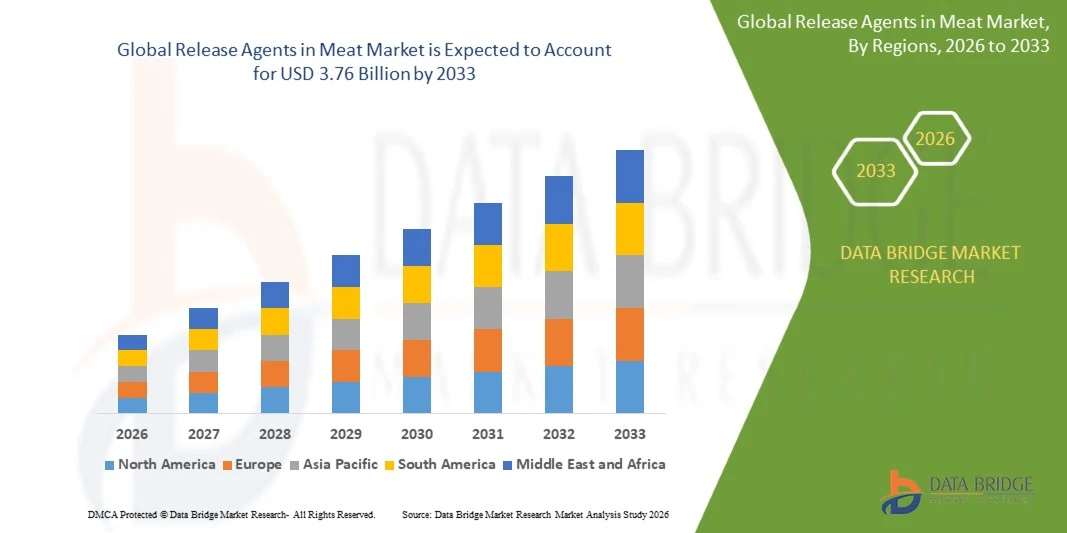
What is the Release Agents in Meat Market Size and Growth Rate?
- As per Data Bridge Market Research analysis, the release agents in meat market was valued at USD 1.82 billion in 2025 and is projected to reach USD 3.76 billion by 2033, growing at a CAGR of 9.50% from 2026 to 2033.
- The market is experiencing consistent growth driven by rising demand for processed meat products, increasing adoption of automated meat processing technologies, and growing emphasis on production efficiency, product quality, and reduced material wastage.
- The expanding consumption of sausages, burgers, patties, and other processed meat products, combined with stricter food safety and hygiene requirements, is encouraging meat processors to adopt effective release agents. These agents help prevent sticking to processing equipment and surfaces, improve product handling, minimize production losses, and support consistent quality across large-scale meat manufacturing operations.
Market Size & Forecast
- Global Market Value (2025): USD 1.82 Billion
- Expected Market Value (2033): USD 3.76 Billion
- Forecast CAGR (2026–2033): 9.50%
What are the Major Takeaways of the Release Agents in Meat Market?
- North America dominated the release agents in meat market with the largest revenue share of 38.7% in 2025, supported by high processed meat consumption and well-established meat processing facilities.
- Asia-Pacific is expected to be the fastest-growing region at a CAGR of 6.2% from 2026 to 2033, fueled by rising disposable incomes, increasing demand for processed and ready-to-eat meat products, and expanding meat processing infrastructure.
- The poultry segment led the market with a 38.0% share in 2025, driven by widespread chicken consumption and extensive use of release agents in processed poultry manufacturing.
- Pork are the fastest-growing meat type, projected to register a CAGR of 5.5%, reflecting the surge in expansion of processed pork products, including bacon, sausages, ham, and pork patties
- The vegetable oils segment dominated the ingredient category with a 42.0% revenue share in 2025, led by widespread availability, effective lubrication properties, and suitability for various meat-processing applications.
- Liquid accounted for 65.0% of the market share in 2025, preferred by ease of application, flexible dosing, and suitability for automated meat-processing lines.
- The non-GMO segment is the fastest-growing formulation category, with a CAGR of 6.0%, driven by increasing interest in ingredient traceability and formulations that meet specific non-genetically modified ingredient requirements.
Report Scope and Release Agents in Meat Market Segmentation
|
Attributes |
Release Agents in Meat Key Market Insights |
|
Segments Covered |
|
|
Countries Covered |
North America
Europe
Asia-Pacific
Middle East and Africa
South America
|
|
Key Market Players |
|
|
Market Opportunities |
|
|
Value Added Data Infosets |
In addition to the insights on market scenarios such as market value, growth rate, segmentation, geographical coverage, and major players, the market reports curated by the Data Bridge Market Research also include in-depth expert analysis, pricing analysis, brand share analysis, consumer survey, demography analysis, supply chain analysis, value chain analysis, raw material/consumables overview, vendor selection criteria, PESTLE Analysis, Porter Analysis, and regulatory framework. |
What is the Key Trend in the Release Agents in Meat Market?
- Meat processors are increasingly adopting specialized food-grade release agents to improve product separation, maintain hygiene, and reduce sticking during large-scale meat processing operations
- For instance, in June 2025, Interflon launched Food Lube 3H, a food-grade release agent registered for direct food contact, designed for applications in meat and poultry processing and formulated to support hygiene and consistent release performance.
- Advanced formulations help create consistent protective coatings on processing surfaces, supporting cleaner separation and reducing product loss during manufacturing.
- Meat processors are increasingly using specialized release agents on molds, racks, conveyors, and netting to improve handling and preserve the appearance of processed meat products.
- For instance, in November 2024, Renewable Lubricants highlighted its Bio-Food Grade Release Agent, a vegetable-oil-based formulation registered as an NSF 3H release agent for direct food contact and suitable for surfaces that come into contact with meat, fish, and poultry.
- As meat manufacturers continue prioritizing production efficiency, product quality, and food safety, demand for application-specific release agents is expected to increase across industrial meat processing facilities.
What are the Key Drivers of the Release Agents in Meat Market?
- The growing consumption of processed meat and ready-to-cook products has increased demand for release agents that improve production efficiency and maintain consistent product quality.
- For instance, in January 2025, ZIP-net promoted its ZIP-Strip Release Agent, formulated to help meat netting release easily from cooked meat products, improve yields, and reduce product downgrading
- Meat processors are increasingly integrating specialized release agents into manufacturing workflows to minimize product damage, improve yields, and support efficient high-volume production.
- For instance, in April 2025, IFC Solutions showcased its food anti-stick and release-agent portfolio at SupplySide East 2025, highlighting processing solutions designed to improve production efficiency and product quality.
- As meat manufacturers increasingly focus on automation, operational efficiency, and consistent product standards, specialized release agents are expected to remain important in modern meat processing operations.
What Factors are Challenging the Growth of the Release Agents in Meat Market?
- Food safety compliance requirements can increase formulation, testing, and documentation costs for manufacturers developing release agents for meat processing applications.
- For instance, in April 2025, the Food Safety and Standards Authority of India (FSSAI) published a revised inspection checklist for meat-processing facilities, requiring food-grade materials, hygienic processing practices, equipment sanitation, and proper documentation. These requirements can increase compliance, cleaning, and quality-control costs for meat processors adopting specialized release agents
- These requirements can limit adoption among smaller meat processors, particularly when specialized formulations and application-specific compliance procedures increase operating expenses.
- The need to meet food-contact requirements and maintain suitable performance under different processing temperatures and equipment conditions can increase development and implementation costs for manufacturers.
- For instance, in March 2022, NSF International issued a registration letter for Solvent Food, identifying its permitted use as a 3H release agent on surfaces contacting meat and poultry products. The registration framework requires formulation and labeling reviews, while changes to formulations or labels without approval can invalidate registration, creating additional compliance requirements for manufacturers.
- These compliance and formulation challenges may slow adoption among price-sensitive processors, particularly smaller facilities, despite growing demand for efficient, hygienic meat production.
How is the Release Agents in Meat Market Segmented?
The release agents in meat market is segmented on the basis of meat type, ingredient, form, and formulation.
- By Meat Type
On the basis of meat type, the release agents in meat market is segmented into poultry, beef, pork, mutton, and other meat types. The poultry segment dominated the market with an estimated share of 38.0% in 2025, supported by widespread chicken consumption and extensive use of release agents in processed poultry manufacturing. Release agents help prevent meat products from sticking to processing equipment, trays, molds, and cooking surfaces. Growing demand for chicken nuggets, sausages, patties, and ready-to-cook poultry products is increasing the need for efficient processing solutions. Large-scale poultry processors also rely on release agents to reduce product damage, minimize waste, and improve production consistency. The high processing volumes associated with poultry manufacturing further support demand.
The pork segment is projected to register the fastest growth at an estimated CAGR of 5.5% from 2026 to 2033, driven by the expansion of processed pork products, including bacon, sausages, ham, and pork patties. Release agents help improve the separation of processed pork products from cooking surfaces, molds, and production equipment. Rising demand for convenience foods is encouraging manufacturers to improve processing efficiency and product presentation. The expansion of automated meat-processing facilities is also supporting the adoption of specialized release formulations. Manufacturers are increasingly focusing on consistent coating performance to minimize sticking and production losses.
- By Ingredient
On the basis of ingredient, the release agents in meat market is segmented into vegetable oils, emulsifiers, wax and wax esters, antioxidants, and other ingredients. The vegetable oils segment dominated the market with an estimated share of 42.0% in 2025, owing to widespread availability, effective lubrication properties, and suitability for various meat-processing applications. Vegetable oils help form a barrier between meat products and processing surfaces, reducing sticking during cooking, molding, and handling. Their versatility makes them suitable for applications involving poultry, beef, pork, and other processed meat products. Food manufacturers can select different oil formulations according to processing temperatures, equipment requirements, and product characteristics. Growing interest in plant-derived ingredients is also encouraging manufacturers to explore vegetable-oil-based formulations.
The emulsifiers segment is projected to register the fastest growth at an estimated CAGR of 5.8% from 2026 to 2033, supported by increasing demand for stable and uniform release-agent formulations. Emulsifiers help combine oil and water-based components, improving formulation consistency and application performance. These ingredients can support more uniform coating across processing equipment and product-contact surfaces. Consistent application is particularly important in high-volume facilities manufacturing sausages, patties, and other processed meat products. Growing automation in meat processing is increasing the need for formulations that can be applied reliably through industrial equipment. Advances in food-grade emulsifier technology are also helping manufacturers develop products suited to specific processing conditions.
- By Form
On the basis of form, the release agents in meat market is segmented into liquid and solid. The liquid segment dominated the market with an estimated share of 65.0% in 2025, owing to ease of application, flexible dosing, and suitability for automated meat-processing lines. Liquid release agents can be sprayed, brushed, or applied through specialized dispensing systems to coat molds, trays, conveyors, and other food-contact surfaces. Their application flexibility makes them suitable for different meat products and production environments. Liquid formulations can help processors achieve consistent coverage across complex equipment surfaces. Integration with automated spraying systems can reduce manual handling and improve production efficiency.
The solid segment is projected to register the fastest growth at an estimated CAGR of 5.0% from 2026 to 2033, driven by demand for controlled application, convenient handling, and reduced spillage in selected meat-processing applications. Solid release agents can be suitable for specific equipment, molds, and processing conditions where controlled application is preferred. Their use may help reduce unwanted spreading and simplify storage or handling in certain production environments. Meat processors are evaluating alternative delivery formats to improve operational efficiency and reduce material waste. Product development focused on application-specific performance is also supporting interest in solid formulations. However, suitability depends on processing temperature, equipment design, and required coating characteristics.
- By Formulation
On the basis of formulation, the release agents in meat market is segmented into kosher, non-GMO, trans-fat-free, allergen-free, and certified organic. The trans-fat-free segment dominated the market with an estimated share of 32.0% in 2025, supported by food manufacturers' emphasis on healthier ingredient profiles and compliance with applicable food regulations. Trans-fat-free formulations can help processors meet ingredient specifications while maintaining the release performance required in meat manufacturing. These products are suitable for manufacturers seeking to avoid industrial trans fats in their food-production inputs. Increasing consumer awareness of dietary health is encouraging food brands to review ingredients throughout their supply chains. Meat processors are also considering formulation characteristics when selecting food-grade processing aids.
The non-GMO segment is projected to register the fastest growth at an estimated CAGR of 6.0% from 2026 to 2033, driven by increasing interest in ingredient traceability and formulations that meet specific non-genetically modified ingredient requirements. Food manufacturers supplying retailers and consumers with defined sourcing preferences may seek release agents that align with their product specifications. Non-GMO formulations can help processors meet customer requirements for selected processed meat products, depending on the ingredients used and applicable certification standards. Growing attention to supply-chain transparency is encouraging manufacturers to evaluate the origin of oils and other formulation components. Suppliers may also benefit from developing documented sourcing and verification processes. Demand will depend on regional consumer preferences, certification requirements, and procurement policies.
Which Region Holds the Largest Share of the Release Agents in Meat Market?
- North America dominated the release agents in meat market with the largest revenue share of 38.7% in 2025, supported by high processed meat consumption and well-established meat processing facilities.
- The region also benefits from advanced food-processing technologies, stringent food safety requirements, and strong demand for ready-to-eat and value-added meat products. Increasing emphasis on production efficiency, consistent product quality, and reduced processing waste continues to strengthen North America's leading position in the global market.
U.S. Release Agents in Meat Market Insight
The U.S. release agents in meat market is witnessing steady growth due to rising demand for processed meat products, advanced meat-processing technologies, and increasing emphasis on production efficiency. The country's established meat processing industry, along with widespread adoption of food-grade release agents, is driving demand across poultry, beef, and pork applications. In addition, growing focus on food safety, consistent product quality, and reducing processing waste is accelerating the adoption of specialized release-agent formulations among meat manufacturers.
Asia-Pacific Release Agents in Meat Market Insight
The Asia-Pacific release agents in meat market is expected to witness rapid growth, driven by rising meat consumption, expanding food-processing infrastructure, and increasing demand for convenient and ready-to-cook meat products across China, India, Japan, and other regional economies. Growing investments in automated processing facilities and rising awareness of food hygiene are supporting regional market expansion. In addition, increasing demand for processed poultry products and improvements in industrial meat manufacturing are encouraging the adoption of specialized release agents across the region.
Japan Release Agents in Meat Market Insight
The Japan release agents in meat market is witnessing consistent growth due to rising demand for processed meat products, advanced food manufacturing technologies, and increasing emphasis on hygienic production practices. Meat processors are adopting specialized release agents to improve product separation, maintain consistency, and minimize waste during manufacturing. Moreover, the country's focus on automation, food safety, and efficient production processes is encouraging the use of advanced food-grade formulations across processed meat applications.
China Release Agents in Meat Market Insight
The China release agents in meat market is growing steadily, driven by expanding meat-processing operations, rising demand for convenience foods, and increasing consumption of processed poultry and pork products. Growing investments in modern food manufacturing facilities and automated production technologies are supporting the adoption of specialized release agents. In addition, increasing emphasis on food safety, production efficiency, and consistent product quality is encouraging manufacturers to improve processing practices, positioning China as an important market for meat release-agent suppliers.
U.K. Release Agents in Meat Market Insight
The U.K. release agents in meat market is experiencing steady growth, supported by demand for processed meat products, established food manufacturing capabilities, and increasing adoption of efficient processing solutions. Meat processors are using food-grade release agents to reduce sticking, improve product handling, and minimize material waste across manufacturing operations. Furthermore, growing emphasis on food hygiene, regulatory compliance, and consistent product quality is encouraging manufacturers to adopt specialized release-agent formulations for poultry, beef, pork, and other processed meat applications.
Germany Release Agents in Meat Market Insight
The Germany release agents in meat market is expanding steadily due to the country's established meat-processing industry, advanced food manufacturing infrastructure, and increasing focus on production efficiency. Meat processors are increasingly adopting specialized release agents to improve product separation, maintain consistent quality, and reduce losses during high-volume manufacturing. Continuous improvements in automated processing equipment, food-grade formulation technologies, and hygiene practices are further supporting market development in Germany
Which are the Top Companies in Release Agents in Meat Market?
The release agents in meat industry is primarily led by well-established companies, including:
- IFC Solutions (U.S.)
- ZIP-net (U.S.)
- PLZ Corp (U.S.)
- Renewable Lubricants, Inc. (U.S.)
- Interflon (Netherlands)
- JAX Incorporated (U.S.)
- Mallet & Company, Inc. (U.S.)
- Avatar Corporation (U.S.)
- AAK AB (Sweden)
- Cargill, Incorporated (U.S.)
- Archer-Daniels-Midland Company (U.S.)
- Kemin Industries, Inc. (U.S.)
- Corbion N.V. (Netherlands)
- Kerry Group plc (Ireland)
- Lallemand Inc. (Canada)
- Masterol Foods Pty Ltd (Australia)
- Bakels Worldwide (Switzerland)
- Sonneveld Group B.V. (Netherlands)
- Maverik Oils (U.S.)
- Lubriplate Lubricants Company, Inc. (U.S.)
What are Latest Developments in Release Agents in Meat Market?
- In June 2025, Interflon announced the launch of Food Lube 3H, a food-grade lubricant and release agent registered for both direct food contact under NSF 3H and incidental food contact under NSF H1. Formulated with an edible synthetic ester base and MicPol technology, the product is designed for applications including meat and poultry processing. The launch highlights industry efforts to improve food safety, equipment maintenance, and release performance through multipurpose formulations.
- In November 2024, Renewable Lubricants introduced its Bio-Food Grade Release Agent in an industry product announcement. The vegetable-oil-based formulation uses food ingredients and is NSF 3H registered for direct food contact. It is designed to prevent sticking on processing surfaces, including equipment that comes into contact with meat, fish, and poultry. This development reflects growing interest in plant-derived, food-grade release-agent formulations.
- In May 2024, ROCOL received NSF registration and certification for its PUROL Spray Grease, according to the NSF certificate dated May 13, 2024. The product holds 3H and H1 registrations and ISO 21469 certification, supporting its use in food-processing environments, including as a release agent on surfaces contacting meat and poultry. The certification highlights the importance of verified hygiene and food-contact suitability in release-agent applications.
- In March 2024, the Food Safety and Standards Authority of India (FSSAI) issued a direction concerning compliance with processing-aid requirements under India's food regulations. The direction established an active list of processing aids for provisional use while relevant regulatory amendments were being completed. This development is relevant to manufacturers supplying food-processing aids, including products used for release and anti-stick applications, because it emphasizes regulatory compliance and appropriate use in food manufacturing.
- In May 2021, NSF published guidance explaining how food-grade lubricant registrations establish suitability for food-processing environments. The guidance covered applicable ingredient requirements, incidental food-contact limits, and the role of H1 registration and ISO 21469 certification. Although not a product launch, the publication provided relevant guidance for food processors and suppliers evaluating the safety and suitability of lubricants and release agents used around food-contact surfaces.
- Interactive Data Analysis Dashboard
- Company Analysis Dashboard for high growth potential opportunities
- Research Analyst Access for customization & queries
- Competitor Analysis with Interactive dashboard
- Latest News, Updates & Trend analysis
- Harness the Power of Benchmark Analysis for Comprehensive Competitor Tracking
Global Release Agents In Meat Market, Supply Chain Analysis and Ecosystem Framework
To support market growth and help clients navigate the impact of geopolitical shifts, DBMR has integrated in-depth supply chain analysis into its Global Release Agents In Meat Market research reports. This addition empowers clients to respond effectively to global changes affecting their industries. The supply chain analysis section includes detailed insights such as Global Release Agents In Meat Market consumption and production by country, price trend analysis, the impact of tariffs and geopolitical developments, and import and export trends by country and HSN code. It also highlights major suppliers with data on production capacity and company profiles, as well as key importers and exporters. In addition to research, DBMR offers specialized supply chain consulting services backed by over a decade of experience, providing solutions like supplier discovery, supplier risk assessment, price trend analysis, impact evaluation of inflation and trade route changes, and comprehensive market trend analysis.
Data collection and base year analysis are done using data collection modules with large sample sizes. The stage includes obtaining market information or related data through various sources and strategies. It includes examining and planning all the data acquired from the past in advance. It likewise envelops the examination of information inconsistencies seen across different information sources. The market data is analysed and estimated using market statistical and coherent models. Also, market share analysis and key trend analysis are the major success factors in the market report. To know more, please request an analyst call or drop down your inquiry.
The key research methodology used by DBMR research team is data triangulation which involves data mining, analysis of the impact of data variables on the market and primary (industry expert) validation. Data models include Vendor Positioning Grid, Market Time Line Analysis, Market Overview and Guide, Company Positioning Grid, Patent Analysis, Pricing Analysis, Company Market Share Analysis, Standards of Measurement, Global versus Regional and Vendor Share Analysis. To know more about the research methodology, drop in an inquiry to speak to our industry experts.
Data Bridge Market Research is a leader in advanced formative research. We take pride in servicing our existing and new customers with data and analysis that match and suits their goal. The report can be customized to include price trend analysis of target brands understanding the market for additional countries (ask for the list of countries), clinical trial results data, literature review, refurbished market and product base analysis. Market analysis of target competitors can be analyzed from technology-based analysis to market portfolio strategies. We can add as many competitors that you require data about in the format and data style you are looking for. Our team of analysts can also provide you data in crude raw excel files pivot tables (Fact book) or can assist you in creating presentations from the data sets available in the report.