


Remote Construction Market Size
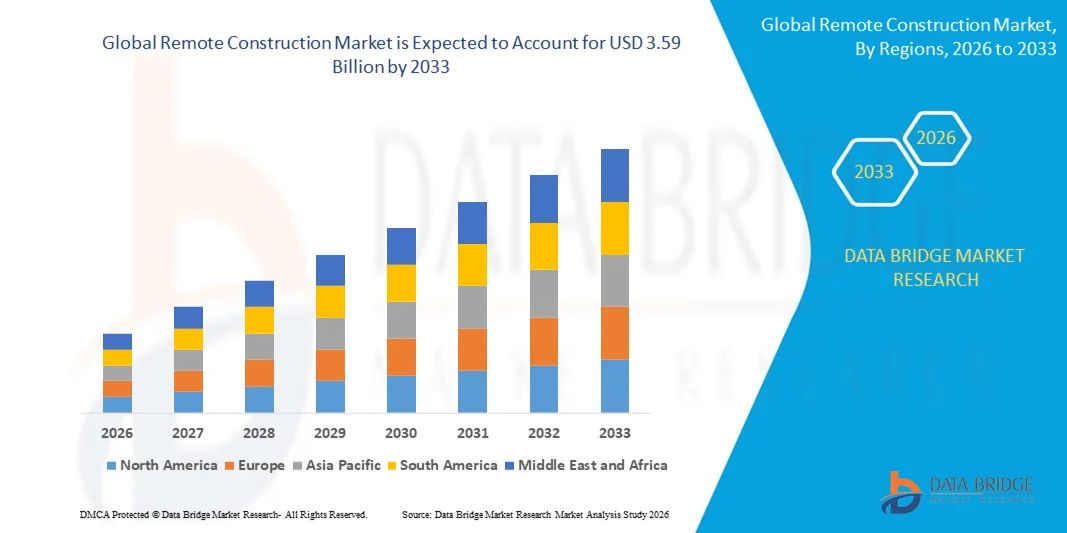
- The global remote construction market size was valued at USD 1.06 billion in 2025 and is expected to reach USD 3.59 billion by 2033, at a CAGR of 16.50% during the forecast period
- The market growth is largely fueled by the increasing adoption of digital technologies such as IoT, cloud computing, AI-driven analytics, and remote monitoring systems across construction projects, enabling real-time visibility and centralized control over geographically dispersed job sites
- Furthermore, rising demand for improved operational efficiency, enhanced worker safety, cost optimization, and faster project delivery is establishing remote construction solutions as a critical component of modern infrastructure development. These converging factors are accelerating the integration of connected equipment, drones, and data-driven management platforms, thereby significantly boosting the industry's growth
Remote Construction Market Analysis
- Remote construction solutions, encompassing cloud-based project management platforms, remote equipment control systems, IoT-enabled sensors, and digital collaboration tools, are becoming essential in large-scale infrastructure and commercial projects due to their ability to enhance transparency, streamline workflows, and reduce on-site workforce dependency
- The escalating demand for remote construction technologies is primarily driven by increasing infrastructure investments, growing complexity of multi-site projects, rising labor shortages, and heightened emphasis on safety compliance, efficiency improvement, and data-driven decision-making across the global construction sector
- North America dominated the remote construction market with a share of around 42% in 2025, due to early adoption of digital construction technologies and strong investments in infrastructure modernization across the region
- Asia-Pacific is expected to be the fastest growing region in the remote construction market during the forecast period due to rapid urbanization, expanding infrastructure investments, and increasing digitalization in emerging economies
- Solution segment dominated the market with a market share of 62.9% in 2025, due to increasing deployment of integrated digital platforms that enable real-time site monitoring, equipment tracking, workforce coordination, and data analytics. Construction companies prioritize comprehensive software solutions to streamline project execution, enhance productivity, and minimize cost overruns across geographically dispersed sites
Report Scope and Remote Construction Market Segmentation
|
Attributes |
Remote Construction Key Market Insights |
|
Segments Covered |
|
|
Countries Covered |
North America
Europe
Asia-Pacific
Middle East and Africa
South America
|
|
Key Market Players |
|
|
Market Opportunities |
|
|
Value Added Data Infosets |
In addition to the insights on market scenarios such as market value, growth rate, segmentation, geographical coverage, and major players, the market reports curated by the Data Bridge Market Research also include in-depth expert analysis, geographically represented company-wise production and capacity, network layouts of distributors and partners, detailed and updated price trend analysis and deficit analysis of supply chain and demand. |
Remote Construction Market Trends
Increasing Integration of Robotics, Drones, and Remote Monitoring Technologies
- A significant trend in the remote construction market is the increasing integration of robotics, drones, and remote monitoring technologies to enable off-site supervision and automated execution of complex construction activities. This shift is transforming conventional job sites into digitally connected environments that rely on real-time data transmission and machine-assisted operations to enhance accuracy and productivity
- For instance, Built Robotics deploys autonomous construction equipment that operates heavy machinery through AI-driven guidance systems, reducing the need for constant on-site human control. Such deployments demonstrate how robotics is enabling remote earthmoving and excavation activities while maintaining operational precision and safety standards
- The adoption of unmanned aerial vehicles for surveying and inspection is expanding as drones provide high-resolution imaging and progress tracking across large infrastructure projects. This capability improves site visibility for project managers who can assess development remotely and make faster, data-driven decisions
- Remote monitoring platforms integrated with IoT sensors are being used to track equipment performance, structural conditions, and workforce movement in real time. These systems enhance transparency and reduce downtime by enabling predictive maintenance and immediate response to irregularities
- Construction firms are increasingly incorporating digital twin technologies to replicate physical assets in virtual environments for simulation and planning. This development strengthens remote coordination between architects, engineers, and contractors working across geographically dispersed locations
- The rising convergence of robotics, drones, and data analytics is redefining construction workflows by reducing manual dependency and enhancing centralized oversight. This comprehensive technological integration is positioning remote construction as a scalable and efficiency-driven model for modern infrastructure development
Remote Construction Market Dynamics
Driver
Rising Demand for Enhanced Worker Safety and Operational Efficiency
- The increasing emphasis on worker safety and operational efficiency is a major driver for the remote construction market as companies seek to minimize on-site risks while maintaining project timelines. Remote technologies reduce human exposure to hazardous environments such as high-altitude structures, mining zones, and disaster-affected areas
- For instance, Komatsu has introduced smart construction solutions that enable remote equipment monitoring and semi-autonomous operations, helping contractors lower accident rates and improve productivity. These solutions support safer machinery handling and provide centralized control over multiple job sites
- The growing complexity of infrastructure projects requires continuous monitoring and precise coordination, which remote systems facilitate through live data sharing and automated reporting. This reduces manual intervention and streamlines workflow management across distributed teams
- Companies are leveraging wearable technologies and sensor-based tracking systems to monitor worker health and equipment interactions in real time. These tools strengthen compliance with safety regulations and help prevent operational disruptions caused by accidents
- The combined focus on safety enhancement and productivity improvement continues to accelerate the adoption of remote construction solutions. This driver is reinforcing long-term investment in digital infrastructure that supports secure, efficient, and remotely managed construction environments
Restraint/Challenge
High Initial Investment and Integration Complexity of Advanced Remote Systems
- The remote construction market faces challenges due to the high initial capital required to deploy robotics, advanced sensors, connectivity infrastructure, and integrated software platforms. These upfront expenditures can deter small and mid-sized contractors from adopting comprehensive remote operation models
- For instance, Caterpillar Inc. offers advanced telematics and autonomous haulage systems that require substantial investment in compatible machinery and digital ecosystems. The integration of these systems often demands technical expertise and significant customization, increasing implementation complexity
- Integrating remote technologies with legacy construction equipment presents compatibility issues that may require additional retrofitting and system upgrades. This process extends deployment timelines and elevates operational disruption during transition phases
- Reliable connectivity is critical for real-time data exchange, yet many construction sites are located in remote areas with limited network infrastructure. Establishing stable communication channels adds further cost and logistical challenges
- These financial and technical barriers collectively restrain rapid adoption across the industry. Overcoming integration complexity and reducing capital intensity remain essential for expanding remote construction implementation on a broader scale
Remote Construction Market Scope
The market is segmented on the basis of component, application, and end-user.
- By Component
On the basis of component, the Remote Construction market is segmented into solution and services. The solution segment dominated the market with the largest revenue share of 62.9% in 2025, driven by increasing deployment of integrated digital platforms that enable real-time site monitoring, equipment tracking, workforce coordination, and data analytics. Construction companies prioritize comprehensive software solutions to streamline project execution, enhance productivity, and minimize cost overruns across geographically dispersed sites. The ability of these platforms to centralize project data, improve transparency, and support predictive decision-making further strengthens their adoption. Growing investments in digital transformation and smart construction practices continue to reinforce the dominance of the solution segment.
The services segment is anticipated to witness the fastest growth rate from 2026 to 2033, fueled by rising demand for consulting, system integration, training, and ongoing technical support. As remote construction technologies become more complex, companies increasingly rely on specialized service providers to ensure seamless implementation and optimization. The need for continuous system upgrades, cybersecurity management, and customized deployment strategies further accelerates the adoption of professional and managed services across large-scale infrastructure projects.
- By Application
On the basis of application, the Remote Construction market is segmented into remote management, construction management, communication, and others. The construction management segment dominated the market with the largest revenue share in 2025, driven by the growing need for efficient planning, scheduling, budgeting, and resource allocation across remote and multi-site projects. Advanced construction management platforms enable stakeholders to monitor progress in real time, reduce delays, and maintain quality standards through centralized dashboards and analytics tools. Increasing complexity of infrastructure projects and heightened focus on cost control further contribute to the strong demand for construction management applications.
The remote management segment is expected to witness the fastest CAGR from 2026 to 2033, propelled by the rising adoption of IoT-enabled devices, drones, and cloud-based monitoring systems for off-site supervision. Organizations are increasingly leveraging remote management tools to enhance operational visibility, improve safety compliance, and reduce the need for on-site personnel. The growing emphasis on minimizing downtime and optimizing asset performance across remote locations continues to drive rapid growth within this segment.
- By End-User
On the basis of end-user, the Remote Construction market is segmented into construction, energy and utilities, and mining. The construction segment accounted for the largest market revenue share in 2025, driven by extensive infrastructure development activities and the increasing adoption of digital tools to manage complex building projects. Construction firms are integrating remote technologies to improve collaboration among contractors, streamline procurement processes, and ensure adherence to project timelines. The accelerating pace of urbanization and smart city initiatives further reinforces the segment’s leading position in the market.
The energy and utilities segment is projected to witness the fastest growth rate from 2026 to 2033, supported by expanding renewable energy installations and modernization of power grid infrastructure in remote areas. Companies in this sector are adopting remote construction solutions to monitor large-scale projects, manage dispersed assets, and enhance operational efficiency. The growing focus on sustainable energy development and remote asset management continues to drive increased adoption within the energy and utilities segment.
Remote Construction Market Regional Analysis
- North America dominated the remote construction market with the largest revenue share of around 42% in 2025, driven by early adoption of digital construction technologies and strong investments in infrastructure modernization across the region
- Construction firms in the region highly value real-time project monitoring, advanced analytics, and seamless coordination enabled by remote construction platforms to manage multi-site operations efficiently
- This widespread adoption is further supported by high technology penetration, strong presence of major market players, and increasing demand for cost control and operational transparency, establishing remote construction solutions as a critical tool across large-scale commercial and infrastructure projects
U.S. Remote Construction Market Insight
The U.S. remote construction market captured the largest revenue share in 2025 within North America, fueled by rapid digital transformation in the construction sector and significant federal investments in infrastructure development. Companies are increasingly prioritizing cloud-based project management, remote equipment monitoring, and data-driven decision-making to enhance productivity and reduce delays. The growing integration of IoT, drones, and AI-powered analytics into construction workflows continues to accelerate market expansion across commercial and industrial projects.
Europe Remote Construction Market Insight
The Europe remote construction market is projected to expand at a substantial CAGR throughout the forecast period, primarily driven by stringent regulatory standards, sustainability targets, and increasing adoption of digital construction practices. Rising urban redevelopment projects and smart city initiatives are encouraging the use of remote monitoring and management platforms. The region is witnessing steady growth across residential, commercial, and public infrastructure projects, where efficiency, safety compliance, and environmental monitoring remain key priorities.
U.K. Remote Construction Market Insight
The U.K. remote construction market is anticipated to grow at a noteworthy CAGR during the forecast period, driven by strong emphasis on digital construction strategies and modernization of aging infrastructure. Government-backed infrastructure programs and the adoption of Building Information Modeling integrated with remote technologies are supporting market growth. The increasing need for efficient project delivery and improved risk management further stimulates demand for remote construction solutions across the country.
Germany Remote Construction Market Insight
The Germany remote construction market is expected to expand at a considerable CAGR during the forecast period, fueled by the country’s focus on engineering excellence, industrial automation, and sustainable construction practices. Advanced digital tools are being integrated into large-scale infrastructure and industrial projects to enhance precision and operational efficiency. The strong emphasis on data security, quality standards, and technological innovation aligns with increasing adoption of remote construction platforms.
Asia-Pacific Remote Construction Market Insight
The Asia-Pacific remote construction market is poised to grow at the fastest CAGR during the forecast period of 2026 to 2033, driven by rapid urbanization, expanding infrastructure investments, and increasing digitalization in emerging economies. The region’s growing number of mega infrastructure projects, supported by government initiatives promoting smart cities and digital construction technologies, is accelerating adoption of remote construction platforms. Rising investments in transportation networks, energy projects, and commercial developments, combined with expanding construction activities in developing economies, are establishing Asia-Pacific as the fastest-growing regional market.
Japan Remote Construction Market Insight
The Japan remote construction market is gaining momentum due to the country’s advanced technological ecosystem and focus on automation in infrastructure development. The adoption of robotics, IoT-enabled monitoring systems, and remote project management tools is supporting efficiency in complex construction projects. In addition, labor shortages and the need for productivity enhancement are encouraging companies to deploy remote construction technologies across residential and commercial developments.
China Remote Construction Market Insight
The China remote construction market accounted for the largest market revenue share in Asia Pacific in 2025, attributed to massive infrastructure expansion, rapid urbanization, and strong government support for digital transformation in construction. The country’s leadership in smart city development and large-scale transportation and energy projects is accelerating the integration of remote monitoring and management solutions. The presence of domestic technology providers and large construction enterprises further strengthens market growth in China.
Remote Construction Market Share
The remote construction industry is primarily led by well-established companies, including:
- Oracle Corporation (U.S.)
- Autodesk, Inc. (U.S.)
- Trimble Inc. (U.S.)
- Caterpillar Inc. (U.S.)
- Hitachi, Ltd. (Japan)
- Giatec Scientific Inc. (Canada)
- KORE Wireless (U.S.)
- Worldsensing (Spain)
- CalAmp Corp. (U.S.)
- Topcon Corporation (Japan)
- Hexagon AB (Sweden)
- Procore Technologies, Inc. (U.S.)
- Bentley Systems, Incorporated (U.S.)
- Bluebeam, Inc. (U.S.)
Latest Developments in Global Remote Construction Market
- In January 2026, Caterpillar Inc. strengthened the remote construction market by expanding its Cat Command remote control technology across a wider portfolio of dozers, excavators, and loaders, enabling operators to control heavy machinery from centralized command centers located miles away from job sites. This advancement significantly enhances operator safety in high-risk environments such as mining, demolition, and disaster recovery zones while maintaining high levels of precision and productivity. The reduced need for on-site personnel lowers operational risks, improves workforce flexibility, and accelerates the industry’s transition toward semi-autonomous and remotely operated construction ecosystems
- In October 2025, Komatsu Ltd. enhanced its Smart Construction platform by integrating advanced drone surveying, autonomous haulage systems, and AI-powered predictive analytics into a unified remote management interface. This development enables contractors to collect and analyze real-time site data, optimize fleet performance, and make faster data-driven decisions from off-site locations. By improving transparency, minimizing rework, and increasing cost efficiency, Komatsu’s initiative is reinforcing the global shift toward intelligent, connected, and remotely managed construction projects
- In July 2025, Doka GmbH scaled the global deployment of its Concremote remote concrete monitoring system, embedding smart sensors within formwork systems to deliver continuous insights into curing conditions and structural strength development. This solution allows project managers to remotely monitor concrete performance through cloud dashboards, reducing guesswork and preventing premature formwork removal. The technology enhances quality assurance, shortens construction cycles, and supports data-driven scheduling, thereby increasing efficiency and reliability in large-scale infrastructure developments
- In March 2025, Balfour Beatty expanded its investment in digitally enabled offsite construction methods, combining modular prefabrication with remote project coordination platforms to streamline complex builds. By manufacturing components in controlled factory environments and assembling them on-site with minimal workforce presence, the company improves consistency, reduces material waste, and accelerates completion timelines. This strategic shift strengthens market adoption of hybrid construction models that integrate remote planning, sustainability objectives, and advanced digital collaboration tools
- In November 2024, Trimble Inc. introduced enhanced cloud-based construction management and machine control solutions designed to support fully connected job sites with remote accessibility. The platform synchronizes field data, equipment diagnostics, and project workflows in real time, enabling stakeholders to monitor progress, manage assets, and coordinate teams from any location. This innovation improves interoperability across construction technologies, enhances productivity through data transparency, and supports the broader industry movement toward integrated, remotely managed construction operations

- Interactive Data Analysis Dashboard
- Company Analysis Dashboard for high growth potential opportunities
- Research Analyst Access for customization & queries
- Competitor Analysis with Interactive dashboard
- Latest News, Updates & Trend analysis
- Harness the Power of Benchmark Analysis for Comprehensive Competitor Tracking
Global Remote Construction Market, Supply Chain Analysis and Ecosystem Framework
To support market growth and help clients navigate the impact of geopolitical shifts, DBMR has integrated in-depth supply chain analysis into its Global Remote Construction Market research reports. This addition empowers clients to respond effectively to global changes affecting their industries. The supply chain analysis section includes detailed insights such as Global Remote Construction Market consumption and production by country, price trend analysis, the impact of tariffs and geopolitical developments, and import and export trends by country and HSN code. It also highlights major suppliers with data on production capacity and company profiles, as well as key importers and exporters. In addition to research, DBMR offers specialized supply chain consulting services backed by over a decade of experience, providing solutions like supplier discovery, supplier risk assessment, price trend analysis, impact evaluation of inflation and trade route changes, and comprehensive market trend analysis.
Data collection and base year analysis are done using data collection modules with large sample sizes. The stage includes obtaining market information or related data through various sources and strategies. It includes examining and planning all the data acquired from the past in advance. It likewise envelops the examination of information inconsistencies seen across different information sources. The market data is analysed and estimated using market statistical and coherent models. Also, market share analysis and key trend analysis are the major success factors in the market report. To know more, please request an analyst call or drop down your inquiry.
The key research methodology used by DBMR research team is data triangulation which involves data mining, analysis of the impact of data variables on the market and primary (industry expert) validation. Data models include Vendor Positioning Grid, Market Time Line Analysis, Market Overview and Guide, Company Positioning Grid, Patent Analysis, Pricing Analysis, Company Market Share Analysis, Standards of Measurement, Global versus Regional and Vendor Share Analysis. To know more about the research methodology, drop in an inquiry to speak to our industry experts.
Data Bridge Market Research is a leader in advanced formative research. We take pride in servicing our existing and new customers with data and analysis that match and suits their goal. The report can be customized to include price trend analysis of target brands understanding the market for additional countries (ask for the list of countries), clinical trial results data, literature review, refurbished market and product base analysis. Market analysis of target competitors can be analyzed from technology-based analysis to market portfolio strategies. We can add as many competitors that you require data about in the format and data style you are looking for. Our team of analysts can also provide you data in crude raw excel files pivot tables (Fact book) or can assist you in creating presentations from the data sets available in the report.













