


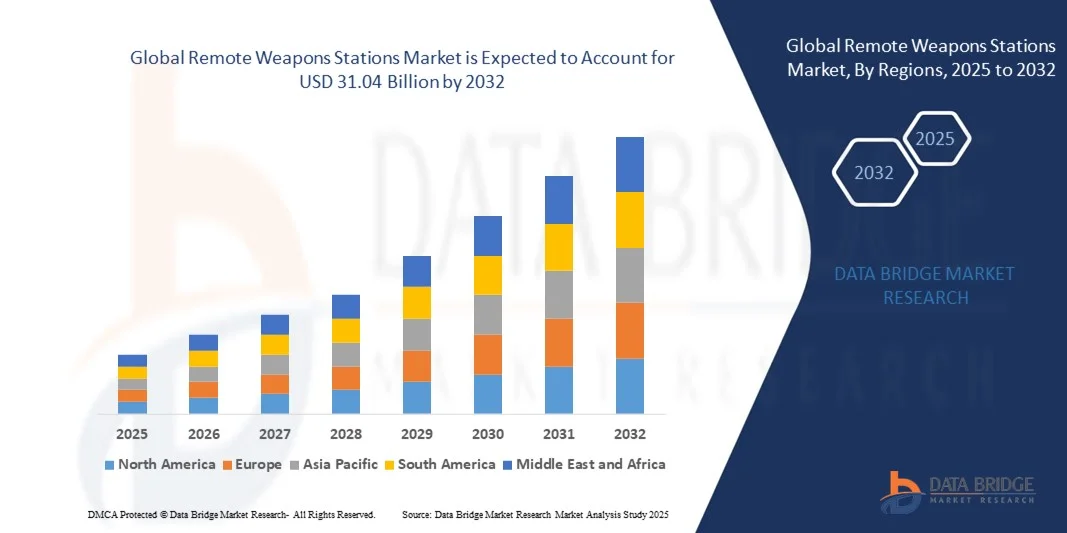
What is the Global Remote Weapons Stations Market Size and Growth Rate?
- The global remote weapons stations market size was valued at USD 13.44 billion in 2024 and is expected to reach USD 31.04 billion by 2032, at a CAGR of 11.03% during the forecast period
- The major driving issue for the remote weapon station market is that the increasing want for remote weapons station within the defence forces across the world. The remote weapons station helps the military troops with efficiency throughout close-in combat things. Due to this reality, the demand for remote weapons station is increasing among the defence forces within the developed further as developing nations
- Moreover, rise in political conflicts, and regional conflicts in several components of the planet is in addition increasing the usage of remote weapon stations by the native land securities and enforcement agencies, that is boosting the market to grow over the forecast period
What are the Major Takeaways of Remote Weapons Stations Market?
- Over the past few years, the world economy has witnessed many armed conflicts and disputes at each, intrastate still as interstate levels. A number of the continued conflicts presently have conjointly had vital impacts on the world economy; Countries area unit enterprise high investments to reinforce their military strengths by commutation older technologies and weapons with fashionable instrumentation
- Increasing investments within the modernization of armoured vehicles area unit resulting in the high demand for remote weapon stations thus lifting market growth. Moreover, ongoing military modernization programs in various countries across the globe and rise in defence expenditure by emerging economies will act as opportunities for remote weapons stations market
- Asia-Pacific dominated the remote weapons stations market with the largest revenue share of 41.2% in 2024, driven by extensive defense modernization programs and rising geopolitical tensions across the region
- The North America remote weapons stations market is projected to grow at the fastest CAGR of 9.8% during 2025–2032, driven by sustained defense spending and the integration of advanced technologies such as AI, sensor fusion, and unmanned platforms
- The Weapons segment dominated the market in 2024 with the largest share of 41.6%, driven by rising demand for advanced guns, cannons, and launchers integrated on combat vehicles and naval platforms
Report Scope and Remote Weapons Stations Market Segmentation
|
Attributes |
Remote Weapons Stations Key Market Insights |
|
Segments Covered |
|
|
Countries Covered |
North America
Europe
Asia-Pacific
Middle East and Africa
South America
|
|
Key Market Players |
|
|
Market Opportunities |
|
|
Value Added Data Infosets |
In addition to the insights on market scenarios such as market value, growth rate, segmentation, geographical coverage, and major players, the market reports curated by the Data Bridge Market Research also include in-depth expert analysis, pricing analysis, brand share analysis, consumer survey, demography analysis, supply chain analysis, value chain analysis, raw material/consumables overview, vendor selection criteria, PESTLE Analysis, Porter Analysis, and regulatory framework. |
What is the Key Trend in the Remote Weapons Stations Market?
Integration of Artificial Intelligence (AI) and Advanced Targeting Systems
- A significant trend shaping the remote weapons stations market is the integration of AI-driven targeting, tracking, and decision-support systems to enhance operational efficiency and precision. AI enables faster threat detection and engagement, improving both lethality and survivability on the battlefield
- For instance, Elbit Systems has developed AI-powered fire-control solutions that enable RWS platforms to automatically track multiple moving targets while optimizing ammunition usage. Similarly, Rheinmetall is incorporating machine-learning algorithms into its weapon stations for enhanced situational awareness
- The fusion of AI with electro-optical sensors, thermal imaging, and ballistic computers allows autonomous decision-making support while maintaining human oversight. This helps armed forces operate in complex, multi-domain environments
- The adoption of AI-powered RWS is reshaping defense strategies, enabling smarter, faster, and more precise engagement capabilities for modern militaries worldwide
What are the Key Drivers of Remote Weapons Stations Market?
- The growing demand for enhanced soldier safety and force protection is a major driver, as RWS enables operators to engage threats from inside an armored vehicle without direct exposure
- Rising military modernization programs, particularly in the U.S., Europe, and Asia-Pacific, are fueling the procurement of advanced RWS integrated with precision targeting and remote operation features
- For instance, in 2024, BAE Systems secured contracts to upgrade U.S. Army combat vehicles with state-of-the-art remote weapon stations to enhance firepower and survivability
- In addition, the increasing emphasis on lightweight, modular, and scalable weapon stations that can be mounted on diverse platforms—from armored vehicles to naval vessels and unmanned systems is expanding the application scope
- The ongoing shift towards network-centric warfare, where integrated sensors and communication systems enhance interoperability, is further propelling market demand
Which Factor is Challenging the Growth of the Remote Weapons Stations Market?
- One of the key challenges facing the RWS market is the high cost of advanced systems, particularly those integrated with AI, electro-optical sensors, and advanced fire-control technologies. This makes procurement difficult for price-sensitive nations
- Cybersecurity risks also pose concerns, as modern RWS rely on digital connectivity and software-driven systems, creating vulnerabilities to hacking or electronic warfare attacks
- For instance, defense analysts have raised concerns that advanced RWS platforms could be susceptible to GPS jamming, data spoofing, or cyber intrusions, potentially compromising mission integrity
- In addition, export restrictions and regulatory barriers, especially for lethal autonomous systems, limit market penetration in certain regions
- Addressing these challenges will require defense companies to focus on cost-effective modular designs, robust cybersecurity protocols, and compliance with international arms regulations to ensure sustainable growth
How is the Remote Weapons Stations Market Segmented?
The market is segmented on the basis of component type, technology, applications, platforms, mobility, and weapon type.
- By Component
On the basis of component, the remote weapons stations market is segmented into Human Machine Interface (HMI), Sensors, Weapons, and Armaments. The Weapons segment dominated the market in 2024 with the largest share of 41.6%, driven by rising demand for advanced guns, cannons, and launchers integrated on combat vehicles and naval platforms. Nations are prioritizing high-precision weapons to enhance lethality and deterrence capabilities, making this segment the backbone of RWS contracts.
Meanwhile, the Sensors segment is anticipated to register the fastest CAGR of 8.7% from 2025 to 2032, fueled by advancements in electro-optical/infrared (EO/IR) systems, radar, and laser range finders. Modern militaries increasingly rely on sensor fusion for target detection, tracking, and battlefield awareness. The integration of next-generation sensors with AI-driven fire control enhances situational awareness and survivability, pushing strong adoption across both land and naval applications.
- By Platform
On the basis of platform, the remote weapons stations market is segmented into Land, Naval, and Airborne. The Land segment accounted for the largest share of 54.3% in 2024, supported by widespread adoption of RWS in armored fighting vehicles, infantry vehicles, and unmanned ground platforms. Military modernization programs in the U.S., Europe, and Asia-Pacific are driving the replacement of manually operated turrets with advanced remotely controlled weapon stations.
The Naval segment is projected to witness the fastest CAGR of 9.1% from 2025 to 2032, due to growing demand for close-in weapon systems and automated gun stations on patrol vessels, destroyers, and frigates. Naval forces are increasingly deploying modular RWS to counter piracy, terrorism, and asymmetric maritime threats. Rising geopolitical tensions and naval expansion programs in the Indo-Pacific are further accelerating naval RWS integration, making it the most dynamic growth area.
- By Weapon Type
On the basis of weapon type, the remote weapons stations market is segmented into Lethal Weapons and Non-lethal Weapons. The Lethal Weapons segment dominated the market with a 68.4% share in 2024, owing to the extensive deployment of heavy machine guns, grenade launchers, and cannons on combat vehicles and naval platforms. Governments worldwide prioritize lethal force capabilities to ensure tactical superiority and deterrence.
However, the Non-lethal Weapons segment is expected to record the fastest CAGR of 10.2% from 2025 to 2032, driven by rising interest in riot control, peacekeeping operations, and homeland security missions. These systems employ technologies such as acoustic devices, water cannons, and dazzlers to incapacitate without causing fatalities. With the increasing emphasis on urban warfare and compliance with international humanitarian laws, non-lethal RWS solutions are gaining traction as complementary systems in both defense and law enforcement applications.
- By Application
On the basis of application, the remote weapons stations market is segmented into Military and Homeland Security. The Military segment dominated with the largest revenue share of 74.5% in 2024, primarily due to large-scale adoption of RWS in defense modernization programs across the U.S., NATO nations, China, and India. Demand is concentrated in armored vehicles, naval combatants, and unmanned systems where remote operations improve both safety and lethality.
The Homeland Security segment is forecasted to grow at the fastest CAGR of 9.5% during 2025–2032, driven by rising concerns over border security, terrorism, and civil unrest. Governments are increasingly procuring RWS for critical infrastructure protection, border surveillance vehicles, and coastal patrol craft. Integration of non-lethal RWS with surveillance technologies makes homeland security applications particularly attractive, as they balance deterrence with compliance to civil-use safety standards.
- By Technology
On the basis of technology, the remote weapons stations market is segmented into Close-in Weapon Systems (CIWS), Remote Controlled Gun Systems, and Others. The Remote Controlled Gun Systems segment held the largest market share of 57.8% in 2024, owing to their widespread use in armored vehicles, patrol vessels, and fixed installations. These systems combine precision firepower with remote operation, ensuring maximum crew safety.
The Close-in Weapon Systems (CIWS) segment is projected to grow at the fastest CAGR of 10.6% from 2025 to 2032, driven by increasing naval deployments to counter modern threats such as drones, cruise missiles, and swarm attacks. The growing emphasis on layered defense architectures and integrated air-and-missile defense strategies is boosting CIWS adoption. Advances in directed-energy CIWS, such as laser-based systems, are also fueling growth in this segment, transforming the RWS technology landscape.
- By Mobility
On the basis of mobility, the remote weapons stations market is segmented into Stationary and Moving. The Moving segment dominated the market with a 62.1% share in 2024, supported by the extensive deployment of RWS on armored vehicles, naval ships, and unmanned platforms. The mobility advantage ensures flexible deployment across dynamic combat zones, enhancing force protection and adaptability.
Meanwhile, the Stationary segment is expected to register the fastest CAGR of 8.9% during 2025–2032, driven by increasing investments in border security, fixed installations, and critical infrastructure protection. Nations facing asymmetric threats are adopting stationary RWS for perimeter defense and strategic checkpoints. Integration of stationary systems with surveillance and automated command centers enhances their utility for both defense and homeland security, reflecting growing global interest in static deterrence solutions.
Which Region Holds the Largest Share of the Remote Weapons Stations Market?
- Asia-Pacific dominated the remote weapons stations market with the largest revenue share of 41.2% in 2024, driven by extensive defense modernization programs and rising geopolitical tensions across the region. Countries such as China, India, Japan, and South Korea are heavily investing in advanced defense systems, leading to significant procurement of RWS for land, naval, and airborne platforms
- Defense budgets in the region are expanding, with strong emphasis on indigenization and joint ventures with global defense firms. Asia-Pacific is also becoming a hub for RWS manufacturing and integration, enhancing regional capacity
- This widespread adoption is further supported by urbanization, cross-border threats, and the need for technologically advanced combat readiness, establishing Asia-Pacific as the dominant hub for Remote Weapons Stations deployment
China Remote Weapons Stations Market Insight
The China remote weapons stations market accounted for the largest revenue share within Asia-Pacific in 2024, supported by the country’s aggressive defense modernization strategy and robust domestic manufacturing base. China’s rising military spending and its focus on strengthening naval and land-based combat platforms are fueling RWS integration at scale. Domestic defense companies are developing cost-effective solutions, boosting local adoption while also expanding exports to allied nations. The drive toward self-reliance, combined with advancements in sensors and weapon systems, positions China as the leading force shaping the RWS market across Asia-Pacific.
Japan Remote Weapons Stations Market Insight
The Japan remote weapons stations market is experiencing steady growth, fueled by the nation’s strategic defense initiatives and technological leadership. Japan’s defense procurement programs prioritize RWS integration on maritime and airborne platforms to counter growing regional threats. With its advanced electronics industry, Japan is driving innovation in sensor systems and human–machine interfaces within RWS platforms. Moreover, the nation’s emphasis on joint military exercises and cooperation with allied forces is stimulating demand. The Japanese market demonstrates strong interest in high-tech, reliable, and interoperable RWS solutions to safeguard both regional security and maritime trade routes.
India Remote Weapons Stations Market Insight
The India remote weapons stations market is poised for robust growth, supported by the government’s “Make in India” initiative and rising defense budgets. The Indian Army and Navy are rapidly adopting RWS for infantry combat vehicles, naval ships, and unmanned platforms. Partnerships with international defense manufacturers are enabling technology transfer and domestic production, driving competitive local ecosystems. Increasing border security needs, counter-terrorism operations, and modernization of armored fleets further fuel adoption. India’s growing role as both a consumer and producer of defense technologies places it as one of the fastest-evolving RWS markets in Asia-Pacific.
Which Region is the Fastest Growing Region in the Remote Weapons Stations Market?
The North America remote weapons stations market is projected to grow at the fastest CAGR of 9.8% during 2025–2032, driven by sustained defense spending and the integration of advanced technologies such as AI, sensor fusion, and unmanned platforms. The U.S. remains at the forefront, with large-scale programs focused on equipping armored vehicles, naval ships, and border patrol systems with next-generation RWS.
U.S. Remote Weapons Stations Market Insight
The U.S. remote weapons stations market captured the largest revenue share of 83% within North America in 2024, supported by ongoing military modernization programs and rapid adoption of advanced weapon stations across all platforms. Strong demand is fueled by counterterrorism operations, overseas deployments, and homeland security needs. Moreover, U.S.-based defense giants are driving RWS innovation through AI-powered targeting, modular systems, and integration with unmanned vehicles. This ensures the U.S. continues to lead in both adoption and technological development of RWS solutions.
Canada Remote Weapons Stations Market Insight
The Canada remote weapons stations market is anticipated to expand at a steady CAGR, supported by investments in defense modernization and peacekeeping missions. Canada is enhancing its land and naval fleets with advanced RWS to strengthen national defense and NATO commitments. Collaborations with U.S. and European defense contractors are driving access to cutting-edge technologies. Growing emphasis on border security and the Arctic’s strategic importance are further encouraging RWS adoption across Canadian defense forces.
Which are the Top Companies in Remote Weapons Stations Market?
The remote weapons stations industry is primarily led by well-established companies, including:
- Kongsberg Gruppen (Norway)
- Raytheon Company (U.S.)
- Elbit Systems (Israel)
- Saab AB (Sweden)
- Leonardo S.p.A. (Italy)
- Electro Optic Systems (Australia)
- BAE Systems (U.K.)
- Rheinmetall AG (Germany)
- ASELSAN A.S (Turkey)
- FN Herstal (Belgium)
- Rafael Advanced Defense Systems (Israel)
What are the Recent Developments in Global Remote Weapons Stations Market?
- In September 2022, Elbit Systems was awarded a contract valued at USD 80 million to supply unmanned turrets for Armoured Fighting Vehicles of an Asia-Pacific country, to be executed over a three-year period. The company will deliver 30mm-gun unmanned light turrets integrating advanced sensors and display systems, enhancing situational awareness, target acquisition, fire control, and weapon operations. This contract is expected to significantly upgrade the operational capabilities and mission performance of the AFVs
- In October 2020, ASELSAN signed a sales contract with the Indonesian Navy for naval platforms, under which the company will supply the 30mm SMASH Remote Controlled Stabilized Gun System. The contract aims to strengthen the naval capabilities of Indonesia, providing enhanced accuracy, stability, and operational efficiency. This agreement underscores ASELSAN’s commitment to advancing defense technology and supporting regional maritime security

- Interactive Data Analysis Dashboard
- Company Analysis Dashboard for high growth potential opportunities
- Research Analyst Access for customization & queries
- Competitor Analysis with Interactive dashboard
- Latest News, Updates & Trend analysis
- Harness the Power of Benchmark Analysis for Comprehensive Competitor Tracking
Data collection and base year analysis are done using data collection modules with large sample sizes. The stage includes obtaining market information or related data through various sources and strategies. It includes examining and planning all the data acquired from the past in advance. It likewise envelops the examination of information inconsistencies seen across different information sources. The market data is analysed and estimated using market statistical and coherent models. Also, market share analysis and key trend analysis are the major success factors in the market report. To know more, please request an analyst call or drop down your inquiry.
The key research methodology used by DBMR research team is data triangulation which involves data mining, analysis of the impact of data variables on the market and primary (industry expert) validation. Data models include Vendor Positioning Grid, Market Time Line Analysis, Market Overview and Guide, Company Positioning Grid, Patent Analysis, Pricing Analysis, Company Market Share Analysis, Standards of Measurement, Global versus Regional and Vendor Share Analysis. To know more about the research methodology, drop in an inquiry to speak to our industry experts.
Data Bridge Market Research is a leader in advanced formative research. We take pride in servicing our existing and new customers with data and analysis that match and suits their goal. The report can be customized to include price trend analysis of target brands understanding the market for additional countries (ask for the list of countries), clinical trial results data, literature review, refurbished market and product base analysis. Market analysis of target competitors can be analyzed from technology-based analysis to market portfolio strategies. We can add as many competitors that you require data about in the format and data style you are looking for. Our team of analysts can also provide you data in crude raw excel files pivot tables (Fact book) or can assist you in creating presentations from the data sets available in the report.













