


Remote Work Security Market Size
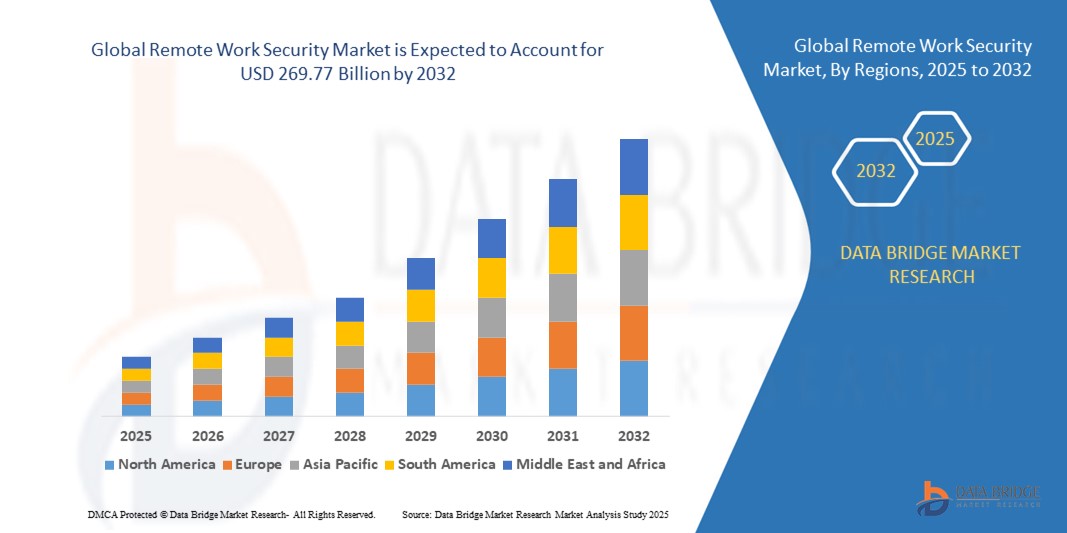
- The global remote work security market size was valued at USD 62.32 billion in 2024 and is expected to reach USD 269.77 billion by 2032, at a CAGR of 20.10% during the forecast period
- The market growth is largely fueled by the sustained shift towards hybrid and remote working environments, compelling organizations to invest in robust cybersecurity frameworks, endpoint protection, and secure access solutions to safeguard digital operations
- Furthermore, increasing threats of data breaches, phishing attacks, and unauthorized access in decentralized work models are accelerating demand for comprehensive, scalable, and user-centric security infrastructures. These converging factors are driving rapid adoption of remote work security solutions, thereby significantly boosting the industry’s growth
Remote Work Security Market Analysis
- Remote work security solutions, encompassing endpoint protection, IoT security, and secure access tools, have become essential for protecting distributed workforces and digital assets in hybrid and fully remote setups, ensuring secure communication and operational continuity
- The escalating demand for remote work security is primarily fueled by increasing cyber threats, rising adoption of cloud collaboration tools, and the proliferation of unsecured personal and IoT devices accessing corporate networks
- North America dominated the remote work security market with the largest revenue share of 43.2% in 2024, supported by advanced IT infrastructure, early adoption of hybrid work models, and strong investments by enterprises in AI-driven security platforms, especially in the U.S., where regulatory compliance and data privacy concerns have intensified post-pandemic
- Asia-Pacific is expected to be the fastest growing region in the remote work security market during the forecast period due to rapid digitalization, growing tech startup ecosystems, and heightened awareness of cyber risks across developing economies
- Endpoint & IoT security segment dominated the remote work security market with a market share of 44.8% in 2024, driven by the need to protect an expanding range of remote endpoints and connected devices that pose critical vulnerabilities in remote work environments
Report Scope and Remote Work Security Market Segmentation
|
Attributes |
Remote Work Security Key Market Insights |
|
Segments Covered |
|
|
Countries Covered |
North America
Europe
Asia-Pacific
Middle East and Africa
South America
|
|
Key Market Players |
|
|
Market Opportunities |
|
|
Value Added Data Infosets |
In addition to the insights on market scenarios such as market value, growth rate, segmentation, geographical coverage, and major players, the market reports curated by the Data Bridge Market Research also include in-depth expert analysis, pricing analysis, brand share analysis, consumer survey, demography analysis, supply chain analysis, value chain analysis, raw material/consumables overview, vendor selection criteria, PESTLE Analysis, Porter Analysis, and regulatory framework. |
Remote Work Security Market Trends
AI-Driven Threat Detection and Zero Trust Adoption
- A significant and accelerating trend in the global remote work security market is the integration of artificial intelligence (AI) and the rapid adoption of Zero Trust security models, which ensure strict identity verification for every user and device accessing corporate networks. This shift is crucial for managing dynamic and dispersed workforces securely
- For instance, CrowdStrike’s AI-powered Falcon platform continuously monitors and responds to potential threats across remote endpoints using behavioral analysis and machine learning algorithms. Similarly, Cisco’s Zero Trust framework, integrated with Duo Security, is designed to authenticate users and devices in real time, reinforcing perimeter-less security
- AI in remote work security enables intelligent threat detection, adaptive response, and proactive risk mitigation. Platforms such as Microsoft Defender for Endpoint utilize AI to detect anomalies, automate threat responses, and reduce alert fatigue, allowing security teams to prioritize real risks. These capabilities help mitigate sophisticated attacks such as ransomware, phishing, and lateral movement across remote access points
- The application of AI also extends to identity and access management (IAM), where it analyzes login patterns to detect unauthorized access attempts and flag suspicious user behaviors. This aligns with the Zero Trust principle of “never trust, always verify,” ensuring that even internal users are continuously authenticated and monitored
- As hybrid work models become permanent across sectors, the demand for AI-driven and Zero Trust-based security frameworks is rising rapidly among organizations of all sizes. Vendors such as Zscaler and Palo Alto Networks are investing heavily in cloud-native Zero Trust platforms that protect remote users while simplifying IT operations
- This trend toward intelligent, adaptive, and identity-focused security is transforming the cybersecurity landscape, with enterprises seeking unified, automated, and AI-enhanced solutions to protect remote employees and sensitive business data in an increasingly complex digital environment
Remote Work Security Market Dynamics
Driver
Rising Cyber Threats Amid Proliferation of Remote Workforces
- The surge in remote and hybrid workforces across sectors has dramatically increased the number of unsecured endpoints, cloud workloads, and personal devices accessing corporate networks, thereby amplifying the risk of cyberattacks and data breaches
- For instance, in March 2024, Palo Alto Networks launched its Prisma Access 5.0, an advanced Secure Access Service Edge (SASE) solution offering unified security and performance optimization for remote users across global enterprises. Such developments indicate a growing emphasis on securing distributed workforces
- As organizations increasingly rely on cloud-based tools such as Microsoft Teams, Zoom, and Google Workspace, they are turning to remote work security solutions to ensure encrypted communication, secure data transfer, and identity management. Endpoint detection and response (EDR), secure web gateways, VPN alternatives such as ZTNA (Zero Trust Network Access), and multifactor authentication are now critical components of enterprise cybersecurity
- The growing need for business continuity, regulatory compliance and risk management in remote work settings is further accelerating the demand for robust cybersecurity architectures. The ability to protect intellectual property, financial data, and customer information from unauthorized access is paramount
- In response, companies are prioritizing comprehensive security solutions that offer centralized visibility, real-time threat intelligence, and scalable protection across devices, locations, and users. The demand spans industries from IT and BFSI to healthcare and education where remote work is now integral to operations
Restraint/Challenge
Security Complexity and Budget Constraints for SMEs
- Despite the growing need for remote work security, many small and medium-sized enterprises (SMEs) face challenges in adopting comprehensive cybersecurity solutions due to budget limitations, technical complexity, and limited in-house expertise
- For instance, while advanced platforms such as Fortinet and CrowdStrike offer powerful security features, they may be resource-intensive and difficult to deploy without a dedicated IT security team. This makes SMEs more vulnerable to targeted attacks such as ransomware, social engineering, and credential theft
- Moreover, the evolving nature of threats and the continuous need for software updates, patch management, and user training add to operational burdens. The complexity of managing multiple point solutions such as firewalls, VPNs, and endpoint security without centralized control often results in inefficient protection and fragmented risk management
- In addition, compliance with regional and industry-specific data protection regulations requires ongoing investment in policy implementation, audits, and documentation, which may be burdensome for budget-conscious firms
- Overcoming these challenges will require the development of cost-effective, easy-to-deploy, and scalable remote security solutions tailored for SMEs, along with managed security service providers (MSSPs) that can offer 24/7 protection without heavy infrastructure costs. Increasing awareness and education about affordable security frameworks such as Zero Trust and SASE can also help democratize access to enterprise-grade security for smaller businesses
Remote Work Security Market Scope
The market is segmented on the basis of offering, security type, remote work model, and vertical.
- By Offering
On the basis of offering, the remote work security market is segmented into solutions and services. The solutions segment dominated the market with the largest revenue share in 2024, driven by increasing enterprise demand for endpoint protection, identity and access management (IAM), secure web gateways, and Zero Trust security frameworks. Organizations prioritizing digital transformation and securing hybrid workforce operations are investing heavily in comprehensive security platforms to protect remote endpoints and sensitive data.
The services segment is anticipated to witness the fastest growth rate from 2025 to 2032, owing to the rising need for managed security services, consulting, and system integration. As small and medium-sized enterprises (SMEs) face resource constraints in maintaining in-house cybersecurity teams, they are increasingly turning to third-party providers for 24/7 monitoring, incident response, and compliance management.
- By Security Type
On the basis of security type, the market is segmented into endpoint & IoT, network, cloud, and application security. The endpoint & IoT security segment dominated the market with the highest revenue share of 44.8% in 2024, fueled by the growing number of unsecured devices such as laptops, smartphones, and IoT sensors being used in remote environments. Organizations are focusing on securing these endpoints through EDR (Endpoint Detection and Response), anti-malware tools, and device access control to prevent breaches.
The cloud security segment is expected to experience the fastest CAGR during the forecast period, driven by widespread adoption of SaaS tools and cloud storage solutions in remote work environments. With a growing reliance on platforms such as Google Workspace, Microsoft 365, and Zoom, the demand for data encryption, secure file sharing, and cloud workload protection is accelerating.
- By Remote Work Model
On the basis of remote work model, the market is segmented into fully remote, hybrid, and temporary. The hybrid work model segment held the largest market share in 2024, supported by the growing number of organizations adopting flexible working structures post-pandemic. Hybrid models require persistent and scalable security infrastructure across both office and remote environments, driving demand for secure access and unified threat management solutions.
The fully remote segment is projected to witness rapid growth through 2032 as digital-first companies and startups continue to operate without centralized office setups, requiring robust endpoint and cloud security to manage geographically dispersed teams securely.
- By Vertical
On the basis of vertical, the remote work security market is segmented into BFSI, retail & e-commerce, IT & ITes, telecommunications, education, government, media & entertainment, and others. The IT & ITes segment dominated the market in 2024 due to the sector’s heavy reliance on remote software development, cloud operations, and global teams. Companies in this vertical are early adopters of Zero Trust architecture, secure DevOps, and AI-driven threat detection.
The education segment is expected to grow at the fastest rate during the forecast period, driven by the rapid shift to virtual learning environments and the increasing need for secure access to online learning platforms and student data protection across K–12 and higher education institutions.
Remote Work Security Market Regional Analysis
- North America dominated the remote work security market with the largest revenue share of 43.2% in 2024, supported by advanced IT infrastructure, early adoption of hybrid work models, and strong investments by enterprises in AI-driven security platforms, especially in the U.S., where regulatory compliance and data privacy concerns have intensified post-pandemic
- Enterprises across the region prioritize comprehensive cybersecurity frameworks that include endpoint protection, secure cloud access, and identity management solutions to ensure business continuity and regulatory compliance
- The region’s leadership in market adoption is further reinforced by a tech-savvy workforce, high cloud adoption rates, and the presence of major cybersecurity providers. These factors, combined with growing concerns over data breaches and the need for advanced threat detection, continue to accelerate demand for remote work security solutions across industries
U.S. Remote Work Security Market Insight
The U.S. remote work security market captured the largest revenue share of 78% in 2024 within North America, driven by the rapid expansion of hybrid work models and the increasing frequency of cyber threats targeting remote endpoints and cloud services. Organizations are prioritizing investment in Zero Trust security architectures, AI-powered threat detection, and secure access solutions. High regulatory compliance standards, such as HIPAA and CCPA, further accelerate the adoption of advanced cybersecurity platforms. The strong presence of leading cybersecurity firms and high digital literacy among U.S. businesses continue to fuel market growth.
Europe Remote Work Security Market Insight
The Europe remote work security market is projected to expand at a substantial CAGR throughout the forecast period, largely driven by evolving data protection laws such as GDPR and the rising demand for secure digital collaboration. Organizations are focusing on securing their cloud environments and distributed workforce through advanced encryption, identity access management, and compliance-focused security solutions. The increase in remote education, digital healthcare, and e-government services also contributes to rising security requirements across the region.
U.K. Remote Work Security Market Insight
The U.K. remote work security market is anticipated to grow at a noteworthy CAGR during the forecast period, supported by robust government emphasis on cybersecurity and data protection. With a growing hybrid workforce and increased digital interactions, businesses are adopting endpoint detection, secure cloud storage, and multi-factor authentication. In addition, rising awareness of ransomware and phishing threats, especially among SMEs and public sector institutions, is encouraging the deployment of scalable and cost-effective security platforms.
Germany Remote Work Security Market Insight
The Germany remote work security market is expected to expand at a considerable CAGR during the forecast period, driven by the country’s focus on enterprise-grade cybersecurity and privacy compliance. German companies prioritize strict data handling practices and prefer localized, GDPR-compliant solutions. The integration of AI-based threat detection and secure VPN alternatives is gaining traction, particularly among manufacturing, automotive, and finance sectors. Moreover, national strategies aimed at strengthening cybersecurity frameworks further boost demand.
Asia-Pacific Remote Work Security Market Insight
The Asia-Pacific remote work security market is poised to grow at the fastest CAGR of 25.4% during the forecast period of 2025 to 2032, driven by accelerated digital transformation, rising cyberattack incidents, and the expansion of remote workforces in countries such as India, China, and Australia. Regional governments are implementing cybersecurity policies, while enterprises are adopting cloud security, endpoint protection, and secure collaboration tools. Increasing internet penetration and growing tech investments make APAC a key growth region for remote security vendors.
Japan Remote Work Security Market Insight
The Japan remote work security market is gaining momentum due to its high-tech infrastructure, mature IT sector, and the growing adoption of hybrid work arrangements. Enterprises in Japan are increasingly implementing Zero Trust models, behavioral analytics, and cloud-native security tools to safeguard operations. As remote access becomes more common across industries such as finance, education, and healthcare, secure digital authentication and endpoint protection are being prioritized.
India Remote Work Security Market Insight
The India remote work security market accounted for the largest market revenue share in Asia-Pacific in 2024, fueled by the country’s burgeoning IT & ITeS sector, rapid enterprise digitization, and rising awareness of cyber threats. Indian businesses are increasingly deploying endpoint security, cloud access protection, and managed security services to ensure business continuity. The government's push for Digital India and the increasing affordability of security solutions contribute to robust adoption across both large enterprises and SMEs.
Remote Work Security Market Share
The remote work security industry is primarily led by well-established companies, including:
- Cisco (U.S.)
- VMware (U.S.)
- Palo Alto Networks (U.S.)
- Check Point (Israel)
- Fortinet (U.S.)
- Microsoft (U.S.)
- IBM (U.S.)
- Trend Micro (Japan)
- Broadcom (U.S.)
- Cloudflare (U.S.)
- Sophos (U.K.)
- ZScaler (U.S.)
- Citrix (U.S.)
- CyberArk (U.S.)
- Crowdstrike (U.S.)
- Forcepoint (U.S.)
- Proofpoint (U.S.)
- ESET (Slovakia)
- Seclore (U.S.)
What are the Recent Developments in Global Remote Work Security Market?
- In April 2025, Palo Alto Networks, the global cybersecurity leader, announced its latest advancements in Prisma SASE, the industry's most comprehensive secure access service edge (SASE) solution, including the unveiling of Prisma Access Browser 2.0, the world's only SASE-native secure browser. Prisma Access Browser 2.0, along with Endpoint Data Loss Prevention (DLP) and expanded cloud presence with Oracle Cloud Infrastructure (OCI), are new Prisma SASE capabilities designed to secure generative AI (GenAI) usage, improve user experience and enhance operational resilience in the modern workplace
- In May 2025, Cisco, the leader in security and networking, unveiled Duo Identity and Access Management (IAM), a new security solution that transforms how organizations combat persistent identity-based attacks that are accelerating in the AI era
- In September 2024, Proofpoint and CyberArk expanded their strategic partnership to enhance identity security across hybrid and multi-cloud environments. This collaboration introduces new integrations, including Proofpoint's ZenWeb browser extension and CyberArk's Secure Browser, aiming to prevent phishing attacks and secure user identities. By combining their technologies, the partnership offers comprehensive protection against identity-based threats, addressing the evolving cybersecurity challenges faced by organizations in today's digital landscape
- In April 2022, Fortinet, global leader in broad, integrated, and automated cybersecurity solutions, today announced the release of FortiOS 7.2, the latest upgrades to its flagship operating system and the foundation of the Fortinet Security Fabric. Over 300 new features enhance Fortinet's ability to converge security at every network edge combined with the performance and scale needed to detect and prevent threats across an organization's entire infrastructure
- In September 2021, Siemens and Zscaler, Inc., the leader in cloud security, are partnering to enable customers to securely access Operational Technology (OT) systems and applications in the production network from the workplace whether in the office or working remote. These new capabilities enable users to remotely manage and control quality assurance or diagnoses issues
- In January 2023, Microsoft Corporation enhanced its Defender for Endpoint platform with new capabilities tailored for small and medium-sized businesses (SMBs). The updates include automated investigation and response, advanced threat detection using AI, and simplified onboarding for remote employees. These developments highlight Microsoft’s strategy to democratize enterprise-grade security tools, ensuring secure operations for organizations of all sizes in a remote work-driven world

- Interactive Data Analysis Dashboard
- Company Analysis Dashboard for high growth potential opportunities
- Research Analyst Access for customization & queries
- Competitor Analysis with Interactive dashboard
- Latest News, Updates & Trend analysis
- Harness the Power of Benchmark Analysis for Comprehensive Competitor Tracking
Data collection and base year analysis are done using data collection modules with large sample sizes. The stage includes obtaining market information or related data through various sources and strategies. It includes examining and planning all the data acquired from the past in advance. It likewise envelops the examination of information inconsistencies seen across different information sources. The market data is analysed and estimated using market statistical and coherent models. Also, market share analysis and key trend analysis are the major success factors in the market report. To know more, please request an analyst call or drop down your inquiry.
The key research methodology used by DBMR research team is data triangulation which involves data mining, analysis of the impact of data variables on the market and primary (industry expert) validation. Data models include Vendor Positioning Grid, Market Time Line Analysis, Market Overview and Guide, Company Positioning Grid, Patent Analysis, Pricing Analysis, Company Market Share Analysis, Standards of Measurement, Global versus Regional and Vendor Share Analysis. To know more about the research methodology, drop in an inquiry to speak to our industry experts.
Data Bridge Market Research is a leader in advanced formative research. We take pride in servicing our existing and new customers with data and analysis that match and suits their goal. The report can be customized to include price trend analysis of target brands understanding the market for additional countries (ask for the list of countries), clinical trial results data, literature review, refurbished market and product base analysis. Market analysis of target competitors can be analyzed from technology-based analysis to market portfolio strategies. We can add as many competitors that you require data about in the format and data style you are looking for. Our team of analysts can also provide you data in crude raw excel files pivot tables (Fact book) or can assist you in creating presentations from the data sets available in the report.













