


What is the Renewable Feedstocks Market Size and Overview?
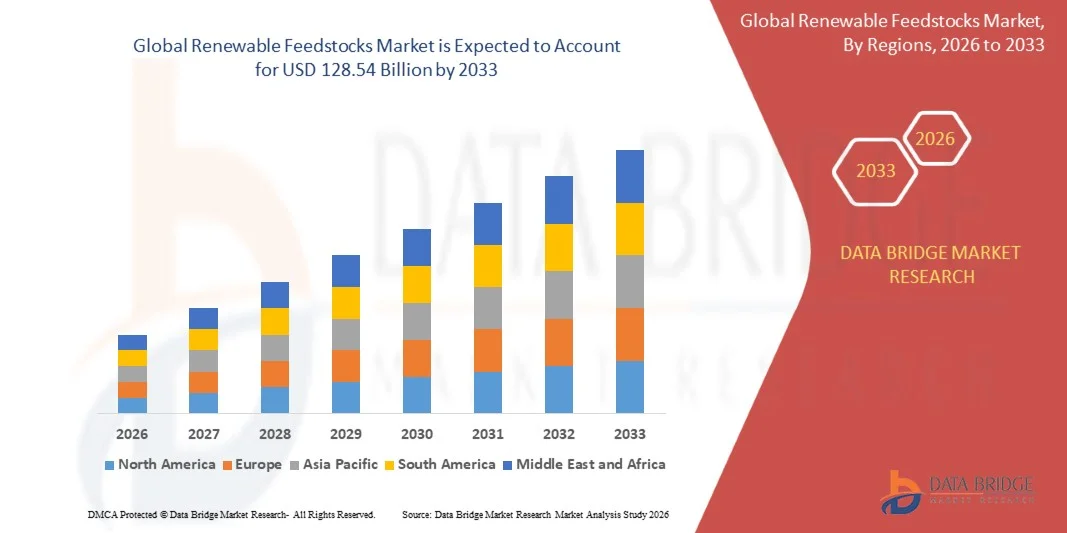
As per Data Bridge Market Research analysis the renewable feedstocks market was valued at USD 54.43 billion in 2025 and is projected to reach USD 128.54 billion by 2033, growing at a CAGR of 11.34% from 2026 to 2033. The market is witnessing strong growth driven by the increasing transition toward sustainable raw materials, rising production of biofuels and renewable chemicals, and stringent environmental regulations promoting low-carbon manufacturing across multiple industries.
Market Size & Forecast
- Global Market Value (2025): USD 54.43 Billion
- Expected Market Value (2033): USD 128.54 Billion
- Forecast CAGR (2026–2033): 11.34%
Growing concerns over greenhouse gas emissions, volatility in fossil fuel prices, and the push toward decarbonization are encouraging industries to adopt renewable feedstocks derived from biomass, agricultural residues, waste oils, vegetable oils, animal fats, and other biological resources. These feedstocks are increasingly being utilized in biofuels, bioplastics, renewable diesel, sustainable aviation fuel (SAF), chemicals, and industrial applications. In addition, supportive government policies, expanding investments in biorefineries, and technological advancements in biomass conversion processes are further accelerating market growth while strengthening the transition toward a circular and bio-based economy.
Key Market Trends & Insights
- North America dominated the renewable feedstocks market with the largest revenue share in 2025, supported by strong government policies promoting renewable fuels, well-established agricultural and waste feedstock supply chains, and increasing investments in renewable diesel and sustainable aviation fuel (SAF) production.
- Asia-Pacific renewable feedstocks market is expected to witness the fastest growth rate from 2026 to 2033, supported by abundant biomass resources, rapid industrialization, increasing biofuel production, and expanding government initiatives promoting renewable energy across China, India, Japan, Indonesia, and Malaysia.
- The agricultural residues segment held the largest market revenue share in 2025, driven by the abundant availability of crop residues, used cooking oil, sugarcane bagasse, corn stover, wheat straw, and oilseed-derived biomass. These feedstocks are widely utilized in the production of renewable diesel, sustainable aviation fuel (SAF), bioethanol, and bio-based chemicals due to their established supply chains and cost-effectiveness.
- The forestry residues segment is projected to register the fastest growth at a CAGR from 2026 to 2033, driven by increasing investments in advanced biorefineries and the commercialization of lignocellulosic biomass technologies. Growing utilization of wood waste, sawdust, forest thinnings, and logging residues for advanced biofuels, renewable chemicals, and bioenergy applications is accelerating segment growth.
- The biofuels segment held the largest market revenue share in 2025, driven by increasing production of renewable diesel, biodiesel, sustainable aviation fuel (SAF), and bioethanol. Government blending mandates, decarbonization policies, and rising investments in renewable fuel infrastructure continue to strengthen demand for renewable feedstocks across the transportation sector.
- The bio-based chemicals segment is projected to register the fastest growth at a CAGR from 2026 to 2033, driven by rising demand for sustainable polymers, green solvents, specialty chemicals, and industrial intermediates. Increasing adoption of renewable raw materials by the chemical industry to reduce carbon emissions and meet sustainability targets is supporting rapid segment expansion.
- The industrial segment held the largest market revenue share in 2025, driven by extensive utilization of renewable feedstocks in biofuel production, chemical manufacturing, renewable diesel, sustainable aviation fuel, power generation, and industrial processing applications. Increasing investments in biorefineries and low-carbon manufacturing are further supporting segment dominance.
- The commercial segment is projected to register the fastest growth at a CAGR from 2026 to 2033, driven by rising adoption of renewable fuels across commercial transportation, aviation, logistics, shipping, and corporate sustainability programs. Growing commitments toward net-zero emissions are encouraging commercial organizations to increase renewable feedstock utilization.
Report Scope and Renewable Feedstocks Market Segmentation
|
Attributes |
Renewable Feedstocks Key Market Insights |
|
Segments Covered |
|
|
Countries Covered |
North America
Europe
Asia-Pacific
Middle East and Africa
South America
|
|
Key Market Players |
|
|
Market Opportunities |
|
|
Value Added Data Infosets |
In addition to the insights on market scenarios such as market value, growth rate, segmentation, geographical coverage, and major players, the market reports curated by the Data Bridge Market Research also include import export analysis, production capacity overview, production consumption analysis, price trend analysis, climate change scenario, supply chain analysis, value chain analysis, raw material/consumables overview, vendor selection criteria, PESTLE Analysis, Porter Analysis, and regulatory framework. |
What is the Key Trend in the Renewable Feedstocks Market?
Trend: Growing Adoption Of Waste-Based Feedstocks And Sustainable Aviation Fuel Production
Increasing demand for low-carbon fuels, renewable chemicals, and sustainable industrial raw materials is accelerating the adoption of renewable feedstocks across the energy, transportation, and chemical sectors. Conventional fossil-based feedstocks contribute significantly to greenhouse gas emissions and are exposed to price volatility, encouraging governments and industries to shift toward renewable alternatives such as used cooking oil (UCO), animal fats, agricultural residues, vegetable oils, and lignocellulosic biomass. This transition is supporting circular economy initiatives while reducing dependence on petroleum-derived resources.
In the transportation sector, renewable feedstocks are increasingly being utilized for the production of renewable diesel and sustainable aviation fuel (SAF) to meet stringent decarbonization targets. For instance, in April 2025, Neste started producing Sustainable Aviation Fuel (SAF) at its expanded Rotterdam renewables refinery, increasing its SAF production capability to 1.5 million tons annually using renewable waste and residue feedstocks. The expansion strengthens the availability of renewable feedstocks for low-carbon aviation fuel production and supports growing SAF demand.
Growing investments in advanced biorefineries and feedstock diversification are further accelerating market expansion. In addition, chemical manufacturers are increasingly incorporating renewable feedstocks into bio-based polymers, specialty chemicals, and industrial materials to reduce carbon footprints and improve supply chain sustainability. The increasing commercialization of advanced biomass conversion technologies is expected to further strengthen the renewable feedstocks market.
Renewable Feedstocks Market Dynamics
Key Market Driver: Rising Demand For Low-Carbon Fuels And Bio-Based Chemicals
Industries worldwide are facing increasing regulatory pressure to reduce greenhouse gas emissions and transition toward sustainable production processes. Growing demand for renewable diesel, sustainable aviation fuel, bio-based chemicals, and circular economy solutions is significantly increasing the utilization of renewable feedstocks derived from waste oils, agricultural residues, animal fats, and biomass.
Energy companies, refiners, and chemical manufacturers are expanding investments in renewable feedstock processing to replace fossil-based raw materials and meet carbon reduction targets. Governments across North America, Europe, and Asia-Pacific continue introducing renewable fuel mandates and incentives supporting the adoption of bio-based feedstocks for transportation and industrial applications.
For instance, in May 2025, World Energy signed an agreement with Singapore Airlines Group to supply 2,000 tonnes of CORSIA-eligible Sustainable Aviation Fuel (SAF) using its Book & Claim model. The agreement demonstrates the growing commercial demand for renewable feedstocks in aviation while supporting airline decarbonization targets and accelerating adoption of sustainable fuels.
Key Restraint/Challenge: Limited Feedstock Availability And Supply Chain Volatility
The renewable feedstocks market faces challenges related to limited availability of sustainable raw materials, feedstock price volatility, and increasing competition among biofuel, renewable diesel, and biochemical producers. Growing demand for used cooking oil, animal fats, vegetable oils, and agricultural residues has intensified supply constraints, affecting production economics and long-term feedstock security.
In addition, seasonal agricultural output, changing weather patterns, land-use constraints, and evolving sustainability regulations create uncertainty in feedstock availability across different regions. Maintaining consistent feedstock quality while ensuring compliance with sustainability certification standards further increases operational complexity and production costs.
For instance, in 2024, the International Energy Agency (IEA) reported in its Renewables 2024 report that increasing demand for renewable fuels is tightening the availability of sustainable feedstocks such as waste oils and residues. The report identified feedstock supply constraints and growing competition among renewable diesel, SAF, and bio-based chemical producers as key challenges affecting long-term market expansion.
Key Market Opportunity: Expansion Of Sustainable Aviation Fuel And Advanced Biorefineries
The growing commercialization of sustainable aviation fuel, renewable diesel, and advanced bio-based chemicals is creating significant opportunities for renewable feedstock suppliers worldwide. Airlines, refiners, and chemical manufacturers are increasing investments in advanced biorefineries capable of processing multiple renewable feedstocks, including municipal waste, forestry residues, agricultural biomass, and used cooking oil.
Energy companies are increasingly expanding renewable fuel production capacity to meet rising demand for low-carbon transportation fuels. For instance, in April 2025, Neste commenced commercial production of Sustainable Aviation Fuel at its expanded Rotterdam refinery, enabling the facility to produce larger volumes of SAF and renewable diesel from renewable waste and residue feedstocks. The expansion strengthens renewable fuel supply chains and creates new growth opportunities for renewable feedstock producers.
In addition, advancements in biomass conversion technologies, hydrotreated vegetable oil (HVO) production, and lignocellulosic feedstock processing are improving production efficiency and expanding feedstock flexibility. These innovations are expected to accelerate renewable feedstock adoption across sustainable fuels, bio-based chemicals, and industrial manufacturing throughout North America, Europe, and Asia-Pacific.
How is the Renewable Feedstocks Market Segmented?
The market is segmented on the basis of source, application, and end-user.
- By Source
On the basis of source, the renewable feedstocks market is segmented into agricultural residues and forestry residues. The agricultural residues segment held the largest market revenue share in 2025, driven by the abundant availability of crop residues, used cooking oil, sugarcane bagasse, corn stover, wheat straw, and oilseed-derived biomass. These feedstocks are widely utilized in the production of renewable diesel, sustainable aviation fuel (SAF), bioethanol, and bio-based chemicals due to their established supply chains and cost-effectiveness.
The forestry residues segment is projected to register the fastest growth at a CAGR from 2026 to 2033, driven by increasing investments in advanced biorefineries and the commercialization of lignocellulosic biomass technologies. Growing utilization of wood waste, sawdust, forest thinnings, and logging residues for advanced biofuels, renewable chemicals, and bioenergy applications is accelerating segment growth.
- By Application
On the basis of application, the renewable feedstocks market is segmented into biofuels, bio-based chemicals, lubricants, cosmetics and personal care, and others. The biofuels segment held the largest market revenue share in 2025, driven by increasing production of renewable diesel, biodiesel, sustainable aviation fuel (SAF), and bioethanol. Government blending mandates, decarbonization policies, and rising investments in renewable fuel infrastructure continue to strengthen demand for renewable feedstocks across the transportation sector.
The bio-based chemicals segment is projected to register the fastest growth at a CAGR from 2026 to 2033, driven by rising demand for sustainable polymers, green solvents, specialty chemicals, and industrial intermediates. Increasing adoption of renewable raw materials by the chemical industry to reduce carbon emissions and meet sustainability targets is supporting rapid segment expansion.
- By End-User
On the basis of end-user, the renewable feedstocks market is segmented into residential, commercial, industrial, and others. The industrial segment held the largest market revenue share in 2025, driven by extensive utilization of renewable feedstocks in biofuel production, chemical manufacturing, renewable diesel, sustainable aviation fuel, power generation, and industrial processing applications. Increasing investments in biorefineries and low-carbon manufacturing are further supporting segment dominance.
The commercial segment is projected to register the fastest growth at a CAGR from 2026 to 2033, driven by rising adoption of renewable fuels across commercial transportation, aviation, logistics, shipping, and corporate sustainability programs. Growing commitments toward net-zero emissions are encouraging commercial organizations to increase renewable feedstock utilization.
Which Region Holds the Largest Share of the Renewable Feedstocks Market?
North America Renewable Feedstocks Market Insight
North America dominated the renewable feedstocks market with the largest revenue share in 2025, supported by strong government policies promoting renewable fuels, well-established agricultural and waste feedstock supply chains, and increasing investments in renewable diesel and sustainable aviation fuel (SAF) production. The region benefits from abundant availability of soybean oil, used cooking oil, animal fats, and agricultural residues, along with growing refinery conversions toward renewable fuel production. Rising decarbonization initiatives and expanding bio-based chemical manufacturing continue to strengthen regional market growth.
U.S. Renewable Feedstocks Market Insight
The U.S. renewable feedstocks market captured the largest revenue share in 2025 within North America, fueled by increasing production of renewable diesel, sustainable aviation fuel, and bio-based chemicals. Strong federal and state renewable fuel policies, expanding oilseed processing capacity, and rising investments in biomass utilization are driving demand for renewable feedstocks. Moreover, growing collaborations between agricultural producers, refiners, and biofuel manufacturers continue to strengthen domestic feedstock supply chains and accelerate market expansion.
Canada Renewable Feedstocks Market Insight
The Canada renewable feedstocks market is expected to witness significant growth from 2026 to 2033, driven by increasing investments in renewable diesel, sustainable aviation fuel production, and biomass utilization projects. The country's abundant forestry resources, agricultural residues, and supportive clean fuel regulations are encouraging the adoption of renewable feedstocks across energy and industrial sectors. Growing investments in bio-refineries and low-carbon fuel infrastructure are further supporting market growth.
Europe Renewable Feedstocks Market Insight
The Europe renewable feedstocks market is expected to witness the fastest growth rate from 2026 to 2033, primarily driven by stringent carbon reduction policies, renewable energy directives, and increasing investments in sustainable aviation fuel and renewable diesel production. Rising adoption of circular economy practices, expanding biorefinery capacity, and strong demand for bio-based chemicals are encouraging greater utilization of renewable feedstocks across the region. Increasing regulatory support for low-carbon fuels continues to accelerate market expansion.
U.K. Renewable Feedstocks Market Insight
The U.K. renewable feedstocks market is expected to witness substantial growth from 2026 to 2033, driven by growing investments in sustainable aviation fuel, biomass energy projects, and renewable chemical manufacturing. Government initiatives supporting net-zero emissions and increasing utilization of waste-based feedstocks are encouraging industrial adoption. Expanding research into advanced biofuels and circular economy solutions is expected to further strengthen market development.
Germany Renewable Feedstocks Market Insight
The Germany renewable feedstocks market is expected to witness strong growth from 2026 to 2033, fueled by increasing production of renewable diesel, bio-based chemicals, and sustainable industrial materials. Germany's advanced chemical industry, strong renewable energy policies, and growing investments in biorefineries are driving demand for agricultural and forestry-based feedstocks. The country's continued focus on industrial decarbonization and resource efficiency further supports renewable feedstock adoption.
Asia-Pacific Renewable Feedstocks Market Insight
The Asia-Pacific renewable feedstocks market is expected to witness the fastest growth rate from 2026 to 2033, supported by abundant biomass resources, rapid industrialization, increasing biofuel production, and expanding government initiatives promoting renewable energy across China, India, Japan, Indonesia, and Malaysia. Rising investments in sustainable aviation fuel, renewable diesel, and bio-based chemicals, coupled with increasing agricultural residue utilization, are significantly driving regional market growth.
Japan Renewable Feedstocks Market Insight
The Japan renewable feedstocks market is expected to witness significant growth from 2026 to 2033 due to increasing investments in sustainable aviation fuel, biomass utilization, and circular economy initiatives. The country's limited fossil fuel resources and strong decarbonization commitments are encouraging greater use of renewable feedstocks derived from waste oils, forestry biomass, and agricultural residues. Growing collaborations between energy companies and feedstock suppliers are further supporting market expansion.
China Renewable Feedstocks Market Insight
The China renewable feedstocks market accounted for the largest market revenue share in Asia-Pacific in 2025, attributed to the country's large agricultural base, expanding biofuel production capacity, and increasing investments in biomass utilization technologies. Growing government support for renewable energy, rapid development of bio-based chemical manufacturing, and increasing adoption of agricultural and forestry residues are strengthening renewable feedstock demand. China's expanding renewable fuel infrastructure and industrial decarbonization initiatives continue to position the country as the leading market in the Asia-Pacific region.
Renewable Feedstocks Market Share
The Renewable Feedstocks industry is primarily led by well-established companies, including:
- Neste Oyj (Finland)
- Darling Ingredients Inc. (U.S.)
- Bunge SA (U.S.)
- Archer Daniels Midland Company (U.S.)
- Cargill, Incorporated (U.S.)
- Wilmar International Limited (Singapore)
- Louis Dreyfus Company B.V. (Netherlands)
- Chevron Corporation (U.S.)
- BP p.l.c. (U.K.)
- TotalEnergies SE (France)
- Repsol S.A. (Spain)
- UPM-Kymmene Corporation (Finland)
- Eni S.p.A. (Italy)
- Valero Energy Corporation (U.S.)
- Verbio SE (Germany)
What are Latest Developments in Renewable Feedstocks Market?
- In April 2025, Neste Corporation started producing Sustainable Aviation Fuel (SAF) at its expanded Rotterdam renewables refinery in the Netherlands. The expansion increased the refinery's SAF production capacity by 500,000 tonnes per year, raising Neste's SAF production capability to 1.5 million tonnes annually using renewable waste and residue feedstocks. The development strengthens renewable feedstock utilization, supports aviation decarbonization, and boosts demand for sustainable raw materials across the renewable fuels industry.
- In October 2024, Neste Corporation entered a renewable feedstock supply agreement with Braskem to provide renewable and recycled feedstocks for the production of circular and bio-circular polymers and chemicals. The collaboration expands the commercial use of renewable feedstocks beyond fuels into sustainable chemicals and plastics, strengthens circular economy initiatives, and creates new growth opportunities for the renewable feedstocks market.
- In March 2024, Bunge Chevron Ag Renewables LLC announced the construction of a new oilseed processing facility in Louisiana to expand the supply of renewable fuel feedstocks. The facility will process soybeans and other oilseed crops used in renewable diesel and sustainable aviation fuel production, improving feedstock availability while supporting the growing biofuels industry.
- In February 2022, Chevron Corporation and Bunge Limited signed definitive agreements to establish Bunge Chevron Ag Renewables LLC. The joint venture combines Bunge's oilseed processing expertise with Chevron's renewable fuels business to expand renewable feedstock production for renewable diesel and other low-carbon fuels, strengthening supply security and accelerating commercialization of renewable energy solutions.
- In May 2022, Bunge and Chevron officially launched Bunge Chevron Ag Renewables LLC to expand oilseed processing and sustainable agricultural supply chains for renewable fuel feedstocks. The venture enhances the availability of renewable raw materials for renewable diesel production, supports lower-carbon transportation fuels, and contributes to long-term growth in the renewable feedstocks market.

- Interactive Data Analysis Dashboard
- Company Analysis Dashboard for high growth potential opportunities
- Research Analyst Access for customization & queries
- Competitor Analysis with Interactive dashboard
- Latest News, Updates & Trend analysis
- Harness the Power of Benchmark Analysis for Comprehensive Competitor Tracking
Global Renewable Feedstocks Market, Supply Chain Analysis and Ecosystem Framework
To support market growth and help clients navigate the impact of geopolitical shifts, DBMR has integrated in-depth supply chain analysis into its Global Renewable Feedstocks Market research reports. This addition empowers clients to respond effectively to global changes affecting their industries. The supply chain analysis section includes detailed insights such as Global Renewable Feedstocks Market consumption and production by country, price trend analysis, the impact of tariffs and geopolitical developments, and import and export trends by country and HSN code. It also highlights major suppliers with data on production capacity and company profiles, as well as key importers and exporters. In addition to research, DBMR offers specialized supply chain consulting services backed by over a decade of experience, providing solutions like supplier discovery, supplier risk assessment, price trend analysis, impact evaluation of inflation and trade route changes, and comprehensive market trend analysis.
Data collection and base year analysis are done using data collection modules with large sample sizes. The stage includes obtaining market information or related data through various sources and strategies. It includes examining and planning all the data acquired from the past in advance. It likewise envelops the examination of information inconsistencies seen across different information sources. The market data is analysed and estimated using market statistical and coherent models. Also, market share analysis and key trend analysis are the major success factors in the market report. To know more, please request an analyst call or drop down your inquiry.
The key research methodology used by DBMR research team is data triangulation which involves data mining, analysis of the impact of data variables on the market and primary (industry expert) validation. Data models include Vendor Positioning Grid, Market Time Line Analysis, Market Overview and Guide, Company Positioning Grid, Patent Analysis, Pricing Analysis, Company Market Share Analysis, Standards of Measurement, Global versus Regional and Vendor Share Analysis. To know more about the research methodology, drop in an inquiry to speak to our industry experts.
Data Bridge Market Research is a leader in advanced formative research. We take pride in servicing our existing and new customers with data and analysis that match and suits their goal. The report can be customized to include price trend analysis of target brands understanding the market for additional countries (ask for the list of countries), clinical trial results data, literature review, refurbished market and product base analysis. Market analysis of target competitors can be analyzed from technology-based analysis to market portfolio strategies. We can add as many competitors that you require data about in the format and data style you are looking for. Our team of analysts can also provide you data in crude raw excel files pivot tables (Fact book) or can assist you in creating presentations from the data sets available in the report.













