


Residential and Commercial Smart Glass Market Overview
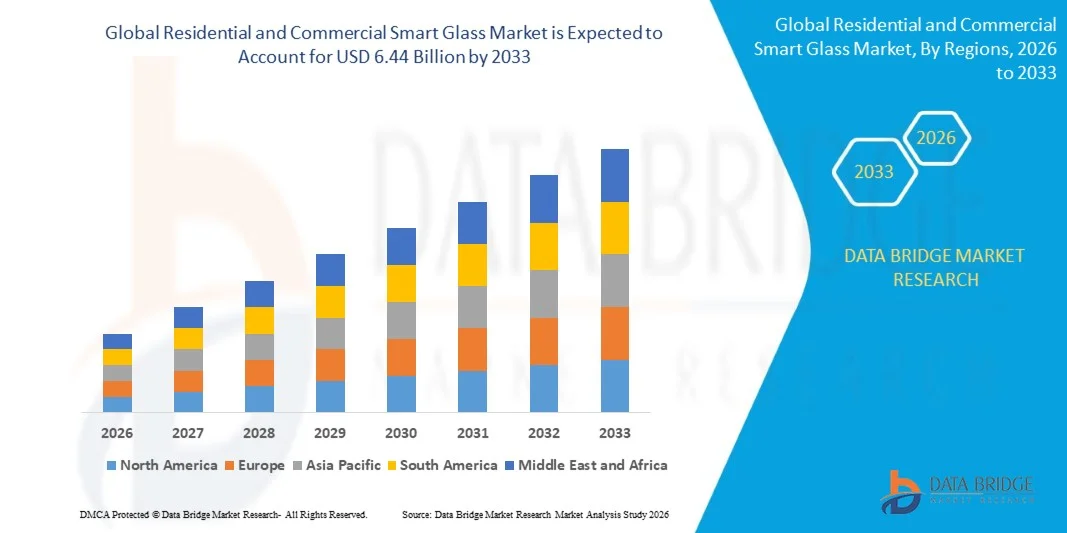
The Residential and Commercial Smart Glass Market was valued at USD 3.75 Billion in 2025 and is projected to reach USD 6.44 Billion by 2033, growing at a CAGR of 7.00% from 2026 to 2033. The market is experiencing consistent growth driven by increasing demand for energy-efficient building materials, rising adoption of smart building technologies, and growing investments in sustainable construction projects worldwide. Expanding implementation of green building standards and advancements in electrochromic, suspended particle display, and liquid crystal smart glass technologies are further supporting market expansion across both residential and commercial sectors.
The increasing global focus on reducing building energy consumption and enhancing occupant comfort, combined with stringent energy-efficiency regulations, is encouraging developers and property owners to adopt smart glass solutions in modern construction projects. Smart glass technologies are increasingly replacing conventional glazing systems by enabling dynamic control of light transmission, heat gain, and privacy while reducing reliance on artificial lighting and HVAC systems. Growing integration of smart glass with building automation platforms and rising investments in intelligent infrastructure are further accelerating market adoption across major construction markets worldwide.
Key Market Trends & Insights
- North America dominated the Residential and Commercial Smart Glass Market with the largest revenue share of 36.53% in 2025, supported by strong adoption of energy-efficient building technologies, increasing investments in smart infrastructure, and stringent building energy regulations
- The commercial segment led the market with a 67.4% share in 2025, driven by strong adoption across office buildings, hotels, hospitals, educational institutions, airports, and retail facilities
- Asia-Pacific is expected to be the fastest-growing region at a CAGR of 11.7% from 2026 to 2033, fueled by rapid urbanization, expanding construction activities, and increasing adoption of smart building technologies
- Suspended particle display is the fastest-growing technology type, projected to register a CAGR of 13.8% from 2026 to 2033, supported by increasing demand for instant light control and privacy solutions across commercial and residential applications
- The electrochromic segment dominated the technology category with a 39.8% revenue share in 2025, led by its superior ability to dynamically control light transmission, glare, and heat gain in buildings
- The residential segment is the fastest-growing architecture category, with a CAGR of 12.9% from 2026 to 2033, driven by increasing consumer awareness regarding energy-efficient homes and growing adoption of smart home technologies
Market Size & Forecast
- Global Market Value (2025): USD 3.75 Billion
- Expected Market Value (2033): USD 6.44 Billion
- Forecast CAGR (2026–2033): 7.00%
- Leading Region in 2025: North America
- Fastest Growing Region: Asia-Pacific
Report Scope and Residential and Commercial Smart Glass Market Segmentation
|
Attributes |
Residential and Commercial Smart Glass Key Market Insights |
|
Segments Covered |
|
|
Countries Covered |
North America · U.S. · Canada · Mexico Europe · Germany · France · U.K. · Netherlands · Switzerland · Belgium · Russia · Italy · Spain · Turkey · Rest of Europe Asia-Pacific · China · Japan · India · South Korea · Singapore · Malaysia · Australia · Thailand · Indonesia · Philippines · Rest of Asia-Pacific Middle East and Africa · Saudi Arabia · U.A.E. · South Africa · Egypt · Israel · Rest of Middle East and Africa South America · Brazil · Argentina · Rest of South America |
|
Key Market Players |
· SAGE Electrochromics, Inc. (U.S.) · Research Frontiers Inc. (U.S.) · View, Inc. (U.S.) · Asahi India Glass Limited (India) · GENTEX CORPORATION (U.S.) · Hitachi Chemical Co., Ltd. (Japan) · Glass Apps (U.S.) · Pleotint LLC. (U.S.) · Scienstry, Inc. (U.S.) · SPD Control Systems Corporation (U.S.) · Schott AG (Germany) · SmartGlass International (Ireland) · Corning Incorporated (U.S.) · Argil Inc. (U.S.) · Scienstry, Inc. (U.S.) |
|
Market Opportunities |
· Growing Adoption in Green Commercial Buildings · Expansion of Smart Home Construction · Rising Use in Healthcare and Hospitality Buildings |
|
Value Added Data Infosets |
In addition to the insights on market scenarios such as market value, growth rate, segmentation, geographical coverage, and major players, the market reports curated by the Data Bridge Market Research also include in-depth expert analysis, geographically represented company-wise production and capacity, network layouts of distributors and partners, detailed and updated price trend analysis and deficit analysis of supply chain and demand. |
Residential and Commercial Smart Glass Market Trends
Trend: Increasing Integration of Smart Glass in Smart Buildings
Building owners and developers are increasingly integrating smart glass technologies into smart building ecosystems to improve energy efficiency, occupant comfort, and automated environmental control. Smart glass solutions are being connected with building management systems to dynamically regulate daylight, glare, and indoor temperatures while reducing energy consumption. The trend is gaining momentum across commercial offices, healthcare facilities, airports, hotels, and premium residential developments. Advancements in electrochromic and suspended particle display technologies are further enhancing functionality and adoption across intelligent infrastructure projects.
Companies such as Saint-Gobain's SageGlass and View, Inc. are actively expanding smart glass deployments in commercial buildings, enabling automated tinting and energy management capabilities that support the growing development of connected and intelligent building environments.
Residential and Commercial Smart Glass Market Dynamics
Key Market Driver: Rising Demand for Energy-Efficient Building Materials
The growing emphasis on reducing building energy consumption and carbon emissions is significantly driving demand for smart glass solutions worldwide. Buildings account for nearly 30% of global final energy consumption according to the International Energy Agency (IEA), encouraging governments and developers to adopt advanced energy-efficient materials. Smart glass helps reduce dependence on artificial lighting and HVAC systems by controlling solar heat gain and natural light transmission. Increasing implementation of green building standards and sustainability regulations is further accelerating market adoption across residential and commercial sectors.
Major organizations such as Saint-Gobain, View, Inc., and AGC Inc. continue to invest in advanced smart glazing technologies that help building owners improve energy performance while meeting increasingly stringent environmental and efficiency requirements.
Key Restraint/Challenge: High Installation Costs of Smart Glass Solutions
A major challenge in the Residential and Commercial Smart Glass market is the relatively high upfront cost associated with smart glass products and installation. Smart glazing systems require advanced manufacturing processes, specialized materials, control units, and integration with building automation systems, resulting in higher costs compared to conventional glass solutions. Installation complexity and replacement expenses can further increase total project expenditure, particularly for large commercial developments. These cost considerations often limit adoption among budget-sensitive residential projects and small-scale construction developments.
Large-scale smart glass installations in commercial buildings frequently require significant capital investment for glazing systems, electrical integration, and control infrastructure, creating financial barriers that can delay deployment despite long-term energy-saving benefits.
Key Market Opportunity: Expansion of Smart Home Construction
The rapid expansion of smart home construction is creating significant growth opportunities for the Residential and Commercial Smart Glass market. Homeowners are increasingly adopting connected technologies that enhance comfort, privacy, convenience, and energy efficiency. Smart glass is becoming an important component of modern residential designs due to its ability to automatically adjust transparency, reduce heat gain, and integrate with home automation systems. Growing consumer demand for luxury and energy-efficient housing is further supporting adoption across residential applications.
Companies such as Asahi Glass, Gentex Corporation, and Pleotint LLC are expanding smart glazing offerings targeted toward residential markets, supporting the integration of intelligent glass technologies into next-generation smart homes and connected living environments.
Residential and Commercial Smart Glass Market Scope
The residential and commercial smart glass market is segmented on the basis of technology and architecture.
- By Technology
On the basis of technology, the Residential and Commercial Smart Glass Market is segmented into Suspended Particle Display, Electrochromic, Liquid Crystal, Micro-Blinds, Photochromic, and Thermochromic. The Electrochromic segment dominated the market with the largest share of 39.8% in 2025, driven by its superior ability to dynamically control light transmission, glare, and heat gain in buildings. Electrochromic smart glass is increasingly adopted across commercial offices, airports, healthcare facilities, and premium residential projects due to its energy-saving capabilities and enhanced occupant comfort. Growing emphasis on green building construction and energy-efficient infrastructure is accelerating deployment of electrochromic solutions worldwide. The technology also offers seamless integration with building automation systems, enabling intelligent daylight and temperature management. Continuous advancements in switching speed, durability, and large-area glass manufacturing further reinforce its leading market position.
The Suspended Particle Display (SPD) segment is projected to register the fastest growth at a CAGR of 13.8% from 2026 to 2033, driven by increasing demand for instant light control and privacy solutions across commercial and residential applications. SPD technology allows users to rapidly adjust glass transparency, making it highly suitable for smart buildings, luxury residences, hospitality spaces, and premium architectural projects. Rising investments in modern infrastructure and intelligent building systems are supporting wider adoption of SPD-based smart glass. Technological improvements in energy efficiency and optical performance are further enhancing commercial viability. Growing consumer preference for customizable and responsive glazing solutions is expected to accelerate segment expansion during the forecast period.
- By Architecture
On the basis of architecture, the Residential and Commercial Smart Glass Market is segmented into Commercial and Residential. The Commercial segment dominated the market with a share of 67.4% in 2025, supported by strong adoption across office buildings, hotels, hospitals, educational institutions, airports, and retail facilities. Commercial property developers are increasingly utilizing smart glass technologies to improve energy efficiency, reduce HVAC costs, and enhance indoor environmental quality. Rising implementation of sustainable building standards and green construction certifications is further driving demand. Smart glass solutions also provide improved aesthetics, privacy management, and occupant comfort, making them highly attractive for modern commercial developments. Large-scale investments in smart city and commercial infrastructure projects continue to strengthen segment dominance.
The Residential segment is projected to register the fastest growth at a CAGR of 12.9% from 2026 to 2033, driven by increasing consumer awareness regarding energy-efficient homes and growing adoption of smart home technologies. Homeowners are increasingly installing smart glass in windows, skylights, partitions, and doors to enhance privacy, reduce energy consumption, and improve living comfort. Rising disposable incomes and growing demand for luxury residential properties are supporting market growth. Advancements in smart glass affordability and integration with home automation systems are making the technology more accessible to residential users. Increasing focus on sustainable housing and intelligent living environments is expected to significantly accelerate adoption across global residential markets.
Residential and Commercial Smart Glass Market Regional Analysis
North America dominated the residential and commercial smart glass market and accounted for the largest revenue share of 36.53% in 2025, driven by strong adoption of energy-efficient building technologies, increasing investments in smart infrastructure, and stringent building energy regulations. The region benefits from a highly developed construction sector, widespread implementation of green building standards, and growing demand for intelligent glazing solutions across commercial and residential projects. Property developers are increasingly integrating smart glass into office buildings, healthcare facilities, airports, and luxury residential developments to improve energy efficiency and occupant comfort. Rising adoption of smart building management systems is further supporting market growth. In addition, the presence of leading smart glass manufacturers and advanced construction technology providers continues to reinforce North America’s leadership position in the global market.
U.S. Residential and Commercial Smart Glass Market Insight
The U.S. Residential and Commercial Smart Glass market is experiencing strong growth driven by increasing adoption of sustainable construction practices, rising investments in smart buildings, and growing demand for energy-efficient architectural solutions. Commercial developers are actively deploying smart glass technologies to reduce HVAC costs, improve daylight utilization, and enhance occupant well-being. The country's stringent energy-efficiency standards and expanding green building initiatives are accelerating product adoption across multiple sectors. Growing integration of smart glass with automated building management systems is further supporting market expansion. In addition, rising demand for premium residential properties with advanced home automation features is contributing to market growth across the U.S.
Canada Residential and Commercial Smart Glass Market Insight
The Canada Residential and Commercial Smart Glass market is witnessing steady growth supported by increasing focus on sustainable building development and rising adoption of energy-saving construction materials. Commercial and residential property owners are increasingly utilizing smart glass solutions to improve thermal efficiency and reduce energy consumption. The country’s commitment to carbon reduction targets and green infrastructure investments is encouraging deployment of advanced glazing technologies. Growing construction activity in urban areas and increasing awareness of intelligent building solutions are further supporting market demand. In addition, favorable government initiatives promoting energy-efficient buildings continue to contribute to market growth in Canada.
Europe Residential and Commercial Smart Glass Market Insight
The Europe Residential and Commercial Smart Glass market is expanding steadily due to stringent energy-efficiency regulations, growing adoption of sustainable construction materials, and increasing investments in smart building infrastructure. The region benefits from strong environmental policies that encourage the deployment of advanced glazing technologies to reduce building energy consumption. Commercial property developers are increasingly integrating smart glass into offices, transportation hubs, and healthcare facilities to enhance sustainability and operational efficiency. Rising demand for green-certified buildings is further supporting market growth. Continuous innovation in electrochromic and dynamic glass technologies continues to strengthen regional market expansion.
U.K. Residential and Commercial Smart Glass Market Insight
The U.K. Residential and Commercial Smart Glass market is growing steadily, driven by increasing investments in energy-efficient building renovations, rising adoption of smart home technologies, and strong demand for sustainable construction solutions. Property developers are incorporating smart glass technologies into commercial and residential projects to improve energy performance and occupant comfort. Growing emphasis on achieving net-zero building targets is accelerating demand for advanced glazing systems. The presence of a mature construction industry and increasing implementation of intelligent building technologies further support market development. In addition, rising refurbishment activities across commercial properties are strengthening market expansion in the U.K.
Germany Residential and Commercial Smart Glass Market Insight
The Germany Residential and Commercial Smart Glass market is expanding due to strong adoption of energy-efficient building technologies, increasing investments in sustainable infrastructure, and growing focus on reducing building-related carbon emissions. Commercial and residential developers are increasingly implementing smart glass solutions to comply with strict energy performance regulations and improve indoor environmental quality. The country's leadership in green construction practices is driving demand for advanced glazing materials. Growing integration of smart building automation systems is further enhancing market adoption. In addition, continued investments in modern commercial infrastructure are accelerating market development in Germany.
Asia-Pacific Residential and Commercial Smart Glass Market Insight
The Asia-Pacific Residential and Commercial Smart Glass market is expected to register the fastest growth with a CAGR of 11.7% from 2026 to 2033, driven by rapid urbanization, expanding construction activities, and increasing adoption of smart building technologies. Rising investments in commercial complexes, residential high-rises, airports, and smart city projects are significantly boosting demand for smart glass solutions. Countries such as China, India, Japan, and South Korea are witnessing strong implementation of energy-efficient construction practices and green building standards. Growing awareness regarding energy conservation and indoor comfort is further supporting market growth. In addition, increasing disposable income and demand for premium residential properties are accelerating regional market expansion.
Japan Residential and Commercial Smart Glass Market Insight
The Japan Residential and Commercial Smart Glass market is witnessing steady growth supported by strong technological innovation, increasing adoption of energy-efficient construction materials, and rising investments in intelligent building infrastructure. Developers are increasingly utilizing smart glass technologies to improve energy management and enhance occupant comfort in both residential and commercial properties. The country's advanced building automation ecosystem is supporting seamless integration of dynamic glazing systems. Growing focus on sustainable urban development and environmental conservation is further contributing to market growth. In addition, increasing demand for high-performance building materials is strengthening market expansion in Japan.
China Residential and Commercial Smart Glass Market Insight
The China Residential and Commercial Smart Glass market is growing rapidly due to large-scale urban development projects, expanding commercial construction activities, and increasing government support for green building initiatives. Developers are actively adopting smart glass technologies to improve building efficiency, reduce energy consumption, and enhance architectural aesthetics. The country’s strong manufacturing capabilities and growing investments in smart city infrastructure are enabling wider deployment of advanced glazing solutions. Rising demand for premium residential developments and intelligent commercial buildings is further supporting market growth. In addition, increasing implementation of energy-efficiency regulations is driving substantial market expansion in China.
Residential and Commercial Smart Glass Market Share
The residential and commercial smart glass industry is primarily led by well-established companies, including:
- SAGE Electrochromics, Inc. (U.S.)
- Research Frontiers Inc. (U.S.)
- View, Inc. (U.S.)
- Asahi India Glass Limited (India)
- GENTEX CORPORATION (U.S.)
- Hitachi Chemical Co., Ltd. (Japan)
- Glass Apps (U.S.)
- Pleotint LLC. (U.S.)
- Scienstry, Inc. (U.S.)
- SPD Control Systems Corporation (U.S.)
- Schott AG (Germany)
- SmartGlass International (Ireland)
- Corning Incorporated (U.S.)
- Argil Inc. (U.S.)
- Scienstry, Inc. (U.S.)
Latest Developments in Residential and Commercial Smart Glass Market
- In August 2025, Gauzy was selected as the exclusive smart glass supplier for one of the largest U.S. financial institutions to support deployment across its nationwide commercial office network. This development is expected to accelerate the adoption of smart glass technologies in large-scale commercial infrastructure by demonstrating the value of dynamic glazing solutions in improving energy efficiency, occupant comfort, and privacy management. The project further highlights growing demand for intelligent building materials as organizations increasingly invest in sustainable and smart workplace environments
- In July 2025, Gauzy and Research Frontiers announced the commercial production and delivery of Suspended Particle Device (SPD) smart glass technology for General Motors’ Cadillac CELESTIQ program. This milestone is expected to strengthen market confidence in SPD technology and encourage broader commercialization of advanced smart glass solutions. The successful scale-up of production capabilities demonstrates technological maturity and supports wider adoption of dynamic glazing products across architectural and residential applications
- In July 2025, Gauzy introduced the industry's first prefabricated smart glass stack designed to simplify manufacturing processes and improve production efficiency. This innovation is expected to reduce manufacturing complexity, lower installation barriers, and improve scalability for smart glass deployment across commercial and residential buildings. The development supports increasing market demand for cost-effective smart glazing solutions and is likely to enhance industry-wide adoption rates
- In January 2025, SageGlass, a subsidiary of Saint-Gobain, launched RealTone, an advanced electrochromic smart glass solution featuring a neutral visual appearance while maintaining high-performance daylight and heat management capabilities. This product introduction is expected to expand the appeal of electrochromic glass among architects, developers, and property owners seeking enhanced aesthetics alongside energy efficiency. The launch further strengthens innovation within the smart glass industry and supports growing penetration across premium residential and commercial construction projects
- In January 2025, Gauzy unveiled its Black SPD Smart Glass technology at CES 2025, expanding the range of intelligent glazing solutions available to the market. The innovation is expected to increase adoption of smart glass technologies by offering enhanced design flexibility, improved visual performance, and greater customization options for modern buildings. The development reflects the industry's continued focus on product innovation and supports the growing integration of smart materials within energy-efficient building designs

- Interactive Data Analysis Dashboard
- Company Analysis Dashboard for high growth potential opportunities
- Research Analyst Access for customization & queries
- Competitor Analysis with Interactive dashboard
- Latest News, Updates & Trend analysis
- Harness the Power of Benchmark Analysis for Comprehensive Competitor Tracking
Global Residential And Commercial Smart Glass Market, Supply Chain Analysis and Ecosystem Framework
To support market growth and help clients navigate the impact of geopolitical shifts, DBMR has integrated in-depth supply chain analysis into its Global Residential And Commercial Smart Glass Market research reports. This addition empowers clients to respond effectively to global changes affecting their industries. The supply chain analysis section includes detailed insights such as Global Residential And Commercial Smart Glass Market consumption and production by country, price trend analysis, the impact of tariffs and geopolitical developments, and import and export trends by country and HSN code. It also highlights major suppliers with data on production capacity and company profiles, as well as key importers and exporters. In addition to research, DBMR offers specialized supply chain consulting services backed by over a decade of experience, providing solutions like supplier discovery, supplier risk assessment, price trend analysis, impact evaluation of inflation and trade route changes, and comprehensive market trend analysis.
Data collection and base year analysis are done using data collection modules with large sample sizes. The stage includes obtaining market information or related data through various sources and strategies. It includes examining and planning all the data acquired from the past in advance. It likewise envelops the examination of information inconsistencies seen across different information sources. The market data is analysed and estimated using market statistical and coherent models. Also, market share analysis and key trend analysis are the major success factors in the market report. To know more, please request an analyst call or drop down your inquiry.
The key research methodology used by DBMR research team is data triangulation which involves data mining, analysis of the impact of data variables on the market and primary (industry expert) validation. Data models include Vendor Positioning Grid, Market Time Line Analysis, Market Overview and Guide, Company Positioning Grid, Patent Analysis, Pricing Analysis, Company Market Share Analysis, Standards of Measurement, Global versus Regional and Vendor Share Analysis. To know more about the research methodology, drop in an inquiry to speak to our industry experts.
Data Bridge Market Research is a leader in advanced formative research. We take pride in servicing our existing and new customers with data and analysis that match and suits their goal. The report can be customized to include price trend analysis of target brands understanding the market for additional countries (ask for the list of countries), clinical trial results data, literature review, refurbished market and product base analysis. Market analysis of target competitors can be analyzed from technology-based analysis to market portfolio strategies. We can add as many competitors that you require data about in the format and data style you are looking for. Our team of analysts can also provide you data in crude raw excel files pivot tables (Fact book) or can assist you in creating presentations from the data sets available in the report.













