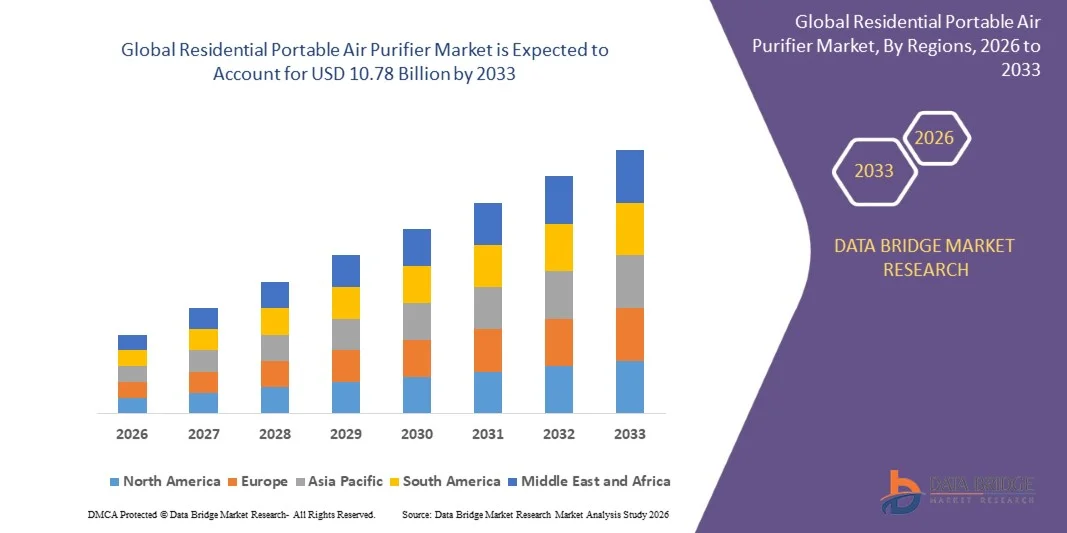
Residential Portable Air Purifier Market Size
- The global residential portable air purifier market size was valued at USD 6.00 billion in 2025 and is expected to reach USD 10.78 billion by 2033, at a CAGR of 7.60% during the forecast period
- The market growth is largely fueled by increasing awareness of indoor air quality and rising concerns over respiratory health, which are driving the adoption of residential portable air purifiers. Technological advancements in filtration systems, including HEPA, activated carbon, and smart connectivity features, are enhancing product efficiency and convenience, making air purifiers a preferred choice for health-conscious consumers
- Furthermore, rising consumer demand for energy-efficient, user-friendly, and smart-integrated air purifiers is establishing these devices as essential components of modern homes. These converging factors are accelerating the adoption of advanced purification solutions, thereby significantly boosting the industry’s growth
Residential Portable Air Purifier Market Analysis
- Residential portable air purifiers, designed to remove airborne pollutants, allergens, and pathogens, are increasingly becoming integral to improving indoor air quality in homes. Their portability, ease of use, and capability to integrate with smart home systems make them highly desirable in both urban and suburban residential settings
- The escalating demand for residential air purifiers is primarily driven by rising pollution levels, increasing prevalence of respiratory diseases, and growing awareness about the benefits of clean indoor air. In addition, the integration of smart features such as app-based control, air quality monitoring, and voice assistance is further fueling market expansion and adoption among tech-savvy consumers
- North America dominated residential portable air purifier market with a share of 41.5% in 2025, due to growing awareness of indoor air quality, increasing health concerns, and rising adoption of smart home devices
- Asia-Pacific is expected to be the fastest growing region in the residential portable air purifier market during the forecast period due to increasing urbanization, rising disposable incomes, and worsening air pollution in countries such as China, India, and Japan
- HEPA segment dominated the market with a market share of 47% in 2025, due to its proven efficiency in removing fine particulate matter, allergens, and airborne pollutants. Homeowners often prefer HEPA purifiers for their consistent performance and ability to improve indoor air quality effectively. The segment also benefits from high consumer awareness of health impacts caused by dust, pollen, and other airborne irritants. Compatibility with various room sizes and the availability of multi-stage filtration systems further enhance the demand for HEPA purifiers
Report Scope and Residential Portable Air Purifier Market Segmentation
|
Attributes |
Residential Portable Air Purifier Key Market Insights |
|
Segments Covered |
|
|
Countries Covered |
North America
Europe
Asia-Pacific
Middle East and Africa
South America
|
|
Key Market Players |
|
|
Market Opportunities |
|
|
Value Added Data Infosets |
In addition to the insights on market scenarios such as market value, growth rate, segmentation, geographical coverage, and major players, the market reports curated by the Data Bridge Market Research also include in-depth expert analysis, pricing analysis, brand share analysis, consumer survey, demography analysis, supply chain analysis, value chain analysis, raw material/consumables overview, vendor selection criteria, PESTLE Analysis, Porter Analysis, and regulatory framework. |
Residential Portable Air Purifier Market Trends
Rising Adoption of Smart and Connected Air Purifiers
- A prominent trend in the residential portable air purifier market is the growing adoption of smart and connected devices integrated with advanced sensors and IoT-enabled controls. Consumers are increasingly opting for air purifiers that provide real-time monitoring, remote operability, and automated air quality adjustments to enhance convenience and efficiency in maintaining healthier indoor spaces
- For instance, LG Electronics introduced its PuriCare smart air purifier series equipped with Wi-Fi connectivity and AI-based air quality sensors. These models automatically adjust filtration intensity based on detected particulate matter levels and can be managed through mobile applications, offering a seamless connected-home experience
- The integration of IoT, mobile app interfaces, and voice-assistant compatibility with platforms such as Alexa and Google Assistant is transforming how users interact with portable air purifiers. Smart connectivity allows continuous air monitoring and automation linked to weather conditions, occupancy, and pollution data for improved performance
- Artificial intelligence and sensor innovations are enabling precise detection of pollutants, allergens, and volatile organic compounds. Modern air purifiers equipped with laser sensors, HEPA 13 filters, and activated carbon combinations ensure better filtration efficiency while optimizing energy usage and noise levels
- Cloud-based data analytics are also being leveraged to provide users with insights on indoor air trends, filter life, and energy consumption patterns. These features enhance user engagement while supporting predictive maintenance for extended product lifespan
- The shift toward smart and connected air cleaning systems highlights the industry’s movement toward personalized indoor health management. This evolution is reinforcing the role of portable air purifiers as an essential component of modern, technology-driven home environments
Residential Portable Air Purifier Market Dynamics
Driver
Increasing Awareness of Indoor Air Quality and Health Concerns
- The rising awareness of air pollution and its adverse effects on respiratory health is a major driver fueling residential portable air purifier adoption. Growing urbanization, coupled with deteriorating indoor air conditions caused by dust, allergens, and household chemicals, is encouraging consumers to invest in high-efficiency air cleaning devices
- For instance, Philips Domestic Appliances launched its advanced series of HEPA and NanoProtect-equipped air purifiers tailored for urban households. These systems focus on reducing airborne irritants, pet dander, and fine particles, catering to rising concerns about allergies and long-term respiratory well-being
- Studies linking poor air quality to asthma, cardiovascular diseases, and weakened immunity have prompted families to prioritize clean indoor environments. This awareness has driven demand from both health-conscious consumers and those seeking preventive wellness solutions
- Government health advisories and environmental campaigns are also promoting indoor air purification as an essential household measure. E-commerce platforms and retail suppliers are further amplifying awareness through smart device marketing and bundled health product offerings
- As consumer preferences continue to shift toward health-oriented and energy-efficient appliances, demand for portable air purifiers equipped with advanced purification layers and digital monitoring capabilities will continue to strengthen. This growing health consciousness underpins long-term market expansion opportunities across all demographics
Restraint/Challenge
High Cost of Advanced and Multi-Functional Air Purifiers
- The high cost of advanced portable air purifiers featuring multi-layer filtration and smart technology integration poses a significant challenge to market growth. Premium pricing often restricts adoption among cost-sensitive consumers, particularly in emerging markets where awareness is rising but affordability remains limited
- For instance, brands such as Dyson and Blueair offer high-end purifiers incorporating HEPA, activated carbon, and UV-based filtration technologies with smart connectivity and digital sensors. Although these models deliver exceptional efficiency, their elevated prices limit accessibility for middle-income households
- The cost burden results from sophisticated hardware components and also from advanced sensors, connectivity modules, and research-intensive product design. In addition, recurring expenses related to filter replacements and maintenance contribute to higher long-term ownership costs
- Economic disparities and varying levels of consumer purchasing power across different regions create uneven market penetration. Manufacturers targeting mass markets face challenges in balancing product affordability with performance quality without compromising brand reliability
- Addressing these cost challenges through scalable production, innovative filter materials, and modular design approaches will be essential. Expanding cost-efficient smart purifier ranges and introducing subscription-based filter replacement models could enable wider consumer adoption and sustained market growth for residential portable air purifiers
Residential Portable Air Purifier Market Scope
The market is segmented on the basis of type, price range, and distribution channel.
- By Type
On the basis of type, the residential portable air purifier market is segmented into HEPA, Active Carbon, Electrostatic Precipitator, Ion and Ozone Generator, and Others. The HEPA segment dominated the market with the largest market revenue share of 47% in 2025, driven by its proven efficiency in removing fine particulate matter, allergens, and airborne pollutants. Homeowners often prefer HEPA purifiers for their consistent performance and ability to improve indoor air quality effectively. The segment also benefits from high consumer awareness of health impacts caused by dust, pollen, and other airborne irritants. Compatibility with various room sizes and the availability of multi-stage filtration systems further enhance the demand for HEPA purifiers.
The Ion and Ozone Generator segment is anticipated to witness the fastest growth rate of 19.8% from 2026 to 2033, fueled by increasing interest in advanced air purification technologies. These purifiers offer additional benefits such as odor neutralization and microbial reduction, making them attractive to health-conscious consumers. The compact design and energy efficiency of ionizing purifiers support their growing adoption in small apartments and personal spaces. In addition, manufacturers are integrating smart features and remote control options, increasing their appeal to tech-savvy users. Rising awareness of indoor air pollution and demand for multi-functional devices further drive this segment's expansion.
- By Price Range
On the basis of price range, the residential portable air purifier market is segmented into Low Price Range, Medium Price Range, and High Price Range. The Medium Price Range segment dominated the market with the largest revenue share in 2025, driven by its balance of affordability and advanced features. Consumers are increasingly seeking purifiers that provide effective filtration without high upfront costs, making mid-range options highly attractive. For instance, brands such as Philips and Honeywell have expanded their medium-range product lines to include HEPA and multi-stage purifiers, catering to households seeking reliable performance. The segment also benefits from increasing awareness of health and wellness, prompting buyers to invest in better-quality purifiers without overspending.
The High Price Range segment is expected to witness the fastest CAGR from 2026 to 2033, fueled by rising demand for premium devices offering smart integration, real-time air quality monitoring, and multi-functional purification. These high-end purifiers often combine HEPA, carbon, and UV-C technologies to ensure superior performance, making them preferred in urban homes with severe pollution. Consumers are drawn to aesthetic designs and quiet operation, which enhance convenience and home décor compatibility. In addition, the surge in disposable income and growing focus on health and wellness among urban populations support this segment’s rapid growth.
- By Distribution Channel
On the basis of distribution channel, the residential portable air purifier market is segmented into Online and Offline. The Offline segment dominated the market with the largest revenue share in 2025, driven by consumer preference for physically inspecting devices before purchase and accessing after-sales support. Retail stores allow customers to evaluate noise levels, design, and filter replacement mechanisms firsthand, making offline channels crucial for brand trust. For instance, retail chains such as Best Buy and Home Depot continue to drive strong offline sales by offering in-store demonstrations and expert consultations. Brand visibility and consumer confidence contribute to the continued dominance of offline distribution in the residential segment.
The Online segment is anticipated to witness the fastest growth rate of 22.3% from 2026 to 2033, fueled by increasing e-commerce penetration and convenience of doorstep delivery. Online platforms provide detailed product descriptions, customer reviews, and easy price comparisons, enabling informed purchase decisions. In addition, the growing trend of digital-first consumers and festive or seasonal online promotions contribute to rapid adoption. The COVID-19 pandemic further accelerated online purchases, making this channel increasingly critical for reaching tech-savvy and urban buyers seeking contactless shopping options.
Residential Portable Air Purifier Market Regional Analysis
- North America dominated the residential portable air purifier market with the largest revenue share of 41.5% in 2025, driven by growing awareness of indoor air quality, increasing health concerns, and rising adoption of smart home devices
- Consumers in the region highly value advanced filtration technologies, portability, and the convenience offered by air purifiers integrated with smart controls and mobile apps
- This widespread adoption is further supported by high disposable incomes, a health-conscious population, and the growing preference for energy-efficient, low-noise devices, establishing residential air purifiers as a favored solution for both homes and offices
U.S. Residential Portable Air Purifier Market Insight
The U.S. residential portable air purifier market captured the largest revenue share in 2025 within North America, fueled by heightened awareness of air pollution and the increasing prevalence of respiratory illnesses. Consumers are increasingly prioritizing devices with HEPA and multi-stage filtration systems that effectively remove allergens, dust, and airborne pathogens. The growing preference for smart, app-controlled purifiers, coupled with strong e-commerce growth and availability of premium devices from brands such as Dyson and Honeywell, further propels market expansion. Moreover, seasonal air quality concerns and rising interest in wellness and home comfort continue to drive demand.
Europe Residential Portable Air Purifier Market Insight
The Europe residential portable air purifier market is projected to expand at a substantial CAGR throughout the forecast period, primarily driven by increasing urban pollution, regulatory emphasis on indoor air quality, and growing health awareness. The adoption of purifiers is also fueled by rising consumer preference for compact, energy-efficient devices suitable for apartments and homes. Countries such as Germany, France, and Italy are witnessing significant growth across residential and commercial spaces, with purifiers being integrated into both newly built and renovated properties.
U.K. Residential Portable Air Purifier Market Insight
The U.K. residential portable air purifier market is anticipated to grow at a noteworthy CAGR during the forecast period, driven by the rising concern for indoor air pollution and its impact on health, particularly allergies and asthma. In addition, urbanization, smaller living spaces, and an increasing preference for smart, portable purification devices are encouraging adoption. The UK’s strong e-commerce infrastructure and growing availability of mid-to-high-end air purifiers support market expansion, with consumers showing increasing interest in multi-functional devices offering HEPA, carbon, and ionization technologies.
Germany Residential Portable Air Purifier Market Insight
The Germany residential portable air purifier market is expected to expand at a considerable CAGR during the forecast period, fueled by growing environmental awareness, rising pollution levels, and emphasis on health and wellness. Germany’s developed infrastructure, strong purchasing power, and consumer preference for technologically advanced and energy-efficient appliances promote adoption. Integration of purifiers with smart home systems and the availability of devices featuring low noise levels and multi-stage filtration are further supporting market growth in both residential and office environments.
Asia-Pacific Residential Portable Air Purifier Market Insight
The Asia-Pacific residential portable air purifier market is poised to grow at the fastest CAGR during the forecast period of 2026 to 2033, driven by increasing urbanization, rising disposable incomes, and worsening air pollution in countries such as China, India, and Japan. The region's growing awareness of health and indoor air quality, along with government initiatives promoting clean air and digital adoption, is driving demand. In addition, APAC is emerging as a manufacturing hub for affordable air purifiers, making advanced filtration technologies accessible to a broader consumer base.
Japan Residential Portable Air Purifier Market Insight
The Japan residential portable air purifier market is gaining momentum due to rapid urbanization, a high-tech lifestyle, and the population's focus on health and wellness. Consumers increasingly prefer compact, efficient purifiers with HEPA, carbon, and ionization technologies suitable for apartments and smaller homes. Integration with smart home systems and mobile apps, along with demand from an aging population seeking easy-to-use devices, is fueling growth in both residential and commercial sectors.
China Residential Portable Air Purifier Market Insight
The China residential portable air purifier market accounted for the largest market revenue share in Asia-Pacific in 2025, attributed to rapid urbanization, rising pollution levels, and a growing middle-class population. China is one of the largest markets for home appliances and smart devices, with strong demand for HEPA and multi-functional purifiers in residential and commercial spaces. Government initiatives promoting clean air, coupled with affordable products from domestic manufacturers, are key factors driving market expansion in the country.
Residential Portable Air Purifier Market Share
The residential portable air purifier industry is primarily led by well-established companies, including:
- Godrej (India)
- Electrolux (Sweden)
- Haier Inc. (China)
- Koninklijke Philips N.V. (Netherlands)
- Hitachi Appliances, Inc. (Japan)
- SAMSUNG (South Korea)
- Whirlpool Corporation (U.S.)
- LG Electronics (South Korea)
- BSH Home Appliances Group (Germany)
- Honeywell International Inc. (U.S.)
- SHARP CORPORATION (Japan)
- KENT RO Systems Ltd. (India)
- Panasonic Corporation (Japan)
- Dyson (U.K.)
- Levoit (U.S.)
- Xiaomi (China)
- 3M (U.S.)
- Guardian Technologies (U.S.)
- Molekule (U.S.)
Latest Developments in Global Residential Portable Air Purifier Market
- In September 2025, Shark introduced pastel-colored variants of its “NeverChange5 Compact Pro” air purifier, specifically targeting small rooms, dormitories, and urban apartments. This launch strengthens market appeal among younger and design-conscious consumers, highlighting the growing importance of aesthetic and space-efficient products in the residential segment. Coupled with its advanced filtration performance, the new models are likely to stimulate adoption in densely populated areas where compact, stylish, and efficient purifiers are in high demand
- In May 2025, the European Union passed the new Air Quality Directive, enforcing stricter regulations to improve indoor and outdoor air quality. This directive is expected to drive significant growth in the residential portable air purifier market across EU member states, as consumers and businesses increasingly adopt air purifiers to comply with regulatory standards. The mandate encourages the use of advanced filtration technologies and promotes healthier indoor environments, thereby expanding market demand for both mid-range and premium air purifiers
- In April 2025, Coway, a leading South Korean home appliance company, raised USD 200 million in a Series E funding round to expand its product offerings and global footprint. This investment is expected to intensify competition within the residential air purifier market, driving innovation in smart, energy-efficient, and multi-functional devices. The funding also enables Coway to target emerging markets and enhance its distribution network, thereby increasing accessibility and accelerating adoption of advanced air purifiers worldwide
- In March 2024, Dyson and IKEA announced a strategic partnership to distribute Dyson’s air purifiers through IKEA stores globally. This collaboration significantly expands Dyson’s market reach, making high-performance air purifiers more widely accessible to residential consumers. By combining Dyson’s technological expertise with IKEA’s global retail presence, the partnership is poised to increase consumer awareness and adoption of premium air purification solutions, particularly in urban and high-income regions
- In January 2024, Blueair launched its Sense+ Pro model, featuring Wi-Fi connectivity and voice control integration. This development strengthens the market for smart residential air purifiers, appealing to tech-savvy consumers seeking convenience, remote control, and seamless integration with home automation systems. The product’s advanced features and compatibility with digital ecosystems are likely to boost demand for connected air purifiers and accelerate the shift toward intelligent, IoT-enabled purification solutions

- Interactive Data Analysis Dashboard
- Company Analysis Dashboard for high growth potential opportunities
- Research Analyst Access for customization & queries
- Competitor Analysis with Interactive dashboard
- Latest News, Updates & Trend analysis
- Harness the Power of Benchmark Analysis for Comprehensive Competitor Tracking
Data collection and base year analysis are done using data collection modules with large sample sizes. The stage includes obtaining market information or related data through various sources and strategies. It includes examining and planning all the data acquired from the past in advance. It likewise envelops the examination of information inconsistencies seen across different information sources. The market data is analysed and estimated using market statistical and coherent models. Also, market share analysis and key trend analysis are the major success factors in the market report. To know more, please request an analyst call or drop down your inquiry.
The key research methodology used by DBMR research team is data triangulation which involves data mining, analysis of the impact of data variables on the market and primary (industry expert) validation. Data models include Vendor Positioning Grid, Market Time Line Analysis, Market Overview and Guide, Company Positioning Grid, Patent Analysis, Pricing Analysis, Company Market Share Analysis, Standards of Measurement, Global versus Regional and Vendor Share Analysis. To know more about the research methodology, drop in an inquiry to speak to our industry experts.
Data Bridge Market Research is a leader in advanced formative research. We take pride in servicing our existing and new customers with data and analysis that match and suits their goal. The report can be customized to include price trend analysis of target brands understanding the market for additional countries (ask for the list of countries), clinical trial results data, literature review, refurbished market and product base analysis. Market analysis of target competitors can be analyzed from technology-based analysis to market portfolio strategies. We can add as many competitors that you require data about in the format and data style you are looking for. Our team of analysts can also provide you data in crude raw excel files pivot tables (Fact book) or can assist you in creating presentations from the data sets available in the report.