


Residue Testing Market Size
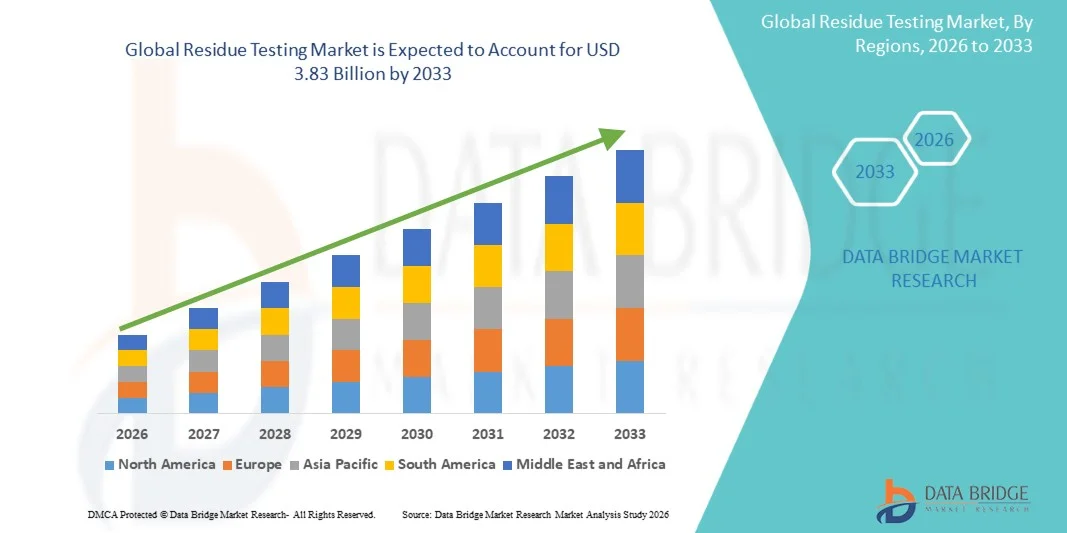
- The global residue testing market size was valued at USD 2.20 billion in 2025 and is expected to reach USD 3.83 billion by 2033, at a CAGR of 7.20% during the forecast period
- The market growth is largely fueled by the increasing adoption of stringent food safety regulations, continuous technological advancements in analytical testing equipment, and rising digitalization across food production, agriculture, and supply chain monitoring systems.
- Furthermore, growing consumer demand for safe, high-quality, and contaminant-free food products is establishing Residue Testing as a critical component of modern food quality assurance and regulatory compliance. These converging factors are accelerating the uptake of Residue Testing solutions, thereby significantly boosting the industry's growth
Residue Testing Market Analysis
- Residue Testing solutions, including pesticide residue analysis, veterinary drug residue testing, mycotoxin screening, heavy metal detection, and contaminant monitoring, are increasingly vital components of modern food safety and quality assurance systems across agricultural, food processing, and export industries due to their role in ensuring regulatory compliance and consumer protection
- The escalating demand for Residue Testing is primarily fueled by stringent food safety regulations, rising global trade of food products, growing consumer awareness regarding food contamination, and increasing preference for safe and traceable food supplies
- North America dominated the residue testing market with the largest revenue share of 39.4% in 2025, characterized by advanced laboratory infrastructure, strict regulatory frameworks, high food safety awareness, and strong presence of leading testing service providers, with the U.S. experiencing substantial growth in residue testing demand across processed foods, dairy, meat, and agricultural exports
- Asia-Pacific is expected to be the fastest-growing region in the residue testing market during the forecast period, projected to register a CAGR of approximately 8.9%, due to increasing food exports, rising urbanization, growing disposable incomes, expanding food processing industries, and stronger enforcement of food safety standards
- The food safety segment held the largest market revenue share of 52.4% in 2025, driven by growing regulatory scrutiny and rising consumer concerns over contaminated food products. Testing is essential across dairy, meat, seafood, cereals, and beverages
Report Scope and Residue Testing Market Segmentation
|
Attributes |
Residue Testing Key Market Insights |
|
Segments Covered |
|
|
Countries Covered |
North America
Europe
Asia-Pacific
Middle East and Africa
South America
|
|
Key Market Players |
• SGS SA (Switzerland) |
|
Market Opportunities |
|
|
Value Added Data Infosets |
In addition to the insights on market scenarios such as market value, growth rate, segmentation, geographical coverage, and major players, the market reports curated by the Data Bridge Market Research also include in-depth expert analysis, patient epidemiology, pipeline analysis, pricing analysis, and regulatory framework. |
Residue Testing Market Trends
“Increasing Adoption of Rapid Testing Technologies and Automated Analytical Systems”
- A significant and accelerating trend in the global Residue Testing market is the growing adoption of rapid testing technologies, automated laboratory systems, and advanced analytical instruments to improve the speed, accuracy, and efficiency of residue detection across food, agriculture, pharmaceutical, and environmental applications. This trend is helping manufacturers and regulators strengthen product safety and quality assurance standards
- For instance, companies are increasingly deploying LC-MS/MS (Liquid Chromatography–Mass Spectrometry) and GC-MS (Gas Chromatography–Mass Spectrometry) platforms for detecting pesticide residues, veterinary drug residues, and contaminants in food products. Rapid immunoassay kits are also being used for on-site screening in dairy, meat, and grain industries
- Advanced residue testing systems enable laboratories to simultaneously detect multiple contaminants in a single sample, reducing turnaround time and operational costs. For example, multi-residue testing methods can identify hundreds of pesticides or antibiotic traces in fruits, vegetables, and processed foods with high precision
- The integration of automated sample preparation systems and digital laboratory workflows is improving productivity and reducing human error. Through centralized software platforms, laboratories can manage sample tracking, reporting, compliance documentation, and result validation more efficiently
- This trend toward faster, more reliable, and regulation-compliant testing is reshaping industry expectations for quality control. Consequently, companies such as Eurofins Scientific, SGS, Bureau Veritas, and Intertek are expanding residue testing capabilities globally
- Demand for residue testing solutions is rising rapidly across food processing companies, exporters, pharmaceutical manufacturers, and government agencies as safety regulations become stricter worldwide
Residue Testing Market Dynamics
Driver
“Growing Need Due to Rising Food Safety Concerns and Stringent Regulatory Standards”
- Increasing consumer awareness regarding food safety, along with stricter global regulations on contaminants and chemical residues, is a major driver for the residue testing market. Governments and regulatory bodies are enforcing maximum residue limits (MRLs) for pesticides, antibiotics, heavy metals, and toxins in food and agricultural products
- For instance, in April 2025, several exporting countries strengthened residue monitoring programs for fruits, vegetables, and seafood to meet international trade standards set by the European Union and North America. Such initiatives are expected to support market growth during the forecast period
- As consumers become more health-conscious, food producers are investing in regular residue testing to maintain brand reputation and ensure regulatory compliance. Testing helps prevent recalls, import rejections, and legal penalties
- Furthermore, the expansion of global food trade is increasing the need for standardized residue testing, as products shipped internationally must comply with different regional safety requirements
- Rising demand for organic foods, clean-label products, and sustainable farming practices is also driving testing adoption, as buyers increasingly expect transparency regarding chemical usage and contamination risks
Restraint/Challenge
“High Testing Costs and Complexity of Multi-Residue Analysis”
- The high cost of advanced analytical instruments, laboratory infrastructure, and skilled personnel remains a major challenge for broader market adoption, especially in developing regions and small-scale industries. Equipment such as LC-MS/MS and GC-MS requires substantial capital investment and ongoing maintenance
- For instance, many small food processors and agricultural cooperatives in emerging economies rely on third-party laboratories because establishing in-house residue testing facilities is financially challenging
- In addition to cost barriers, residue testing procedures can be technically complex due to the need to detect multiple chemicals across different sample types such as fruits, meat, water, and pharmaceuticals. Matrix interference and varying detection thresholds can complicate results
- Delays in testing turnaround times, especially during peak export seasons, may also disrupt supply chains and delay shipments. This creates operational pressure for exporters and manufacturers
- Frequent updates in residue regulations across countries require laboratories to continuously upgrade methods and maintain certifications, adding to compliance costs
- Overcoming these challenges through affordable rapid test kits, laboratory automation, harmonized regulations, and expanded testing infrastructure will be essential for sustained market growth
Residue Testing Market Scope
The market is segmented on the basis of technology, residue type, application, and end user.
• By Technology
On the basis of technology, the Residue Testing market is segmented into chromatography, immunoassay, spectroscopy, rapid test kits, and others. The chromatography segment dominated the largest market revenue share of 41.8% in 2025, driven by its high accuracy, sensitivity, and capability to detect multiple residues simultaneously. Techniques such as HPLC and GC are widely used for pesticide, antibiotic, and contaminant analysis in food samples. Regulatory laboratories prefer chromatography for compliance testing. Increasing global food exports require validated and standardized methods. Rising consumer demand for safe food products supports adoption. Advanced chromatography systems reduce turnaround times and improve productivity. Pharmaceutical and agricultural sectors also rely on these methods. Investments in automated laboratory infrastructure further strengthen demand. Developed economies continue to lead installations of advanced chromatography platforms. Strong acceptance across government testing facilities sustains market dominance. Continuous innovations in hybrid analytical systems further enhance growth.
The rapid test kits segment is projected to witness the fastest CAGR of 9.7% from 2026 to 2033, owing to growing demand for quick, low-cost, and on-site residue screening solutions. Food manufacturers increasingly require instant testing before shipment. Rapid kits reduce dependence on centralized laboratories. Advancements in portable diagnostics improve detection reliability. Rising adoption in developing countries supports growth. Retail chains are implementing quick screening for quality assurance. Increasing awareness regarding contamination risks boosts demand. User-friendly formats enable adoption by small processors and farms. Expansion of point-of-care analytical technologies further supports uptake. Growing e-commerce food supply chains also accelerate this segment.
• By Residue Type
On the basis of residue type, the Residue Testing market is segmented into pesticides, veterinary drugs, toxins, heavy metals, and others. The pesticides segment accounted for the largest market revenue share of 38.6% in 2025, driven by strict regulations on pesticide limits in fruits, vegetables, grains, and processed foods. Governments worldwide are tightening maximum residue level (MRL) standards. Exporters require regular pesticide screening to access global markets. Increasing use of crop protection chemicals supports testing demand. Consumer preference for organic and clean-label food also drives growth. Laboratories are expanding multi-residue pesticide testing capabilities. Food recalls linked to contamination further strengthen market need. Rising agricultural production in Asia-Pacific contributes significantly. Continuous updates in food safety standards sustain dominance.
The veterinary drugs segment is expected to witness the fastest CAGR of 10.2% from 2026 to 2033, fueled by rising meat and dairy consumption globally. Antibiotic and hormone monitoring in livestock products is becoming critical. Concerns over antimicrobial resistance increase testing frequency. Governments are enforcing stricter residue thresholds in poultry and seafood. Expansion of commercial livestock farming supports demand. Export-oriented meat producers are investing in residue monitoring programs. Growth in aquaculture further boosts testing requirements. Improved immunoassay and LC-MS methods accelerate adoption.
• By Application
On the basis of application, the Residue Testing market is segmented into food safety, pharmaceuticals, environmental monitoring, agriculture, and others. The food safety segment held the largest market revenue share of 52.4% in 2025, driven by growing regulatory scrutiny and rising consumer concerns over contaminated food products. Testing is essential across dairy, meat, seafood, cereals, and beverages. Increasing foodborne illness outbreaks have intensified monitoring programs. Retailers are demanding certified quality assurance from suppliers. Globalization of food trade raises the need for harmonized testing standards. Governments continue investing in national food control laboratories. Adoption of automated sample preparation systems supports throughput. Rising processed food consumption also strengthens demand. Continuous product recalls further reinforce this segment’s leadership.
The environmental monitoring segment is anticipated to witness the fastest CAGR of 9.4% from 2026 to 2033, driven by increasing concern regarding soil, water, and air contamination from agricultural chemicals and industrial waste. Governments are mandating pollution surveillance programs. Residue testing is expanding in wastewater treatment and groundwater analysis. Sustainability initiatives are supporting environmental diagnostics. Growing public awareness of ecosystem health boosts demand. Industrial compliance audits further contribute to growth. Advanced portable analyzers are improving field testing efficiency. Expansion of green regulations globally accelerates adoption.
• By End User
On the basis of end user, the Residue Testing market is segmented into food manufacturers, laboratories, government agencies, research institutes, and others. The laboratories segment dominated the largest market revenue share of 44.1% in 2025, driven by centralized testing demand, technical expertise, and access to advanced analytical instruments. Independent and contract labs process high sample volumes for exporters and manufacturers. Accredited laboratories are trusted for regulatory certifications. Investments in automation and skilled workforce strengthen their position. Outsourcing of testing by small food companies boosts revenues. Increasing demand for third-party validation supports segment growth. Expansion of global laboratory networks further enhances market presence. Continuous upgrades in analytical platforms sustain leadership.
The food manufacturers segment is projected to witness the fastest CAGR of 10.5% from 2026 to 2033, owing to increasing in-house quality control programs and real-time contamination screening. Producers aim to reduce recall risks and maintain brand reputation. Growing adoption of rapid test kits supports internal testing. Large processors are building dedicated analytical labs. Rising private label food production also drives demand. Integration of residue testing into production workflows accelerates growth. Increasing compliance pressure from retailers further supports expansion.
Residue Testing Market Regional Analysis
- North America dominated the residue testing market with the largest revenue share of approximately 39.4% in 2025, characterized by advanced laboratory infrastructure, strict regulatory frameworks, high food safety awareness, and strong presence of leading testing service providers
- The region is witnessing substantial growth in residue testing demand across processed foods, dairy, meat, beverages, and agricultural exports, supported by stringent quality compliance requirements and increasing consumer focus on food safety
- Strong adoption of advanced analytical technologies, expanding trade activities, and increasing third-party laboratory outsourcing continue to strengthen North America’s leadership in the global Residue Testing market
U.S. Residue Testing Market Insight
The U.S. residue testing market captured the largest revenue share within North America in 2025, driven by robust regulatory oversight, high consumption of packaged and processed foods, and increasing demand for pesticide, antibiotic, and contaminant testing across food supply chains. The country benefits from a strong network of accredited laboratories, advanced chromatography and spectroscopy technologies, and growing export compliance requirements. Furthermore, increasing awareness regarding foodborne risks and traceability standards is accelerating market growth.
Europe Residue Testing Market Insight
The Europe residue testing market is projected to expand at a substantial CAGR throughout the forecast period, primarily driven by stringent food safety regulations, increasing imports of agricultural commodities, and strong emphasis on consumer health protection. The region’s mature food processing industry and rising demand for clean-label products are supporting greater use of residue analysis services. In addition, regulatory monitoring of pesticides, veterinary drugs, and heavy metals continues to create sustained demand across European markets.
U.K. Residue Testing Market Insight
The U.K. residue testing market is anticipated to grow at a noteworthy CAGR during the forecast period, driven by rising food safety standards, growing demand for certified imports, and increasing focus on supply chain transparency. Expanding packaged food consumption and higher adoption of laboratory quality assurance programs are further supporting market growth. In addition, demand from retailers and foodservice operators for strict compliance testing is expected to accelerate adoption.
Germany Residue Testing Market Insight
The Germany residue testing market is expected to expand at a considerable CAGR during the forecast period, fueled by advanced food manufacturing capabilities, strong export orientation, and increasing emphasis on premium-quality food standards. Germany’s well-developed testing infrastructure and focus on technological innovation are supporting widespread adoption of rapid and high-precision residue analysis methods. The country’s commitment to sustainability and food traceability also aligns with growing demand for residue testing solutions.
Asia-Pacific Residue Testing Market Insight
The Asia-Pacific residue testing market is expected to be the fastest-growing region during the forecast period, projected to register a CAGR of approximately 8.9%, due to increasing food exports, rising urbanization, growing disposable incomes, expanding food processing industries, and stronger enforcement of food safety standards. Governments across the region are investing in laboratory modernization and export certification systems to improve international competitiveness. Rising demand for safe packaged foods is further boosting market expansion.
Japan Residue Testing Market Insight
The Japan residue testing market is gaining momentum due to the country’s strict food quality standards, advanced laboratory ecosystem, and high consumer preference for safe and premium food products. Increasing imports of raw materials and processed foods are encouraging stronger residue monitoring practices. Moreover, adoption of sophisticated analytical technologies is supporting continued market growth.
China Residue Testing Market Insight
The China residue testing market accounted for the largest market revenue share in Asia Pacific in 2025, attributed to the country’s expanding food processing sector, rising export volumes, rapid urbanization, and increasing implementation of food safety regulations. China’s large domestic consumer base and growing awareness regarding contaminant-free food products are driving demand for testing services. The expansion of accredited laboratories and government inspection programs continues to propel market growth.
Residue Testing Market Share
The Residue Testing industry is primarily led by well-established companies, including:
• SGS SA (Switzerland)
• Eurofins Scientific SE (Luxembourg)
• Bureau Veritas S.A. (France)
• Intertek Group plc (U.K.)
• TÜV SÜD AG (Germany)
• ALS Limited (Australia)
• Merieux NutriSciences Corporation (France)
• Neogen Corporation (U.S.)
• Thermo Fisher Scientific Inc. (U.S.)
• Agilent Technologies, Inc. (U.S.)
• Waters Corporation (U.S.)
• Shimadzu Corporation (Japan)
• PerkinElmer, Inc. (U.S.)
• Bio-Rad Laboratories, Inc. (U.S.)
• FOSS A/S (Denmark)
• Romer Labs Division Holding GmbH (Austria)
• AsureQuality Limited (New Zealand)
• Microbac Laboratories, Inc. (U.S.)
• NSF International (U.S.)
• UL Solutions Inc. (U.S.)
Latest Developments in Global Residue Testing Market
- In December 2021, Neogen Corporation completed its merger agreement with 3M’s Food Safety business, creating a stronger global player in food diagnostics and residue testing solutions. The combination expanded Neogen’s portfolio in contaminant detection, pathogen screening, and residue testing for food and agriculture markets
- In March 2022, the European Union implemented updated pesticide maximum residue level (MRL) regulations for multiple imported and domestic food products, increasing demand for advanced multi-residue testing services across fruits, vegetables, grains, and processed foods. The regulatory tightening accelerated laboratory outsourcing and analytical testing volumes worldwide
- In December 2023, Neogen Corporation introduced the Veratox VIP quantitative ELISA assay for walnut detection, expanding its residue and allergen testing portfolio for food manufacturers. The launch reflected rising demand for rapid, high-sensitivity contaminant and residue screening technologies.
- In March 2024, the U.S. FDA announced sufficient accredited laboratory capacity for mycotoxin testing under the Food Safety Modernization Act (FSMA) Laboratory Accreditation for Analyses of Foods (LAAF) program. This move strengthened global residue and contaminant testing compliance standards for imported foods.
- In May 2024, Agilent Technologies entered a strategic partnership with the ICAR-National Research Centre for Grapes (India) to enhance food safety standards through advanced workflows for PFAS, polar pesticides, and antibiotic residue testing. The collaboration supported regulatory compliance and innovation in agricultural export testing
- In October 2024, Unisensor Technologies launched the aurox system, a new automated testing platform for detecting beta-lactams and tetracyclines in dairy operations. The system improved milk residue testing efficiency, safety, and workflow automation for dairies and milk transport operators.
- In October 2024, Bureau Veritas completed the divestment of its global food testing business to Mérieux NutriSciences for approximately EUR 360 million. The transaction significantly reshaped the competitive landscape in food residue and safety testing laboratories worldwide.
- In January 2025, the European Commission implemented Regulation 2025/115, establishing new residue limits for fluxapyroxad, lambda-cyhalothrin, metalaxyl, and nicotine in food products across the EU. The updated standards increased demand for pesticide residue screening and compliance testing services
- In June 2025, Eurofins Scientific expanded its multi-residue pesticide testing portfolio with a new LC-MS/MS platform capable of detecting more than 600 compounds simultaneously while reducing turnaround time by 35%. The development strengthened high-throughput laboratory testing capabilities for global food exporters and regulators

- Interactive Data Analysis Dashboard
- Company Analysis Dashboard for high growth potential opportunities
- Research Analyst Access for customization & queries
- Competitor Analysis with Interactive dashboard
- Latest News, Updates & Trend analysis
- Harness the Power of Benchmark Analysis for Comprehensive Competitor Tracking
Data collection and base year analysis are done using data collection modules with large sample sizes. The stage includes obtaining market information or related data through various sources and strategies. It includes examining and planning all the data acquired from the past in advance. It likewise envelops the examination of information inconsistencies seen across different information sources. The market data is analysed and estimated using market statistical and coherent models. Also, market share analysis and key trend analysis are the major success factors in the market report. To know more, please request an analyst call or drop down your inquiry.
The key research methodology used by DBMR research team is data triangulation which involves data mining, analysis of the impact of data variables on the market and primary (industry expert) validation. Data models include Vendor Positioning Grid, Market Time Line Analysis, Market Overview and Guide, Company Positioning Grid, Patent Analysis, Pricing Analysis, Company Market Share Analysis, Standards of Measurement, Global versus Regional and Vendor Share Analysis. To know more about the research methodology, drop in an inquiry to speak to our industry experts.
Data Bridge Market Research is a leader in advanced formative research. We take pride in servicing our existing and new customers with data and analysis that match and suits their goal. The report can be customized to include price trend analysis of target brands understanding the market for additional countries (ask for the list of countries), clinical trial results data, literature review, refurbished market and product base analysis. Market analysis of target competitors can be analyzed from technology-based analysis to market portfolio strategies. We can add as many competitors that you require data about in the format and data style you are looking for. Our team of analysts can also provide you data in crude raw excel files pivot tables (Fact book) or can assist you in creating presentations from the data sets available in the report.













