


What is the Residues and Contamination Testing Market Size and Growth Rate?
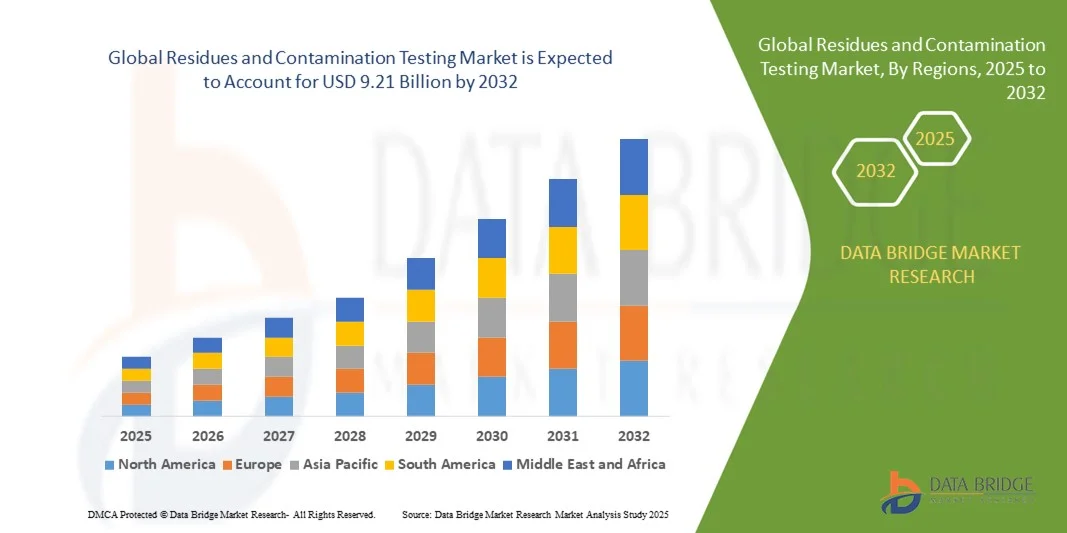
- As per Data Bridge Market Research Analysis the global residues and contamination testing market size was valued at USD 5.09 billion in 2024 and is expected to reach USD 9.21 billion by 2032, at a CAGR of 7.70% during the forecast period
- The market growth is largely fueled by increasing regulatory scrutiny and stringent food safety standards across the globe, driving widespread adoption of residues and contamination testing solutions in food processing, dairy, meat, fruits, vegetables, and packaged food industries
- Furthermore, rising consumer awareness about chemical residues, allergens, and microbial contamination in food products is establishing advanced testing solutions as essential tools for ensuring food safety and quality. These converging factors are accelerating the uptake of rapid, accurate, and high-throughput testing technologies, thereby significantly boosting the industry's growth
Market Size & Forecast
- Global Market Value (2024): USD 5.09 billion
- Expected Market Value (2032): USD 9.21 billion
- Forecast CAGR (2024–2032): 7.70%
What are the Major Takeaways of Residues and Contamination Testing Market?
- Residues and contamination testing solutions, including pesticide, heavy metal, allergen, and microbial tests, are increasingly vital for maintaining food safety and regulatory compliance in both large-scale food processing and smaller manufacturing units, owing to their role in ensuring product quality and consumer protection
- The escalating demand for these testing solutions is primarily fueled by growing food safety awareness among consumers, increasing incidences of foodborne illnesses, and advancements in rapid and automated testing technologies that improve accuracy, efficiency, and scalability across laboratories and production facilities
- North America dominated the residues and contamination testing market with a share of 44.02% in 2024, due to stringent food safety regulations, high consumer awareness, and strong demand for safe and high-quality food products
- Asia-Pacific is expected to be the fastest growing region in the residues and contamination testing market during the forecast period due to rapid urbanization, rising disposable incomes, and increasing awareness of food safety in countries such as China, India, and Japan
- Pesticide test segment dominated the market with a market share of 43% in 2024, due to increasing regulatory scrutiny and consumer awareness regarding chemical residues in food products. Pesticide testing is widely adopted by food manufacturers, exporters, and government agencies to ensure compliance with stringent safety standards. Rising concerns over public health, coupled with the need to prevent contamination-related recalls, reinforce the dominance of pesticide testing in the market. The segment also benefits from technological advancements in analytical methods, offering faster, more accurate, and cost-effective testing solutions
Report Scope and Residues and Contamination Testing Market Segmentation
|
Attributes |
Residues and Contamination Testing Key Market Insights |
|
Segments Covered |
|
|
Countries Covered |
North America
Europe
Asia-Pacific
Middle East and Africa
South America
|
|
Key Market Players |
|
|
Market Opportunities |
|
|
Value Added Data Infosets |
|
What is the Key Trend in the Residues and Contamination Testing Market?
Growing Adoption of Rapid and Automated Food Testing Technologies
- The residues and contamination testing market is experiencing accelerated growth due to the widespread adoption of rapid and automated technologies designed to detect contaminants efficiently and ensure compliance with stringent food safety standards. These solutions enable faster decision-making in production environments, reducing the risk of product recalls and brand damage
- For instance, Thermo Fisher Scientific has introduced automated PCR-based food testing platforms that deliver high-speed detection of microbial and chemical contaminants. Similarly, Agilent Technologies offers advanced chromatography and mass spectrometry systems with automation features for precise and rapid identification of residues in various food matrices
- Automated food testing equipment integrates real-time analytics, barcode tracking, and AI-assisted data interpretation to streamline workflows and reduce human error. This allows food processors to meet increasingly tight regulatory timelines while improving overall testing accuracy and repeatability
- The demand for rapid testing is rising alongside the expansion of global food trade, where cross-border product movements require timely certification and clearance. Automated systems are particularly beneficial in large-scale food processing facilities and export-oriented operations where speed and consistency are essential
- The integration of portable and compact rapid testing devices is enabling on-site assessments for residues such as pesticides, heavy metals, and allergens. This minimizes downtime by allowing immediate corrective actions during production or packaging stages, enhancing end-product integrity
- The growing adoption of rapid and automated food testing technologies signals a strategic shift in food safety practices toward efficiency, precision, and traceability. This transformation supports industry-wide goals to safeguard consumer health while enabling producers to maintain competitive responsiveness in global markets
Residues and Contamination Testing Market Dynamics
Driver
Rising Consumer Awareness and Stricter Food Safety Regulations
- Increasing consumer concern over contamination risks and food quality is a key driver for the residues and contamination testing market. Public health incidents and media coverage of safety breaches have amplified the need for transparent, verifiable assurance of product integrity for both domestic and international supply chains
- For instance, Eurofins Scientific has expanded its certified testing laboratories globally to address rising demand for pesticide residue and contaminant analysis in fresh produce and processed foods. This illustrates the direct link between heightened consumer awareness and the growth of specialized testing services
- Governments and regulatory agencies are continuously updating food safety laws, introducing stricter permissible limits for contaminants and mandating regular compliance checks. This fuels demand for advanced testing programs capable of meeting precise detection thresholds and reporting requirements
- The push for traceability and accountability in the food supply chain is accelerating adoption of sophisticated analytical methods such as LC-MS/MS, GC-MS, and enzyme-linked immunoassays. These techniques enable comprehensive coverage for contaminants including mycotoxins, veterinary drug residues, and heavy metals
- Higher safety expectations from both consumers and regulators are driving investments in comprehensive residue testing programs. This convergence of public awareness and regulatory oversight ensures that contamination detection remains integral to brand trust and market access, reinforcing the sector’s long-term growth trajectory
Restraint/Challenge
High Cost of Advanced Testing Equipment
- The high acquisition and maintenance costs of advanced residue and contamination testing equipment present a significant challenge, particularly for small and medium-sized food producers. Sophisticated instruments with high sensitivity and rapid processing capabilities often require substantial upfront investments and skilled operators
- For instance, advanced LC-MS/MS systems offered by Shimadzu and Agilent Technologies involve considerable purchase and calibration expenses. Smaller facilities may find it difficult to justify these costs without clear, continuous demand or government funding support
- The complex engineering and precision calibration involved in manufacturing high-performance testing equipment increase production costs. In addition, maintenance contracts, consumables, and software updates add ongoing financial commitments for operators
- Limited access to financing, coupled with the intense competition in the food industry, can deter many companies from implementing advanced testing technologies. This can potentially slow adoption rates in regions with lower industrial margins and less regulatory enforcement
- Overcoming this challenge will require cost optimization through shared laboratory services, modular instrument designs, and government-backed subsidy programs. Facilitating broader accessibility to high-performance testing equipment is essential for achieving universal food safety compliance across global markets
How is the Residues and Contamination Testing Market Segmented?
The market is segmented on the basis of product type and application.
- By Product Type
On the basis of product type, the residues and contamination testing market is segmented into pesticide test, lab test, heavy metal test, food allergen test, and others. The pesticide test segment dominated the market with the largest revenue share of 43% in 2024, driven by increasing regulatory scrutiny and consumer awareness regarding chemical residues in food products. Pesticide testing is widely adopted by food manufacturers, exporters, and government agencies to ensure compliance with stringent safety standards. Rising concerns over public health, coupled with the need to prevent contamination-related recalls, reinforce the dominance of pesticide testing in the market. The segment also benefits from technological advancements in analytical methods, offering faster, more accurate, and cost-effective testing solutions.
The food allergen test segment is expected to witness the fastest growth rate from 2025 to 2032, fueled by rising incidences of food allergies and intolerances across the globe. Increasing consumer demand for allergen-free products, especially in packaged and processed foods, drives the adoption of specialized testing. Advances in immunoassay-based and DNA-based detection methods further accelerate growth, as these solutions provide high sensitivity, rapid results, and suitability across multiple food matrices. Food manufacturers and regulatory bodies are increasingly prioritizing allergen testing to ensure product safety and maintain consumer trust.
- By Application
On the basis of application, the residues and contamination testing market is segmented into dairy products, fruit and vegetable, meat, cereal and pulses, and others. The dairy products segment dominated the market in 2024 with the largest revenue share, owing to stringent safety standards for milk and dairy derivatives and high susceptibility of dairy to microbial contamination and chemical residues. Regular testing is mandated to ensure compliance with food safety regulations, minimize health risks, and maintain product quality. The segment’s dominance is further reinforced by rising consumer demand for safe, high-quality dairy products and the adoption of advanced testing technologies for rapid detection.
The fruit and vegetable segment is anticipated to witness the fastest growth from 2025 to 2032, driven by increasing consumer demand for fresh, safe, and pesticide-free produce. Rising awareness about the health implications of chemical residues and microbial contamination fuels the adoption of testing solutions in this category. Technological advancements in rapid, non-destructive testing and portable analysis devices allow real-time assessment of contaminants, enhancing operational efficiency. In addition, global expansion of organized retail and e-commerce platforms for fresh produce creates further demand for residue and contamination testing in this application segment.
Which Region Holds the Largest Share of the Residues and Contamination Testing Market?
- North America dominated the residues and contamination testing market with the largest revenue share of 44.02% in 2024, driven by stringent food safety regulations, high consumer awareness, and strong demand for safe and high-quality food products
- Consumers in the region prioritize products tested for pesticide residues, heavy metals, and allergens, supporting widespread adoption of advanced testing solutions across food manufacturers, retailers, and regulatory bodies
- The market is further supported by robust R&D infrastructure, technological advancements in rapid testing methods, and growing preference for reliable, automated testing solutions across dairy, meat, and processed food sectors
U.S. Residues and Contamination Testing Market Insight
The U.S. market captured the largest revenue share in North America in 2024, fueled by strict FDA regulations and rising demand for chemical- and allergen-free food products. Consumers and businesses are increasingly prioritizing reliable testing for food safety, traceability, and quality assurance. The adoption of advanced laboratory technologies, portable testing kits, and AI-enabled analysis is significantly contributing to market expansion, making the U.S. the dominant regional market for residues and contamination testing.
Europe Residues and Contamination Testing Market Insight
The Europe market is projected to expand at a substantial CAGR throughout the forecast period, driven by stringent EU food safety regulations and rising consumer awareness regarding chemical residues and contaminants. Countries such as Germany, France, and Italy are witnessing strong demand for testing across dairy, meat, and fresh produce. The region is experiencing significant growth across residential, commercial, and industrial food sectors, with residues and contamination testing being incorporated into regulatory compliance and quality assurance programs.
U.K. Residues and Contamination Testing Market Insight
The U.K. market is anticipated to grow at a noteworthy CAGR during the forecast period, driven by government regulations and increasing consumer demand for allergen-free and contaminant-free food. Concerns regarding foodborne risks and chemical residues are encouraging manufacturers and retailers to adopt advanced testing solutions. The U.K.’s robust food processing and retail infrastructure, combined with strong regulatory enforcement, is expected to continue to stimulate market growth.
Germany Residues and Contamination Testing Market Insight
The Germany market is expected to expand at a considerable CAGR during the forecast period, fueled by strict regulatory frameworks, high-quality food standards, and growing consumer focus on safety. Advanced laboratories and automated testing technologies are driving adoption in dairy, meat, and fresh produce. Germany’s emphasis on innovation, sustainability, and precision testing promotes consistent growth in residues and contamination testing.
Asia-Pacific Residues and Contamination Testing Market Insight
The Asia-Pacific market is poised to grow at the fastest CAGR during 2025–2032, driven by rapid urbanization, rising disposable incomes, and increasing awareness of food safety in countries such as China, India, and Japan. Government initiatives and food safety regulations are encouraging the adoption of testing solutions across multiple food categories. The expansion of organized retail, e-commerce for fresh produce, and growing consumer focus on chemical- and allergen-free products are driving rapid market growth.
Japan Residues and Contamination Testing Market Insight
The Japan market is gaining momentum due to high consumer awareness, an aging population, and growing demand for accurate, rapid, and reliable testing solutions. The integration of automated laboratory systems and IoT-enabled devices is enhancing efficiency. The focus on safe and high-quality food products is fueling growth across residential and commercial food sectors, making Japan a key contributor to the Asia-Pacific market.
China Residues and Contamination Testing Market Insight
China accounted for the largest market revenue share in Asia-Pacific in 2024, attributed to strong regulatory frameworks, rapid urbanization, and increasing consumer demand for safe food. The growing food processing industry and government initiatives to ensure food safety are key drivers. Availability of advanced testing technologies and a strong domestic manufacturing base for testing equipment are significantly contributing to market growth, establishing China as the dominant market in the region.
Residues and Contamination Testing Market Share
The residues and contamination testing industry is primarily led by well-established companies, including:
- Eurofins Scientific (Luxembourg)
- SGS SA (Switzerland)
- Intertek Group plc (U.K.)
- ALS Limited (Australia)
- SCS Global Services (U.S.)
- Microbac Laboratories, Inc. (U.S.)
- Symbio Laboratories (U.S.)
- AsureQuality (New Zealand)
- Mérieux NutriSciences (France)
- Bureau Veritas (France)
- NSF International (U.S.)
- TÜV SÜD (Germany)
- AB Sciex (U.S.)
- Scicorp Laboratories PTY Ltd (Australia)
- Neogen Corporation (U.S.)
- IDEXX Laboratories, Inc. (U.S.)
- Charm Sciences (U.S.)
- VICAM (U.S.)
- Campden BRI (U.K.)
- Arbro Pharmaceuticals Pvt. Ltd. (India)
- JORDI LABS, LLC. (U.S.)
- Chr. Hansen Holding A/S (Denmark)
Latest Developments in Global Residues and Contamination Testing Market
- In October 2024, Unisensor Technologies introduced the aurox system, a cutting-edge testing solution designed to detect beta-lactams and tetracyclines in milk. This innovation automates critical workflows for dairies and milk transport operations, ensuring faster, highly accurate detection of antibiotic residues. By streamlining testing processes, the aurox system enhances operational efficiency, reduces the risk of human error, and strengthens compliance with stringent food safety regulations, supporting the production of safer, higher-quality dairy products
- In September 2024, Neogen Corporation launched the Veratox VIP assay for walnut allergens, a high-sensitivity ELISA test capable of detecting trace amounts of walnut proteins even in complex and heat-processed food matrices. The rapid assay, delivering results in just 30 minutes, improves testing efficiency for manufacturers, laboratories, and regulatory agencies. This development addresses the rising consumer demand for allergen-free products and enables companies to ensure regulatory compliance, minimize recall risks, and protect public health
- In July 2024, Neogen introduced the Petrifilm product for high-throughput laboratories, tailored for operations managing over 100,000 quality indicator tests annually. This solution simplifies microbial testing workflows, significantly reducing labor requirements and processing time. By improving throughput and accuracy, the Petrifilm system enables laboratories to scale efficiently, maintain consistent food safety standards, and respond quickly to contamination issues, strengthening overall quality control in the food industry
- In June 2024, Neogen expanded its Petrifilm® portfolio with enhanced solutions designed for laboratories handling high-volume microbial tests. These innovations improve testing precision, accelerate result turnaround, and reduce operational costs by automating repetitive steps in microbial analysis. The development supports rapid decision-making, ensures regulatory compliance, and empowers food producers and laboratories to maintain consistent safety standards across dairy, meat, and processed food products
- In December 2023, Neogen Corporation introduced the Quantitative ELISA AssayVeratox VIP assay for walnut detection, reinforcing advanced allergen monitoring capabilities. The assay delivers highly reliable, sensitive results across multiple food types, enabling manufacturers to identify and mitigate allergen risks effectively. By providing robust testing solutions, this development strengthens consumer trust, aids regulatory compliance, and promotes safer production practices in the growing allergen-sensitive food market

- Interactive Data Analysis Dashboard
- Company Analysis Dashboard for high growth potential opportunities
- Research Analyst Access for customization & queries
- Competitor Analysis with Interactive dashboard
- Latest News, Updates & Trend analysis
- Harness the Power of Benchmark Analysis for Comprehensive Competitor Tracking
Global Residues And Contamination Testing Market, Supply Chain Analysis and Ecosystem Framework
To support market growth and help clients navigate the impact of geopolitical shifts, DBMR has integrated in-depth supply chain analysis into its Global Residues And Contamination Testing Market research reports. This addition empowers clients to respond effectively to global changes affecting their industries. The supply chain analysis section includes detailed insights such as Global Residues And Contamination Testing Market consumption and production by country, price trend analysis, the impact of tariffs and geopolitical developments, and import and export trends by country and HSN code. It also highlights major suppliers with data on production capacity and company profiles, as well as key importers and exporters. In addition to research, DBMR offers specialized supply chain consulting services backed by over a decade of experience, providing solutions like supplier discovery, supplier risk assessment, price trend analysis, impact evaluation of inflation and trade route changes, and comprehensive market trend analysis.
Data collection and base year analysis are done using data collection modules with large sample sizes. The stage includes obtaining market information or related data through various sources and strategies. It includes examining and planning all the data acquired from the past in advance. It likewise envelops the examination of information inconsistencies seen across different information sources. The market data is analysed and estimated using market statistical and coherent models. Also, market share analysis and key trend analysis are the major success factors in the market report. To know more, please request an analyst call or drop down your inquiry.
The key research methodology used by DBMR research team is data triangulation which involves data mining, analysis of the impact of data variables on the market and primary (industry expert) validation. Data models include Vendor Positioning Grid, Market Time Line Analysis, Market Overview and Guide, Company Positioning Grid, Patent Analysis, Pricing Analysis, Company Market Share Analysis, Standards of Measurement, Global versus Regional and Vendor Share Analysis. To know more about the research methodology, drop in an inquiry to speak to our industry experts.
Data Bridge Market Research is a leader in advanced formative research. We take pride in servicing our existing and new customers with data and analysis that match and suits their goal. The report can be customized to include price trend analysis of target brands understanding the market for additional countries (ask for the list of countries), clinical trial results data, literature review, refurbished market and product base analysis. Market analysis of target competitors can be analyzed from technology-based analysis to market portfolio strategies. We can add as many competitors that you require data about in the format and data style you are looking for. Our team of analysts can also provide you data in crude raw excel files pivot tables (Fact book) or can assist you in creating presentations from the data sets available in the report.













