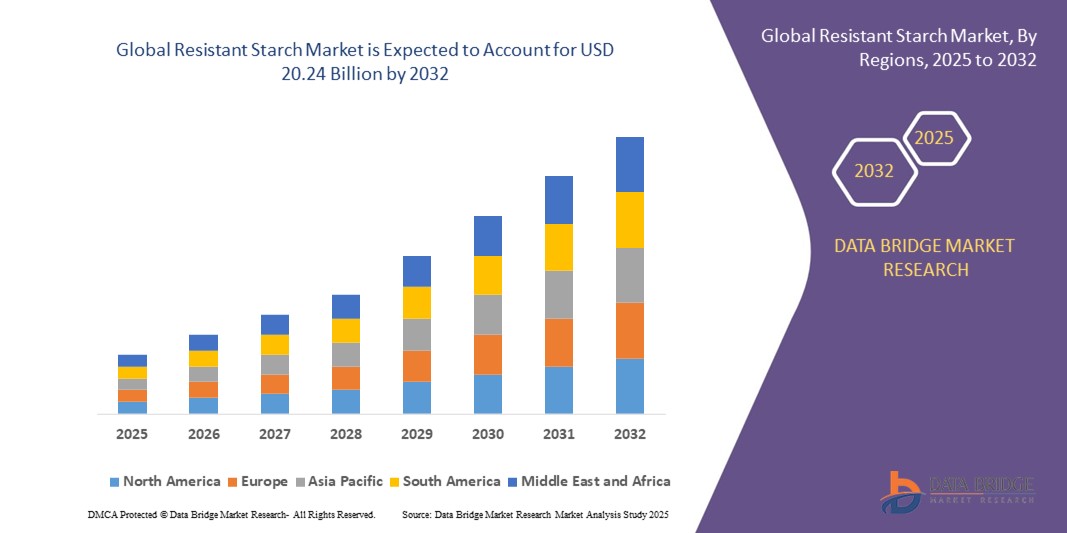
What is the Global Resistant Starch Market Size and Growth Rate?
- The global resistant starch market size was valued at USD 11.96 billion in 2024 and is expected to reach USD 20.24 billion by 2032, at a CAGR of 6.80% during the forecast period
- Increasing awareness among consumers about the health benefits of resistant starch fuels market growth. Resistant starch is known to improve digestive health, regulate blood sugar levels, promote weight management, and enhance satiety, aligning with consumer preferences for healthier food choices is expected to fuel the growth of the global resistant starch market
- Incorporating resistant starch into food and beverage formulations can pose technical challenges related to texture, taste, and stability. Formulating products with resistant starch without compromising sensory attributes or shelf life requires extensive research and development, which can increase production costs and deter manufacturers hampering the overall market.
What are the Major Takeaways of Resistant Starch Market?
- The increasing health consciousness among consumers is driving demand for products containing resistant starch due to its associated health benefits. Resistant starch functions similarly as dietary fiber which helps in promoting improved gut health by supporting the growth of beneficial gut bacteria and aiding digestion. It also contributes to weight management by promoting feelings of fullness and reducing calorie absorption
- In addition, resistant starch can help stabilize blood sugar levels by slowing down the release of glucose into the bloodstream. As consumers become more informed about these benefits, they are seeking out products enriched with resistant starch as a natural and effective way to support their overall health and wellness goals
- North America dominated the resistant starch market with the largest revenue share of 41.2% in 2024, driven by increasing consumer awareness of gut health, rising demand for functional foods, and strong adoption of dietary supplements and fiber-enriched products
- Asia-Pacific resistant starch market is expected to grow at the fastest CAGR of 13.5% from 2025 to 2032, driven by rapid urbanization, rising disposable incomes, and increased awareness of dietary fiber and functional food benefits
- The retrograded starch segment dominated the market with a revenue share of 38.5% in 2024, driven by its superior functional properties, including high resistance to digestion and better applicability in bakery, snack, and pasta products
Report Scope and Resistant Starch Market Segmentation
|
Attributes |
Resistant Starch Key Market Insights |
|
Segments Covered |
|
|
Countries Covered |
North America
Europe
Asia-Pacific
Middle East and Africa
South America
|
|
Key Market Players |
|
|
Market Opportunities |
|
|
Value Added Data Infosets |
In addition to the insights on market scenarios such as market value, growth rate, segmentation, geographical coverage, and major players, the market reports curated by the Data Bridge Market Research also include in-depth expert analysis, pricing analysis, brand share analysis, consumer survey, demography analysis, supply chain analysis, value chain analysis, raw material/consumables overview, vendor selection criteria, PESTLE Analysis, Porter Analysis, and regulatory framework. |
What is the Key Trend in the Resistant Starch Market?
Rising Demand for Functional and Health-Oriented Ingredients
- A major and accelerating trend in the global resistant starch market is the growing focus on functional foods and gut health, as consumers increasingly prefer ingredients that improve digestive health, support weight management, and regulate blood sugar levels
- For instance, manufacturers are incorporating resistant starch into bakery products, snacks, and beverages to enhance fiber content without affecting taste or texture, driving product innovation
- The integration of resistant starch in low-calorie, gluten-free, and diabetic-friendly formulations allows food companies to meet evolving dietary needs and consumer preferences. Brands are leveraging these applications to position products as healthier alternatives to traditional carbohydrates
- The demand for clean-label and plant-based ingredients is also fueling adoption, as resistant starch derived from sources such as corn, potato, and tapioca aligns with the growing preference for natural and minimally processed foods
- This trend toward health-focused formulations and functional ingredients is reshaping product development strategies, with companies such as Ingredion and Roquette investing in innovative resistant starch solutions tailored for specific nutritional and functional requirements
- Overall, the rising awareness of digestive health benefits and functional food trends is significantly driving the resistant starch market across food, beverage, and dietary supplement applications
What are the Key Drivers of Resistant Starch Market?
- Increasing consumer awareness of gut health and metabolic disorders is a primary driver, with more individuals seeking dietary fibers that support digestion and blood sugar regulation
- For instance, in 2023, Cargill launched fiber-rich resistant starch ingredients for bakery and snack applications, highlighting the trend toward healthier, functional products
- Rising prevalence of obesity, diabetes, and lifestyle-related health issues is encouraging food manufacturers to reformulate products with resistant starch, as it contributes to lower glycemic response and improved satiety
- The growth of the functional foods and dietary supplements sector is promoting resistant starch adoption, as it can be seamlessly incorporated into nutritional bars, beverages, and meal replacements
- In addition, consumer preference for clean-label, non-GMO, and plant-based ingredients is pushing manufacturers to adopt naturally derived resistant starch sources in their product formulations
Which Factor is Challenging the Growth of the Resistant Starch Market?
- High cost of extraction and processing of resistant starch compared to conventional starches poses a challenge, particularly for small and medium-sized food manufacturers
- For instance, resistant starch produced from specialty sources such as high-amylose maize or modified potato starch can be expensive, limiting adoption in price-sensitive markets
- Lack of consumer awareness in developing regions about the health benefits of resistant starch is another barrier, as many end-users still equate starch with high-calorie intake rather than functional benefits
- Technical challenges in food formulation—such as changes in texture, moisture retention, or taste when adding resistant starch—can limit its use in certain processed foods
- Overcoming these challenges through cost-effective production methods, educational campaigns, and product innovation will be essential to sustain market growth and expand resistant starch adoption globally
How is the Resistant Starch Market Segmented?
The market is segmented on the basis of type, application, and end user.
- By Type
On the basis of type, the resistant starch market is segmented into physically inaccessible starch, granular starch, retrograded starch, and chemically modified starch. The retrograded starch segment dominated the market with a revenue share of 38.5% in 2024, driven by its superior functional properties, including high resistance to digestion and better applicability in bakery, snack, and pasta products. Retrograded starch is preferred by food manufacturers for its ability to enhance dietary fiber content without altering taste or texture.
The chemically modified starch segment is expected to witness the fastest CAGR of 22% from 2025 to 2032, as it offers tailored functional benefits, such as improved viscosity, water retention, and stability, making it ideal for processed foods, beverages, and nutraceutical formulations. Growing consumer awareness of gut health and regulatory support for functional foods are further fueling adoption of these starch types globally.
- By Application
On the basis of application, the resistant starch market is segmented into food and beverages, animal feed, and pharmaceuticals. The food and beverages segment accounted for the largest market revenue share of 45.3% in 2024, driven by increasing demand for functional bakery products, snacks, and dairy items enriched with resistant starch. Food manufacturers are leveraging resistant starch to improve dietary fiber intake, support gut health, and reduce glycemic impact in end consumers.
The pharmaceutical segment is expected to witness the fastest CAGR of 20.8% from 2025 to 2032, as resistant starch is increasingly incorporated into tablets, capsules, and nutraceutical formulations as a prebiotic fiber, excipient, and carrier for active ingredients. Rising health awareness, coupled with the expanding nutraceutical market, is encouraging adoption in both clinical and preventive healthcare applications.
- By End User
On the basis of end user, the resistant starch market is segmented into food manufacturers, animal feed producers, pharmaceutical companies, and others. The food manufacturers segment dominated the market with a 46% revenue share in 2024, driven by the surge in functional and fiber-enriched product launches targeting health-conscious consumers. Resistant starch helps food producers meet regulatory requirements and consumer demand for reduced-calorie, low-glycemic, and high-fiber foods.
The pharmaceutical companies segment is expected to grow at the fastest CAGR of 19.5% from 2025 to 2032, owing to its increasing use as a functional excipient, prebiotic ingredient, and carrier in dietary supplements, tablets, and capsules. Innovations in formulation and a focus on gut health and metabolic wellness are driving resistant starch adoption among pharmaceutical end users.
Which Region Holds the Largest Share of the Resistant Starch Market?
- North America dominated the resistant starch market with the largest revenue share of 41.2% in 2024, driven by increasing consumer awareness of gut health, rising demand for functional foods, and strong adoption of dietary supplements and fiber-enriched products
- Consumers in the region prioritize health benefits such as improved digestion, blood sugar regulation, and satiety, encouraging food manufacturers to integrate resistant starch in bakery, snack, and beverage products
- The widespread adoption is further supported by high disposable incomes, technologically advanced food processing infrastructure, and a growing trend toward preventive healthcare, establishing resistant starch as a key functional ingredient across both commercial and retail applications
U.S. Resistant Starch Market Insight
U.S. resistant starch market captured the largest revenue share of 78% in 2024 within North America, fueled by the rising focus on health-conscious diets, diabetes-friendly foods, and functional food innovations. Manufacturers are increasingly incorporating resistant starch into bakery, dairy, and snack items to enhance fiber content without altering taste or texture. The growth is further supported by strong regulatory standards, widespread distribution channels, and rising consumer preference for natural, plant-based ingredients.
Canada Resistant Starch Market Insight
Canada market is projected to expand steadily, driven by growing functional food consumption, increasing awareness about dietary fibers, and rising demand for gut-friendly ingredients. Consumers are embracing fortified products and health-oriented meal solutions, boosting resistant starch adoption in both retail and institutional applications.
Which Region is the Fastest Growing in the Resistant Starch Market?
Asia-Pacific resistant starch market is expected to grow at the fastest CAGR of 13.5% from 2025 to 2032, driven by rapid urbanization, rising disposable incomes, and increased awareness of dietary fiber and functional food benefits. The region’s expanding middle-class population and health-conscious consumers are increasingly opting for fiber-enriched bakery, snack, and beverage products.
China Resistant Starch Market Insight
China market accounted for the largest revenue share in Asia-Pacific in 2024, due to rapid urbanization, high rates of processed food consumption, and growing health awareness. The increasing focus on dietary health, combined with domestic manufacturing capabilities, is driving the production and adoption of resistant starch in food, beverages, and nutraceuticals.
Japan Resistant Starch Market Insight
Japan market is witnessing steady growth, supported by its aging population and rising demand for gut health-promoting foods and functional ingredients. Resistant starch adoption is particularly strong in bakery, confectionery, and dietary supplement sectors.
India Resistant Starch Market Insight
India market is expected to grow rapidly due to increasing urbanization, rising disposable income, and the growing popularity of fortified and functional foods. Government initiatives promoting nutritional awareness are further encouraging resistant starch adoption in both food and dietary supplement applications.
Which are the Top Companies in Resistant Starch Market?
The resistant starch industry is primarily led by well-established companies, including:
- Ingredion (U.S.)
- Cargill (U.S.)
- Roquette (France)
- Tate & Lyle (U.K.)
- MGP Ingredients (U.S.)
- Avebe (Netherlands)
- Emsland Group (Germany)
What are the Recent Developments in Global Resistant Starch Market?
- In May 2025, Kraftwell Foods, a U.S.-based company, announced the launch of Fiber Boost Bakes, a new line of cookies and breads fortified with banana-derived resistant starch for gut health and satiety support, reflecting the company’s commitment to functional and health-oriented snack innovations. This launch is expected to drive greater consumer adoption of fiber-enriched bakery products
- In July 2024, BENEO, a leading supplier of functional ingredients, introduced a range of resistant starches derived from natural sources such as corn and potatoes, including BENEO-Remyline RS4, designed for dairy applications to enhance fiber content and improve digestive health benefits. This initiative supports manufacturers in meeting nutritional labeling and regulatory requirements while catering to health-conscious consumers
- In July 2024, Danone incorporated resistant starch into its Activia yogurt line to boost fiber content and promote gut health, demonstrating the company’s focus on enhancing the nutritional profile of its products. This move reinforces Danone’s positioning in the functional dairy market
- In July 2024, Mars Wrigley introduced M&M Protein, containing resistant starch to increase protein content and provide more filling snack options, aligning with consumer demand for healthier and functional confectionery products. This product launch highlights the growing trend of integrating functional ingredients into mainstream snacks
- In January 2021, Tate & Lyle expanded its product portfolio by launching BRIOGEL® gelling starches and REZISTA® MAX thickening starches, which are tapioca-based, aiming to provide food manufacturers with versatile, fiber-rich, and functional ingredient solutions. This expansion supports the growing market for functional and clean-label food ingredients

- Interactive Data Analysis Dashboard
- Company Analysis Dashboard for high growth potential opportunities
- Research Analyst Access for customization & queries
- Competitor Analysis with Interactive dashboard
- Latest News, Updates & Trend analysis
- Harness the Power of Benchmark Analysis for Comprehensive Competitor Tracking
Data collection and base year analysis are done using data collection modules with large sample sizes. The stage includes obtaining market information or related data through various sources and strategies. It includes examining and planning all the data acquired from the past in advance. It likewise envelops the examination of information inconsistencies seen across different information sources. The market data is analysed and estimated using market statistical and coherent models. Also, market share analysis and key trend analysis are the major success factors in the market report. To know more, please request an analyst call or drop down your inquiry.
The key research methodology used by DBMR research team is data triangulation which involves data mining, analysis of the impact of data variables on the market and primary (industry expert) validation. Data models include Vendor Positioning Grid, Market Time Line Analysis, Market Overview and Guide, Company Positioning Grid, Patent Analysis, Pricing Analysis, Company Market Share Analysis, Standards of Measurement, Global versus Regional and Vendor Share Analysis. To know more about the research methodology, drop in an inquiry to speak to our industry experts.
Data Bridge Market Research is a leader in advanced formative research. We take pride in servicing our existing and new customers with data and analysis that match and suits their goal. The report can be customized to include price trend analysis of target brands understanding the market for additional countries (ask for the list of countries), clinical trial results data, literature review, refurbished market and product base analysis. Market analysis of target competitors can be analyzed from technology-based analysis to market portfolio strategies. We can add as many competitors that you require data about in the format and data style you are looking for. Our team of analysts can also provide you data in crude raw excel files pivot tables (Fact book) or can assist you in creating presentations from the data sets available in the report.