


What is the Respiratory Protective Equipment (RPE) Market Size and Growth Rate?
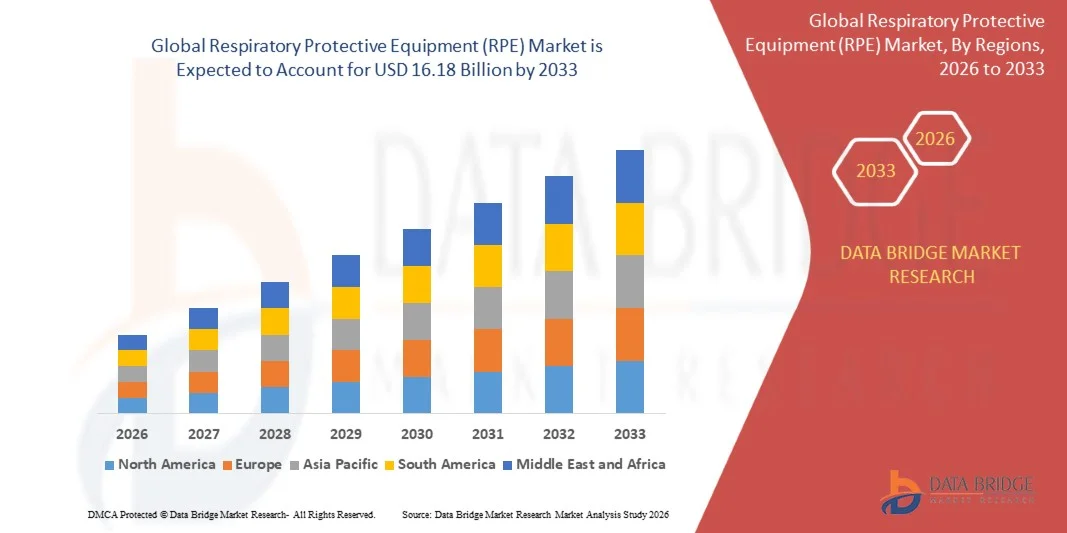
- As per Data Bridge Market Research analysis, the respiratory protective equipment (RPE) market was valued at USD 9.91 billion in 2025 and is projected to reach USD 16.18 billion by 2033, growing at a CAGR of 6.32% from 2026 to 2033.
- The market is experiencing consistent growth driven by increasing awareness of occupational respiratory hazards, stringent workplace safety regulations, expanding industrial activities, rising healthcare-sector demand, and technological advancements in respiratory protection products.
- The increasing focus on worker health and safety, combined with stricter regulatory requirements and the expansion of industries such as oil and gas, mining, construction, pharmaceuticals, and manufacturing, is encouraging organizations to adopt advanced respiratory protective equipment. The growing use of air-purifying respirators (APR), supplied-air respirators (SAR), and powered air-purifying respirators (PAPR) is further supporting market adoption, particularly in environments exposed to dust, fumes, gases, vapors, and other airborne contaminants
Market Size & Forecast
- Global Market Value (2025): USD 9.91 Billion
- Expected Market Value (2033): USD 16.18 Billion
- Forecast CAGR (2026–2033): 6.32%
- Leading Region in 2025: North America
- Fastest Growing Region: Asia Pacific
What are the Major Takeaways of the Respiratory Protective Equipment (RPE) Market?
- North America dominated the respiratory protective equipment market with the largest revenue share of 39.2% in 2025, supported by stringent occupational safety regulations, high industrial activity, and strong demand for respiratory protection across healthcare and industrial applications.
- Asia-Pacific is expected to be the fastest-growing region at a CAGR of 10.6% from 2026 to 2033, fueled by industrial expansion, increasing awareness of occupational respiratory hazards, rising air-pollution concerns, and strengthening workplace safety regulations
- The air purifying respirators (APR) segment led the market with a 72.8% share in 2025, driven by its broad application across healthcare, manufacturing, construction, mining, fire services, and other workplaces with airborne hazards.
- Supplied air respirators are the fastest-growing product type, projected to register a CAGR of 7.6%, reflecting the surge in requirements for higher-level respiratory protection in hazardous work environments
- The particle segment dominated the filter category with a 44.6% revenue share in 2025, led by widespread exposure to dust, fumes, mists, smoke, and other particulate contaminants across industrial environments.
- Industrial accounted for 35% of the market share in 2025, preferred by extensive RPE requirements across manufacturing, fabrication, welding, metal processing, and other industrial operations.
- The combined filters segment is the fastest-growing filter category, with a CAGR of 8.0%, driven by increasing demand for protection against multiple airborne hazards within the same workplace.
Report Scope and Respiratory Protective Equipment (RPE) Market Segmentation
|
Attributes |
Respiratory Protective Equipment (RPE) Key Market Insights |
|
Segments Covered |
|
|
Countries Covered |
North America
Europe
Asia-Pacific
Middle East and Africa
South America
|
|
Key Market Players |
|
|
Market Opportunities |
|
|
Value Added Data Infosets |
In addition to the insights on market scenarios such as market value, growth rate, segmentation, geographical coverage, and major players, the market reports curated by the Data Bridge Market Research also include import export analysis, production capacity overview, production consumption analysis, price trend analysis, climate change scenario, supply chain analysis, value chain analysis, raw material/consumables overview, vendor selection criteria, PESTLE Analysis, Porter Analysis, and regulatory framework. |
What is the Key Trend in the Respiratory Protective Equipment (RPE) Market?
- Reusable respiratory protection is increasingly gaining attention across healthcare and industrial workplaces as organizations seek longer-use equipment, lower replacement requirements, and greater supply resilience while maintaining effective filtration and protection.
- For instance, in May 2022, Honeywell launched two new respiratory protection solutions for healthcare professionals, including a smaller-sized surgical N95 respirator and a reusable half-mask respirator designed for extended wear. The launch highlighted increasing emphasis on fit, comfort, filtration performance, and user-specific respiratory protection rather than one-size-fits-all products.
- Powered air-purifying respirators are increasingly being used where workers require higher protection levels, lower breathing resistance, and greater comfort during prolonged exposure to airborne contaminants.
- For instance, in April 2024, 3M launched its 3M Verify app, enabling customers to authenticate certain disposable respirators by scanning product barcodes. The initiative demonstrates the increasing use of digital technology and product traceability to improve respiratory PPE authenticity and safety, particularly in response to counterfeit-product risks.
- As respiratory hazards become more diverse across healthcare, emergency response, construction, mining, and industrial environments, manufacturers and safety organizations are increasingly emphasizing specialized protection against emerging chemical, biological, radiological, and nuclear hazards.
What are the Key Drivers of the Respiratory Protective Equipment (RPE) Market?
- The increasing prevalence of occupational exposure to dust, fumes, gases, vapors, infectious agents, and other airborne contaminants is strengthening demand for certified respiratory protection across healthcare and industrial workplaces.
- For instance, in March 2025, NIOSH highlighted that workers across healthcare, construction, public safety, emergency response, and mining rely on respiratory protection to reduce exposure to workplace respiratory hazards. NIOSH also emphasized that employers must use NIOSH-approved respirators when workplace conditions require respiratory protection, reinforcing the role of occupational safety requirements in RPE adoption.
- Governments and workplace safety authorities are strengthening respiratory protection requirements, requiring employers to conduct hazard assessments, select appropriate respirators, and maintain comprehensive respiratory protection programs.
- For instance, in February 2025, NIOSH reiterated that employers are responsible for selecting appropriate respirators based on potential workplace hazards and that required respirators must be used as part of a complete respiratory protection program. This reinforces demand for suitable RPE where workers face dust, fumes, gases, vapors, aerosols, and other airborne contaminants.
- With organizations increasingly prioritizing worker safety and exposure control, respiratory protective equipment will remain essential across hazardous workplaces, particularly as employers strengthen compliance with occupational health and safety requirements.
Which Factors are Challenging the Growth of the Respiratory Protective Equipment (RPE) Market?
- Respiratory protective equipment requires proper selection, fit testing, training, maintenance, and periodic replacement, increasing the operational burden and total cost for organizations with large numbers of respirator users
- For instance, in September 2024, the British Safety Council highlighted challenges associated with respiratory protective equipment (RPE) fit and inclusivity, noting that employers must fit-test workers using tight-fitting respirators and find suitable masks for individual users. The need to identify suitable facepiece designs can make RPE implementation more complex, particularly across workforces with diverse facial characteristics.
- These requirements can create adoption challenges for smaller employers and organizations with limited occupational safety resources, particularly where trained personnel and formal respiratory protection programs are not readily available.
- The recurring compliance, training, medical evaluation, fit-testing, cleaning, storage, and maintenance requirements associated with respiratory protection programs continue to increase implementation complexity, particularly for organizations operating across multiple workplaces.
- For instance, in July 2024, Shawcity emphasized that poor-fitting RPE can leak and fail to provide the intended protection, making fit testing necessary to identify unsuitable respirators. This requirement can add operational complexity and time for organizations that need to test and maintain appropriate RPE for individual workers.
- These requirements can slow deployment where employers lack dedicated safety personnel, standardized procedures, or adequate resources for maintaining compliant respiratory protection programs.
How is the Respiratory Protective Equipment (RPE) Market Segmented?
The respiratory protective equipment (RPE) market is segmented on the basis of product, filter, distribution channel, and end-use.
- By Product
On the basis of product, the respiratory protective equipment (RPE) market is segmented into air purifying respirators (APR) and supplied air respirators. The air purifying respirators (APR) segment dominated the market with a 72.8% share in 2025, owing to its broad application across healthcare, manufacturing, construction, mining, fire services, and other workplaces with airborne hazards. APRs filter contaminants from ambient air before inhalation and are available in a wide range of configurations, including filtering facepieces, half-mask respirators, and full-face respirators. Their portability and comparatively straightforward operation support extensive adoption among workers exposed to particles, gases, and vapors. The availability of disposable and reusable designs also enables organizations to select products according to the nature and duration of exposure. APRs are widely incorporated into workplace respiratory protection programs because of their versatility across different applications
The supplied air respirators segment is projected to register the fastest growth at CAGR of 7.6% from 2026 to 2033, driven by increasing requirements for higher-level respiratory protection in hazardous work environments. Supplied Air Respirators provide breathing air from an external source, making them suitable for environments where air-purifying systems may not provide adequate protection. They are particularly relevant in chemical processing, oil and gas, pharmaceutical, confined-space, and other high-risk applications. Increasing industrial activity is creating additional requirements for controlled breathing-air systems. Growing attention toward worker protection in environments with high contaminant concentrations is further supporting adoption. The expansion of chemical, pharmaceutical, and oil and gas activities, particularly in developing markets, is also contributing to demand.
- By Filter
On the basis of filter, the respiratory protective equipment (RPE) market is segmented into particle, gas or vapour, and combined filters. The particle segment dominated the market with an 44.6% share in 2025, supported by widespread exposure to dust, fumes, mists, smoke, and other particulate contaminants across industrial environments. Particle filters are extensively used in manufacturing, construction, mining, healthcare, and other applications where airborne particulates can create occupational respiratory hazards. Their broad compatibility with different respirator configurations increases their applicability across workplaces. Increasing awareness of the health effects associated with airborne particulate exposure is supporting demand for particle filtration. Employers also rely on particle-filtering respirators as part of workplace respiratory protection programs.
The combined filters segment is expected to witness the fastest growth at a CAGR of 8.0% from 2026 to 2033, driven by increasing demand for protection against multiple airborne hazards within the same workplace. Combined filters provide protection against both particulate contaminants and gases or vapors, making them suitable for complex industrial environments. They are particularly relevant to chemical processing, petrochemical operations, painting, pharmaceutical manufacturing, and other applications involving different types of airborne contaminants. The growing complexity of industrial processes is increasing the need for versatile respiratory protection solutions. Organizations are also seeking equipment capable of addressing changing exposure conditions without requiring completely different respirator systems. Increasing occupational safety awareness and regulatory compliance requirements are further supporting adoption.
- By Distribution Channel
On the basis of distribution channel, the respiratory protective equipment (RPE) market is segmented into direct or institutional sales and retail sales. The direct or institutional sales segment dominated the market with 51.3% share in 2025, supported by bulk procurement from industrial companies, healthcare organizations, construction firms, mining operators, government agencies, and emergency-response organizations. Institutional customers typically require respiratory protection products for large numbers of workers and therefore purchase directly from manufacturers, distributors, or authorized suppliers. Direct procurement allows organizations to obtain standardized products that meet workplace-specific protection requirements. It can also facilitate recurring purchases of replacement respirators, filters, cartridges, and related components. Large organizations frequently establish procurement arrangements to maintain consistent availability and product specifications.
The retail sales segment is projected to register the fastest growth at CAGR of 10.9% from 2026 to 2033, supported by the increasing availability of RPE through online and offline retail channels. Retail distribution provides smaller businesses, contractors, individual workers, and consumers with convenient access to respirators and replacement filtration products. The expansion of e-commerce platforms is making it easier for customers to compare product specifications, filtration capabilities, sizes, and configurations. Online channels can also improve access to specialized respiratory protection products in locations with limited physical distribution networks. Growing awareness of airborne hazards is expanding demand among users outside large institutional procurement programs. Increasing availability of reusable respirators and replacement filters is further creating recurring retail purchases.
- By End-Use
On the basis of end-use, the respiratory protective equipment (RPE) market is segmented into oil and gas, fire services, petrochemical or chemical, industrial, pharmaceutical, construction, healthcare, mining, and others. The industrial segment dominated the market with 35% share in 2025, supported by extensive RPE requirements across manufacturing, fabrication, welding, metal processing, and other industrial operations. Workers in these environments can encounter dust, fumes, gases, vapors, and other airborne contaminants that require appropriate respiratory protection. Industrial organizations increasingly implement respiratory protection programs to reduce occupational exposure and comply with applicable safety requirements. The large global manufacturing base provides a broad user base for respirators and replacement filtration products.
The healthcare segment is expected to witness the fastest growth at CAGR of 9.7% from 2026 to 2033, driven by increasing emphasis on infection prevention and respiratory protection for healthcare personnel. Healthcare facilities use respirators when workers may encounter airborne infectious agents, aerosols, and other respiratory hazards. Greater awareness of occupational exposure risks has strengthened the importance of appropriate respiratory protection within healthcare settings. Hospitals and other healthcare organizations also require fit-tested respiratory equipment for workers performing procedures that may generate infectious aerosols. Expansion of healthcare infrastructure is increasing the number of facilities requiring respiratory protection programs. Continued investment in healthcare worker safety and preparedness is further supporting demand for specialized RPE.
Which Region Holds the Largest Share of the Respiratory Protective Equipment (RPE) Market?
- North America dominated the respiratory protective equipment market with the largest revenue share of 39.2% in 2025, supported by stringent occupational safety regulations, high industrial activity, and strong demand for respiratory protection across healthcare and industrial applications.
- The region also benefits from strong enforcement of workplace safety standards, widespread adoption of certified respiratory protection, and the presence of established RPE manufacturers and distribution networks. Increasing awareness of worker exposure to airborne contaminants and continued demand from industrial and healthcare applications further support regional market growth.
U.S. Respiratory Protective Equipment (RPE) Market Insight
The U.S. respiratory protective equipment (RPE) market is witnessing strong growth due to stringent occupational safety regulations, rising awareness of workplace respiratory hazards, and increasing demand across industrial, healthcare, construction, mining, and oil and gas applications. The country’s mature industrial ecosystem, along with increasing adoption of advanced respirators, powered air-purifying respirators, and specialized protective systems, is driving demand across hazardous work environments. In addition, growing emphasis on worker safety, respiratory protection programs, and compliance with workplace exposure standards is accelerating RPE adoption across industries.
Asia-Pacific Respiratory Protective Equipment (RPE) Market Insight
The Asia-Pacific respiratory protective equipment (RPE) market is expected to witness rapid growth, driven by expanding industrialization, increasing manufacturing activities, and rising investments in workplace safety infrastructure across countries such as China, India, and Japan. Growing awareness regarding occupational respiratory hazards, rising adoption of certified protective equipment, and increasing demand for cost-effective respiratory protection solutions are supporting regional market expansion. In addition, the growing presence of chemical, pharmaceutical, construction, mining, and oil and gas industries is accelerating RPE adoption across commercial and industrial sectors.
Japan Respiratory Protective Equipment (RPE) Market Insight
The Japan respiratory protective equipment (RPE) market is witnessing consistent growth due to rising investments in workplace safety, industrial protection technologies, and occupational health initiatives. Manufacturing companies, healthcare facilities, construction firms, and chemical industries are increasingly adopting advanced respirators to protect workers from airborne particles, gases, vapors, and other hazards. Moreover, increasing integration of lightweight, comfortable, and technologically advanced respiratory protection systems and the country’s focus on maintaining high workplace safety standards are further contributing to market growth.
China Respiratory Protective Equipment (RPE) Market Insight
The China respiratory protective equipment (RPE) market is growing rapidly, driven by increasing industrialization, expanding manufacturing activities, and rising government focus on occupational health and workplace safety. Growing adoption of advanced respirators and filtration systems across industrial, construction, mining, chemical, and healthcare sectors is significantly boosting market demand. In addition, rising awareness regarding workplace exposure to airborne contaminants, increasing implementation of occupational safety standards, and continued expansion of high-hazard industries are strengthening China’s position as a major market for respiratory protective equipment.
U.K. Respiratory Protective Equipment (RPE) Market Insight
The U.K. respiratory protective equipment (RPE) market is experiencing steady growth, supported by stringent workplace safety requirements, rising adoption of respiratory protection programs, and increasing demand across construction, healthcare, manufacturing, chemical, and other industrial applications. Increasing investments in advanced respirator technologies and growing demand for comfortable, properly fitted, and effective respiratory protection solutions are contributing to market growth. Furthermore, greater emphasis on fit testing, worker protection, and exposure control is improving RPE adoption, positioning the U.K. as an important market for respiratory protective equipment.
Germany Respiratory Protective Equipment (RPE) Market Insight
The Germany respiratory protective equipment (RPE) market is expanding steadily due to the country’s strong industrial manufacturing base, advanced workplace safety infrastructure, and increasing adoption of next-generation respiratory protection technologies. Manufacturing companies, chemical producers, construction organizations, healthcare facilities, and other industrial users are increasingly utilizing respirators to protect workers from airborne contaminants and hazardous substances. Continuous advancements in filtration, respirator ergonomics, and powered respiratory protection technologies, along with strong emphasis on occupational health and safety compliance, are further driving market growth in Germany.
Which are the Top Companies in Respiratory Protective Equipment (RPE) Market?
The respiratory protective equipment (RPE) industry is primarily led by well-established companies, including:
- 3M (U.S.)
- Honeywell International Inc. (U.S.)
- MSA Safety Incorporated (U.S.)
- Drägerwerk AG & Co. KGaA (Germany)
- Moldex-Metric, Inc. (U.S.)
- E.D. Bullard Co. (U.S.)
- GVS S.p.A. (Italy)
- GENTEX Corporation (U.S.)
- Avon Protection plc (U.K.)
- JSP Ltd (U.K.)
- Sundström Safety AB (Sweden)
- Delta Plus Group (France)
- Ansell Limited (Australia)
- Lakeland Industries, Inc. (U.S.)
- AlphaProTech (U.S.)
- RSG Safety (Netherlands)
- Allegro Industries (U.S.)
- Radians, Inc. (U.S.)
- KOKEN LTD. (Japan)
- Protective Industrial Products, Inc. (U.S.)
What are Latest Developments in Respiratory Protective Equipment (RPE) Market?
- In November 2025, MSA Safety announced that its latest MSA G1 XR 2025 Edition SCBA received NIOSH approval and Safety Equipment Institute certification for compliance with the 2025 NFPA 1970 standard. The upgraded self-contained breathing apparatus incorporates enhancements to soft goods and Bluetooth indicators and represents continued development of advanced respiratory protection for firefighters and other emergency-response applications.
- In May 2024, 3M and Direct Relief launched a global Respiratory Protection initiative focused on strengthening preparedness for hurricanes and wildfires. As part of the initiative, 3M pledged N95 filtering facepiece respirators to support Direct Relief’s humanitarian response activities, highlighting the continued importance of respiratory protection during disaster response and recovery operations.
- In August 2023, Honeywell released guidance on effective N95 respirator use during the wildfire crisis, emphasizing respirator quality, proper fit, and appropriate use against airborne particles. The development highlighted the expanding role of respiratory protective equipment in protecting workers and communities from wildfire smoke and other airborne respiratory hazards beyond traditional industrial applications.
- In May 2022, Honeywell launched two new NIOSH-certified respiratory protection solutions for healthcare professionals, the DC365 Small Surgical N95 Respirator and RU8500X series reusable half-mask respirator. The products were designed to address different facial sizes, improve fit and comfort, and provide respiratory protection during extended healthcare shifts, demonstrating continued innovation in specialized healthcare RPE.
- In March 2021, 3M announced the launch of its 3M Exhalation Valve Filter 604, an accessory designed for the 3M Reusable Respirator Half Facepiece 6000 Series. The filter was developed to filter the wearer’s exhaled breath and provide source control, adding functionality to reusable respiratory protection systems.

- Interactive Data Analysis Dashboard
- Company Analysis Dashboard for high growth potential opportunities
- Research Analyst Access for customization & queries
- Competitor Analysis with Interactive dashboard
- Latest News, Updates & Trend analysis
- Harness the Power of Benchmark Analysis for Comprehensive Competitor Tracking
Global Respiratory Protective Equipment Rpe Market, Supply Chain Analysis and Ecosystem Framework
To support market growth and help clients navigate the impact of geopolitical shifts, DBMR has integrated in-depth supply chain analysis into its Global Respiratory Protective Equipment Rpe Market research reports. This addition empowers clients to respond effectively to global changes affecting their industries. The supply chain analysis section includes detailed insights such as Global Respiratory Protective Equipment Rpe Market consumption and production by country, price trend analysis, the impact of tariffs and geopolitical developments, and import and export trends by country and HSN code. It also highlights major suppliers with data on production capacity and company profiles, as well as key importers and exporters. In addition to research, DBMR offers specialized supply chain consulting services backed by over a decade of experience, providing solutions like supplier discovery, supplier risk assessment, price trend analysis, impact evaluation of inflation and trade route changes, and comprehensive market trend analysis.
Data collection and base year analysis are done using data collection modules with large sample sizes. The stage includes obtaining market information or related data through various sources and strategies. It includes examining and planning all the data acquired from the past in advance. It likewise envelops the examination of information inconsistencies seen across different information sources. The market data is analysed and estimated using market statistical and coherent models. Also, market share analysis and key trend analysis are the major success factors in the market report. To know more, please request an analyst call or drop down your inquiry.
The key research methodology used by DBMR research team is data triangulation which involves data mining, analysis of the impact of data variables on the market and primary (industry expert) validation. Data models include Vendor Positioning Grid, Market Time Line Analysis, Market Overview and Guide, Company Positioning Grid, Patent Analysis, Pricing Analysis, Company Market Share Analysis, Standards of Measurement, Global versus Regional and Vendor Share Analysis. To know more about the research methodology, drop in an inquiry to speak to our industry experts.
Data Bridge Market Research is a leader in advanced formative research. We take pride in servicing our existing and new customers with data and analysis that match and suits their goal. The report can be customized to include price trend analysis of target brands understanding the market for additional countries (ask for the list of countries), clinical trial results data, literature review, refurbished market and product base analysis. Market analysis of target competitors can be analyzed from technology-based analysis to market portfolio strategies. We can add as many competitors that you require data about in the format and data style you are looking for. Our team of analysts can also provide you data in crude raw excel files pivot tables (Fact book) or can assist you in creating presentations from the data sets available in the report.













