


Resuscitators and Transport Ventilators Market Overview
The Resuscitators and Transport Ventilators Market was valued at USD 621.76 million in 2025 and is projected to reach USD 961.46 million by 2033, growing at a CAGR of 5.60% from 2026 to 2033. The market is witnessing steady expansion driven by the rising incidence of respiratory emergencies, increasing prevalence of chronic respiratory diseases, and growing demand for rapid emergency and critical care interventions across healthcare systems worldwide.
The increasing burden of conditions such as COPD, asthma, and acute respiratory failure, combined with a rising number of trauma and cardiac arrest cases globally, is accelerating the adoption of advanced resuscitation and portable ventilation systems. In addition, stringent emergency care protocols, expansion of ambulance and pre-hospital care infrastructure, and technological advancements in lightweight, battery-operated, and AI-enabled transport ventilators are further supporting market growth, enabling faster and more effective patient stabilization during critical care and transit situations.
Key Market Trends & Insights
- North America dominated the Resuscitators and Transport Ventilators Market with the largest revenue share of 38.6% in 2025, supported by advanced emergency healthcare infrastructure, high ICU capacity, and strong adoption of portable life-support devices in EMS systems.
- The Noninvasive Positive Pressure Ventilation (NIPPV) segment led the market with a 46.3% share in 2025, driven by its wide usage in emergency care and critical respiratory failure management without the need for invasive intubation.
- Asia-Pacific is expected to be the fastest-growing region from 2026 to 2033, registering a CAGR of 7.1%, fueled by rising healthcare investments, expanding emergency medical services, growing respiratory disease burden, and improving hospital infrastructure in countries such as India and China.
- Continuous Positive Airway Pressure (CPAP) are the type, projected to register a CAGR of 6.9%, reflecting the surge in adoption in sleep apnea management and emergency respiratory stabilization.
- The Electronic ventilation segment dominated the technology category with a 53.2% revenue share in 2025, led by increasing demand for microprocessor-controlled ventilators with advanced monitoring and automation capabilities.
- Public Sector accounted for 57.8% of the market, preferred by strong government investments in emergency medical services, public hospitals, and disaster response systems.
- The Private Sector segment is the fastest-growing application category, with a CAGR of 7.0%, driven by rising investments in private hospitals, specialty clinics, and corporate healthcare facilities.
Market Size & Forecast
- Global Market Value (2025): USD 621.76 Million
- Expected Market Value (2033): USD 961.46 Million
- Forecast CAGR (2026–2033): 5.60%
- Leading Region in 2025: North America
- Fastest Growing Region: Asia Pacific
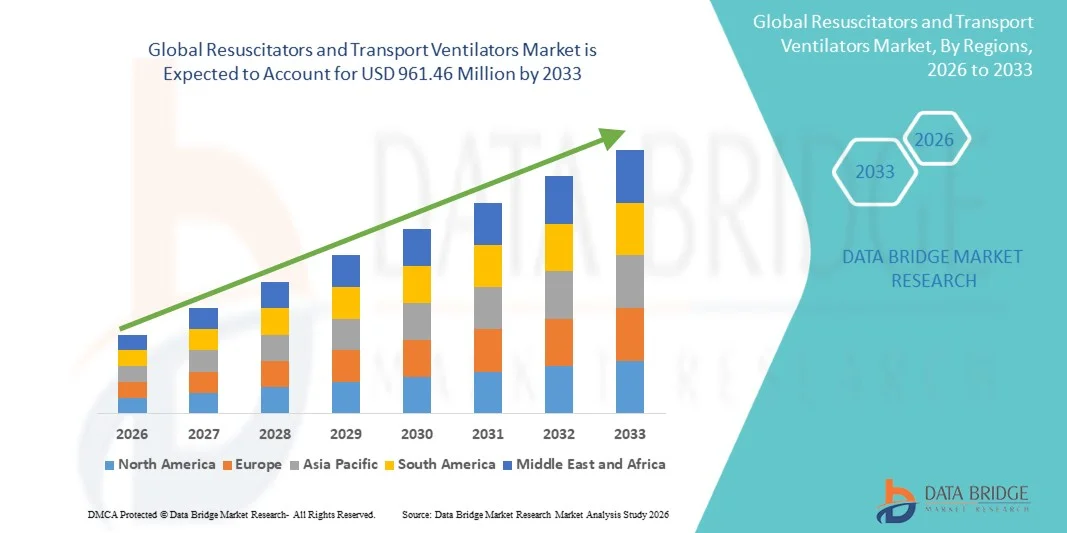
Report Scope and Resuscitators and Transport Ventilators Market Segmentation
|
Attributes |
Resuscitators and Transport Ventilators Key Market Insights |
|
Segments Covered |
|
|
Countries Covered |
North America · U.S. · Canada · Mexico Europe · Germany · France · U.K. · Netherlands · Switzerland · Belgium · Russia · Italy · Spain · Turkey · Rest of Europe Asia-Pacific · China · Japan · India · South Korea · Singapore · Malaysia · Australia · Thailand · Indonesia · Philippines · Rest of Asia-Pacific Middle East and Africa · Saudi Arabia · U.A.E. · South Africa · Egypt · Israel · Rest of Middle East and Africa South America · Brazil · Argentina · Rest of South America |
|
Key Market Players |
· Drägerwerk AG & Co. KGaA (Germany) · Hamilton Medical AG (Switzerland) · Getinge AB (Sweden) · Medtronic (Ireland) · GE HealthCare (U.S.) · Koninklijke Philips N.V. (Netherlands) · ZOLL Medical Corporation (U.S.) · Smiths Group plc (U.K.) · Smiths Medical (U.S.) · Vyaire Medical, Inc. (U.S.) · ResMed Inc. (U.S.) · Weinmann Emergency Medical Technology GmbH + Co. KG (Germany) · Mindray Medical International Limited (China) · Shenzhen Comen Medical Instruments Co., Ltd. (China) · Aeonmed Co., Ltd. (China) · MicroVent Respiratory Care (U.S.) · Fisher & Paykel Healthcare Corporation Limited (New Zealand) · Air Liquide Medical Systems (France) · Breas Medical AB (Sweden) · Schiller AG (Switzerland) |
|
Market Opportunities |
· Rapid expansion of EMS and pre-hospital care infrastructure · Growing adoption of minimally invasive and home-based respiratory care · Integration of smart sensors and AI-enabled ventilation systems |
|
Value Added Data Infosets |
In addition to the insights on market scenarios such as market value, growth rate, segmentation, geographical coverage, and major players, the market reports curated by the Data Bridge Market Research also include in-depth expert analysis, patient epidemiology, pipeline analysis, pricing analysis, and regulatory framework. |
Resuscitators and Transport Ventilators Market Trends
Trend: Rising Adoption of Portable Emergency Ventilation Systems
Healthcare providers are increasingly deploying compact, battery-powered transport ventilators and manual resuscitators in ambulances and emergency departments to ensure rapid respiratory support during patient transfer. The integration of advanced monitoring features, such as real-time oxygen delivery tracking and pressure control systems, is improving patient safety and treatment precision. Hospitals and EMS agencies are prioritizing lightweight and highly durable devices to enhance mobility and response time in critical care scenarios, while improving outcomes in time-sensitive respiratory emergencies. For instance, modern ambulance systems in urban regions are now standardizing portable ventilator deployment for pre-hospital stabilization.
Resuscitators and Transport Ventilators Market Dynamics
Key Market Driver: Rising Burden of Respiratory and Emergency Cases
The increasing prevalence of chronic respiratory diseases such as COPD, asthma, and acute respiratory distress syndrome is significantly driving demand for resuscitators and transport ventilators across hospitals and emergency care settings. In addition, the growing number of trauma cases, cardiac arrests, and surgical complications is strengthening the need for immediate respiratory intervention systems. Healthcare infrastructure expansion and improved emergency medical services are further supporting rapid adoption of life-support ventilation devices in both developed and emerging economies. For instance, expanding ICU capacity in tertiary care hospitals is increasing deployment of advanced transport ventilators during critical patient transfers.
Key Restraint/Challenge: High Cost and Maintenance Complexity of Advanced Devices
The high acquisition cost of advanced transport ventilators and smart resuscitation systems remains a major barrier, particularly for small healthcare facilities and resource-limited regions. In addition, ongoing expenses related to maintenance, calibration, consumables, and software upgrades increase the total cost of ownership significantly. The requirement for skilled professionals to operate and manage advanced ventilation systems further limits widespread adoption in rural and underdeveloped healthcare infrastructures. For instance, many small ambulance service providers still rely on basic manual resuscitators due to affordability constraints and limited technical support availability.
Key Market Opportunity: Integration of Smart Monitoring and AI-Assisted Ventilation Systems
The integration of artificial intelligence, IoT-enabled monitoring, and smart ventilation control systems presents a major growth opportunity in the resuscitators and transport ventilators market. These technologies enable real-time patient monitoring, predictive respiratory support, and automated adjustment of ventilation parameters for improved clinical outcomes. Additionally, cloud-based data integration allows remote tracking and analysis of patient respiratory performance during transport and critical care. For instance, next-generation ICU ventilators are increasingly incorporating AI-driven adaptive ventilation modes to optimize oxygen delivery and reduce clinician workload.
Resuscitators and Transport Ventilators Market Scope
The resuscitators and transport ventilators market is segmented on the basis of type, technology, and application.
- By Type
On the basis of type, the Resuscitators and Transport Ventilators Market is segmented into Continuous Positive Airway Pressure (CPAP), Noninvasive Positive Pressure Ventilation (NIPPV), and Others. The Noninvasive Positive Pressure Ventilation (NIPPV) segment dominated the market with a 46.3% share in 2025, driven by its wide usage in emergency care and critical respiratory failure management without the need for invasive intubation. These systems are increasingly preferred in ICU and pre-hospital settings due to reduced infection risk and improved patient comfort. Hospitals are rapidly adopting NIPPV devices for COPD, asthma exacerbations, and acute respiratory distress cases. Continuous technological improvements in pressure control and monitoring systems are enhancing clinical outcomes. Growing preference for non-invasive treatment protocols is further strengthening segment dominance. For instance, emergency departments in urban hospitals are increasingly standardizing NIPPV for first-line respiratory support.
The CPAP segment is projected to register the fastest growth at a CAGR of 6.9% from 2026 to 2033, driven by rising adoption in sleep apnea management and emergency respiratory stabilization. CPAP devices are gaining traction due to their simplicity, portability, and effectiveness in maintaining airway pressure. Increasing awareness of sleep-related breathing disorders is expanding their use beyond hospitals into home care settings. Technological advancements in compact and wearable CPAP systems are improving patient compliance. Growing integration of smart monitoring features is further enhancing their clinical value. For instance, portable CPAP units are increasingly being deployed in ambulances for rapid oxygenation support during transit.
- By Technology
On the basis of technology, the market is segmented into Mechanical ventilation and Electronic ventilation. The Electronic ventilation segment dominated the market with a 53.2% share in 2025, driven by increasing demand for advanced microprocessor-based ventilators offering precise control and real-time patient monitoring. These systems enable multiple ventilation modes, automated adjustments, and improved safety through integrated alarm systems. Hospitals and ICUs prefer electronic ventilators due to their accuracy, reliability, and adaptability across complex respiratory conditions. Growing integration with ICU monitoring systems and digital health platforms is further strengthening adoption. Continuous technological innovation is improving device efficiency and reducing manual intervention. For instance, modern emergency transport ventilators increasingly rely on electronic systems for stable respiratory support during inter-hospital transfers.
The Mechanical ventilation segment is expected to grow at the fastest CAGR of 6.7% from 2026 to 2033, driven by strong demand in low-resource healthcare settings and cost-sensitive markets. Mechanical ventilators remain widely used due to their affordability, durability, and ease of maintenance. They are particularly important in rural hospitals, emergency field setups, and developing regions with limited infrastructure. Increasing focus on expanding basic critical care access is supporting adoption. Governments and NGOs are investing in low-cost respiratory support systems to strengthen emergency preparedness. For instance, mechanical resuscitators are widely deployed in rural ambulance services where advanced electronic systems may not be feasible.
- By Application
On the basis of application, the market is segmented into public sector and private sector. The Public Sector segment dominated the market with a 57.8% share in 2025, driven by strong government investments in emergency medical services, public hospitals, and disaster response systems. Public healthcare institutions account for the majority of emergency admissions requiring respiratory support. Large-scale procurement programs and national healthcare initiatives are boosting device adoption. Governments are also focusing on strengthening ambulance infrastructure and trauma care networks. Standardization of emergency protocols is further increasing deployment of resuscitators and transport ventilators. For instance, publicly funded hospitals are increasingly equipping ICUs and ambulances with advanced ventilator systems for critical care readiness.
The Private Sector segment is expected to witness the fastest growth at a CAGR of 7.0% from 2026 to 2033, driven by rising investments in private hospitals, specialty clinics, and corporate healthcare facilities. Increasing demand for premium critical care services is accelerating adoption of advanced respiratory support devices. Private healthcare providers are focusing on upgrading ICU infrastructure with high-end ventilator systems. Growing medical tourism and rising healthcare expenditure are further supporting market expansion. Technological differentiation and service quality improvements are key growth drivers. For instance, private hospital chains are rapidly integrating smart ventilators to enhance patient monitoring and treatment efficiency.
Resuscitators and Transport Ventilators Market Regional Analysis
North America dominated the Resuscitators and Transport Ventilators Market with the largest revenue share of 38.6% in 2025, supported by advanced emergency healthcare infrastructure, high ICU capacity, and strong adoption of portable life-support devices in EMS systems. The region benefits from a well-established trauma care network, high prevalence of respiratory diseases, and rapid response ambulance services equipped with advanced life-support systems. Strong regulatory frameworks and continuous investment in critical care modernization are further accelerating device adoption. Increasing integration of smart ventilators with real-time patient monitoring and electronic health records is enhancing clinical efficiency. Growing focus on pre-hospital care and emergency preparedness continues to strengthen North America’s leadership position in the global market.
U.S. Resuscitators and Transport Ventilators Market Insight
The U.S. resuscitators and transport ventilators market is witnessing strong growth due to high prevalence of respiratory diseases, advanced emergency healthcare infrastructure, and widespread adoption of portable life-support systems in EMS and hospital settings. The country’s well-established ICU network, along with increasing incidence of COPD, asthma, and trauma-related emergencies, is driving consistent demand for advanced ventilation devices. In addition, growing investments in smart ventilators, AI-enabled monitoring systems, and portable emergency respiratory solutions are further strengthening market expansion. Increasing focus on reducing response time in pre-hospital care and improving patient survival rates is accelerating adoption across ambulances and emergency departments.
Europe Resuscitators and Transport Ventilators Market Insight
The Europe resuscitators and transport ventilators market remains a major contributor to global revenue, driven by strong healthcare infrastructure, stringent emergency care regulations, and high adoption of advanced critical care technologies. The region benefits from widespread use of standardized emergency medical protocols and increasing deployment of portable ventilators across hospitals and EMS systems. Growing investments in ICU modernization and non-invasive ventilation technologies are further supporting market growth. In addition, rising focus on patient safety, infection control, and digital integration of respiratory care systems continues to enhance adoption across the region.
U.K. Resuscitators and Transport Ventilators Market Insight
The U.K. resuscitators and transport ventilators market is experiencing steady growth, supported by rising demand for advanced emergency care solutions, strong NHS infrastructure, and increasing adoption of portable ventilators in ambulances and hospitals. Growing investments in critical care capacity and respiratory disease management are contributing to market expansion. In addition, integration of digital monitoring systems and smart ventilation technologies is improving treatment efficiency and patient outcomes. Rising focus on improving emergency response time and reducing hospital mortality rates is further driving adoption across healthcare facilities.
Germany Resuscitators and Transport Ventilators Market Insight
The Germany resuscitators and transport ventilators market is expanding steadily due to its strong hospital network, advanced medical device manufacturing ecosystem, and increasing focus on high-quality critical care services. Hospitals and emergency services are increasingly adopting electronic ventilators and non-invasive respiratory support systems for improved patient management. Continuous innovation in medical engineering and strong government emphasis on healthcare modernization are further driving market growth. In addition, rising demand for efficient ICU transport solutions and advanced emergency response systems is strengthening adoption across the country.
Asia-Pacific Resuscitators and Transport Ventilators Market Insight
The Asia-Pacific resuscitators and transport ventilators market is expected to witness rapid growth, driven by rising healthcare investments, expanding emergency medical services, and increasing burden of respiratory diseases across countries such as China, India, and Japan. Growing awareness regarding critical care management and improving hospital infrastructure are supporting regional market expansion. In addition, increasing adoption of cost-effective portable ventilators and government initiatives to strengthen emergency response systems are accelerating demand. Rapid urbanization and expansion of private healthcare facilities further enhance market growth across the region.
Japan Resuscitators and Transport Ventilators Market Insight
The Japan resuscitators and transport ventilators market is witnessing consistent growth due to its advanced healthcare system, aging population, and strong focus on respiratory care technologies. Hospitals and emergency services are increasingly adopting compact, high-precision ventilators for critical care and patient transport applications. Integration of smart monitoring systems and advanced non-invasive ventilation technologies is further improving treatment outcomes. In addition, the country’s emphasis on medical innovation and high-quality healthcare delivery continues to support steady market expansion.
China Resuscitators and Transport Ventilators Market Insight
The China resuscitators and transport ventilators market is growing rapidly, driven by expanding healthcare infrastructure, rising prevalence of respiratory disorders, and strong government investments in emergency medical systems. Increasing adoption of advanced ventilators in hospitals, ambulances, and critical care units is significantly boosting demand. Growing focus on improving emergency response efficiency and expanding ICU capacity is further accelerating market growth. In addition, rising domestic medical device manufacturing and increasing integration of smart and portable ventilation technologies are positioning China as one of the fastest-growing markets globally.
Resuscitators and Transport Ventilators Market Share
The resuscitators and transport ventilators industry is primarily led by well-established companies, including:
- Drägerwerk AG & Co. KGaA (Germany)
- Hamilton Medical AG (Switzerland)
- Getinge AB (Sweden)
- Medtronic (Ireland)
- GE HealthCare (U.S.)
- Koninklijke Philips N.V. (Netherlands)
- ZOLL Medical Corporation (U.S.)
- Smiths Group plc (U.K.)
- Smiths Medical (U.S.)
- Vyaire Medical, Inc. (U.S.)
- ResMed Inc. (U.S.)
- Weinmann Emergency Medical Technology GmbH + Co. KG (Germany)
- Mindray Medical International Limited (China)
- Shenzhen Comen Medical Instruments Co., Ltd. (China)
- Aeonmed Co., Ltd. (China)
- MicroVent Respiratory Care (U.S.)
- Fisher & Paykel Healthcare Corporation Limited (New Zealand)
- Air Liquide Medical Systems (France)
- Breas Medical AB (Sweden)
- Schiller AG (Switzerland)
Latest Developments in Resuscitators and Transport Ventilators Market
- In August 2025, the U.S. FDA issued a Class I recall for certain Philips Respironics BiPAP ventilators after reports of malfunction leading to serious patient harm and fatalities, where devices were found to unexpectedly reboot or become non-operational during use. This created significant risk in critical care and emergency transport environments where continuous ventilation support is essential for patient survival. The recall emphasized persistent safety challenges in electronic ventilator systems and highlighted the importance of robust fail-safe mechanisms. It also intensified regulatory scrutiny on advanced respiratory devices used in hospitals and ambulances
- In April 2024, Philips Respironics reached a final agreement with the U.S. Department of Justice and FDA under a consent decree related to its large-scale 2021 ventilator recall, requiring the company to significantly strengthen its manufacturing quality systems and regulatory compliance processes. The agreement allowed Philips to continue servicing existing respiratory devices while restricting new U.S. product introductions until compliance conditions are fully met. This development marked a critical regulatory milestone following widespread safety concerns affecting ventilators used in ICUs, emergency care, and homecare settings. It also reinforced stricter global oversight of resuscitators and transport ventilators, influencing hospital procurement and supplier trust
- In June 2022, the U.S. FDA issued a Class I recall for Philips V60 and V60 Plus ventilators due to internal power fluctuations causing unexpected device shutdowns, which posed serious risks of oxygen interruption during critical care and patient transport. These ventilators were widely used in hospitals for acute respiratory failure management and emergency ventilation support. The malfunction raised concerns about power stability and operational safety in life-support systems. Reports included patient injuries and at least one fatality linked to device failure
- In March 2022, the U.S. FDA announced multiple recall actions for Philips Respironics ventilators, including Trilogy and BiPAP series, due to performance and safety-related defects, such as airflow interruption and software malfunctions affecting respiratory delivery systems. These devices were widely used in ICU care, emergency transport, and home ventilation applications, making the recalls highly impactful across healthcare systems. The issues raised concerns about reliability and consistency in life-support ventilation equipment. Hospitals and EMS providers were advised to transition to alternative devices and reassess equipment safety
- In June 2021, Philips Respironics initiated a global recall of millions of ventilators and CPAP/BiPAP devices due to degradation of sound-abatement foam used in device construction, which could release harmful particles and volatile compounds into the airflow. This recall affected a large number of respiratory support devices used in hospitals, ICUs, and homecare settings worldwide. The issue led to widespread regulatory action and supply chain disruptions in the ventilator market during a period of high respiratory care demand. Healthcare providers were forced to urgently replace or discontinue affected devices, increasing demand for alternative resuscitators and transport ventilators

- Interactive Data Analysis Dashboard
- Company Analysis Dashboard for high growth potential opportunities
- Research Analyst Access for customization & queries
- Competitor Analysis with Interactive dashboard
- Latest News, Updates & Trend analysis
- Harness the Power of Benchmark Analysis for Comprehensive Competitor Tracking
Data collection and base year analysis are done using data collection modules with large sample sizes. The stage includes obtaining market information or related data through various sources and strategies. It includes examining and planning all the data acquired from the past in advance. It likewise envelops the examination of information inconsistencies seen across different information sources. The market data is analysed and estimated using market statistical and coherent models. Also, market share analysis and key trend analysis are the major success factors in the market report. To know more, please request an analyst call or drop down your inquiry.
The key research methodology used by DBMR research team is data triangulation which involves data mining, analysis of the impact of data variables on the market and primary (industry expert) validation. Data models include Vendor Positioning Grid, Market Time Line Analysis, Market Overview and Guide, Company Positioning Grid, Patent Analysis, Pricing Analysis, Company Market Share Analysis, Standards of Measurement, Global versus Regional and Vendor Share Analysis. To know more about the research methodology, drop in an inquiry to speak to our industry experts.
Data Bridge Market Research is a leader in advanced formative research. We take pride in servicing our existing and new customers with data and analysis that match and suits their goal. The report can be customized to include price trend analysis of target brands understanding the market for additional countries (ask for the list of countries), clinical trial results data, literature review, refurbished market and product base analysis. Market analysis of target competitors can be analyzed from technology-based analysis to market portfolio strategies. We can add as many competitors that you require data about in the format and data style you are looking for. Our team of analysts can also provide you data in crude raw excel files pivot tables (Fact book) or can assist you in creating presentations from the data sets available in the report.













