


What is the Retinal Implants Market Size and Growth Rate?
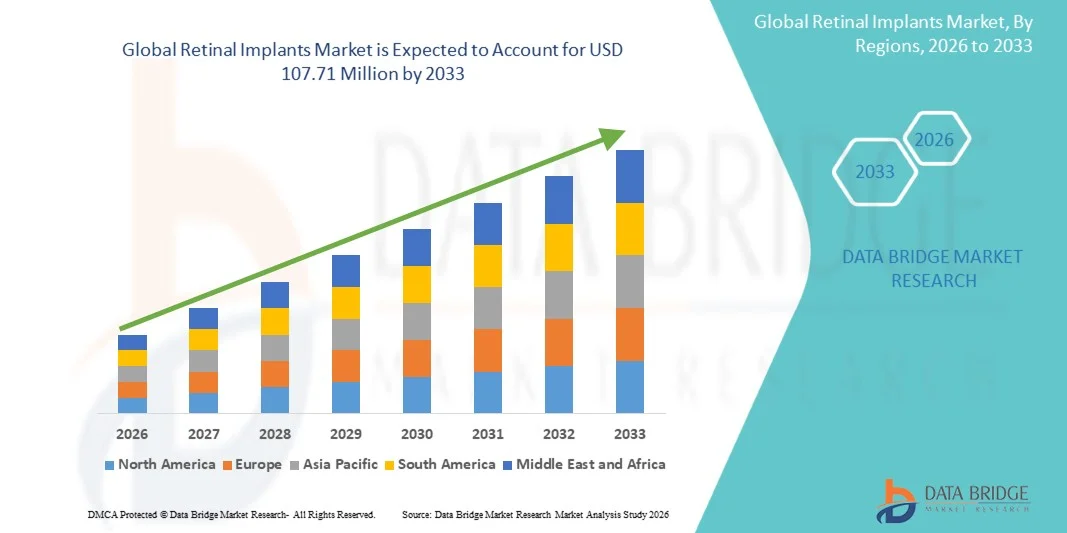
- As per Data Bridge Market Research analysis the retinal implants market was valued at USD 56.50 million in 2025 and is projected to reach USD 107.71 million by 2033, growing at a CAGR of 8.40% from 2026 to 2033.
- The market is experiencing consistent growth driven by the rising prevalence of retinal disorders and vision loss, increasing demand for advanced vision restoration technologies, and ongoing advancements in retinal implant design and neuroprosthetic technologies.
- Growing investments in ophthalmic research, increasing awareness of innovative treatment options, and improvements in minimally invasive implantation procedures are further supporting the adoption of retinal implants, particularly among patients with severe retinal degeneration and limited treatment alternatives.
Market Size & Forecast
- Global Market Value (2025): USD 56.50 million
- Expected Market Value (2033): USD 107.71 million
- Forecast CAGR (2026–2033): 8.40%
What are the Major Takeaways of the Retinal Implants Market?
- North America dominated the retinal implants market with the largest revenue share in 2025, supported by advanced ophthalmic healthcare infrastructure, a strong network of retinal specialists, and increasing clinical development of next-generation visual prostheses.
- Asia-Pacific retinal implants market is projected to register the fastest growth at a CAGR from 2026 to 2033, supported by increasing healthcare expenditure, expanding ophthalmic infrastructure, and growing investment in retinal implant research and development.
- The epiretinal implants segment held the largest market revenue share in 2025, driven by its established clinical history, established implantation procedures, and widespread use in retinal prosthesis applications. Epiretinal implants are positioned on the surface of the retina and are designed to electrically stimulate retinal ganglion cells, making them suitable for patients with advanced retinal degeneration.
- The subretinal implants segment is projected to register the fastest growth at a CAGR from 2026 to 2033, driven by advances in photovoltaic retinal technologies that position stimulation closer to surviving retinal cells. Suprachoroidal implants are also gaining attention because their placement outside the retina can simplify implantation and reduce direct retinal tissue damage.
- The retinitis pigmentosa segment held the largest market revenue share in 2025, supported by its long-standing role as a major indication for retinal prosthesis development and the increasing demand for vision-restoration technologies among patients with advanced retinal degeneration.
- The age-related macular degeneration segment is projected to register the fastest growth at a CAGR from 2026 to 2033, driven by the rising prevalence of advanced AMD and increasing development of subretinal implants for geographic atrophy. Advances in photovoltaic retinal prostheses are further expanding opportunities for retinal implants among patients with severe vision loss caused by AMD.
Report Scope and Retinal Implants Market Segmentation
|
Attributes |
Retinal Implants Key Market Insights |
|
Segments Covered |
|
|
Countries Covered |
North America
Europe
Asia-Pacific
Middle East and Africa
South America
|
|
Key Market Players |
|
|
Market Opportunities |
|
|
Value Added Data Infosets |
In addition to the insights on market scenarios such as market value, growth rate, segmentation, geographical coverage, and major players, the market reports curated by the Data Bridge Market Research also include depth expert analysis, patient epidemiology, pipeline analysis, pricing analysis, and regulatory framework. |
What is the Key Trend in the Retinal Implants Market?
- Retinal implant developers are increasingly focusing on photovoltaic and wireless subretinal technologies designed to restore functional central vision in patients with advanced retinal degeneration while reducing dependence on conventional external hardware.
- For instance, in June 2025, Science Corporation submitted a CE Mark application for its PRIMA retinal implant following clinical trial results supporting its potential use in patients with geographic atrophy caused by age-related macular degeneration (AMD).
- Integration of miniaturized retinal implants with specialized glasses and near-infrared light is enabling visual information and power to be transmitted wirelessly to implanted devices, stimulating surviving retinal nerve cells.
- Clinical development is increasingly emphasizing functional visual outcomes, including the ability to recognize letters and perform vision-related tasks, rather than only measuring basic light perception.
- For instance, the PRIMA clinical study reported that 26 of 32 participants assessed at 12 months achieved a clinically meaningful improvement in visual acuity, representing 81% of the evaluated participants.
- As manufacturers continue advancing wireless stimulation, implant miniaturization, and functional vision restoration, retinal implants are expected to gain importance as an emerging treatment approach for severe and irreversible retinal vision loss.
What are the Key Drivers of the Retinal Implants Market?
- The increasing prevalence of retinal degenerative diseases, particularly age-related macular degeneration and inherited retinal disorders, is driving demand for technologies capable of restoring functional vision when damaged photoreceptors can no longer support normal sight.
- For instance, the PRIMA clinical study evaluated a subretinal photovoltaic implant in 38 participants with geographic atrophy caused by AMD, with results demonstrating significant improvement in visual acuity after implantation.
- Advances in microelectronics, photovoltaic materials, wireless power transmission, and neural stimulation are enabling retinal implants to directly activate surviving retinal neurons with increasing precision.
- For instance, Science Corporation's PRIMA system combines a small photovoltaic implant positioned beneath the retina with glasses that transmit visual data and power through patterned near-infrared light.
- Clinical evidence is strengthening the development of retinal prostheses by demonstrating measurable improvements in functional vision among patients with advanced retinal degeneration.
- With continued investment in implant miniaturization, clinical research, wireless stimulation, and regulatory development, retinal implants are expected to become increasingly important for addressing severe vision loss where conventional treatments cannot restore damaged photoreceptors.
Which Factors are Challenging the Growth of the Retinal Implants Market?
- Retinal implants require complex surgical procedures, specialized ophthalmic expertise, post-implantation rehabilitation, and sophisticated external equipment, creating significant clinical and economic barriers to widespread adoption.
- These requirements can limit accessibility in healthcare systems where specialized retinal surgery, advanced diagnostic infrastructure, and long-term rehabilitation services are not readily available.
- For instance, the PRIMA clinical study reported 26 serious adverse events among 19 participants, with 21 events occurring within two months after surgery, highlighting the procedural risks associated with retinal implantation.
- The technology also remains subject to extensive regulatory evaluation, requiring manufacturers to demonstrate long-term safety, device reliability, visual benefits, and clinical durability before achieving broad commercial availability.
- For instance, in June 2025, Science Corporation submitted its CE Mark application for PRIMA, while the company continued regulatory development toward potential availability for patients, indicating the extensive approval process associated with advanced retinal implants.
- The high cost of specialized implantation procedures, regulatory requirements, rehabilitation, and long-term clinical monitoring continues to constrain adoption, particularly while retinal prostheses remain an emerging technology with limited commercial availability.
How is the Retinal Implants Market Segmented?
The market is segmented on the basis of type, indication, end user, and distribution channel.
- By Type
On the basis of type, the retinal implants market is segmented into epiretinal implants, subretinal implants, suprachoroidal implants, and other retinal implants. The epiretinal implants segment held the largest market revenue share in 2025, driven by its established clinical history, established implantation procedures, and widespread use in retinal prosthesis applications. Epiretinal implants are positioned on the surface of the retina and are designed to electrically stimulate retinal ganglion cells, making them suitable for patients with advanced retinal degeneration.
The subretinal implants segment is projected to register the fastest growth at a CAGR from 2026 to 2033, driven by advances in photovoltaic retinal technologies that position stimulation closer to surviving retinal cells. Suprachoroidal implants are also gaining attention because their placement outside the retina can simplify implantation and reduce direct retinal tissue damage.
- By Indication
On the basis of indication, the retinal implants market is segmented into retinitis pigmentosa, age-related macular degeneration, and other retinal disorders. The retinitis pigmentosa segment held the largest market revenue share in 2025, supported by its long-standing role as a major indication for retinal prosthesis development and the increasing demand for vision-restoration technologies among patients with advanced retinal degeneration.
The age-related macular degeneration segment is projected to register the fastest growth at a CAGR from 2026 to 2033, driven by the rising prevalence of advanced AMD and increasing development of subretinal implants for geographic atrophy. Advances in photovoltaic retinal prostheses are further expanding opportunities for retinal implants among patients with severe vision loss caused by AMD.
- By End User
On the basis of end user, the retinal implants market is segmented into hospitals, specialty clinics, ophthalmic centers, and research institutes. The hospitals segment held the largest market revenue share in 2025, driven by the availability of specialized retinal surgeons, advanced ophthalmic surgical infrastructure, and comprehensive preoperative and postoperative care.
The specialty clinics and ophthalmic centers segment i s projected to register the fastest growth at a CAGR from 2026 to 2033 as advanced vitreoretinal procedures increasingly expand into specialized ophthalmic facilities. Research institutes will also remain important for clinical trials, feasibility studies, and the development of next-generation retinal prostheses.
- By Distribution Channel
On the basis of distribution channel, the retinal implants market is segmented into direct tenders, distributors, and online channels. The direct tenders segment held the largest market revenue share in 2025, driven by the specialized nature of retinal implants and their procurement by hospitals, healthcare institutions, and specialized ophthalmic centers.
The distributors segment is projected to register the fastest growth at a CAGR from 2026 to 2033 as manufacturers expand specialized medical-device distribution networks to reach ophthalmic centers and healthcare providers across different regions. Online channels are expected to maintain a limited role because retinal implants require specialized clinical evaluation, surgical implantation, and professional procurement.
Which Region Holds the Largest Share of the Retinal Implants Market?
- North America dominated the retinal implants market with the largest revenue share in 2025, supported by advanced ophthalmic healthcare infrastructure, a strong network of retinal specialists, and increasing clinical development of next-generation visual prostheses.
- The U.S. remains the major contributor to regional demand, supported by established research institutions, specialized implanting centers, and regulatory pathways that facilitate development of innovative retinal technologies. The region's concentration of device developers and clinical research capabilities continues to strengthen its position in the global retinal implants market.
U.S. Retinal Implants Market Insight
The U.S. retinal implants market captured the largest share within North America in 2025, driven by advanced ophthalmic research, specialized surgical capabilities, and growing clinical development of retinal prostheses. The country is also benefiting from regulatory support for breakthrough medical technologies and increasing investment in visual neuroprostheses. For instance, Science Corporation is conducting a U.S. feasibility study for its PRIMA retinal implant for advanced age-related macular degeneration, while continuing its regulatory development program.
Europe Retinal Implants Market Insight
Europe retinal implants market is projected to register the fastest growth at a CAGR from 2026 to 2033, supported by advanced ophthalmic research, specialized retinal surgery capabilities, and increasing clinical validation of retinal prostheses. Germany, France, Switzerland, and the U.K. are important centers for retinal implant research and clinical studies. For instance, Science Corporation completed its PRIMAvera clinical study in Europe and submitted a CE Mark application in June 2025, strengthening the region's position in the development of next-generation retinal implants.
U.K. Retinal Implants Market Insight
U.K. retinal implants market is projected to register the fastest growth at a CAGR from 2026 to 2033, supported by advanced ophthalmic services, specialist retinal centers, and participation in clinical research for vision-restoration technologies. The country's established healthcare infrastructure and specialist eye hospitals provide an important environment for evaluating emerging retinal prostheses. For instance, Moorfields Eye Hospital was among the European clinical sites involved in the PRIMA retinal implant study for patients with advanced geographic atrophy caused by age-related macular degeneration.
Germany Retinal Implants Market Insight
Germany retinal implants market is projected to register the fastest growth at a CAGR from 2026 to 2033, driven by advanced ophthalmology infrastructure, an aging population, and increasing research into technologies for severe retinal degeneration. Germany has also emerged as an important clinical research location for photovoltaic retinal implants. For instance, the University of Bonn's Department of Ophthalmology participated in the PRIMAvera study, which evaluated the PRIMA subretinal implant for patients with advanced age-related macular degeneration.
Asia-Pacific Retinal Implants Market Insight
The Asia-Pacific retinal implants market is projected to register the fastest growth at a CAGR from 2026 to 2033, supported by increasing healthcare expenditure, expanding ophthalmic infrastructure, and growing investment in retinal implant research and development. Japan is expected to be one of the region's fastest-growing markets, while China and other Asian economies are expanding their capabilities in advanced ophthalmic technologies. The regional market is also benefiting from increasing clinical research and adoption of innovative retinal treatment approaches.
Japan Retinal Implants Market Insight
Japan retinal implants market is projected to register the fastest growth at a CAGR from 2026 to 2033, supported by advanced medical technology, an aging population, and strong investment in regenerative and retinal healthcare research. The country's ophthalmic research ecosystem is increasingly focused on innovative approaches for treating severe retinal degeneration. For instance, Japanese researchers and healthcare institutions have been advancing iPS cell-based retinal therapies, reflecting the country's strong capabilities in developing advanced vision-restoration technologies.
China Retinal Implants Market Insight
China retinal implants market is projected to register the fastest growth at a CAGR from 2026 to 2033, supported by its large aging population, expanding healthcare infrastructure, and increasing investment in advanced ophthalmic technologies. Growing demand for treatments addressing severe retinal degeneration and improvements in specialized eye-care services are supporting market development. China is also expected to become an increasingly important Asia-Pacific market as healthcare capabilities and access to advanced retinal treatment technologies continue to expand.
Which are the Top Companies in Retinal Implants Market?
The retinal implants industry is primarily led by well-established companies, including:
- Science Corporation (U.S.)
- Cortigent, Inc. (U.S.)
- VisionCare Ophthalmic Technologies, Inc. (U.S.)
- Nano Retina Ltd. (Israel)
- Bionic Vision Technologies Pty Ltd (Australia)
- Retina Implant AG (Germany)
- iBIONICS Inc. (Canada)
- LambdaVision, Inc. (U.S.)
- NIDEK CO., LTD. (Japan)
- GenSight Biologics S.A. (France)
- Intelligent Implants GmbH (Germany)
- Vivani Medical, Inc. (U.S.)
- Optobionics Corporation (U.S.)
- Bionic Sight LLC (U.S.)
- Labtician Ophthalmics, Inc. (Canada)
What are Latest Developments in Retinal Implants Market?
- In March 2026, Science Corporation closed a USD 230 million Series C financing round to support commercialization of its PRIMA BCI retinal implant and expansion of clinical trials into Stargardt disease and retinitis pigmentosa. The funding is intended to accelerate PRIMA development and commercialization activities, while expanding clinical research beyond geographic atrophy caused by age-related macular degeneration. The additional indications could broaden the potential patient population for photovoltaic retinal implants. The financing also supports the company's wider development of visual neuroprosthetic technologies.
- In March 2026, Science Corporation announced plans to begin PRIMA clinical trials for Stargardt disease and retinitis pigmentosa at Sydney Eye Hospital in Australia, expanding the potential applications of photovoltaic retinal implants. The planned studies will evaluate whether PRIMA can provide functional vision restoration in patients with inherited retinal diseases. Both conditions are associated with progressive photoreceptor loss and severe visual impairment. Expansion into these indications represents an important step toward applying retinal implant technology across multiple forms of retinal degeneration.
- In January 2026, Science Corporation reported that a New England Journal of Medicine editorial described PRIMA as the first treatment to restore vision in patients with advanced geographic atrophy caused by age-related macular degeneration. The editorial followed publication of clinical results demonstrating meaningful visual improvement among patients treated with the photovoltaic retinal implant. PRIMA is designed to bypass damaged photoreceptors and stimulate remaining retinal neurons through near-infrared light. The development strengthened clinical recognition of photovoltaic retinal prostheses as an emerging approach to vision restoration.
- In October 2025, the New England Journal of Medicine published clinical results showing that Science Corporation's PRIMA implant restored functional central vision in patients with geographic atrophy caused by AMD. The study evaluated 38 participants with geographic atrophy, with 32 completing the 12-month assessment. Among those assessed at 12 months, 26 achieved clinically meaningful visual-acuity improvement. The findings provided important clinical evidence supporting the development of subretinal photovoltaic implants for advanced vision loss.
- In June 2025, Science Corporation submitted a CE Mark application for PRIMA after completing a major European clinical trial, advancing the retinal implant toward potential commercialization in Europe. The application followed clinical findings from the PRIMAvera study evaluating the implant in patients with geographic atrophy caused by AMD. PRIMA combines a photovoltaic subretinal implant with specialized glasses that deliver visual information and power through near-infrared light. The regulatory submission represented a significant milestone in moving retinal implant technology from clinical development toward potential commercial use.

- Interactive Data Analysis Dashboard
- Company Analysis Dashboard for high growth potential opportunities
- Research Analyst Access for customization & queries
- Competitor Analysis with Interactive dashboard
- Latest News, Updates & Trend analysis
- Harness the Power of Benchmark Analysis for Comprehensive Competitor Tracking
Data collection and base year analysis are done using data collection modules with large sample sizes. The stage includes obtaining market information or related data through various sources and strategies. It includes examining and planning all the data acquired from the past in advance. It likewise envelops the examination of information inconsistencies seen across different information sources. The market data is analysed and estimated using market statistical and coherent models. Also, market share analysis and key trend analysis are the major success factors in the market report. To know more, please request an analyst call or drop down your inquiry.
The key research methodology used by DBMR research team is data triangulation which involves data mining, analysis of the impact of data variables on the market and primary (industry expert) validation. Data models include Vendor Positioning Grid, Market Time Line Analysis, Market Overview and Guide, Company Positioning Grid, Patent Analysis, Pricing Analysis, Company Market Share Analysis, Standards of Measurement, Global versus Regional and Vendor Share Analysis. To know more about the research methodology, drop in an inquiry to speak to our industry experts.
Data Bridge Market Research is a leader in advanced formative research. We take pride in servicing our existing and new customers with data and analysis that match and suits their goal. The report can be customized to include price trend analysis of target brands understanding the market for additional countries (ask for the list of countries), clinical trial results data, literature review, refurbished market and product base analysis. Market analysis of target competitors can be analyzed from technology-based analysis to market portfolio strategies. We can add as many competitors that you require data about in the format and data style you are looking for. Our team of analysts can also provide you data in crude raw excel files pivot tables (Fact book) or can assist you in creating presentations from the data sets available in the report.













