


What is the Retrieval Augmented Generation (RAG) Market Size and Growth Rate?
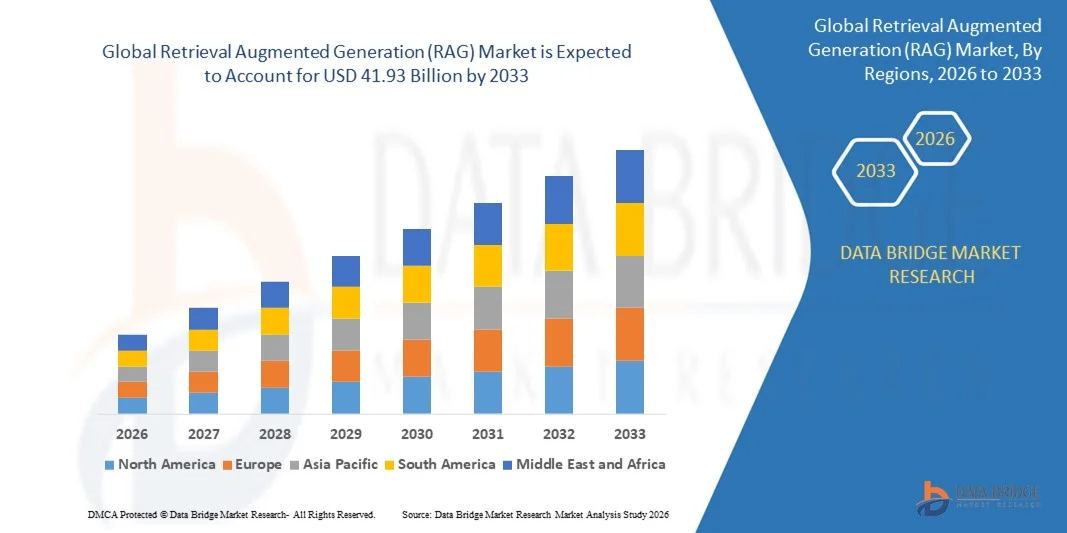
- As per Data Bridge Market Research Analysis the global Retrieval Augmented Generation (RAG) market size was valued at USD 2.30 billion in 2025 and is expected to reach USD 41.93 billion by 2033, at a CAGR of 43.75% during the forecast period
- The market growth is primarily driven by the increasing adoption of AI-powered enterprise solutions and the integration of generative AI with external knowledge sources, enabling more accurate, context-aware, and real-time content generation
- Moreover, rising demand from industries such as customer support, knowledge management, legal, and content creation for intelligent, automated, and reliable information retrieval is positioning RAG solutions as essential tools for modern businesses. These converging factors are accelerating the deployment of RAG platforms, thereby significantly enhancing the market's growth
Market Size & Forecast
- Global Market Value (2025): USD 2.30 Billion
- Expected Market Value (2033): USD 41.93 Billion
- Forecast CAGR (2026–2033): 43.75%
What are the Major Takeaways of Retrieval Augmented Generation (RAG) Market?
- Retrieval-Augmented Generation (RAG) solutions, combining generative AI models with external data retrieval, are increasingly critical for enterprises seeking accurate, context-aware, and real-time content generation across customer support, knowledge management, legal, research, and content creation applications due to their ability to enhance operational efficiency and decision-making
- The escalating demand for Retrieval-Augmented Generation (RAG) systems is primarily fueled by the widespread adoption of AI and NLP technologies, increasing enterprise focus on automation, and the growing need for intelligent systems that deliver precise, personalized outputs while reducing manual workload and operational costs
- North America dominated the Retrieval-Augmented Generation (RAG) market with the largest revenue share of 37.8% in 2025, characterized by early adoption of AI solutions, high investment in cloud infrastructure and R&D, and a strong presence of key technology providers, with the U.S. witnessing substantial growth in RAG deployments, particularly in large enterprises and AI-driven startups leveraging these solutions for customer support, knowledge management, and automated content generation
- Asia-Pacific is expected to be the fastest-growing region in the Retrieval-Augmented Generation (RAG) market during the forecast period due to expanding digital transformation initiatives, increasing enterprise adoption of AI-powered solutions, and rising investments in cloud infrastructure and AI research
- Knowledge Management segment dominated the Retrieval-Augmented Generation (RAG) market with a combined market share of 41.5% in 2025, driven by their critical role in improving operational efficiency, reducing response times, and delivering AI-augmented, accurate, and context-aware outputs across enterprise workflows
Report Scope and Retrieval Augmented Generation (RAG) Market Segmentation
|
Attributes |
Retrieval Augmented Generation (RAG) Key Market Insights |
|
Segments Covered |
|
|
Countries Covered |
North America
Europe
Asia-Pacific
Middle East and Africa
South America
|
|
Key Market Players |
|
|
Market Opportunities |
|
|
Value Added Data Infosets |
In addition to the market insights such as market value, growth rate, market segments, geographical coverage, market players, and market scenario, the market report curated by the Data Bridge Market Research team includes in-depth expert analysis, import/export analysis, pricing analysis, production consumption analysis, and pestle analysis |
What is the Key Trend in the Retrieval Augmented Generation (RAG) Market?
Enterprise Adoption of Domain-Specific and Multimodal AI Systems
- A significant and accelerating trend in the global Retrieval-Augmented Generation (RAG) market is the rapid enterprise integration of domain-specific large language models with proprietary knowledge bases and multimodal data sources, significantly enhancing contextual accuracy and decision intelligence across industries
- For instance, enterprise AI platforms are embedding RAG capabilities into customer support and knowledge management systems, enabling organizations to retrieve internal documents and generate real-time responses tailored to business workflows
- RAG integration enables features such as contextual grounding of responses, hallucination reduction, citation-backed outputs, and adaptive learning from enterprise data. For instance, some AI vendors deploy RAG pipelines that connect vector databases with language models to improve answer precision and provide traceable references for compliance-sensitive industries. Furthermore, multimodal RAG systems can process text, images, and structured datasets simultaneously to generate comprehensive analytical outputs
- The seamless integration of Retrieval-Augmented Generation (RAG) systems with cloud ecosystems and enterprise SaaS platforms facilitates centralized AI orchestration across departments. Through unified dashboards, organizations can manage document retrieval, conversational AI agents, analytics engines, and workflow automation, creating a cohesive and intelligent operational environment
- This trend toward more explainable, reliable, and enterprise-grade generative AI solutions is fundamentally reshaping organizational AI strategies. Consequently, companies are developing secure RAG frameworks with enhanced data governance, real-time indexing, and scalable deployment capabilities across hybrid infrastructures
- The demand for Retrieval-Augmented Generation (RAG) solutions offering secure enterprise integration, reduced hallucination risk, and scalable cloud compatibility is expanding rapidly across sectors including BFSI, healthcare, IT services, and government, as enterprises increasingly prioritize trustworthy and context-aware AI systems
- In addition, advancements in vector databases, embedding models, and retrieval optimization techniques are improving system performance and latency, enabling real-time enterprise-scale deployments and supporting more complex, data-intensive AI use cases
Retrieval Augmented Generation (RAG) Market Dynamics
Driver
Growing Enterprise Need for Accurate and Context-Aware AI Systems
- The increasing enterprise reliance on generative AI for mission-critical workflows, coupled with the growing demand for contextually grounded and verifiable outputs, is a significant driver for the heightened adoption of Retrieval-Augmented Generation (RAG) systems
- For instance, in 2025 several enterprise AI vendors expanded RAG-based copilots integrated with internal databases and cloud storage systems to improve decision support and automated reporting capabilities. Such strategic deployments by key technology providers are expected to accelerate market growth during the forecast period
- As organizations seek to minimize misinformation risks associated with standalone language models, RAG solutions offer enhanced reliability through real-time document retrieval, citation-backed answers, and improved transparency, providing a compelling advancement over traditional generative AI systems
- Furthermore, the rapid digital transformation across industries and the expansion of enterprise data repositories are making RAG systems integral to modern AI architectures, offering scalable integration with analytics platforms, CRM systems, and enterprise resource planning tools
- The ability to automate knowledge discovery, enhance customer engagement through intelligent chatbots, and support research-intensive workflows via contextual summarization are key factors propelling RAG adoption across large enterprises and technology-driven organizations. The increasing availability of user-friendly AI development frameworks and managed cloud services further contributes to overall market expansion
- Growing investments in AI infrastructure by governments and private enterprises are further strengthening the deployment of Retrieval-Augmented Generation (RAG) solutions, particularly in data-intensive sectors seeking competitive differentiation through intelligent automation
- Moreover, the need for explainable AI systems that align with regulatory compliance and corporate governance standards is accelerating enterprise adoption of RAG architectures capable of providing traceable and auditable outputs
Restraint/Challenge
Data Privacy Risks and Infrastructure Complexity Hurdles
- Concerns surrounding data privacy, regulatory compliance, and secure handling of proprietary enterprise information pose a significant challenge to broader market penetration of Retrieval-Augmented Generation (RAG) systems. As RAG architectures require continuous access to internal databases and cloud repositories, organizations remain cautious about potential data exposure or compliance violations
- For instance, stringent data protection regulations in regions such as Europe and North America have prompted enterprises to conduct extensive security audits before deploying AI systems connected to sensitive data environments
- Addressing these concerns through advanced encryption, role-based access controls, secure vector database management, and transparent audit trails is crucial for building enterprise trust. Companies developing RAG platforms emphasize data isolation frameworks and compliance-ready deployment models to reassure potential clients. In addition, the relatively high infrastructure and integration costs associated with implementing scalable RAG pipelines can present barriers for small and mid-sized enterprises
- While cloud-based RAG services are becoming more accessible, the complexity of configuring retrieval mechanisms, maintaining updated knowledge bases, and optimizing large language models still requires specialized expertise, potentially limiting adoption among resource-constrained organizations
- Overcoming these challenges through improved data governance frameworks, simplified deployment architectures, cost-effective AI infrastructure solutions, and enterprise education initiatives will be essential for sustaining long-term market growth in the Retrieval-Augmented Generation (RAG) market
- In addition, interoperability challenges between legacy enterprise systems and modern AI infrastructures can slow deployment timelines and increase implementation costs, particularly in large organizations with fragmented IT environments
- Furthermore, concerns regarding model bias, data quality inconsistencies, and the need for continuous system monitoring may require ongoing operational investments, potentially affecting return on investment for some enterprises during early adoption phases
Retrieval Augmented Generation (RAG) Market Scope
The market is segmented on the basis of feature, deployment type, end user, and application.
- By Feature
On the basis of feature, the Retrieval-Augmented Generation (RAG) market is segmented into document retrieval, response generation, summarization & reporting, and recommendation engines. The document retrieval segment dominated the market with the largest revenue share in 2025, driven by its foundational role in grounding AI-generated outputs with accurate and contextually relevant data. Enterprises prioritize advanced retrieval mechanisms to minimize hallucinations and improve answer precision in knowledge-intensive environments. The growing volume of structured and unstructured enterprise data has increased the need for efficient indexing and semantic search capabilities. Document retrieval systems integrated with vector databases enhance scalability and real-time processing. In addition, compliance-sensitive industries such as healthcare and BFSI rely heavily on accurate source referencing, further strengthening this segment’s dominance.
The summarization & reporting segment is anticipated to witness the fastest growth rate from 2026 to 2033, fueled by rising enterprise demand for automated report generation and real-time analytics insights. Organizations increasingly require AI systems capable of condensing vast datasets into actionable summaries. The ability to generate executive briefings, compliance reports, and research digests enhances operational efficiency. As data volumes grow exponentially, businesses are adopting RAG-powered summarization tools to reduce manual analysis workloads. Integration with business intelligence platforms further accelerates adoption across data-driven enterprises.
- By Deployment Type
On the basis of deployment type, the Retrieval-Augmented Generation (RAG) market is segmented into cloud deployment and on-premises deployment. The cloud deployment segment held the largest market revenue share in 2025, driven by scalability, cost efficiency, and seamless integration with existing cloud-based AI ecosystems. Enterprises prefer cloud-based RAG solutions for their ability to handle large-scale data processing and real-time retrieval without extensive infrastructure investment. Cloud platforms enable rapid deployment, continuous updates, and global accessibility. The growing adoption of AI-as-a-Service models further supports this dominance. In addition, cloud-native architectures facilitate integration with SaaS platforms, enhancing enterprise-wide accessibility and collaboration.
The on-premises deployment segment is expected to witness the fastest growth from 2026 to 2033, driven by increasing concerns regarding data privacy, regulatory compliance, and control over proprietary information. Highly regulated industries such as government, defense, and finance prefer localized infrastructure to ensure data sovereignty. On-premises RAG systems provide enhanced customization and security configurations tailored to enterprise needs. Organizations managing sensitive intellectual property are investing in private AI infrastructure to mitigate external data exposure risks. This shift toward secure and controlled AI environments is accelerating growth in the segment.
- By End User
On the basis of end user, the Retrieval-Augmented Generation (RAG) market is segmented into healthcare, financial services, retail & e-commerce, IT & telecommunications, education, media & entertainment, and others. The IT & telecommunications segment dominated the market with the largest revenue share in 2025, driven by early adoption of advanced AI technologies and extensive digital transformation initiatives. IT companies leverage RAG systems to enhance technical support automation, internal knowledge management, and developer assistance tools. Telecom providers deploy RAG-powered chatbots to manage high volumes of customer inquiries efficiently. The sector’s strong investment capacity in AI infrastructure further strengthens its market position. Continuous innovation in cloud computing and AI frameworks also contributes to sustained dominance.
The healthcare segment is anticipated to witness the fastest growth rate from 2026 to 2033, fueled by the need for accurate clinical documentation, research summarization, and decision-support systems. Healthcare providers are increasingly utilizing RAG models to retrieve patient records, medical literature, and treatment guidelines securely. The ability to generate citation-backed insights improves diagnostic support and regulatory compliance. Rising digital health initiatives and AI adoption in hospitals and research institutions further drive expansion. As data-driven medicine advances, RAG systems are becoming integral to modern healthcare workflows.
- By Application
On the basis of application, the Retrieval-Augmented Generation (RAG) market is segmented into knowledge management, customer support & chatbots, legal & compliance, marketing & sales, research & development, and content generation. The knowledge management segment dominated the market with the largest revenue share of 41.5% in 2025, driven by enterprises seeking efficient retrieval of internal documentation and institutional knowledge. Organizations rely on RAG systems to centralize and contextualize vast repositories of information. Improved retrieval accuracy reduces employee search time and enhances productivity. Integration with enterprise collaboration tools strengthens cross-departmental information flow. As businesses prioritize operational efficiency, AI-powered knowledge systems remain a primary adoption area.
The customer support & chatbots segment is expected to witness the fastest CAGR from 2026 to 2033, driven by increasing demand for automated, personalized, and real-time customer engagement solutions. RAG-powered chatbots provide contextually accurate responses by retrieving up-to-date product and policy information. Businesses are leveraging these systems to reduce response times and operational costs. The integration of conversational AI into omnichannel platforms enhances customer satisfaction. Growing e-commerce expansion and digital service adoption further accelerate growth in this segment.
Which Region Holds the Largest Share of the Retrieval Augmented Generation (RAG) Market?
- North America dominated the Retrieval-Augmented Generation (RAG) market with the largest revenue share of 37.8% in 2025, characterized by early adoption of AI solutions, high investment in cloud infrastructure and R&D, and a strong presence of key technology providers
- Organizations in the region highly prioritize accuracy, data security, and seamless integration offered by RAG systems with existing enterprise platforms such as CRM, ERP, analytics engines, and cloud-based collaboration tools
- This widespread adoption is further supported by substantial R&D funding, the presence of leading AI technology providers, a mature digital ecosystem, and the growing demand for explainable and compliance-ready AI solutions, establishing RAG systems as a strategic component for enterprises across sectors including BFSI, healthcare, IT, and government
U.S. Retrieval Augmented Generation (RAG) Market Insight
The U.S. Retrieval-Augmented Generation (RAG) market captured the largest revenue share within North America in 2025, fueled by rapid enterprise adoption of generative AI and the expanding integration of AI copilots across business workflows. Organizations are increasingly prioritizing AI systems that provide accurate, citation-backed, and context-aware outputs to support decision-making. The strong presence of leading AI technology providers, cloud hyperscalers, and venture-backed startups further accelerates innovation in RAG architectures. Moreover, the growing deployment of RAG solutions across sectors such as BFSI, healthcare, legal, and IT services is significantly contributing to market expansion.
Europe Retrieval-Augmented Generation (RAG) Market Insight
The Europe Retrieval-Augmented Generation (RAG) market is projected to expand at a substantial CAGR throughout the forecast period, primarily driven by stringent data protection regulations and the increasing demand for explainable and compliance-ready AI systems. The region’s focus on digital transformation and enterprise automation is fostering the adoption of RAG-based knowledge management and analytics platforms. European organizations are highly attentive to data sovereignty and privacy, encouraging the deployment of secure and auditable AI infrastructures. Growth is observed across financial services, healthcare research, manufacturing, and public sector applications, where accurate document retrieval and traceable AI outputs are essential.
U.K. Retrieval-Augmented Generation (RAG) Market Insight
The U.K. Retrieval-Augmented Generation (RAG) market is anticipated to grow at a noteworthy CAGR during the forecast period, driven by increasing enterprise AI investments and the strong presence of fintech and legal technology sectors. In addition, regulatory compliance requirements and the demand for secure knowledge automation are encouraging businesses to deploy RAG systems. The U.K.’s advanced digital economy, combined with high cloud adoption rates and AI research initiatives, is expected to continue stimulating market growth. Expanding applications in financial advisory, research analytics, and enterprise customer engagement platforms further strengthen adoption.
Germany Retrieval-Augmented Generation (RAG) Market Insight
The Germany Retrieval-Augmented Generation (RAG) market is expected to expand at a considerable CAGR during the forecast period, fueled by rising demand for industrial AI solutions and secure enterprise automation tools. Germany’s strong manufacturing base and emphasis on precision, compliance, and data protection promote the adoption of RAG systems in engineering, automotive, and industrial research sectors. Integration of RAG solutions with enterprise resource planning and analytics systems is becoming increasingly common. Furthermore, the country’s focus on innovation and Industry 4.0 initiatives aligns with the deployment of reliable and explainable AI-driven knowledge systems.
Asia-Pacific Retrieval-Augmented Generation (RAG) Market Insight
The Asia-Pacific Retrieval-Augmented Generation (RAG) market is poised to grow at the fastest CAGR during the forecast period of 2026 to 2033, driven by rapid digital transformation, expanding cloud infrastructure, and increasing AI investments in countries such as China, Japan, and India. The region’s growing enterprise sector and rising adoption of intelligent automation solutions are accelerating demand for RAG-based systems. Government initiatives promoting AI innovation and smart industry ecosystems further support market growth. In addition, the expansion of AI development hubs and technology startups is enhancing accessibility and scalability of RAG platforms across diverse industries.
Japan Retrieval-Augmented Generation (RAG) Market Insight
The Japan Retrieval-Augmented Generation (RAG) market is gaining momentum due to the country’s advanced technological ecosystem, strong research capabilities, and growing demand for automation in enterprise environments. Japanese organizations emphasize precision, reliability, and compliance, making RAG systems attractive for data-intensive sectors such as healthcare, manufacturing, and financial services. Integration of RAG solutions with IoT, robotics, and analytics platforms is further fueling adoption. Moreover, Japan’s commitment to AI innovation and digital governance frameworks is expected to sustain long-term market expansion.
India Retrieval-Augmented Generation (RAG) Market Insight
The India Retrieval-Augmented Generation (RAG) market accounted for a leading revenue share in Asia-Pacific in 2025, attributed to the country’s expanding IT services sector, strong startup ecosystem, and rapid enterprise digitization. India stands as one of the fastest-growing markets for AI-driven automation solutions, with RAG platforms increasingly deployed in customer support, fintech, healthcare analytics, and e-commerce sectors. Government initiatives supporting digital infrastructure and AI innovation further strengthen market growth. The availability of skilled AI professionals and cost-effective cloud solutions is also propelling wider enterprise adoption across industries.
Which are the Top Companies in Retrieval Augmented Generation (RAG) Market?
The Retrieval Augmented Generation (RAG) industry is primarily led by well-established companies, including:
- Amazon.com, Inc. (U.S.)
- Microsoft Corporation (U.S.)
- Google LLC (U.S.)
- International Business Machines Corporation (U.S.)
- NVIDIA Corporation (U.S.)
- Pinecone Systems, Inc. (U.S.)
- Weaviate B.V. (Netherlands)
- Zilliz Inc. (U.S.)
- Elasticsearch B.V. (Netherlands)
- MongoDB, Inc. (U.S.)
- Cohere Inc. (Canada)
- Clarifai, Inc. (U.S.)
- Qdrant Solutions GmbH (Germany)
- deepset GmbH (Germany)
- GigaSpaces Technologies Inc. (U.S.)
- DataStax, Inc. (U.S.)
- Redis Ltd. (Israel)
- Snowflake Inc. (U.S.)
- Oracle Corporation (U.S.)
- Alibaba Group Holding Limited (China)
What are Latest Developments in Retrieval Augmented Generation (RAG) Market?
- In February 2026, MongoDB announced the public preview of its new Embedding and Reranking API on MongoDB Atlas, enabling developers to build semantic search and RAG-powered assistants directly within the managed cloud database, combining vector search and semantic reranking capabilities for more contextually accurate retrieval-augmented AI applications
- In November 2025, Google introduced the “File Search Tool” for its Gemini API, a native RAG-based feature that lets developers ground generative AI responses in trusted data sources (PDF, DOCX, TXT, etc.) with vector search and citations for more accurate, verifiable outputs
- In November 2025, Microsoft unveiled a major overhaul of its Microsoft Foundry platform introducing “Foundry IQ,” a next-generation retrieval-augmented generation (RAG) tool designed to unify and contextualize enterprise data across sources such as OneLake, Amazon S3, and Snowflake to empower AI agents with more accurate, context-aware outputs
- In July 2025, IIT Kanpur and the Uttar Pradesh Police launched an AI-powered Retrieval-Augmented Generation (RAG) chatbot to provide instant access to information from over 1,000 Hindi police circulars via natural language queries, simplifying public access to crime and procedure guidelines
- In August 2024, Contextual AI raised USD 80 million in Series A funding for its enterprise RAG-enhancing technology, highlighting growing investor confidence in RAG frameworks for reducing hallucinations and improving LLM accuracy by integrating curated contextual information

- Interactive Data Analysis Dashboard
- Company Analysis Dashboard for high growth potential opportunities
- Research Analyst Access for customization & queries
- Competitor Analysis with Interactive dashboard
- Latest News, Updates & Trend analysis
- Harness the Power of Benchmark Analysis for Comprehensive Competitor Tracking
Data collection and base year analysis are done using data collection modules with large sample sizes. The stage includes obtaining market information or related data through various sources and strategies. It includes examining and planning all the data acquired from the past in advance. It likewise envelops the examination of information inconsistencies seen across different information sources. The market data is analysed and estimated using market statistical and coherent models. Also, market share analysis and key trend analysis are the major success factors in the market report. To know more, please request an analyst call or drop down your inquiry.
The key research methodology used by DBMR research team is data triangulation which involves data mining, analysis of the impact of data variables on the market and primary (industry expert) validation. Data models include Vendor Positioning Grid, Market Time Line Analysis, Market Overview and Guide, Company Positioning Grid, Patent Analysis, Pricing Analysis, Company Market Share Analysis, Standards of Measurement, Global versus Regional and Vendor Share Analysis. To know more about the research methodology, drop in an inquiry to speak to our industry experts.
Data Bridge Market Research is a leader in advanced formative research. We take pride in servicing our existing and new customers with data and analysis that match and suits their goal. The report can be customized to include price trend analysis of target brands understanding the market for additional countries (ask for the list of countries), clinical trial results data, literature review, refurbished market and product base analysis. Market analysis of target competitors can be analyzed from technology-based analysis to market portfolio strategies. We can add as many competitors that you require data about in the format and data style you are looking for. Our team of analysts can also provide you data in crude raw excel files pivot tables (Fact book) or can assist you in creating presentations from the data sets available in the report.













