


What is the Returnable Plastic Crate Market Size and Growth Rate?
- As per Data Bridge Market Research Analysis the global returnable plastic crate market size was valued at USD 1.92 billion in 2025 and is expected to reach USD 2.96 billion by 2033, at a CAGR of 5.6% during the forecast period
- The market growth is largely fueled by the increasing adoption of reusable and sustainable packaging solutions across retail, agriculture, food processing, and logistics industries, leading to higher demand for durable returnable plastic crates in transportation and storage operations
- Furthermore, rising focus on reducing packaging waste, improving supply chain efficiency, and minimizing operational costs is establishing returnable plastic crates as a preferred reusable packaging solution across multiple end-use sectors. These converging factors are accelerating the adoption of returnable plastic crate systems, thereby significantly boosting the industry’s growth
Market Size & Forecast
Global Market Value (2025): USD 1.92 billion
Expected Market Value (2033): USD 2.96 billion
Forecast CAGR (2026–2033): 5.6%
What are the Major Takeaways of Returnable Plastic Crate Market ?
- Returnable plastic crates, designed for repeated usage in storage, handling, and transportation applications, are increasingly becoming essential components of modern logistics and supply chain systems due to their durability, stackability, moisture resistance, and cost-effectiveness across long-term operations
- The escalating demand for returnable plastic crates is primarily fueled by the rapid expansion of organized retail, increasing agricultural exports, growing cold chain logistics infrastructure, and rising preference for sustainable reusable packaging solutions across industrial and commercial sectors
- North America dominated the returnable plastic crate market with a share of8% in 2025, due to the strong presence of organized retail, advanced logistics infrastructure, and growing adoption of reusable packaging solutions across food and beverage industries
- Asia-Pacific is expected to be the fastest growing region in the returnable plastic crate market during the forecast period due to rapid industrialization, expanding agricultural exports, and rising investments in organized retail and logistics infrastructure across countries such as China, India, and Japan
- Stackable segment dominated the market with a market share of 52.9% in 2025, due to its extensive use in warehousing, transportation, and retail distribution networks. Stackable crates provide superior space utilization during storage and transit while maintaining product safety and load stability. Industries such as agriculture, dairy, and beverage heavily rely on stackable designs for efficient handling of bulk products and streamlined logistics operations
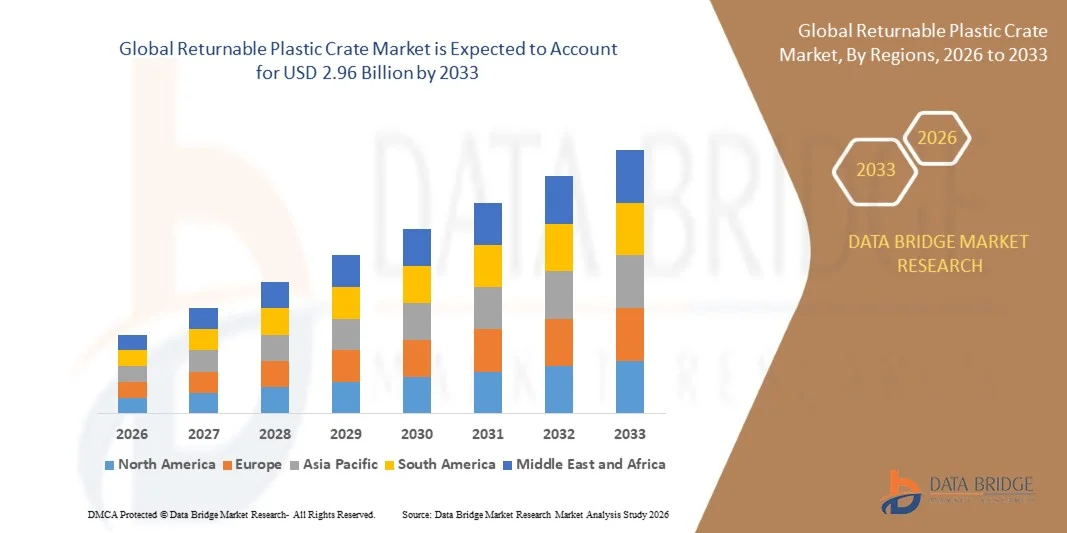
Report Scope and Returnable Plastic Crate Market Segmentation
|
Attributes |
Returnable Plastic Crate Key Market Insights |
|
Segments Covered |
|
|
Countries Covered |
North America · U.S. · Canada · Mexico Europe · Germany · France · U.K. · Netherlands · Switzerland · Belgium · Russia · Italy · Spain · Turkey · Rest of Europe Asia-Pacific · China · Japan · India · South Korea · Singapore · Malaysia · Australia · Thailand · Indonesia · Philippines · Rest of Asia-Pacific Middle East and Africa · Saudi Arabia · U.A.E. · South Africa · Egypt · Israel · Rest of Middle East and Africa South America · Brazil · Argentina · Rest of South America |
|
Key Market Players |
|
|
Market Opportunities |
|
|
Value Added Data Infosets |
In addition to the insights on market scenarios such as market value, growth rate, segmentation, geographical coverage, and major players, the market reports curated by the Data Bridge Market Research also include import export analysis, production capacity overview, production consumption analysis, price trend analysis, climate change scenario, supply chain analysis, value chain analysis, raw material/consumables overview, vendor selection criteria, PESTLE Analysis, Porter Analysis, and regulatory framework. |
What is the Key Trend in the Returnable Plastic Crate Market ?
“Rising Adoption of Reusable Packaging Solutions”
- A significant trend in the returnable plastic crate market is the increasing adoption of reusable packaging solutions across retail, agriculture, food processing, and logistics industries, driven by the growing focus on sustainability, waste reduction, and long-term operational efficiency. This transition is strengthening the role of returnable plastic crates as essential components within modern transportation and material handling systems
- For instance, Schoeller Allibert and Coca-Cola Europacific Partners introduced beverage crates manufactured using 97% recycled plastic to support circular economy packaging initiatives in the Netherlands. Such developments are encouraging industries to replace single-use transport packaging with durable reusable crate systems that reduce carbon emissions and improve sustainability performance across supply chains
- The increasing expansion of organized retail and supermarket distribution networks is accelerating the use of reusable plastic crates for handling fruits, vegetables, dairy products, and packaged goods. These crates improve product protection, reduce handling damage, and enhance storage efficiency during transportation and warehousing operations
- Industries involved in cold chain logistics are increasingly utilizing reusable plastic crates due to their moisture resistance, durability, and compatibility with temperature-controlled environments. This trend is supporting safer transportation of perishable goods while improving hygiene and operational reliability across food and pharmaceutical supply chains
- The market is witnessing growing demand for collapsible and stackable crate designs that optimize warehouse utilization and reduce reverse logistics costs. Businesses are increasingly preferring space-efficient crate systems that enhance transportation economics and improve inventory management efficiency
- The rising emphasis on sustainable logistics practices and reusable packaging infrastructure continues to strengthen market expansion globally. The growing adoption of returnable plastic crates across industrial and commercial sectors is reinforcing the transition toward cost-efficient, durable, and environmentally responsible packaging systems
Returnable Plastic Crate Market Dynamics
Driver
“Increasing Demand for Efficient Logistics Systems”
- The growing requirement for efficient logistics and material handling systems across retail, agriculture, manufacturing, and food distribution industries is driving demand for returnable plastic crates that improve transportation efficiency and reduce operational costs. These crates support better product protection, optimized storage, and streamlined handling processes across complex supply chain networks
- For instance, Tosca supplies reusable plastic crates and bulk containers to major grocery retailers and food distributors to improve transportation efficiency and reduce packaging waste within distribution systems. These reusable solutions help businesses optimize reverse logistics operations and minimize losses during product movement and storage activities
- The rapid growth of organized retail and e-commerce grocery delivery services is increasing the need for durable reusable packaging systems capable of supporting high-frequency transportation operations. Returnable plastic crates provide superior stackability and handling convenience, making them highly suitable for modern logistics environments
- The increasing adoption of automated warehousing and material handling technologies is further accelerating demand for standardized reusable crate systems that integrate efficiently with conveyor systems and robotic operations. These crates help improve warehouse productivity and reduce manual handling complexities across industrial facilities
- The continuous expansion of global trade activities and temperature-controlled logistics infrastructure is reinforcing demand for durable reusable transportation packaging systems. The growing focus on improving logistics performance and reducing long-term packaging expenses continues to position returnable plastic crates as essential components within modern supply chain operations
Restraint/Challenge
“High Initial Investment Costs”
- The returnable plastic crate market faces challenges due to the high initial investment required for purchasing reusable crate systems, establishing reverse logistics infrastructure, and maintaining long-term packaging circulation networks. These cost requirements create barriers for small and medium-sized businesses with limited operational budgets and logistics capabilities
- For instance, companies implementing large-scale reusable packaging systems such as ORBIS Corporation require substantial investments in crate manufacturing, tracking technologies, and recovery operations to maintain efficient reusable packaging cycles. These infrastructure expenses can increase financial pressure on businesses transitioning from single-use packaging formats
- The management of returnable plastic crate systems involves additional operational complexities related to crate collection, cleaning, maintenance, and redistribution processes. These activities increase labor and transportation costs while requiring efficient coordination across supply chain networks
- Businesses operating across fragmented distribution channels often face difficulties in maintaining crate return efficiency and minimizing losses caused by theft, damage, or misplacement during transportation. Such operational challenges can reduce overall cost advantages associated with reusable packaging systems
- The continued requirement for high capital investments and efficient reverse logistics management remains a significant challenge for market participants. These factors collectively create pressure on manufacturers and end users to optimize operational efficiency while maintaining cost-effective reusable packaging solutions across expanding logistics networks
How is the Returnable Plastic Crate Market Segmented?
The market is segmented on the basis of material, type, capacity, and application.
- By Material
On the basis of material, the returnable plastic crate market is segmented into High Density Polyethylene (HDPE), Polypropylene (PP), and Others. The High Density Polyethylene (HDPE) segment dominated the market with the largest market revenue share in 2025, driven by its superior durability, high impact resistance, and ability to withstand harsh transportation and storage conditions. HDPE crates are widely preferred across food, beverage, and agriculture industries due to their strong load-bearing capacity and resistance to moisture, chemicals, and temperature fluctuations. Companies increasingly adopt HDPE-based crates for long-term reusable packaging operations as they reduce replacement frequency and operational costs. The material also supports hygienic handling and easy cleaning, making it suitable for applications involving perishable goods. In addition, the growing focus on sustainable logistics and reusable packaging systems continues to strengthen demand for HDPE returnable plastic crates across global supply chains.
The Polypropylene (PP) segment is anticipated to witness the fastest growth rate from 2026 to 2033, fueled by rising demand for lightweight and cost-efficient packaging solutions across retail and industrial sectors. PP crates offer improved flexibility, reduced overall weight, and excellent fatigue resistance, making them highly suitable for repeated handling and transportation processes. Manufacturers are increasingly utilizing polypropylene materials to develop customizable and foldable crate designs that improve logistics efficiency and storage optimization. The growing expansion of organized retail, e-commerce grocery delivery, and automated warehouse systems is further accelerating the adoption of PP-based crates. In addition, advancements in recyclable polypropylene compounds and increasing environmental regulations encouraging reusable plastic packaging are expected to support strong future growth of this segment.
- By Type
On the basis of type, the returnable plastic crate market is segmented into Stackable, Nestable, and Collapsible. The Stackable segment dominated the market with the largest market revenue share of 52.9% in 2025, driven by its extensive use in warehousing, transportation, and retail distribution networks. Stackable crates provide superior space utilization during storage and transit while maintaining product safety and load stability. Industries such as agriculture, dairy, and beverage heavily rely on stackable designs for efficient handling of bulk products and streamlined logistics operations. These crates also offer high structural strength and compatibility with automated material handling systems, increasing operational productivity across supply chains. The growing need to minimize transportation costs and maximize warehouse capacity utilization continues to support the widespread adoption of stackable returnable plastic crates globally.
The Collapsible segment is anticipated to witness the fastest growth rate from 2026 to 2033, fueled by increasing emphasis on reverse logistics efficiency and reduction in empty return transportation costs. Collapsible crates can be folded when not in use, significantly reducing storage space requirements and improving transportation economics for businesses handling large distribution networks. Retailers and logistics providers are increasingly adopting collapsible solutions to enhance operational flexibility and reduce carbon emissions associated with return trips. The rising penetration of e-commerce, food delivery services, and closed-loop packaging systems is also contributing to growing demand for collapsible crate designs. In addition, advancements in lightweight durable materials and ergonomic crate structures are expected to accelerate the growth of this segment during the forecast period.
- By Capacity
On the basis of capacity, the returnable plastic crate market is segmented into Less Than 10 Kg, 10 Kg to 20 Kg, 20 Kg to 35 Kg, 35 Kg to 50 Kg, and More Than 50 Kg. The 20 Kg to 35 Kg segment dominated the market with the largest market revenue share in 2025, driven by its balanced load-carrying capability and suitability across multiple end-use industries. Crates within this capacity range are extensively utilized for transporting fruits, vegetables, dairy products, beverages, and industrial goods due to their convenient handling and efficient stacking performance. Businesses prefer this capacity category because it supports optimal product protection without significantly increasing manual handling complexity. The segment also benefits from widespread adoption in retail distribution centers and agricultural supply chains where moderate-weight packaging solutions are highly demanded. In addition, increasing investments in reusable logistics infrastructure continue to support the dominance of the 20 Kg to 35 Kg crate category.
The Less Than 10 Kg segment is anticipated to witness the fastest growth rate from 2026 to 2033, fueled by rising demand for lightweight packaging solutions in grocery delivery, bakery, and pharmaceutical applications. Smaller-capacity crates offer improved portability, ease of handling, and suitability for last-mile delivery operations where compact product quantities are transported frequently. The rapid expansion of online grocery platforms and convenience retail stores is increasing the need for lightweight reusable crates that improve logistics efficiency and product safety. These crates are also gaining traction in urban distribution networks where space constraints and quick handling are critical operational factors. In addition, increasing consumer preference for fresh food delivery and small-batch transportation systems is expected to accelerate segment growth over the forecast period.
- By Application
On the basis of application, the returnable plastic crate market is segmented into Agriculture, Grocery, Dairy, Bakery, Seafood and Meat, and Others. The Agriculture segment dominated the market with the largest market revenue share in 2025, driven by the extensive requirement for durable and reusable packaging solutions for fruits, vegetables, and farm produce transportation. Agricultural supply chains rely heavily on returnable plastic crates due to their ability to protect perishable products from damage during harvesting, storage, and distribution processes. These crates provide improved ventilation, moisture resistance, and stacking efficiency, helping maintain product freshness and reducing post-harvest losses. Farmers and distributors increasingly prefer reusable plastic crates over traditional wooden or corrugated packaging because of their longer lifespan and lower operational costs. In addition, rising global agricultural trade activities and increasing focus on sustainable packaging practices continue to strengthen demand for returnable plastic crates in this segment.
The Grocery segment is anticipated to witness the fastest growth rate from 2026 to 2033, fueled by rapid expansion of organized retail chains, supermarket networks, and online grocery delivery platforms. Grocery retailers are increasingly adopting returnable plastic crates to improve inventory handling, product visibility, and transportation efficiency across distribution centers and retail outlets. The growing consumer preference for fresh and packaged food delivery services is accelerating the need for hygienic and reusable packaging systems that support efficient last-mile logistics. These crates also help retailers reduce packaging waste and improve supply chain sustainability in compliance with environmental regulations. In addition, increasing investments in automated retail logistics and cold chain infrastructure are expected to support significant growth of the grocery application segment during the forecast period.
Which Region Holds the Largest Share of the Returnable Plastic Crate Market ?
- North America dominated the returnable plastic crate market with the largest revenue share of 38.8% in 2025, driven by the strong presence of organized retail, advanced logistics infrastructure, and growing adoption of reusable packaging solutions across food and beverage industries
- Businesses in the region highly prioritize durable and sustainable transportation packaging systems that improve supply chain efficiency and reduce packaging waste across warehousing and distribution operations
- This widespread adoption is further supported by strict environmental regulations, increasing investments in cold chain logistics, and the growing preference for cost-effective reusable storage solutions, establishing returnable plastic crates as a preferred packaging format across agriculture, retail, and industrial applications
U.S. Returnable Plastic Crate Market Insight
The U.S. returnable plastic crate market captured the largest revenue share in 2025 within North America, fueled by the rapid expansion of retail distribution networks and increasing demand for reusable transport packaging in agriculture and food processing industries. Companies are increasingly focusing on improving logistics efficiency and minimizing packaging waste through durable returnable crate systems. The growing adoption of automated warehousing and cold chain transportation is further accelerating market growth across the country. Moreover, rising sustainability initiatives and increasing investments in reusable packaging infrastructure are significantly contributing to the expansion of the returnable plastic crate market in the U.S.
Europe Returnable Plastic Crate Market Insight
The Europe returnable plastic crate market is projected to expand at a substantial CAGR throughout the forecast period, primarily driven by stringent environmental regulations and increasing adoption of circular economy packaging solutions. The rising emphasis on reducing single-use packaging waste is encouraging industries to shift toward reusable plastic crate systems across retail and food supply chains. European manufacturers are increasingly utilizing durable and recyclable crate materials to improve transportation efficiency and sustainability targets. The region is witnessing significant demand from agriculture, dairy, bakery, and beverage sectors, with returnable plastic crates becoming an essential component of regional logistics operations.
U.K. Returnable Plastic Crate Market Insight
The U.K. returnable plastic crate market is anticipated to grow at a noteworthy CAGR during the forecast period, driven by increasing demand for reusable logistics packaging across grocery retail and food delivery sectors. Businesses are increasingly adopting returnable plastic crates to improve operational efficiency and comply with sustainability regulations targeting packaging waste reduction. The rapid growth of organized retail chains and e-commerce grocery distribution is further supporting market expansion in the country. In addition, advancements in reverse logistics systems and increasing investments in cold storage infrastructure are expected to continue stimulating market growth in the U.K.
Germany Returnable Plastic Crate Market Insight
The Germany returnable plastic crate market is expected to expand at a considerable CAGR during the forecast period, fueled by strong industrial infrastructure and increasing adoption of sustainable transport packaging systems. Germany’s well-established automotive, food processing, and retail industries are significantly contributing to the demand for durable reusable crate solutions. Companies are increasingly focusing on optimizing warehouse operations and reducing transportation costs through efficient stackable and collapsible crate designs. The growing preference for recyclable packaging materials and automated logistics handling systems is also accelerating market growth across Germany.
Asia-Pacific Returnable Plastic Crate Market Insight
The Asia-Pacific returnable plastic crate market is poised to grow at the fastest CAGR during the forecast period of 2026 to 2033, driven by rapid industrialization, expanding agricultural exports, and rising investments in organized retail and logistics infrastructure across countries such as China, India, and Japan. The region’s increasing focus on reusable packaging solutions for food transportation, cold chain logistics, and warehouse management is accelerating the adoption of returnable plastic crates across multiple industries. Furthermore, the growing expansion of e-commerce platforms, rising urbanization, and increasing government initiatives supporting sustainable packaging practices are contributing to strong regional market growth.
Japan Returnable Plastic Crate Market Insight
The Japan returnable plastic crate market is gaining momentum due to the country’s advanced logistics infrastructure, growing automation in warehousing operations, and increasing demand for efficient reusable packaging systems. Japanese industries are emphasizing hygienic and durable transportation solutions for food, beverage, and pharmaceutical supply chains. The integration of returnable plastic crates with automated material handling systems is supporting improved operational productivity across distribution networks. Moreover, the country’s strong focus on sustainability and waste reduction is further encouraging the adoption of reusable crate packaging solutions in Japan.
China Returnable Plastic Crate Market Insight
The China returnable plastic crate market accounted for the largest market revenue share in Asia Pacific in 2025, attributed to the country’s large-scale manufacturing activities, expanding agricultural trade, and rapid development of organized retail and logistics sectors. China remains one of the leading producers and consumers of reusable plastic packaging products, with increasing demand across food distribution and industrial transportation applications. The growing shift toward sustainable logistics systems and increasing investments in cold chain infrastructure are major factors driving market growth in the country. In addition, the presence of strong domestic manufacturers and cost-effective production capabilities continues to strengthen China’s position in the Asia-Pacific returnable plastic crate market.
Which are the Top Companies in Returnable Plastic Crate Market ?
The returnable plastic crate industry is primarily led by well-established companies, including:
- WestRock Company (U.S.)
- Smurfit Kappa (Ireland)
- International Paper (U.S.)
- Inteplast Group (U.S.)
- UNITED BAGS, INC (U.S.)
- Ronpak. (U.S.)
- El Dorado Packaging (U.S.)
- Danimer Scientific (U.S.)
- Evonik Industries AG (Germany)
- Eastman Chemical Company (U.S.)
- Novolex (U.S.)
- NOVPLASTA CZ, s.r.o (Czechia)
- PAPIER-METTLER KG (Germany)
- PackagingPro (India)
- CPS Paper Products (U.K.)
- BASF SE (Germany)
- TT Global Chemical Public Company Limited (Thailand)
What are Latest Developments in Returnable Plastic Crate Market ?
- In December 2025, Iperal adopted reusable plastic crates and bins supplied by Tosca for its fresh produce operations following the launch of its automated Fresh Food Centre in Giussano. This development is expected to strengthen the returnable plastic crate market by accelerating the replacement of single-use packaging materials with reusable transport solutions that improve logistics efficiency, reduce operational waste, minimize product losses, and support sustainable retail supply chain management practices
- In May 2025, Bouncee introduced a collapsible insulated reusable crate designed for temperature-controlled food and pharmaceutical logistics, featuring lightweight construction, extended durability, and precise temperature management for transit periods under 14 hours. The product’s recognition at the 2025 WorldStar Global Packaging Awards is expected to increase market demand for advanced reusable crate systems that support cold chain efficiency, reduce transportation costs, and improve sustainability across temperature-sensitive logistics operations
- In March 2025, Tetra Pak and Schoeller Allibert launched transport crates manufactured using polyAl material derived from recycled beverage cartons combined with other recycled resources without utilizing virgin plastics. The field testing of these durable reusable crates is anticipated to support market expansion by encouraging circular economy packaging practices, reducing dependence on virgin raw materials, and increasing industry adoption of sustainable reusable transport packaging solutions
- In January 2025, ORBIS Corporation expanded its reusable packaging portfolio with new heavy-duty stackable plastic crates designed for automated warehouse and retail distribution systems. This expansion is expected to positively influence the returnable plastic crate market by improving warehouse automation compatibility, enhancing product handling efficiency, and increasing adoption of reusable logistics packaging solutions across food, beverage, and industrial supply chains
- In June 2024, Schoeller Allibert and Coca-Cola Europacific Partners developed beverage crates made from 97% recycled plastic in collaboration with Healix in the Netherlands. This initiative is expected to drive growth in the returnable plastic crate market by significantly reducing carbon emissions, promoting sustainable packaging innovation, and encouraging wider adoption of high-recycled-content reusable crates within beverage distribution networks

- Interactive Data Analysis Dashboard
- Company Analysis Dashboard for high growth potential opportunities
- Research Analyst Access for customization & queries
- Competitor Analysis with Interactive dashboard
- Latest News, Updates & Trend analysis
- Harness the Power of Benchmark Analysis for Comprehensive Competitor Tracking
Global Returnable Plastic Crate Market, Supply Chain Analysis and Ecosystem Framework
To support market growth and help clients navigate the impact of geopolitical shifts, DBMR has integrated in-depth supply chain analysis into its Global Returnable Plastic Crate Market research reports. This addition empowers clients to respond effectively to global changes affecting their industries. The supply chain analysis section includes detailed insights such as Global Returnable Plastic Crate Market consumption and production by country, price trend analysis, the impact of tariffs and geopolitical developments, and import and export trends by country and HSN code. It also highlights major suppliers with data on production capacity and company profiles, as well as key importers and exporters. In addition to research, DBMR offers specialized supply chain consulting services backed by over a decade of experience, providing solutions like supplier discovery, supplier risk assessment, price trend analysis, impact evaluation of inflation and trade route changes, and comprehensive market trend analysis.
Data collection and base year analysis are done using data collection modules with large sample sizes. The stage includes obtaining market information or related data through various sources and strategies. It includes examining and planning all the data acquired from the past in advance. It likewise envelops the examination of information inconsistencies seen across different information sources. The market data is analysed and estimated using market statistical and coherent models. Also, market share analysis and key trend analysis are the major success factors in the market report. To know more, please request an analyst call or drop down your inquiry.
The key research methodology used by DBMR research team is data triangulation which involves data mining, analysis of the impact of data variables on the market and primary (industry expert) validation. Data models include Vendor Positioning Grid, Market Time Line Analysis, Market Overview and Guide, Company Positioning Grid, Patent Analysis, Pricing Analysis, Company Market Share Analysis, Standards of Measurement, Global versus Regional and Vendor Share Analysis. To know more about the research methodology, drop in an inquiry to speak to our industry experts.
Data Bridge Market Research is a leader in advanced formative research. We take pride in servicing our existing and new customers with data and analysis that match and suits their goal. The report can be customized to include price trend analysis of target brands understanding the market for additional countries (ask for the list of countries), clinical trial results data, literature review, refurbished market and product base analysis. Market analysis of target competitors can be analyzed from technology-based analysis to market portfolio strategies. We can add as many competitors that you require data about in the format and data style you are looking for. Our team of analysts can also provide you data in crude raw excel files pivot tables (Fact book) or can assist you in creating presentations from the data sets available in the report.













