


What is the Reusable Packaging Pooling Services Market Size and Growth Rate?
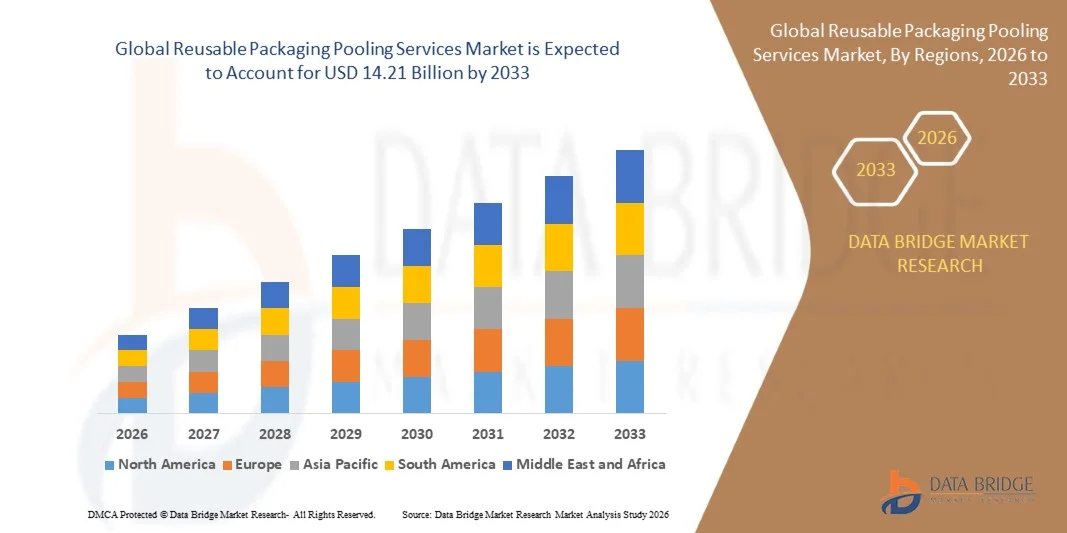
- As per Data Bridge Market Research analysis the reusable packaging pooling services market was valued at USD 8.40 billion in 2025 and is projected to reach USD 14.21 billion by 2033, growing at a CAGR of 6.80% from 2026 to 2033.
- The market is experiencing consistent growth driven by rising demand for sustainable and cost-effective packaging solutions, increasing adoption of circular supply chain models, and growing use of reusable pallets, containers, crates, and totes across industries.
- The increasing focus on reducing packaging waste, combined with stringent environmental regulations and corporate sustainability initiatives, is encouraging manufacturers, retailers, logistics providers, and other supply chain stakeholders to adopt packaging pooling services.
Market Size & Forecast
- Market Value (2025): USD 8.40 Billion
- Expected Market Value (2033): USD 14.21 Billion
- Forecast CAGR (2026–2033): 6.80%
- Leading Region in 2025: North America
- Fastest Growing Region: Asia-Pacific
What are the Major Takeaways of the Reusable Packaging Pooling Services Market?
- North America dominated the reusable packaging pooling services market with the largest revenue share in 2025, supported by strong demand for reusable pallets, containers, and crates across food and beverage, retail, automotive, and industrial supply chains.
- Asia-Pacific reusable packaging pooling services market is expected to witness the fastest growth rate from 2026 to 2033, supported by rapid industrialization, expanding retail and e-commerce sectors, and increasing manufacturing activity across countries such as China, Japan, and India.
- The pallet pooling segment held the largest market revenue share in 2025 driven by widespread adoption of standardized pallets across retail, food and beverage, automotive, and industrial supply chains. Pallet pooling is preferred due to its cost efficiency, standardized handling, asset utilization, and ability to support repeated transportation cycles across distribution networks.
- The container pooling segment is projected to register the fastest growth at a CAGR from 2026 to 2033, driven by increasing demand for durable and reusable transport containers, growing adoption of closed-loop supply chains, and rising efforts to reduce single-use packaging waste across global logistics operations.
- The plastic segment held the largest market revenue share in 2025 driven by the extensive use of durable, lightweight, washable, and reusable plastic pallets, crates, containers, and totes across food, retail, automotive, and industrial applications. Plastic pooling assets are preferred due to their long service life, resistance to moisture and chemicals, and suitability for repeated handling and cleaning.
- The metal segment is projected to register the fastest growth at a CAGR from 2026 to 2033, driven by increasing demand for high-strength reusable packaging in automotive, industrial, and heavy-duty logistics applications. Rising requirements for durable containers capable of protecting components and products during repeated transportation cycles are accelerating segment expansion.
Report Scope and Reusable Packaging Pooling Services Market Segmentation
|
Attributes |
Reusable Packaging Pooling Services Key Market Insights |
|
Segments Covered |
|
|
Countries Covered |
North America
Europe
Asia-Pacific
Middle East and Africa
South America
|
|
Key Market Players |
|
|
Market Opportunities |
|
|
Value Added Data Infosets |
In addition to the insights on market scenarios such as market value, growth rate, segmentation, geographical coverage, and major players, the market reports curated by the Data Bridge Market Research also include import export analysis, production capacity overview, production consumption analysis, price trend analysis, climate change scenario, supply chain analysis, value chain analysis, raw material/consumables overview, vendor selection criteria, PESTLE Analysis, Porter Analysis, and regulatory framework. |
What is the Key Trend in the Reusable Packaging Pooling Services Market?
- • Packaging pooling providers are increasingly expanding closed-loop reusable systems to help retailers, manufacturers, and logistics operators replace single-use packaging, improve asset utilization, and reduce environmental impacts across supply chains.
- For instance, in July 2026, IFCO announced that its SmartCycle pooling model supports customers and pooling partners in preparing for the European Union’s Packaging and Packaging Waste Regulation (PPWR), which began applying from August 12, 2026. IFCO also highlighted digital traceability through technologies such as BLE, RFID, and Global Returnable Asset Identifiers to monitor reusable packaging flows.
- Reusable packaging providers are increasingly integrating asset tracking, automated service centers, cleaning, inspection, and return logistics to improve the efficiency and scalability of pooling networks.
- For instance, in October 2025, IFCO reported that its SmartCycle system operated through six automated service centers in the U.K., with reusable containers collected from retailers, inspected, cleaned, and returned to circulation. IFCO reported that its 2024 U.K. operations avoided 105.9 million kg of CO₂ emissions and eliminated 247.9 million kg of solid waste.
- As retailers and manufacturers increasingly prioritize circular supply chains, digital visibility, and resource efficiency, the adoption of managed reusable packaging pooling systems is expected to accelerate, strengthening their role in sustainable transportation and distribution networks.
What are the Key Drivers of the Reusable Packaging Pooling Services Market?
- The implementation of stricter packaging waste regulations and increasing corporate sustainability commitments are significantly driving demand for reusable packaging pooling services as companies seek to reduce single-use packaging and comply with emerging reuse requirements.
- For instance, in February 2025, the European Commission’s Packaging and Packaging Waste Regulation entered into force, introducing measures to promote reuse and refill, reduce packaging waste, and increase the circular use of packaging materials. The regulation generally applies from August 12, 2026.
- Food and grocery supply chains are increasingly adopting pooled reusable containers because they can support repeated transportation cycles while improving product protection, reducing packaging waste, and generating measurable environmental benefits.
- For instance, in May 2025, IFCO partnered with the Catalan Red Cross and donated 3,000 reusable packaging containers to support surplus food recovery and distribution, helping improve operational efficiency while reducing waste associated with single-use packaging.
- With regulatory pressure, circular economy initiatives, and the need to improve supply chain efficiency accelerating globally, reusable packaging pooling services are expected to remain an important solution for companies transitioning from single-use to scalable reuse models.
Which Factors are Challenging the Growth of the Reusable Packaging Pooling Services Market?
- Reusable packaging pooling systems require substantial investment in packaging assets, cleaning and inspection facilities, reverse logistics, tracking technologies, and service infrastructure, creating financial and operational barriers for smaller businesses and fragmented supply chains.
- These requirements can limit adoption among small and medium-sized companies, particularly where return distances are long, pooling density is low, or sufficient collection and cleaning infrastructure is unavailable.
- For instance, in February 2026, the European Commission exempted pallet wrapping and straps from a 100% reuse requirement under specific transport conditions after determining that mandatory exclusive use of reusable alternatives could create disproportionate adaptation costs.
- The complexity of coordinating packaging collection, cleaning, inspection, redistribution, and asset tracking across multiple supply-chain participants continues to create operational challenges, particularly in markets with limited reverse-logistics infrastructure.
- These capital, infrastructure, and coordination requirements can slow the deployment of pooling networks and increase the cost of transitioning from conventional single-use packaging, limiting market penetration in price-sensitive and developing regions.
How is the Reusable Packaging Pooling Services Market Segmented?
The market is segmented on the basis of service type, material, end-use industry, and application.
- By Service Type
On the basis of service type, the reusable packaging pooling services market is segmented into pallet pooling, container pooling, crate pooling, drum and IBC pooling, and others. The pallet pooling segment held the largest market revenue share in 2025 driven by widespread adoption of standardized pallets across retail, food and beverage, automotive, and industrial supply chains. Pallet pooling is preferred due to its cost efficiency, standardized handling, asset utilization, and ability to support repeated transportation cycles across distribution networks.
The container pooling segment is projected to register the fastest growth at a CAGR from 2026 to 2033, driven by increasing demand for durable and reusable transport containers, growing adoption of closed-loop supply chains, and rising efforts to reduce single-use packaging waste across global logistics operations.
- By Material
On the basis of material, the reusable packaging pooling services market is segmented into plastic, wood, metal, and others. The plastic segment held the largest market revenue share in 2025 driven by the extensive use of durable, lightweight, washable, and reusable plastic pallets, crates, containers, and totes across food, retail, automotive, and industrial applications. Plastic pooling assets are preferred due to their long service life, resistance to moisture and chemicals, and suitability for repeated handling and cleaning.
The metal segment is projected to register the fastest growth at a CAGR from 2026 to 2033, driven by increasing demand for high-strength reusable packaging in automotive, industrial, and heavy-duty logistics applications. Rising requirements for durable containers capable of protecting components and products during repeated transportation cycles are accelerating segment expansion.
- By End-Use Industry
On the basis of end-use industry, the reusable packaging pooling services market is segmented into food and beverage, retail, healthcare, automotive, consumer goods, industrial, and others. The food and beverage segment held the largest market revenue share in 2025 driven by high-volume transportation of fresh produce, beverages, dairy products, meat, and other perishable products. Reusable packaging pooling is preferred in the industry due to its hygienic characteristics, durability, standardized handling, and ability to reduce packaging waste across repeated distribution cycles.
The automotive segment is projected to register the fastest growth at a CAGR from 2026 to 2033, driven by increasing use of reusable containers and pallets for transporting automotive components between suppliers, manufacturing facilities, and distribution centers. Growing emphasis on supply chain efficiency, component protection, and packaging waste reduction is accelerating segment expansion.
- By Application
On the basis of application, the reusable packaging pooling services market is segmented into transportation, storage, distribution, and others. The transportation segment held the largest market revenue share in 2025 driven by extensive use of pooled pallets, containers, crates, and other reusable assets for moving goods across supply chain networks. Transportation applications benefit from standardized packaging dimensions, improved product protection, asset tracking, and repeated utilization across multiple logistics cycles.
The distribution segment is projected to register the fastest growth at a CAGR from 2026 to 2033, driven by increasing adoption of closed-loop distribution networks, expansion of organized retail, and rising demand for efficient reusable packaging systems. Growing focus on reducing single-use packaging and improving asset utilization across warehouses and distribution centers is accelerating segment expansion.
Which Region Holds the Largest Share of the Reusable Packaging Pooling Services Market?
- North America dominated the reusable packaging pooling services market with the largest revenue share in 2025, supported by strong demand for reusable pallets, containers, and crates across food and beverage, retail, automotive, and industrial supply chains.
- Businesses in the region increasingly value pooling services for improving packaging utilization, reducing logistics costs, and minimizing packaging waste. The region’s established logistics infrastructure, high adoption of organized retail, and growing focus on circular supply chains further support the use of reusable packaging pooling services across transportation and distribution networks.
U.S. Reusable Packaging Pooling Services Market Insight
U.S. reusable packaging pooling services market captured the largest revenue share in 2025 within North America, fueled by the extensive adoption of pooled pallets and reusable containers across retail, grocery, automotive, and manufacturing industries. Companies are increasingly prioritizing efficient packaging systems that reduce waste and improve supply chain performance. The growing preference for outsourced pooling services, combined with established reverse logistics infrastructure and increasing corporate sustainability commitments, further propels the reusable packaging pooling services market in the U.S.
Europe Reusable Packaging Pooling Services Market Insight
Europe reusable packaging pooling services market is expected to witness the fastest growth rate from 2026 to 2033, primarily driven by stringent packaging waste regulations and the increasing adoption of circular economy practices. The European Union’s Packaging and Packaging Waste Regulation is strengthening the focus on reuse and refill systems, encouraging businesses to adopt reusable packaging solutions. The region’s well-developed retail, food, beverage, automotive, and logistics industries are further supporting the adoption of pooled pallets, crates, and containers across transportation and distribution operations.
U.K. Reusable Packaging Pooling Services Market Insight
U.K. reusable packaging pooling services market is expected to witness the fastest growth rate from 2026 to 2033, driven by increasing efforts to reduce packaging waste and growing sustainability initiatives across retailers, manufacturers, and logistics providers. The country’s established grocery and retail infrastructure supports the widespread use of reusable pallets, crates, and containers. Moreover, the growing preference for outsourced packaging management, combined with increasing demand for efficient reverse logistics and circular supply chain solutions, is expected to continue stimulating market growth.
Germany Reusable Packaging Pooling Services Market Insight
Germany reusable packaging pooling services market is expected to witness the fastest growth rate from 2026 to 2033, fueled by increasing environmental awareness, strong manufacturing activity, and the demand for resource-efficient logistics solutions. Germany’s well-developed automotive, food and beverage, retail, and industrial sectors provide significant opportunities for reusable pallets, containers, and crates. The growing emphasis on packaging waste reduction, sustainability, and efficient material handling is also encouraging businesses to adopt reusable packaging pooling systems.
Asia-Pacific Reusable Packaging Pooling Services Market Insight
The Asia-Pacific reusable packaging pooling services market is expected to witness the fastest growth rate from 2026 to 2033, supported by rapid industrialization, expanding retail and e-commerce sectors, and increasing manufacturing activity across countries such as China, Japan, and India. The region’s growing logistics networks are creating greater demand for standardized reusable pallets, containers, and crates. Furthermore, increasing awareness of packaging waste reduction, circular economy practices, and supply chain efficiency is expanding the adoption of reusable packaging pooling services across food and beverage, automotive, consumer goods, and industrial applications.
Japan Reusable Packaging Pooling Services Market Insight
Japan reusable packaging pooling services market is expected to witness the fastest growth rate from 2026 to 2033 due to the country’s advanced logistics infrastructure, strong manufacturing base, and emphasis on resource efficiency. Japanese companies increasingly require durable, standardized, and efficient packaging solutions for repeated transportation and distribution cycles. The growing focus on reducing material consumption, improving logistics productivity, and supporting sustainable supply chains is further encouraging the adoption of reusable pallets, containers, and crates.
China Reusable Packaging Pooling Services Market Insight
China reusable packaging pooling services market accounted for the largest market revenue share in Asia Pacific in 2025, attributed to the country’s extensive manufacturing base, rapid expansion of e-commerce and retail, and increasing demand for efficient logistics solutions. China has substantial demand for reusable pallets, containers, and crates across automotive, electronics, food and beverage, consumer goods, and industrial supply chains. The growing emphasis on circular economy development, packaging waste reduction, and supply chain optimization is further supporting the expansion of reusable packaging pooling services in the country.
Which are the Top Companies in Reusable Packaging Pooling Services Market?
The reusable packaging pooling services industry is primarily led by well-established companies, including:
- Brambles Limited (Australia)
- ORBIS Corporation (U.S.)
- Schoeller Allibert (Netherlands)
- Rehrig Pacific Company (U.S.)
- Euro Pool System International B.V. (Netherlands)
- IFCO Systems GmbH (Germany)
- CABKA Group GmbH (Germany)
- SSI SCHAEFER Group (Germany)
- Myers Industries, Inc. (U.S.)
- Faber Group (Netherlands)
- Tosca Services, LLC (U.S.)
- Loscam Ltd. (Hong Kong)
- Nefab AB (Sweden)
- Polymer Logistics (U.S.)
- CHEP (Australia)
What are Latest Developments in Reusable Packaging Pooling Services Market?
- In November 2024, IFCO Systems launched a new generation of reusable plastic containers (RPCs) for fresh produce, featuring enhanced ventilation and durability to reduce food waste and improve supply chain efficiency.
- In September 2024, Brambles Limited (CHEP) partnered with a major European retailer to expand its pallet pooling services, helping reduce carbon emissions and optimize logistics operations across the supply chain.
- In July 2024, Schoeller Allibert introduced a new range of sustainable foldable large containers (FLCs) made from recycled materials, targeting the automotive and manufacturing sectors with eco-friendly, space-saving solutions.
- In May 2024, ORBIS Corporation expanded its manufacturing capabilities in North America to meet the growing demand for reusable plastic pallets and bulk containers, strengthening its position in the regional market.

- Interactive Data Analysis Dashboard
- Company Analysis Dashboard for high growth potential opportunities
- Research Analyst Access for customization & queries
- Competitor Analysis with Interactive dashboard
- Latest News, Updates & Trend analysis
- Harness the Power of Benchmark Analysis for Comprehensive Competitor Tracking
Global Reusable Packaging Pooling Services Market, Supply Chain Analysis and Ecosystem Framework
To support market growth and help clients navigate the impact of geopolitical shifts, DBMR has integrated in-depth supply chain analysis into its Global Reusable Packaging Pooling Services Market research reports. This addition empowers clients to respond effectively to global changes affecting their industries. The supply chain analysis section includes detailed insights such as Global Reusable Packaging Pooling Services Market consumption and production by country, price trend analysis, the impact of tariffs and geopolitical developments, and import and export trends by country and HSN code. It also highlights major suppliers with data on production capacity and company profiles, as well as key importers and exporters. In addition to research, DBMR offers specialized supply chain consulting services backed by over a decade of experience, providing solutions like supplier discovery, supplier risk assessment, price trend analysis, impact evaluation of inflation and trade route changes, and comprehensive market trend analysis.
Data collection and base year analysis are done using data collection modules with large sample sizes. The stage includes obtaining market information or related data through various sources and strategies. It includes examining and planning all the data acquired from the past in advance. It likewise envelops the examination of information inconsistencies seen across different information sources. The market data is analysed and estimated using market statistical and coherent models. Also, market share analysis and key trend analysis are the major success factors in the market report. To know more, please request an analyst call or drop down your inquiry.
The key research methodology used by DBMR research team is data triangulation which involves data mining, analysis of the impact of data variables on the market and primary (industry expert) validation. Data models include Vendor Positioning Grid, Market Time Line Analysis, Market Overview and Guide, Company Positioning Grid, Patent Analysis, Pricing Analysis, Company Market Share Analysis, Standards of Measurement, Global versus Regional and Vendor Share Analysis. To know more about the research methodology, drop in an inquiry to speak to our industry experts.
Data Bridge Market Research is a leader in advanced formative research. We take pride in servicing our existing and new customers with data and analysis that match and suits their goal. The report can be customized to include price trend analysis of target brands understanding the market for additional countries (ask for the list of countries), clinical trial results data, literature review, refurbished market and product base analysis. Market analysis of target competitors can be analyzed from technology-based analysis to market portfolio strategies. We can add as many competitors that you require data about in the format and data style you are looking for. Our team of analysts can also provide you data in crude raw excel files pivot tables (Fact book) or can assist you in creating presentations from the data sets available in the report.













