


Reusable Water Bottle Market Analysis
The reusable water bottle market has experienced significant growth due to increasing environmental awareness, government regulations against single-use plastics, and a rising preference for sustainable products. Consumers are shifting towards eco-friendly alternatives, driving demand for stainless steel, glass, and BPA-free plastic bottles. Key players such as CamelBak, Hydro Flask, SIGG, and BRITA are investing in innovative designs, including self-cleaning bottles with UV-C technology, insulated models for temperature retention, and collapsible bottles for portability. Smart water bottles with hydration tracking and app connectivity are also gaining traction, appealing to health-conscious consumers. Advancements in material science, such as bio-based plastics and graphene-enhanced filtration, are further improving durability and safety. E-commerce platforms and direct-to-consumer strategies have expanded market reach, with customization options enhancing brand loyalty. The Asia-Pacific region, led by China and India, is emerging as a key growth hub due to rising disposable income and urbanization. As sustainability trends continue to shape consumer preferences, companies focusing on innovation, recyclability, and multifunctional features will maintain a competitive edge in the evolving reusable water bottle industry.
Reusable Water Bottle Market Size
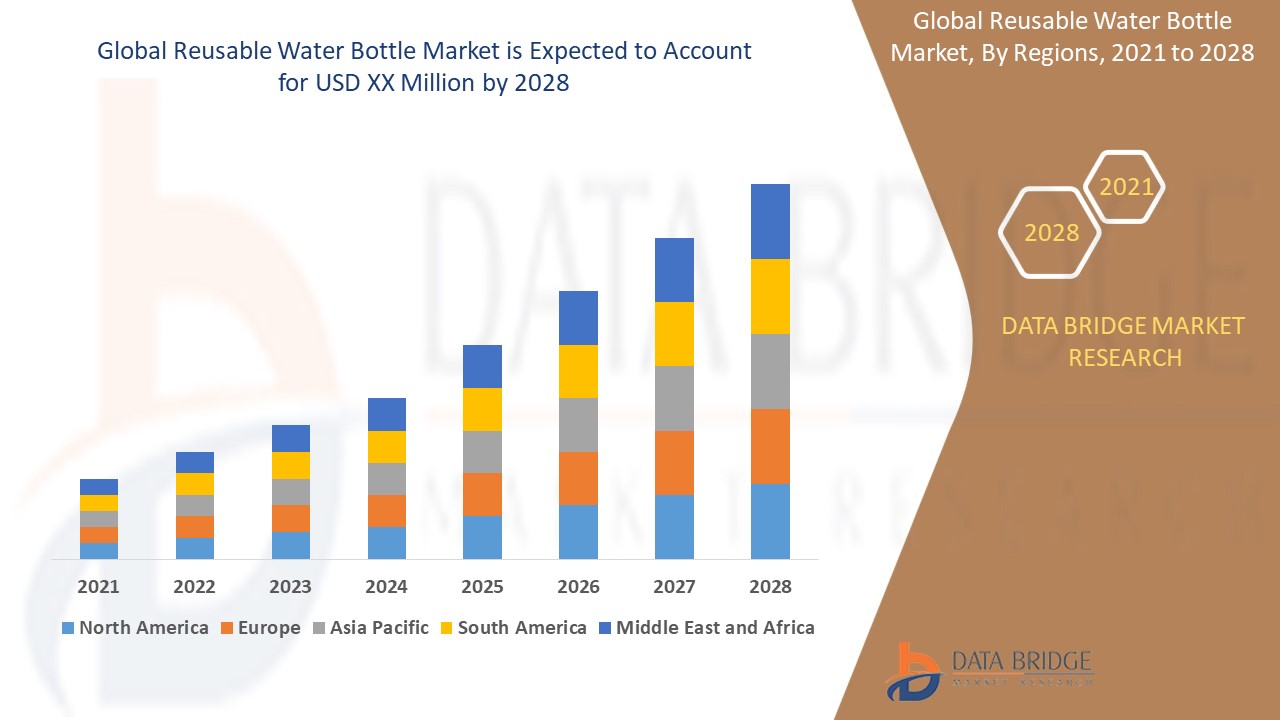
The reusable water bottle market size was valued at USD 9.85 billion in 2024 and is projected to reach USD 17.12 billion by 2032, with a CAGR of 7.15% during the forecast period of 2025 to 2032. In addition to the insights on market scenarios such as market value, growth rate, segmentation, geographical coverage, and major players, the market reports curated by the Data Bridge Market Research also include import export analysis, production capacity overview, production consumption analysis, price trend analysis, climate change scenario, supply chain analysis, value chain analysis, raw material/consumables overview, vendor selection criteria, PESTLE Analysis, Porter Analysis, and regulatory framework.
Reusable Water Bottle Market Trends
“Adoption of Smart Hydration Technology”
The reusable water bottle market is witnessing a trend towards adoption of smart hydration technology, driven by growing consumer interest in health tracking and sustainability. Smart water bottles, equipped with Bluetooth connectivity, hydration reminders, and temperature control, are becoming increasingly popular among fitness enthusiasts and tech-savvy consumers. Brands such as HidrateSpark have introduced bottles that sync with mobile apps to track daily water intake and provide real-time reminders. In addition, UV-C self-cleaning bottles, such as those from LARQ, use advanced sterilization technology to eliminate bacteria, ensuring safer hydration. The demand for these innovations is rising, especially among urban professionals and athletes seeking convenience and efficiency. The integration of IoT (Internet of Things) and AI-driven analytics in reusable bottles further enhances personalization, reinforcing a shift towards sustainable, health-conscious lifestyles. As technology advances, smart water bottles are expected to dominate the market, blending functionality, innovation, and eco-friendliness into everyday hydration solutions.
Report Scope and Reusable Water Bottle Segmentation
|
Attributes |
Reusable Water Bottle Key Market Insights |
|
Segments Covered |
|
|
Countries Covered |
U.S., Canada and Mexico in North America, Germany, France, U.K., Netherlands, Switzerland, Belgium, Russia, Italy, Spain, Turkey, Rest of Europe in Europe, China, Japan, India, South Korea, Singapore, Malaysia, Australia, Thailand, Indonesia, Philippines, Rest of Asia-Pacific (APAC) in the Asia-Pacific (APAC), Saudi Arabia, U.A.E, South Africa, Egypt, Israel, Rest of Middle East and Africa (MEA) as a part of Middle East and Africa (MEA), Brazil, Argentina and Rest of South America as part of South America |
|
Key Market Players |
CamelBak Products LLC (U.S.), BRITA GmbH (Germany), Klean Kanteen Inc. (U.S.), Tupperware Brands Corporation (U.S.), SIGG Switzerland AG (Switzerland), Aquasana Inc. (U.S.), Thermo Fisher Scientific Inc. (U.S.), Thermos L.L.C. (U.S.), Swig Life (U.S.), O2COOL, LLC (U.S.), Zhejiang Hals Vacuum Vessel Co., Ltd. (China), NATHAN Sports, Inc. (U.S.), COOL GEAR International, LLC (U.S.), bkr (U.S.), HYDAWAY (U.S.), LocknLock Co., Ltd. (South Korea), Zojirushi America Corporation (U.S.), Hydro Flask (U.S.), Gem-Water Co. (U.S.), and PMI Worldwide (U.S.) |
|
Market Opportunities |
|
|
Value Added Data Infosets |
In addition to the insights on market scenarios such as market value, growth rate, segmentation, geographical coverage, and major players, the market reports curated by the Data Bridge Market Research also include import export analysis, production capacity overview, production consumption analysis, price trend analysis, climate change scenario, supply chain analysis, value chain analysis, raw material/consumables overview, vendor selection criteria, PESTLE Analysis, Porter Analysis, and regulatory framework. |
Reusable Water Bottle Market Definition
A reusable water bottle is a durable, refillable container designed for multiple uses to store and transport drinking water or other beverages. Unlike single-use plastic bottles, reusable water bottles are typically made from stainless steel, glass, BPA-free plastic, silicone, or aluminum, ensuring environmental sustainability and cost-effectiveness.
Reusable Water Bottle Market Dynamics
Drivers
- Environmental Awareness and Sustainability
The rising concern over environmental pollution, particularly from plastic waste, is a major force driving the demand for reusable water bottles. Single-use plastic bottles are one of the most common pollutants, contributing to overflowing landfills and marine ecosystem degradation. Many governments have introduced strict regulations to combat plastic waste. For instance, the European Union’s Single-Use Plastics Directive has banned certain plastic products and encouraged the use of sustainable alternatives. This has led to increased consumer preference for eco-friendly options such as stainless steel, glass, and recycled plastic water bottles. Companies such as Klean Kanteen and Yeti have responded to this trend by offering durable, high-quality reusable bottles designed for long-term use, further reinforcing sustainability as a key market driver.
- Increasing Corporate and Institutional Sustainability Initiatives
Businesses and institutions are also playing a crucial role in promoting reusable water bottles as part of their sustainability commitments. Many companies have adopted eco-friendly policies, eliminating plastic bottles from their offices and encouraging employees to use refillable bottles. Universities, corporate offices, and public institutions worldwide have installed refill stations to support this transition. For instance, Starbucks has introduced incentives for customers who bring reusable cups, reducing the demand for single-use plastics. Such initiatives enhance corporate social responsibility (CSR) efforts and contribute to the growing market for reusable water bottles, making sustainability a significant business strategy.
Opportunities
- Increasing Technological Advancements and Smart Bottles
Innovation in reusable water bottle technology presents a significant market opportunity. Smart water bottles equipped with features such as hydration tracking, LED reminders, and temperature control are gaining popularity among health-conscious and tech-savvy consumers. These advanced bottles sync with smartphones to monitor water intake, ensuring users stay adequately hydrated throughout the day. For instance, HidrateSpark offers a smart bottle that glows to remind users to drink water and provides real-time hydration tracking via an app. Similarly, REBO has developed a self-cleaning bottle with UV-C light technology to eliminate bacteria. As consumers increasingly adopt health-monitoring devices, the integration of smart technology into reusable water bottles is expected to drive market growth. Brands that invest in these innovations can capitalize on the growing demand for connected and intelligent hydration solutions.
- Expansion of Smart Fitness and Wellness Trends
The rise of fitness and wellness trends has further strengthened the opportunity for smart water bottles. With more people actively tracking their health metrics using wearables such as smartwatches and fitness apps, the demand for complementary smart hydration solutions is growing. Athletes, fitness enthusiasts, and even office workers are looking for bottles that provide real-time hydration data. Companies that develop innovative, app-connected water bottles tailored for fitness, sports, and daily wellness will benefit from this expanding market segment. This trend presents an opportunity for brands to collaborate with tech companies and fitness platforms, creating a seamless hydration experience for users.
Restraints/Challenges
- High Initial Cost
One of the biggest challenges in the reusable water bottle market is its high initial cost, which can deter price-sensitive consumers. Unlike single-use plastic bottles, which are cheap and widely available, premium reusable bottles made from stainless steel, glass, or smart technology often come with a much higher price tag. For instance, a Hydro Flask stainless steel bottle can be significantly more expensive than a disposable plastic alternative. Similarly, smart bottles such as HidrateSpark or LARQ, which feature Bluetooth tracking and UV-C sterilization, require an even larger upfront investment. This cost barrier is particularly challenging in developing markets, where affordability plays a crucial role in purchasing decisions. While reusable bottles offer long-term savings and environmental benefits, the initial expense remains a major hurdle for widespread adoption, limiting the market’s potential in price-sensitive regions and making it harder for some consumers to transition to sustainable options.
- Competition from Alternatives
The reusable water bottle market faces strong competition from alternative sustainable solutions, such as biodegradable water bottles and boxed water. As consumers become more environmentally conscious, some are turning to plant-based, compostable packaging as a middle ground between single-use plastic and reusable options. For instance, brands such as JUST Water offer carton-based water bottles made from 54% paper, 28% plant-based plastic, and 3% aluminum, appealing to eco-conscious consumers who want convenience without committing to long-term reusable options. Similarly, biodegradable bottles made from materials such as cornstarch or algae provide an alternative for those reluctant to carry a reusable bottle. These alternatives are often cheaper and more accessible, especially in regions where carrying a reusable bottle may not be practical due to limited refill stations. As a result, they pose a competitive challenge, drawing customers away from the reusable bottle market and slowing its growth in certain demographics.
This market report provides details of new recent developments, trade regulations, import-export analysis, production analysis, value chain optimization, market share, impact of domestic and localized market players, analyses opportunities in terms of emerging revenue pockets, changes in market regulations, strategic market growth analysis, market size, category market growths, application niches and dominance, product approvals, product launches, geographic expansions, technological innovations in the market. To gain more info on the market contact Data Bridge Market Research for an analyst brief, our team will help you take an informed market decision to achieve market growth.
Impact and Current Market Scenario of Raw Material Shortage and Shipping Delays
Data Bridge Market Research offers a high-level analysis of the market and delivers information by keeping in account the impact and current market environment of raw material shortage and shipping delays. This translates into assessing strategic possibilities, creating effective action plans, and assisting businesses in making important decisions.
Apart from the standard report, we also offer in-depth analysis of the procurement level from forecasted shipping delays, distributor mapping by region, commodity analysis, production analysis, price mapping trends, sourcing, category performance analysis, supply chain risk management solutions, advanced benchmarking, and other services for procurement and strategic support.
Expected Impact of Economic Slowdown on the Pricing and Availability of Products
When economic activity slows, industries begin to suffer. The forecasted effects of the economic downturn on the pricing and accessibility of the products are taken into account in the market insight reports and intelligence services provided by DBMR. With this, our clients can typically keep one step ahead of their competitors, project their sales and revenue, and estimate their profit and loss expenditures.
Reusable Water Bottle Market Scope
The market is segmented on the basis of product type, size, material type, distribution network, and primary usage. The growth amongst these segments will help you analyze meagre growth segments in the industries and provide the users with a valuable market overview and market insights to help them make strategic decisions for identifying core market applications.
Product Type
- Plain
- Insulated
- Filtered
- Collapsible
- Infuser
- Growlers
- Others
Size
- 8-12 Oz.
- 16-27 Oz.
- 32 Oz.
- 40 Oz.
- 64 Oz.
- 1 Gallon and Above
Material Type
- Glass
- Metal
- Polymer
- Silicone
- Plastic
Distribution Network
- Hypermarkets/Supermarkets
- Independent Stores
- Retail Stores
- Departmental Stores
- Online Sales
- E-Commerce
- Others
Primary Usage
- Everyday
- Sports
- Travel
- Others
Reusable Water Bottle Market Regional Analysis
The market is analysed and market size insights and trends are provided by country, product type, size, material type, distribution network, and primary usage as referenced above.
The countries covered in the market report are U.S., Canada, Mexico, Brazil, Argentina, Rest of South America, Germany, France, Italy, U.K., Belgium, Spain, Russia, Turkey, Netherlands, Switzerland, Rest of Europe, Japan, China, India, South Korea, Australia and New Zealand, Singapore, Malaysia, Thailand, Indonesia, Philippines, Rest of Asia-Pacific, United Arab Emirate, Saudi Arabia, Egypt, Israel, South Africa, Rest of Middle East and Africa
Asia-Pacific dominates the reusable water bottle market and is expected to maintain its dominance throughout the forecast period. Factors driving this growth include abundant raw material availability and low manufacturing costs in emerging economies such as India and China. In addition, rapid urbanization, a continuously growing population, and rising personal disposable income contribute to market expansion. These elements collectively create a favorable environment for sustained growth in the region.
Europe is the fastest-growing region in the global reusable water bottle market, driven by increasing environmental awareness and sustainability initiatives. The rising demand for eco-friendly products, coupled with stringent government regulations on single-use plastics, is fueling market expansion. In addition, growing consumer preference for durable and stylish reusable bottles is boosting sales. With a strong focus on reducing plastic waste, Europe is expected to experience continued rapid growth in this sector.
The country section of the report also provides individual market impacting factors and changes in regulation in the market domestically that impacts the current and future trends of the market. Data points such as down-stream and upstream value chain analysis, technical trends and porter's five forces analysis, case studies are some of the pointers used to forecast the market scenario for individual countries. Also, the presence and availability of global brands and their challenges faced due to large or scarce competition from local and domestic brands, impact of domestic tariffs and trade routes are considered while providing forecast analysis of the country data.
Reusable Water Bottle Market Share
The market competitive landscape provides details by competitor. Details included are company overview, company financials, revenue generated, market potential, investment in research and development, new market initiatives, global presence, production sites and facilities, production capacities, company strengths and weaknesses, product launch, product width and breadth, application dominance. The above data points provided are only related to the companies' focus related to market.
Reusable Water Bottle Market Leaders Operating in the Market Are:
- CamelBak Products LLC (U.S.)
- BRITA GmbH (Germany)
- Klean Kanteen Inc. (U.S.)
- Tupperware Brands Corporation (U.S.)
- SIGG Switzerland AG (Switzerland)
- Aquasana Inc. (U.S.)
- Thermo Fisher Scientific Inc. (U.S.)
- Thermos L.L.C. (U.S.)
- Swig Life (U.S.)
- O2COOL, LLC (U.S.)
- Zhejiang Hals Vacuum Vessel Co., Ltd. (China)
- NATHAN Sports, Inc. (U.S.)
- COOL GEAR International, LLC (U.S.)
- bkr (U.S.)
- HYDAWAY (U.S.)
- LocknLock Co., Ltd. (South Korea)
- Zojirushi America Corporation (U.S.)
- Hydro Flask (U.S.)
- Gem-Water Co. (U.S.)
- PMI Worldwide (U.S.)
Latest Developments in Reusable Water Bottle Market
- In August 2023, PathWater, a U.S.-based manufacturer, announced a collaboration with Mattel, a U.S.-based toy company, to introduce a limited-edition Barbie refillable bottle. These vibrant pink refillable water bottles are available for purchase on the company's website and in retail stores across the U.S. and Canada
- In September 2022, Ball Corporation, a U.S.-based bottle manufacturer, formed a joint venture with Boomerang Water LLC, a U.S.-based bottled water company. Under this agreement, Ball Corporation will supply aluminum bottles, while Boomerang will provide bottled water in sustainable packaging for resorts, cruise ships, and various other locations
- In March 2022, Lifetime Brands, a U.S.-based manufacturer, acquired S’well, a New York-based water bottle company. This acquisition is expected to strengthen Lifetime Brands' online sales platform in the coming years
- In June 2021, Ello, a U.S.-based manufacturer, launched reusable water bottles made with Eastman Tritan, containing 50% certified recycled content. These bottles are sold at Target retail stores and through online platforms
- In June 2021, AptarFood, a U.S.-based company, announced a partnership with REBO, a Switzerland-based water bottle manufacturer, to develop a smart reusable water bottle

- Interactive Data Analysis Dashboard
- Company Analysis Dashboard for high growth potential opportunities
- Research Analyst Access for customization & queries
- Competitor Analysis with Interactive dashboard
- Latest News, Updates & Trend analysis
- Harness the Power of Benchmark Analysis for Comprehensive Competitor Tracking
Global Reusable Water Bottle Market, Supply Chain Analysis and Ecosystem Framework
To support market growth and help clients navigate the impact of geopolitical shifts, DBMR has integrated in-depth supply chain analysis into its Global Reusable Water Bottle Market research reports. This addition empowers clients to respond effectively to global changes affecting their industries. The supply chain analysis section includes detailed insights such as Global Reusable Water Bottle Market consumption and production by country, price trend analysis, the impact of tariffs and geopolitical developments, and import and export trends by country and HSN code. It also highlights major suppliers with data on production capacity and company profiles, as well as key importers and exporters. In addition to research, DBMR offers specialized supply chain consulting services backed by over a decade of experience, providing solutions like supplier discovery, supplier risk assessment, price trend analysis, impact evaluation of inflation and trade route changes, and comprehensive market trend analysis.
Data collection and base year analysis are done using data collection modules with large sample sizes. The stage includes obtaining market information or related data through various sources and strategies. It includes examining and planning all the data acquired from the past in advance. It likewise envelops the examination of information inconsistencies seen across different information sources. The market data is analysed and estimated using market statistical and coherent models. Also, market share analysis and key trend analysis are the major success factors in the market report. To know more, please request an analyst call or drop down your inquiry.
The key research methodology used by DBMR research team is data triangulation which involves data mining, analysis of the impact of data variables on the market and primary (industry expert) validation. Data models include Vendor Positioning Grid, Market Time Line Analysis, Market Overview and Guide, Company Positioning Grid, Patent Analysis, Pricing Analysis, Company Market Share Analysis, Standards of Measurement, Global versus Regional and Vendor Share Analysis. To know more about the research methodology, drop in an inquiry to speak to our industry experts.
Data Bridge Market Research is a leader in advanced formative research. We take pride in servicing our existing and new customers with data and analysis that match and suits their goal. The report can be customized to include price trend analysis of target brands understanding the market for additional countries (ask for the list of countries), clinical trial results data, literature review, refurbished market and product base analysis. Market analysis of target competitors can be analyzed from technology-based analysis to market portfolio strategies. We can add as many competitors that you require data about in the format and data style you are looking for. Our team of analysts can also provide you data in crude raw excel files pivot tables (Fact book) or can assist you in creating presentations from the data sets available in the report.













