


RF Front End Module Market Size
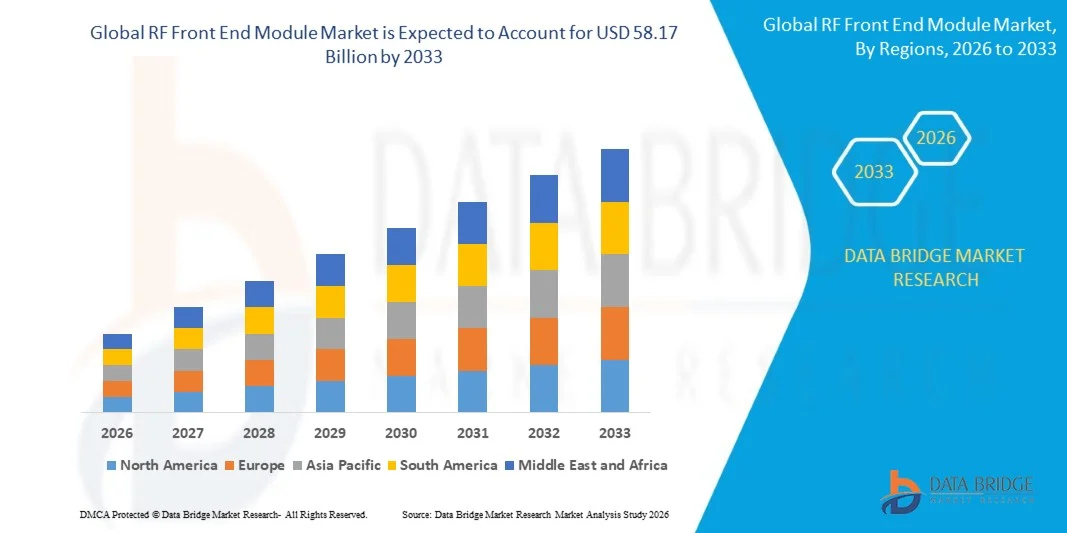
- The global RF front end module market size was valued at USD 28.66 billion in 2025 and is expected to reach USD 58.17 billion by 2033, at a CAGR of 9.25% during the forecast period
- The market growth is largely fueled by the growing adoption of 5G-enabled smartphones, connected vehicles, and IoT devices, driving increased demand for high-performance RF front-end modules across consumer electronics, automotive, and industrial applications
- Furthermore, technological advancements in power amplifiers, low-noise amplifiers, filters, and switches are enhancing signal efficiency, coverage, and reliability, supporting the development of compact, energy-efficient, and high-speed wireless communication systems. These factors are accelerating the adoption of RF front-end modules, thereby significantly boosting the market’s growth
RF Front End Module Market Analysis
- RF front-end modules, comprising power amplifiers, low-noise amplifiers, filters, and switches, are critical components in modern wireless communication systems, enabling efficient signal transmission, reception, and processing across smartphones, automotive, industrial, and telecom applications
- The escalating demand for RF front-end modules is primarily fueled by the widespread deployment of 5G networks, increasing smartphone penetration, and the rising need for enhanced wireless connectivity and high-speed data transmission in consumer, automotive, and industrial sectors
- Asia-Pacific dominated the RF front end module market with a share of 44.8% in 2025, due to rapid adoption of 5G networks, growing smartphone production, and a strong electronics manufacturing ecosystem
- North America is expected to be the fastest growing region in the RF front end module market during the forecast period due to robust demand for 5G-enabled devices, connected cars, and industrial IoT applications
- Filters segment dominated the market with a market share of 38% in 2025, due to its critical role in ensuring signal integrity and reducing interference in wireless communication systems. Filters are essential in smartphones, automotive, and industrial devices to maintain high-quality signal transmission and reception
Report Scope and RF Front End Module Market Segmentation
|
Attributes |
RF Front End Module Key Market Insights |
|
Segments Covered |
|
|
Countries Covered |
North America
Europe
Asia-Pacific
Middle East and Africa
South America
|
|
Key Market Players |
|
|
Market Opportunities |
|
|
Value Added Data Infosets |
In addition to the insights on market scenarios such as market value, growth rate, segmentation, geographical coverage, and major players, the market reports curated by the Data Bridge Market Research also include in-depth expert analysis, geographically represented company-wise production and capacity, network layouts of distributors and partners, detailed and updated price trend analysis and deficit analysis of supply chain and demand. |
RF Front End Module Market Trends
“Rising Adoption of 5G-Enabled Devices and IoT Applications”
- A key trend in the RF front-end module market is the accelerating adoption of 5G-enabled smartphones, wearables, and IoT devices, driven by the need for faster connectivity and seamless wireless communication across diverse applications. This adoption is positioning RF front-end modules as essential enablers of high-frequency signal processing and efficient spectrum utilization in modern devices
- For instance, Qorvo and Skyworks Solutions supply advanced RF front-end modules that integrate power amplifiers, filters, and switches, supporting enhanced signal strength and lower power consumption in 5G smartphones and IoT gateways. These solutions improve network reliability and maintain consistent connectivity in high-density environments
- The market is witnessing growing integration of RF front-end modules in automotive connectivity systems, where applications such as vehicle-to-everything (V2X) communication and telematics require robust high-frequency performance. This trend is driving the development of modules capable of supporting real-time data exchange and safety-critical communications
- Increasing deployment of IoT networks across smart homes, industrial automation, and healthcare is elevating demand for compact and highly efficient RF front-end components. Modules capable of handling multiple frequency bands and maintaining signal integrity are becoming critical for scalable IoT ecosystems
- Wireless infrastructure expansion, including small cells and macro base stations, is creating opportunities for RF front-end modules that can deliver improved bandwidth and reduced signal loss. This is enhancing the adoption of multi-band and multi-mode modules to meet network densification requirements
- The growing focus on energy efficiency and miniaturization is shaping the design of RF front-end modules that reduce power consumption without compromising performance. This trend is reinforcing the market’s trajectory toward more integrated, high-performance, and cost-effective wireless solutions
RF Front End Module Market Dynamics
Driver
“Rising demand for high-performance wireless connectivity”
- The increasing reliance on high-speed and low-latency wireless communication across smartphones, IoT devices, and industrial systems is driving demand for RF front-end modules that provide superior signal amplification, filtering, and switching capabilities. These modules enhance overall device performance and network reliability
- For instance, Murata Manufacturing develops compact, high-performance RF front-end modules for 5G smartphones and wearable devices, enabling faster data rates and improved coverage. These solutions support seamless connectivity in urban environments and high-traffic areas
- The expansion of 5G networks is encouraging the adoption of advanced RF front-end architectures that can handle multiple frequency bands while minimizing interference. Such modules are critical for operators to deliver consistent quality of service across densely populated regions
- Rising adoption of connected consumer electronics and industrial IoT applications is increasing the need for highly integrated RF solutions that reduce footprint and power consumption while maintaining high signal fidelity. This is driving innovation in module design and materials engineering
- The push for ultra-reliable and low-latency communication in automotive, healthcare, and industrial sectors is reinforcing investments in RF front-end modules that support high data throughput and precise signal management. This sustained demand is underpinning market growth and technological advancement
Restraint/Challenge
“High Design Complexity and Costs”
- The RF front-end module market faces challenges due to the complexity of designing modules that integrate multiple components such as filters, power amplifiers, and switches while maintaining compact form factors. This complexity increases R&D investment and design cycles, affecting overall time-to-market
- For instance, Skyworks Solutions employs advanced design and testing processes to produce high-performance RF front-end modules capable of supporting multi-band 5G operation. These processes require specialized expertise and sophisticated simulation tools, which elevate production costs
- Ensuring thermal management, signal isolation, and high linearity in compact modules further adds to engineering challenges and increases manufacturing overheads. These requirements demand precision assembly techniques and rigorous quality control
- The dependence on advanced semiconductor materials such as gallium arsenide (GaAs) and gallium nitride (GaN) adds cost pressure and supply chain complexity, affecting module affordability and scalability
- Scaling production while maintaining performance, reliability, and competitive pricing continues to be a critical challenge. Manufacturers must optimize design and fabrication processes to balance cost, efficiency, and market demand without compromising quality
RF Front End Module Market Scope
The market is segmented on the basis of type, technology, and end-use.
• By Type
On the basis of type, the RF front-end module market is segmented into Power Amplifier (PA), Low-Noise Amplifier, Filters, Switches, and Others. The Filters segment dominated the market with the largest revenue share of 38% in 2025, driven by its critical role in ensuring signal integrity and reducing interference in wireless communication systems. Filters are essential in smartphones, automotive, and industrial devices to maintain high-quality signal transmission and reception. Their increasing adoption in 5G networks, IoT devices, and high-frequency applications further reinforces their dominance in the RF front-end module market.
The Low-Noise Amplifier segment is anticipated to witness the fastest growth from 2026 to 2033, fueled by the rising need for improved signal sensitivity in advanced communication systems. LNAs are crucial in reducing signal degradation and enhancing receiver performance, particularly in smartphones, IoT devices, and automotive communication systems. Their ability to amplify weak signals while maintaining minimal noise makes them essential for emerging high-frequency applications, driving rapid adoption across multiple end-use sectors.
• By Technology
On the basis of technology, the RF front-end module market is segmented into Wi-Fi and Bluetooth. The Wi-Fi segment held the largest market revenue share in 2025, driven by its widespread integration in smartphones, laptops, and consumer electronics. Wi-Fi-enabled modules provide reliable high-speed connectivity and are essential for streaming, cloud access, and smart home applications, making them highly demanded across residential and industrial markets.
The Bluetooth segment is expected to witness the fastest CAGR from 2026 to 2033, owing to its low power consumption and compatibility with wearable devices, smart gadgets, and automotive infotainment systems. Bluetooth modules enable efficient short-range communication, facilitating device-to-device connectivity and seamless integration with smartphones. The growing adoption of wireless audio, IoT ecosystems, and automotive connectivity solutions is accelerating the uptake of Bluetooth-enabled RF front-end modules.
• By End-use
On the basis of end-use, the RF front-end module market is segmented into Smart Phones & Consumer Electronics, Automotive, Industrial, IT & Telecom, and Others. The Smart Phones & Consumer Electronics segment dominated the market in 2025 with the largest revenue share, driven by the growing demand for high-speed mobile communication and advanced multimedia functionality. Consumer electronics increasingly rely on RF front-end modules for better signal processing, improved battery efficiency, and seamless wireless connectivity, reinforcing their dominance in the market.
The Automotive segment is expected to witness the fastest growth from 2026 to 2033, fueled by the rising integration of connected car technologies, vehicle-to-everything (V2X) communication, and infotainment systems. Automotive RF front-end modules support reliable in-vehicle communication, telematics, and advanced driver assistance systems (ADAS). The increasing focus on electric and autonomous vehicles further boosts the demand for high-performance RF modules in the automotive sector.
RF Front End Module Market Regional Analysis
- Asia-Pacific dominated the RF front end module market with the largest revenue share of 44.8% in 2025, driven by rapid adoption of 5G networks, growing smartphone production, and a strong electronics manufacturing ecosystem
- The region’s cost-effective manufacturing capabilities, increasing investments in semiconductor fabrication, and expanding exports of communication devices are accelerating market growth
- Availability of skilled engineers, supportive government policies, and rapid industrialization across developing economies are contributing to higher adoption of RF front-end modules in smartphones, automotive, and industrial applications
China RF Front-End Module Market Insight
China held the largest share in the Asia-Pacific RF front-end module market in 2025, owing to its position as a global leader in smartphone and consumer electronics manufacturing. The country’s strong industrial base, government incentives for 5G and semiconductor production, and extensive export network are major growth drivers. Demand is further supported by increasing adoption of connected devices, IoT infrastructure, and automotive communication systems.
India RF Front-End Module Market Insight
India is witnessing the fastest growth in the Asia-Pacific region, fueled by rising smartphone penetration, growing automotive electronics demand, and expanding IoT adoption. Government initiatives such as “Digital India” and investment in electronics manufacturing clusters are strengthening local production. In addition, the country’s emphasis on self-reliance in semiconductor components and increasing mobile device exports are driving robust market expansion.
Europe RF Front-End Module Market Insight
The Europe RF front-end module market is expanding steadily, supported by high adoption of 5G infrastructure, demand for connected vehicles, and investments in industrial automation. The region emphasizes quality, environmental compliance, and advanced semiconductor design, particularly in telecommunications and automotive sectors. Increasing integration of RF modules in IoT and industrial applications is further enhancing market growth.
Germany RF Front-End Module Market Insight
Germany’s RF front-end module market is driven by its leadership in automotive electronics, industrial automation, and high-precision electronic manufacturing. Strong R&D networks and collaborations between academic institutions and technology companies foster continuous innovation. Demand is particularly strong for automotive infotainment, advanced driver-assistance systems (ADAS), and industrial IoT applications.
U.K. RF Front-End Module Market Insight
The U.K. market is supported by a mature telecommunications sector, increasing focus on 5G rollout, and growth in automotive and industrial electronics. Efforts to strengthen local electronics manufacturing, combined with academic-industry collaboration and investment in semiconductor R&D, continue to boost adoption of RF front-end modules.
North America RF Front-End Module Market Insight
North America is projected to grow at the fastest CAGR from 2026 to 2033, driven by robust demand for 5G-enabled devices, connected cars, and industrial IoT applications. Strong investment in semiconductor manufacturing, focus on next-generation communication infrastructure, and collaboration between tech companies and automotive manufacturers are supporting market expansion.
U.S. RF Front-End Module Market Insight
The U.S. accounted for the largest share in the North America market in 2025, underpinned by its advanced semiconductor industry, extensive R&D infrastructure, and leading technology companies. The country’s focus on innovation, high-speed communication networks, and connected vehicle technologies is driving the adoption of high-performance RF front-end modules. Presence of key global players and a mature electronics supply chain further consolidate the U.S.’s leading position in the region.
RF Front End Module Market Share
The RF front end module industry is primarily led by well-established companies, including:
- Infineon Technologies AG (Germany)
- TDK Corporation (Japan)
- Resonant Inc. (U.S.)
- Murata Manufacturing Co., Ltd. (Japan)
- Skyworks Aerolab Pte. Ltd. (Singapore)
- Broadcom Inc. (U.S.)
- MACOM Technology Solutions Holdings, Inc. (U.S.)
- Qorvo, Inc. (U.S.)
- Wisol Co., Ltd. (South Korea)
- Maxscend Microelectronics Co., Ltd. (China)
- Optimum Semiconductor Technologies Inc. (U.S.)
- UMC RF Solution Business Unit (Taiwan)
- Kyocera Corporation (Japan)
- Skyworks Solutions, Inc. (U.S.)
- NXP Semiconductors N.V. (Netherlands)
- FINWAVE Semiconductor, Inc. (U.S.)
- Tower Semiconductor Ltd. (Israel)
- WIN Semiconductors Corp. (Taiwan)
- pSemi Corporation (U.S.)
- Jiangsu Hengxin Technology Co., Ltd. (China)
Latest Developments in Global RF Front End Module Market
- In October 2025, Qorvo introduced the QPA9510, a compact RF power amplifier offering wideband coverage from 100 MHz to 1000 MHz with high efficiency and robust output performance. This launch is expected to simplify sub-1 GHz RF design challenges in wireless systems such as IoT, public safety, and smart utility applications, enhancing adoption of RF front-end modules in battery-powered and low-power devices. The broad band coverage and strong efficiency of the QPA9510 improve device flexibility, supporting faster integration in next-generation connected products
- In October 2025, Skyworks Solutions updated its Wi-Fi 7 portfolio by launching new front-end modules (FEMs) and BAW filters compatible with 2.4 GHz, 5 GHz, and 6 GHz bands. These Gen 2 FEMs and full-band filters allow multiple bands to operate simultaneously, improving Wi-Fi speed, coverage, and signal quality for next-generation devices. This development strengthens the company’s position in high-performance Wi-Fi RF modules and accelerates market adoption of Wi-Fi 7-enabled consumer electronics
- In December 2024, Samsung Electronics and Skyworks Solutions disclosed a strategic partnership to integrate SKY5 platforms into Galaxy smartphones, reducing RF board area by 30%. This collaboration enhances device miniaturization and energy efficiency while enabling higher performance RF front-end modules, supporting faster adoption of advanced smartphones and boosting market growth for integrated RF solutions
- In October 2024, Guerrilla RF acquired a specialized GaN power amplifier portfolio for USD 85 million, aiming to expand its presence in defense and aerospace RF applications. The acquisition strengthens the company’s high-frequency capabilities and positions it to capture emerging demand in military and industrial RF front-end modules, accelerating market expansion in specialized high-performance sectors
- In March 2024, Qualcomm and TDK jointly created RF360 Holdings, valued at USD 3 billion, to deliver combined modem and RF platforms for 5G and beyond. This partnership enables streamlined integration of RF front-end modules with modems, reducing design complexity and improving device performance. The move supports faster deployment of 5G-enabled smartphones and IoT devices, significantly impacting the growth trajectory of the RF front-end module market

- Interactive Data Analysis Dashboard
- Company Analysis Dashboard for high growth potential opportunities
- Research Analyst Access for customization & queries
- Competitor Analysis with Interactive dashboard
- Latest News, Updates & Trend analysis
- Harness the Power of Benchmark Analysis for Comprehensive Competitor Tracking
Global Rf Front End Module Market, Supply Chain Analysis and Ecosystem Framework
To support market growth and help clients navigate the impact of geopolitical shifts, DBMR has integrated in-depth supply chain analysis into its Global Rf Front End Module Market research reports. This addition empowers clients to respond effectively to global changes affecting their industries. The supply chain analysis section includes detailed insights such as Global Rf Front End Module Market consumption and production by country, price trend analysis, the impact of tariffs and geopolitical developments, and import and export trends by country and HSN code. It also highlights major suppliers with data on production capacity and company profiles, as well as key importers and exporters. In addition to research, DBMR offers specialized supply chain consulting services backed by over a decade of experience, providing solutions like supplier discovery, supplier risk assessment, price trend analysis, impact evaluation of inflation and trade route changes, and comprehensive market trend analysis.
Data collection and base year analysis are done using data collection modules with large sample sizes. The stage includes obtaining market information or related data through various sources and strategies. It includes examining and planning all the data acquired from the past in advance. It likewise envelops the examination of information inconsistencies seen across different information sources. The market data is analysed and estimated using market statistical and coherent models. Also, market share analysis and key trend analysis are the major success factors in the market report. To know more, please request an analyst call or drop down your inquiry.
The key research methodology used by DBMR research team is data triangulation which involves data mining, analysis of the impact of data variables on the market and primary (industry expert) validation. Data models include Vendor Positioning Grid, Market Time Line Analysis, Market Overview and Guide, Company Positioning Grid, Patent Analysis, Pricing Analysis, Company Market Share Analysis, Standards of Measurement, Global versus Regional and Vendor Share Analysis. To know more about the research methodology, drop in an inquiry to speak to our industry experts.
Data Bridge Market Research is a leader in advanced formative research. We take pride in servicing our existing and new customers with data and analysis that match and suits their goal. The report can be customized to include price trend analysis of target brands understanding the market for additional countries (ask for the list of countries), clinical trial results data, literature review, refurbished market and product base analysis. Market analysis of target competitors can be analyzed from technology-based analysis to market portfolio strategies. We can add as many competitors that you require data about in the format and data style you are looking for. Our team of analysts can also provide you data in crude raw excel files pivot tables (Fact book) or can assist you in creating presentations from the data sets available in the report.













