


What is the Global RFID Portals for Doorways and Corridors Market Size and Growth Rate?
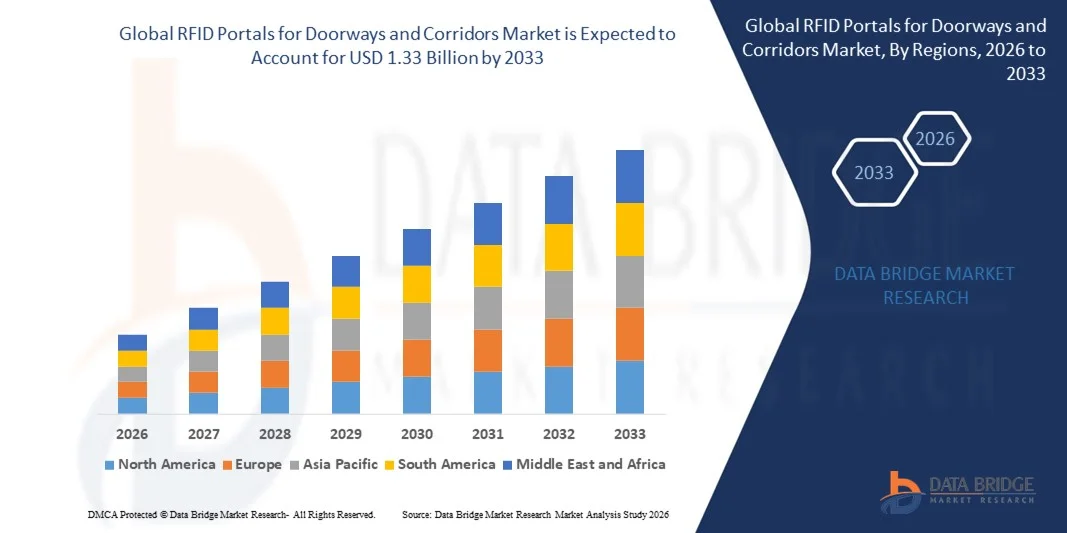
- The global RFID Portals for Doorways and Corridors market size was valued at USD 1.10 billion in 2025 and is expected to reach USD 1.33 billion by 2033, at a CAGR of 2.40% during the forecast period
- The rise in the need for tracking management across various industries acts as one of the major factors driving the growth of RFID portals for doorways and corridors market
- The high use of RFID portals for doorways and corridors for tracking of tools and asset and rise in concerns regarding miss management across industries which leads to the loss of important equipment and incur a monetary loss for the organization accelerate the market growth
Market Size & Forecast
Global Market Value (2025): 1.10 billion USD
Expected Market Value (2033): 1.33 billion USD
Forecast CAGR (2026–2033): 2.40%
What are the Major Takeaways of RFID Portals for Doorways and Corridors Market?
- The high adoption of the technology owning to its ability to keep the data center and tangible files secure and rise in demand for preventing theft of assets and ensuring their moving detail such as time and person ID further influence the market
- In addition, expansion of industries, growth in economy and rise in the cases of theft across businesses positively affect the RFID portals for doorways and corridors market. Furthermore, technological advancement in the tracking technology extends profitable opportunities to the market players
- North America dominated the RFID Portals for Doorways and Corridors market with a 42.05% revenue share in 2025, driven by strong adoption of RFID-enabled inventory automation, asset tracking systems, and advanced security infrastructure across the U.S. and Canada
- Asia-Pacific is projected to register the fastest CAGR of 9.36% from 2026 to 2033, driven by rapid retail expansion, booming e-commerce logistics, and strong electronics manufacturing ecosystems across China, Japan, India, and South Korea
- The Ultra-High Frequency (UHF) segment dominated the market with a 48.6% share in 2025, owing to its long read range, fast data transfer rate, and ability to read multiple tags simultaneously
Report Scope and RFID Portals for Doorways and Corridors Market Segmentation
|
Attributes |
RFID Portals for Doorways and Corridors Key Market Insights |
|
Segments Covered |
|
|
Countries Covered |
North America
Europe
Asia-Pacific
Middle East and Africa
South America
|
|
Key Market Players |
|
|
Market Opportunities |
|
|
Value Added Data Infosets |
In addition to the insights on market scenarios such as market value, growth rate, segmentation, geographical coverage, and major players, the market reports curated by the Data Bridge Market Research also include in-depth expert analysis, pricing analysis, brand share analysis, consumer survey, demography analysis, supply chain analysis, value chain analysis, raw material/consumables overview, vendor selection criteria, PESTLE Analysis, Porter Analysis, and regulatory framework. |
What is the Key Trend in the RFID Portals for Doorways and Corridors Market?
Increasing Shift Toward Intelligent, Real-Time, and Cloud-Integrated RFID Portal Systems
- The RFID Portals for Doorways and Corridors market is witnessing strong adoption of intelligent, fixed-reader portal systems designed to enable automated asset tracking, inventory visibility, and secure access monitoring across warehouses, retail stores, hospitals, and industrial facilities
- Manufacturers are introducing multi-antenna, high-read-accuracy RFID portals integrated with edge computing, AI-based filtering algorithms, and cloud connectivity to enhance real-time data capture and reduce false reads
- Growing demand for contactless tracking, automated stock management, and hands-free asset movement monitoring is accelerating deployment in logistics hubs and high-traffic operational environments
- For instance, leading companies such as Impinj, Cisco Systems, ORBCOMM, and Fujitsu are enhancing their RFID infrastructure solutions with improved reader sensitivity, analytics dashboards, and enterprise software integration
- Increasing need for operational transparency, theft reduction, and process automation is driving large-scale adoption of doorway and corridor-based RFID tracking systems
- As supply chains become more digitized and data-driven, RFID Portals for Doorways and Corridors will remain critical for seamless, high-speed identification and asset visibility
What are the Key Drivers of RFID Portals for Doorways and Corridors Market?
- Rising demand for automated inventory management and real-time asset tracking across retail, logistics, healthcare, and manufacturing sectors
- For instance, in 2025, several global retailers and warehouse operators expanded RFID-enabled portal deployments to enhance stock accuracy and reduce shrinkage
- Growing adoption of Industry 4.0, smart warehouses, and IoT-enabled infrastructure is significantly boosting demand for fixed RFID gateway systems
- Advancements in UHF RFID technology, improved read ranges, and enhanced anti-collision algorithms have strengthened portal efficiency and reliability
- Increasing regulatory requirements for traceability in pharmaceuticals, aerospace, and defence sectors are further supporting RFID portal integration
- Supported by digital transformation initiatives and expanding global supply chains, the RFID Portals for Doorways and Corridors market is expected to witness sustained long-term growth
Which Factor is Challenging the Growth of the RFID Portals for Doorways and Corridors Market?
- High initial installation costs, including readers, antennas, middleware, and integration services, can limit adoption among small and mid-sized enterprises
- During 2024–2025, supply chain constraints and semiconductor component price volatility impacted RFID reader manufacturing costs
- Signal interference from metal surfaces, dense inventory environments, and structural barriers can affect read accuracy and system reliability
- Complex integration with legacy ERP and warehouse management systems increases deployment time and technical requirements
- Data privacy and cybersecurity concerns related to cloud-connected tracking infrastructure may slow adoption in sensitive industries
- To address these challenges, companies are focusing on cost-efficient hardware designs, AI-based filtering software, improved shielding technologies, and stronger cybersecurity frameworks to expand global adoption of RFID Portals for Doorways and Corridors
How is the RFID Portals for Doorways and Corridors Market Segmented?
The market is segmented on the basis of type and application.
- By Type
On the basis of type, the RFID Portals for Doorways and Corridors market is segmented into Ultra-High Frequency (UHF), High Frequency (HF) and Near Field Communication (NFC), Low Frequency (LF), and Dual Frequency (NFC & UHF). The Ultra-High Frequency (UHF) segment dominated the market with a 48.6% share in 2025, owing to its long read range, fast data transfer rate, and ability to read multiple tags simultaneously. UHF RFID portals are widely deployed in warehouses, distribution centers, retail backrooms, and industrial corridors where bulk asset movement tracking is required. Their superior anti-collision capabilities and integration with enterprise systems make them the preferred choice for high-volume operational environments.
The Dual Frequency (NFC & UHF) segment is expected to grow at the fastest CAGR from 2026 to 2033, driven by increasing demand for hybrid tracking solutions that combine long-range asset monitoring with secure short-range authentication in commercial and high-security facilities.
- By Application
On the basis of application, the RFID Portals for Doorways and Corridors market is segmented into Retail and Commercial Outlets, Offices & Commercial Buildings, Hospitals & Healthcare, Assets and IT Equipment Tracking, Banks & Financial Institutions, Government Institutions, Telecommunications, Data Centers, Universities & Education Institutions, Fashion & Textile Outlets, Hotels & Hospitality, and Events & Trade Shows. The Retail and Commercial Outlets segment dominated the market with a 37.9% share in 2025, driven by growing need for real-time inventory visibility, shrinkage reduction, automated stock replenishment, and omnichannel retail operations. RFID portals installed at store entrances and stockroom corridors enable seamless item-level tracking and improved supply chain transparency.
The Hospitals & Healthcare segment is projected to grow at the fastest CAGR from 2026 to 2033, fueled by increasing demand for medical asset tracking, patient safety monitoring, pharmaceutical traceability, and regulatory compliance. Rising adoption of smart hospital infrastructure and contactless tracking technologies is accelerating deployment across healthcare facilities globally.
Which Region Holds the Largest Share of the RFID Portals for Doorways and Corridors Market?
- North America dominated the RFID Portals for Doorways and Corridors market with a 42.05% revenue share in 2025, driven by strong adoption of RFID-enabled inventory automation, asset tracking systems, and advanced security infrastructure across the U.S. and Canada. Widespread deployment in retail chains, logistics hubs, data centers, healthcare facilities, and government buildings supports regional leadership. Increasing focus on real-time supply chain visibility, shrinkage reduction, and compliance tracking further accelerates demand for doorway and corridor-based RFID portal systems
- Leading companies in North America are introducing advanced UHF RFID portals with enhanced read accuracy, anti-collision capabilities, cloud integration, and AI-enabled analytics platforms. Continuous investment in smart warehouses, IoT infrastructure, and automated retail solutions strengthens the region’s technological advantage and long-term market expansion
- Strong digital infrastructure, early technology adoption, and high enterprise spending on automation reinforce North America’s dominant position in the global market
U.S. RFID Portals for Doorways and Corridors Market Insight
The U.S. is the largest contributor in North America, supported by rapid expansion of omnichannel retail, warehouse automation, and healthcare asset tracking systems. Major retailers and logistics providers increasingly deploy RFID portals at entry and exit points to enable real-time inventory validation and loss prevention. Growth in smart hospitals, pharmaceutical traceability mandates, and data center asset monitoring further drives demand. Strong presence of technology integrators, RFID solution providers, and system automation companies enhances innovation and deployment capabilities across commercial and industrial sectors.
Canada RFID Portals for Doorways and Corridors Market Insight
Canada contributes significantly to regional growth, driven by rising adoption of RFID-enabled warehouse management systems, government-backed digital transformation programs, and expanding retail automation. Logistics corridors, public institutions, and healthcare facilities increasingly implement RFID portals for secure asset movement monitoring. Growing investment in smart infrastructure and supply chain modernization supports steady market expansion.
Asia-Pacific RFID Portals for Doorways and Corridors Market
Asia-Pacific is projected to register the fastest CAGR of 9.36% from 2026 to 2033, driven by rapid retail expansion, booming e-commerce logistics, and strong electronics manufacturing ecosystems across China, Japan, India, and South Korea. Increasing deployment of RFID in warehouses, apparel stores, manufacturing plants, and transport hubs accelerates demand for automated doorway tracking solutions. Growth in smart city initiatives, industrial automation, and digital payment ecosystems further strengthens regional adoption.
China RFID Portals for Doorways and Corridors Market Insight
China is the largest contributor in Asia-Pacific due to massive retail networks, strong manufacturing capacity, and government-supported digital supply chain initiatives. Expansion of automated distribution centers and smart logistics parks significantly increases demand for high-performance RFID portals.
Japan RFID Portals for Doorways and Corridors Market Insight
Japan shows steady growth supported by advanced retail automation, precision logistics systems, and strong focus on operational efficiency. Adoption of RFID portals in convenience stores, manufacturing plants, and transport hubs supports sustained market development.
India RFID Portals for Doorways and Corridors Market Insight
India is emerging as a major growth hub, driven by expanding organized retail, rising e-commerce penetration, and government-led digitalization initiatives. Increasing investment in smart warehouses and asset tracking systems accelerates portal adoption.
South Korea RFID Portals for Doorways and Corridors Market Insight
South Korea contributes significantly due to strong electronics manufacturing, advanced telecom infrastructure, and growing smart retail adoption. Deployment of automated inventory and security tracking systems supports continued market expansion.
Which are the Top Companies in RFID Portals for Doorways and Corridors Market?
The RFID Portals for Doorways and Corridors industry is primarily led by well-established companies, including:
- Jamison Door (U.S.)
- Atlas RFID Solutions LLC (U.S.)
- Impinj, Inc. (U.S.)
- SageData (U.S.)
- Cisco Systems, Inc. (U.S.)
- Omnitrol Networks, Inc. (U.S.)
- ORBCOMM (U.S.)
- Tyco Retail Solutions (U.S.)
- SML-RFID. (U.S.)
- ACSIS, Inc. (U.S.)
- GlobeRanger (U.S.)
- OATSystems (U.S.)
- BAE Systems (U.K.)
- TIBCO Software Inc. (U.S.)
- VeriSign, Inc. (U.S.)
- Fujitsu Limited (Japan)
- GAO Tek & GAO Group Inc. (Canada)
- RFIDSupplyChain (U.S.)
- BARCO, sro (Slovakia)

- Interactive Data Analysis Dashboard
- Company Analysis Dashboard for high growth potential opportunities
- Research Analyst Access for customization & queries
- Competitor Analysis with Interactive dashboard
- Latest News, Updates & Trend analysis
- Harness the Power of Benchmark Analysis for Comprehensive Competitor Tracking
Data collection and base year analysis are done using data collection modules with large sample sizes. The stage includes obtaining market information or related data through various sources and strategies. It includes examining and planning all the data acquired from the past in advance. It likewise envelops the examination of information inconsistencies seen across different information sources. The market data is analysed and estimated using market statistical and coherent models. Also, market share analysis and key trend analysis are the major success factors in the market report. To know more, please request an analyst call or drop down your inquiry.
The key research methodology used by DBMR research team is data triangulation which involves data mining, analysis of the impact of data variables on the market and primary (industry expert) validation. Data models include Vendor Positioning Grid, Market Time Line Analysis, Market Overview and Guide, Company Positioning Grid, Patent Analysis, Pricing Analysis, Company Market Share Analysis, Standards of Measurement, Global versus Regional and Vendor Share Analysis. To know more about the research methodology, drop in an inquiry to speak to our industry experts.
Data Bridge Market Research is a leader in advanced formative research. We take pride in servicing our existing and new customers with data and analysis that match and suits their goal. The report can be customized to include price trend analysis of target brands understanding the market for additional countries (ask for the list of countries), clinical trial results data, literature review, refurbished market and product base analysis. Market analysis of target competitors can be analyzed from technology-based analysis to market portfolio strategies. We can add as many competitors that you require data about in the format and data style you are looking for. Our team of analysts can also provide you data in crude raw excel files pivot tables (Fact book) or can assist you in creating presentations from the data sets available in the report.













