


Ribbed Phenolic Cap Market Overview
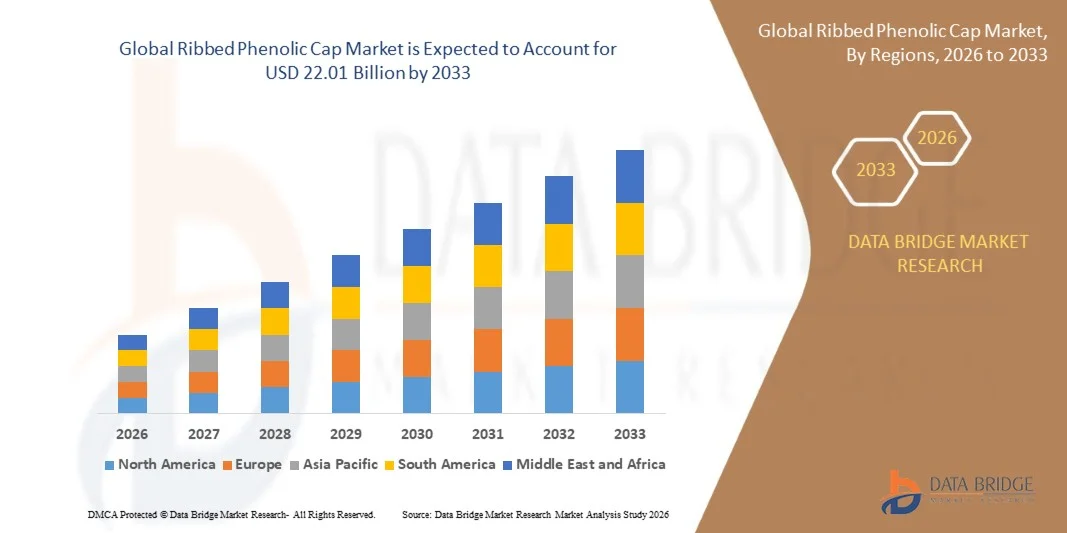
The Ribbed Phenolic Cap Market was valued at USD 15.13 billion in 2025 and is projected to reach USD 22.01 billion by 2033, growing at a CAGR of 4.80% from 2026 to 2033. The market is witnessing steady expansion driven by increasing demand for durable, chemically resistant, and cost-effective closure solutions across industries such as pharmaceuticals, cosmetics, food and beverage, and chemicals. Ribbed phenolic caps are widely preferred for their high mechanical strength, heat resistance, and secure sealing performance, making them suitable for a wide range of packaging applications.
The growing emphasis on product safety, contamination prevention, and extended shelf life is further accelerating the adoption of phenolic closures in industrial and laboratory packaging. In addition, rising industrialization and expanding pharmaceutical manufacturing, particularly in emerging economies, are supporting market growth. For instance, increasing use of ribbed phenolic caps in chemical reagent bottles and laboratory containers is strengthening their role in ensuring leak-proof and tamper-evident packaging solutions across critical end-use sectors.
Key Market Trends & Insights
- North America dominated the ribbed phenolic cap market with the largest revenue share of 38.4% in 2025, supported by a strong pharmaceutical manufacturing base, advanced chemical processing industries, and widespread adoption of laboratory-grade packaging solutions.
- Asia-Pacific is expected to be the fastest-growing region, recording a CAGR of 6.7% from 2026 to 2033. Growth is driven by rapid pharmaceutical expansion, increasing chemical production, rising laboratory infrastructure, and growing export-oriented packaging demand in countries such as China, India, and Japan.
- The 15 mm to 25 mm segment held the largest market revenue share of approximately 41.6% in 2025 driven by its extensive use in pharmaceutical bottles, laboratory reagent containers, and personal care packaging where standard neck finishes are widely adopted. This size range is preferred due to its compatibility with high-volume packaging formats, reliable sealing performance, and suitability for both liquid and semi-liquid formulations across regulated industries.
- The Less than 15 mm segment is projected to register the fastest growth at a CAGR of 8.9% from 2026 to 2033, driven by increasing demand for compact packaging in diagnostic kits, sample vials, and high-density pharmaceutical packaging formats. Rising miniaturization in laboratory and healthcare applications is further supporting adoption of smaller neck diameter closures.
- The Pharmaceuticals segment held the largest market revenue share of approximately 36.9% in 2025 driven by increasing demand for secure, contamination-free packaging of drug formulations, reagents, and diagnostic solutions. Ribbed phenolic caps are widely used in pharmaceutical bottles due to their high chemical resistance and compliance with stringent packaging standards in regulated markets.
- The Cosmetics and Personal Care segment accounted for approximately 18.4% market share in 2025 supported by rising demand for premium skincare and haircare packaging requiring strong sealing performance and product stability. The Beverages segment held around 14.7% share driven by usage in specialty liquid formulations and syrups requiring leak-proof closures.
Market Size & Forecast
- Global Market Value (2025): USD 15.13 Billion
- Expected Market Value (2033): USD 22.01 Billion
- Forecast CAGR (2026–2033): 4.80%
- Leading Region in 2025: North America
- Fastest Growing Region: Asia-Pacific
Report Scope and Ribbed Phenolic Cap Market Segmentation
|
Attributes |
Ribbed Phenolic Cap Key Market Insights |
|
Segments Covered |
|
|
Countries Covered |
North America
Europe
Asia-Pacific
Middle East and Africa
South America
|
|
Key Market Players |
• O.Berk (U.S.) |
|
Market Opportunities |
|
|
Value Added Data Infosets |
In addition to the insights on market scenarios such as market value, growth rate, segmentation, geographical coverage, and major players, the market reports curated by the Data Bridge Market Research also include import export analysis, production capacity overview, production consumption analysis, price trend analysis, climate change scenario, supply chain analysis, value chain analysis, raw material/consumables overview, vendor selection criteria, PESTLE Analysis, Porter Analysis, and regulatory framework. |
Ribbed Phenolic Cap Market Trends
Trend: Growth In Sustainable Packaging And High-Performance Closure Systems
Increasing demand for safe, chemically resistant, and cost-efficient packaging closures across pharmaceuticals, food and beverage, cosmetics, and chemical industries is driving the adoption of ribbed phenolic caps. Traditional plastic closures often face limitations in terms of chemical compatibility, torque retention, and long-term sealing performance, encouraging manufacturers to shift toward phenolic-based solutions that offer higher mechanical strength and improved resistance to solvents and acids.
In pharmaceutical packaging, ribbed phenolic caps are increasingly used for laboratory reagents and diagnostic bottles, For instance in European pharmaceutical laboratories where high-purity chemical storage requires tight-seal closures to prevent contamination and evaporation losses. In the chemical industry, these caps are widely applied in industrial reagent containers and bulk chemical packaging, helping maintain product integrity during long-distance transportation and storage under varying temperature conditions.
The expansion of generic drug manufacturing and laboratory testing facilities in Asia-Pacific is also supporting demand for high-performance closure systems capable of meeting stringent regulatory packaging standards. In addition, increasing export of specialty chemicals from India and China is driving usage of durable phenolic caps in bulk packaging applications, particularly where resistance to corrosive substances and leakage prevention is critical.
Ribbed Phenolic Cap Market Dynamics
Key Market Driver: Rising Demand From Pharmaceutical And Chemical Packaging Industries
The growing pharmaceutical manufacturing base and increasing global demand for safe drug packaging are significantly driving the adoption of ribbed phenolic caps. These closures are widely used for prescription bottles, reagent containers, and diagnostic packaging due to their strong sealing performance, chemical resistance, and ability to maintain product stability over extended storage periods.
Pharmaceutical companies and contract manufacturing organizations are increasingly adopting ribbed phenolic caps, For instance in sterile laboratory environments and drug formulation facilities where contamination control and regulatory compliance are critical requirements. Similarly, the expanding chemical industry is utilizing these caps for packaging acids, solvents, and industrial reagents to ensure safe handling and transportation.
The rise in global laboratory testing volumes, particularly after the expansion of diagnostic infrastructure in 2024–2025, has also increased demand for secure closure systems. Industrial usage in chemical export packaging from countries such as Germany, India, and the U.S. has shown steady growth, with phenolic closures preferred for their durability under harsh storage conditions.
Key Restraint/Challenge: Competition From Low-Cost Plastic And Aluminum Closures
Despite strong performance characteristics, ribbed phenolic caps face competition from lower-cost plastic and aluminum closure alternatives that are widely available in mass packaging applications. These alternatives offer lower production costs and lighter weight, making them attractive for high-volume consumer goods and non-critical packaging segments.
In addition, fluctuations in phenolic resin raw material prices and higher manufacturing complexity compared to standard polymer caps increase overall production costs, limiting adoption among price-sensitive small and medium-scale packaging companies. Environmental concerns regarding phenolic material recycling also create additional regulatory and sustainability challenges in certain markets.
Industry benchmarking indicates that ribbed phenolic caps, For instance high-grade phenolic closures used in chemical packaging, can cost approximately 20–35% more than standard polypropylene caps, making cost optimization a key barrier for large-scale adoption in low-margin packaging segments.
Key Market Opportunity: Expansion In Laboratory, Specialty Chemical, And Export Packaging Applications
Rising global demand for laboratory-grade packaging, specialty chemical storage, and export-oriented industrial packaging is creating strong growth opportunities for ribbed phenolic cap manufacturers. Increasing investment in pharmaceutical R&D infrastructure and chemical production facilities is driving demand for high-integrity closure systems that ensure leak-proof and contamination-free storage.
Pharmaceutical exporters are increasingly using ribbed phenolic caps, For instance in high-value diagnostic reagents and analytical chemicals shipped across international markets where compliance with safety and packaging standards is mandatory. In specialty chemical industries, these caps are being used for corrosive liquid packaging requiring long-term stability and chemical resistance.
In addition, growing export volumes of industrial chemicals from Asia-Pacific and Europe are strengthening demand for durable closure systems capable of withstanding long-distance logistics conditions. In 2025, several chemical packaging suppliers in India and Germany reported increased adoption of phenolic closures in export-grade reagent bottles, with improved leakage reduction performance of nearly 15–20% compared to conventional plastic caps under stress testing conditions.
Ribbed Phenolic Cap Market Scope
The market is segmented on the basis of neck diameter and end-use application.
• By Neck Diameter
On the basis of neck diameter, the ribbed phenolic cap market is segmented into Less than 15 mm, 15 mm to 25 mm, 26 mm to 35 mm, and Above 35 mm. The 15 mm to 25 mm segment held the largest market revenue share of approximately 41.6% in 2025 driven by its extensive use in pharmaceutical bottles, laboratory reagent containers, and personal care packaging where standard neck finishes are widely adopted. This size range is preferred due to its compatibility with high-volume packaging formats, reliable sealing performance, and suitability for both liquid and semi-liquid formulations across regulated industries.
The Less than 15 mm segment is projected to register the fastest growth at a CAGR of 8.9% from 2026 to 2033, driven by increasing demand for compact packaging in diagnostic kits, sample vials, and high-density pharmaceutical packaging formats. Rising miniaturization in laboratory and healthcare applications is further supporting adoption of smaller neck diameter closures.
• By End-Use
On the basis of end-use application, the ribbed phenolic cap market is segmented into Pharmaceuticals, Cosmetics and Personal Care, Beverages, Non-Carbonated Drinks, Carbonated Drinks, Food, Household, and Others. The Pharmaceuticals segment held the largest market revenue share of approximately 36.9% in 2025 driven by increasing demand for secure, contamination-free packaging of drug formulations, reagents, and diagnostic solutions. Ribbed phenolic caps are widely used in pharmaceutical bottles due to their high chemical resistance and compliance with stringent packaging standards in regulated markets.
The Cosmetics and Personal Care segment accounted for approximately 18.4% market share in 2025 supported by rising demand for premium skincare and haircare packaging requiring strong sealing performance and product stability. The Beverages segment held around 14.7% share driven by usage in specialty liquid formulations and syrups requiring leak-proof closures.
Ribbed Phenolic Cap Market Regional Analysis
North America Ribbed Phenolic Cap Market Insight
North America dominated the ribbed phenolic cap market with the largest revenue share of 38.4% in 2025, supported by a strong pharmaceutical manufacturing base, advanced chemical processing industry, and high adoption of laboratory-grade packaging solutions. The region’s well-established regulatory framework for drug safety and chemical handling is increasing the demand for high-performance closures that ensure contamination-free storage and secure sealing. In addition, widespread use of ribbed phenolic caps in diagnostic laboratories, specialty chemical packaging, and industrial reagent containers is further strengthening regional market dominance.
U.S. Ribbed Phenolic Cap Market Insight
The U.S. ribbed phenolic cap market captured the largest revenue share within North America in 2025, driven by the presence of a highly developed pharmaceutical sector, expanding biotechnology research, and strong chemical manufacturing output. Increasing demand for FDA-compliant packaging solutions is encouraging manufacturers to adopt phenolic closures for drug bottles, laboratory reagents, and industrial chemical containers. The growing export of specialty chemicals and pharmaceutical products is also boosting demand for durable, leak-proof, and chemically resistant caps across the country.
Europe Ribbed Phenolic Cap Market Insight
The Europe ribbed phenolic cap market is expected to witness the fastest growth rate from 2026 to 2033, primarily driven by strict regulatory standards for pharmaceutical packaging, rising chemical safety requirements, and increasing demand for sustainable and high-integrity closure systems. The region’s strong focus on laboratory safety and precision packaging is accelerating adoption across pharmaceutical and research applications. Growth in specialty chemical exports and expansion of biotech manufacturing facilities are further supporting market expansion.
U.K. Ribbed Phenolic Cap Market Insight
The U.K. ribbed phenolic cap market is expected to witness steady growth from 2026 to 2033, driven by increasing pharmaceutical production, expanding clinical research activities, and rising demand for secure laboratory packaging solutions. The country’s strong emphasis on drug safety regulations and quality control standards is encouraging the use of ribbed phenolic caps in medical and chemical packaging applications. In addition, growth in contract research organizations is supporting demand for high-performance closure systems.
Germany Ribbed Phenolic Cap Market Insight
The Germany ribbed phenolic cap market is expected to witness strong growth from 2026 to 2033, supported by the country’s advanced chemical industry, high pharmaceutical output, and strong focus on precision engineering and packaging quality. Germany’s well-developed industrial infrastructure and emphasis on chemical safety are increasing the use of phenolic caps in industrial reagent packaging and laboratory applications. Rising exports of specialty chemicals are also contributing to market expansion.
Asia-Pacific Ribbed Phenolic Cap Market Insight
The Asia-Pacific ribbed phenolic cap market is expected to witness the fastest growth rate from 2026 to 2033, supported by rapid industrialization, expanding pharmaceutical manufacturing, and increasing chemical production in countries such as China, India, and Japan. The region’s growing laboratory infrastructure and rising demand for cost-effective yet durable packaging solutions are driving widespread adoption of ribbed phenolic caps. In addition, the expansion of export-oriented chemical and pharmaceutical industries is strengthening regional demand.
Japan Ribbed Phenolic Cap Market Insight
The Japan ribbed phenolic cap market is expected to witness steady growth from 2026 to 2033 due to the country’s advanced pharmaceutical sector, high-quality manufacturing standards, and strong focus on laboratory safety. Increasing adoption of precision packaging solutions in diagnostic and research applications is driving demand for ribbed phenolic caps. Japan’s emphasis on chemical stability and contamination-free storage is further supporting market growth across healthcare and industrial sectors.
China Ribbed Phenolic Cap Market Insight
The China ribbed phenolic cap market accounted for the largest market revenue share in Asia-Pacific in 2025, attributed to rapid expansion of the pharmaceutical industry, strong chemical manufacturing base, and increasing export of industrial and laboratory chemicals. The country’s growing focus on regulatory compliance and packaging safety standards is driving adoption of high-performance closures. In addition, large-scale production of pharmaceuticals and specialty chemicals is significantly boosting demand for ribbed phenolic caps in domestic and international markets.
Ribbed Phenolic Cap Market Share
The Ribbed Phenolic Cap industry is primarily led by well-established companies, including:
• O.Berk (U.S.)
• Berry Global Inc. (U.S.)
• UNITED CAPS (Luxembourg)
• MJS Packaging (U.S.)
• Pipeline Packaging (U.S.)
• Illing Company (U.S.)
• Fillmore Container (U.S.)
• Kaufman Container (U.S.)
• The Cary Company (U.S.)
• Pacific Vial (U.S.)
• WB Bottle (U.S.)
• Feldman Industries (U.S.)
• TomKen Plastic Technologies (U.S.)
• J.G Finneran Associates, Inc. (U.S.)
• Andler Packaging Group (U.S.)
• Cincinnati Container (U.S.)
• Alameda Packaging (U.S.)
• Veritiv Corporation (U.S.)
• Tri-Sure (U.K.)
• Andon Brush Company, Inc. (U.S.)
• Southern Container, Ltd. (U.S.)
• National Novelty Brush Company (U.S.)

- Interactive Data Analysis Dashboard
- Company Analysis Dashboard for high growth potential opportunities
- Research Analyst Access for customization & queries
- Competitor Analysis with Interactive dashboard
- Latest News, Updates & Trend analysis
- Harness the Power of Benchmark Analysis for Comprehensive Competitor Tracking
Global Ribbed Phenolic Cap Market, Supply Chain Analysis and Ecosystem Framework
To support market growth and help clients navigate the impact of geopolitical shifts, DBMR has integrated in-depth supply chain analysis into its Global Ribbed Phenolic Cap Market research reports. This addition empowers clients to respond effectively to global changes affecting their industries. The supply chain analysis section includes detailed insights such as Global Ribbed Phenolic Cap Market consumption and production by country, price trend analysis, the impact of tariffs and geopolitical developments, and import and export trends by country and HSN code. It also highlights major suppliers with data on production capacity and company profiles, as well as key importers and exporters. In addition to research, DBMR offers specialized supply chain consulting services backed by over a decade of experience, providing solutions like supplier discovery, supplier risk assessment, price trend analysis, impact evaluation of inflation and trade route changes, and comprehensive market trend analysis.
Data collection and base year analysis are done using data collection modules with large sample sizes. The stage includes obtaining market information or related data through various sources and strategies. It includes examining and planning all the data acquired from the past in advance. It likewise envelops the examination of information inconsistencies seen across different information sources. The market data is analysed and estimated using market statistical and coherent models. Also, market share analysis and key trend analysis are the major success factors in the market report. To know more, please request an analyst call or drop down your inquiry.
The key research methodology used by DBMR research team is data triangulation which involves data mining, analysis of the impact of data variables on the market and primary (industry expert) validation. Data models include Vendor Positioning Grid, Market Time Line Analysis, Market Overview and Guide, Company Positioning Grid, Patent Analysis, Pricing Analysis, Company Market Share Analysis, Standards of Measurement, Global versus Regional and Vendor Share Analysis. To know more about the research methodology, drop in an inquiry to speak to our industry experts.
Data Bridge Market Research is a leader in advanced formative research. We take pride in servicing our existing and new customers with data and analysis that match and suits their goal. The report can be customized to include price trend analysis of target brands understanding the market for additional countries (ask for the list of countries), clinical trial results data, literature review, refurbished market and product base analysis. Market analysis of target competitors can be analyzed from technology-based analysis to market portfolio strategies. We can add as many competitors that you require data about in the format and data style you are looking for. Our team of analysts can also provide you data in crude raw excel files pivot tables (Fact book) or can assist you in creating presentations from the data sets available in the report.













