


What is the Rice Syrup Market Size and Growth Rate?
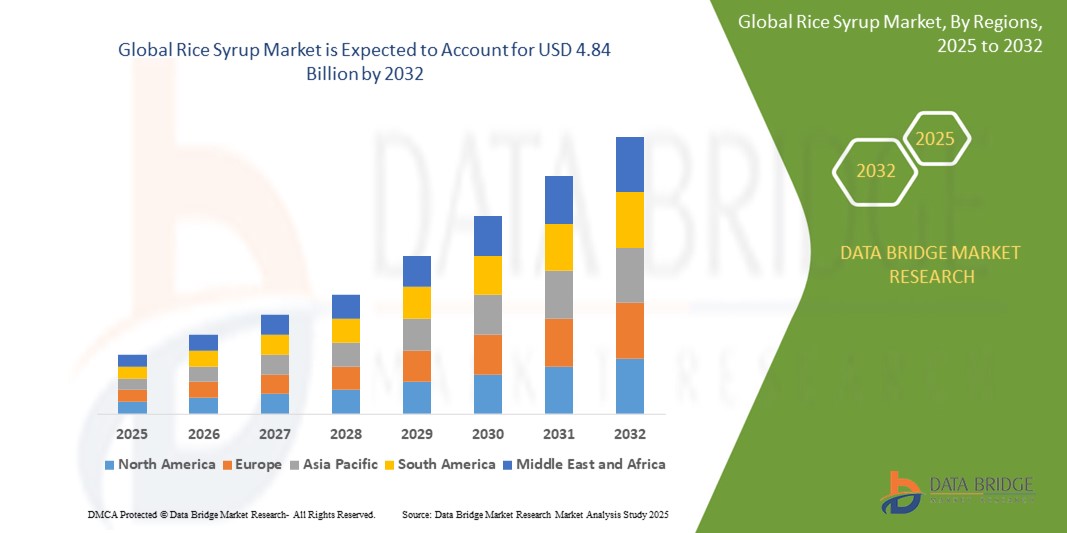
- As per Data Bridge Market Research Analysis the global rice syrup market size was valued at USD 3.13 billion in 2024 and is expected to reach USD 4.84 billion by 2032, at a CAGR of 5.6% during the forecast period
- The market growth is largely fueled by the increasing consumer preference for natural and plant-based sweeteners, driven by heightened health consciousness and the shift away from artificial ingredients in food and beverage products
- Furthermore, rising demand for clean-label, organic, and allergen-free alternatives across various applications, including infant nutrition and health supplements, is establishing rice syrup as a preferred sweetening agent. These converging factors are accelerating the adoption of rice syrup, thereby significantly boosting the industry's growth
Market Size & Forecast
- Global Market Value (2024): USD 3.13 billion
- Expected Market Value (2032): USD 4.84 billio
- Forecast CAGR (2024–2032): 5.6%
What are the Major Takeaways of Rice Syrup Market?
- Rice syrup is a sweetener made from fermented rice starch. It is produced by cooking rice and breaking down its starches into sugars using enzymes. The result is a thick, amber-colored syrup that is less sweet than traditional sugar but has a mild, natural sweetness. Rice syrup is commonly used as a sugar substitute in cooking, baking, and processed foods, and it is often found in products marketed as healthier alternatives to refined sugars
- The escalating demand for rice syrup is primarily fueled by rising health consciousness among consumers, growing preference for organic and non-GMO ingredients, and the widespread shift away from artificial sweeteners and high-fructose corn syrup across global markets
- North America dominated the rice syrup market with a share of 26.5% in 2024, due to strong demand for natural sweeteners, increased health consciousness, and a shift away from high-fructose corn syrup
- Asia-Pacific is expected to be the fastest growing region in the rice syrup market with a share of during the forecast period due to growing health awareness, rapid urbanization, and changing dietary habits across developing countries
- Powder segment dominated the market with a market share of 67.7% in 2024, due to its rising adoption in nutritional supplements, dry mixes, and ready-to-drink powders. Powdered rice syrup is valued for its extended shelf life, portability, and ease of transport, making it a practical choice for health-oriented and convenience food product categories
Report Scope and Rice Syrup Market Segmentation
|
Attributes |
Rice Syrup Key Market Insights |
|
Segments Covered |
|
|
Countries Covered |
North America
Europe
Asia-Pacific
Middle East and Africa
South America
|
|
Key Market Players |
|
|
Market Opportunities |
|
|
Value Added Data Infosets |
|
What is the Key Trend in the Rice Syrup Market?
“Increasing Consumer Demand for Natural Sweeteners”
- A significant and accelerating trend in the global rice syrup market is the rising preference for natural, plant-based sweeteners as consumers move away from artificial ingredients and high-fructose corn syrup. This shift is driven by increasing awareness of the health risks associated with synthetic sweeteners and the growing appeal of clean-label products
- For instance, leading brands in the health food segment are reformulating products to include rice syrup as a natural sweetening agent, capitalizing on its hypoallergenic and vegan-friendly properties. Many organic snack bars, infant foods, and beverages now feature rice syrup to meet consumer demand for transparency and health consciousness
- Consumers are drawn to rice syrup due to its mild sweetness, low allergenic potential, and suitability for gluten-free, dairy-free, and vegan diets. These attributes make it ideal for inclusion in specialty food products aimed at health-conscious demographics
- As product innovation intensifies, rice syrup is increasingly used in functional food and beverage applications, such as energy bars and nutritional supplements, offering both sweetening and binding properties. Manufacturers are also developing powdered rice syrup formats to cater to new application needs and increase product versatility
- The inclusion of rice syrup in infant formula and health supplements is rising due to its digestibility and status as a perceived safer alternative to corn or cane-based sweeteners. Consumers are becoming more selective in choosing minimally processed and naturally sourced ingredients, further accelerating adoption
- This growing trend toward clean-label, organic, and plant-based ingredients is fundamentally reshaping the sweetener market. As a result, companies such as Cargill and ADM are expanding their rice syrup portfolios to meet the evolving demand for healthier and more sustainable sweetening options
Rice Syrup Market Dynamics
Driver
“Rising Demand for Organic Sweeteners”
- The increasing global demand for organic and non-GMO food products is a significant driver of rice syrup market growth, as consumers seek healthier alternatives to conventional sweeteners. Rice syrup aligns well with the clean-label movement and is being adopted across a wide range of food and beverage products
- For instance, companies are launching organic rice syrup variants to cater to the rising health awareness and dietary preferences of consumers. The growth of the vegan and allergen-free food segments is also boosting the use of rice syrup, which is often preferred for its natural composition and ease of digestion
- Retailers and food service providers are increasingly incorporating rice syrup in product offerings ranging from bakery items to infant foods. The expansion of organic-certified farming and processing infrastructure globally supports the availability and adoption of rice syrup in both mature and emerging markets
- Furthermore, the growing demand for clean and sustainable ingredient sourcing practices is prompting food manufacturers to substitute artificial sweeteners with rice syrup. Its role as a versatile, plant-based, and functional ingredient in health-oriented foods is driving significant market traction
- As health-conscious consumers continue to seek natural and organic options, rice syrup is gaining momentum as a mainstream sweetener, supporting sustained market growth across key regions and applications
Restraint/Challenge
“Availability of Alternative Sweeteners”
- The availability and rising popularity of alternative natural sweeteners such as agave syrup, honey, stevia, and monk fruit pose a significant challenge to the rice syrup market. Many of these alternatives offer lower glycemic index levels or stronger sweetness profiles, making them competitive in certain applications
- For instance, stevia and monk fruit extracts are widely used in calorie-conscious formulations, especially in beverages and diabetic-friendly products, where rice syrup’s higher carbohydrate content may limit its usage
- Food manufacturers may opt for alternatives based on desired sweetness intensity, cost-effectiveness, and nutritional attributes, particularly in regions with well-established health food markets. In such scenarios, rice syrup may face slower adoption due to comparative formulation constraints
- Moreover, rice syrup is less suitable for consumers seeking sugar-free solutions, which stevia and monk fruit fulfill more effectively. This has created segmentation within the natural sweetener market, dividing use cases by health objectives
- Overcoming this challenge will require targeted education on rice syrup’s benefits, innovation in low-calorie or blended formulations, and competitive pricing strategies to strengthen its position among available natural sweetener options
How is the Rice Syrup Market Segmented?
The market is segmented on the basis of type, application, form, and distribution channel.
• By Type
On the basis of type, the rice syrup market is segmented into organic rice syrup and conventional rice syrup. The conventional rice syrup segment accounted for the largest market revenue share in 2024, driven by its widespread usage in mass-produced food products due to cost-effectiveness, high sweetness consistency, and longer shelf life. Food manufacturers prefer conventional rice syrup for its ability to act as a natural sweetener and preservative in processed foods, cereals, and bakery products. Its availability in bulk quantities and alignment with clean-label trends further support its dominant market position.
The organic rice syrup segment is expected to witness the fastest growth rate from 2025 to 2032, fueled by increasing consumer preference for organic and non-GMO ingredients. Rising health consciousness and demand for transparency in food sourcing are prompting manufacturers to replace synthetic sweeteners with organic alternatives. Moreover, the expansion of organic-certified food product lines across the globe is driving demand for organic rice syrup as a trusted and recognizable sweetening solution.
• By Application
On the basis of application, the rice syrup market is segmented into food & beverage, infant formula, nutritional supplements, sauces & dressings, and others. The food & beverage segment held the largest market share in 2024 due to the extensive use of rice syrup as a natural sweetener and texture enhancer in bakery products, confectionery, and beverages. The growing shift away from high-fructose corn syrup and artificial sugars in processed foods supports strong demand for rice syrup in this category.
The infant formula segment is projected to experience the fastest growth from 2025 to 2032, driven by increasing parental focus on digestive-friendly, hypoallergenic, and chemical-free ingredients. Rice syrup is favored in infant nutrition due to its low allergenic potential, smooth digestibility, and mild sweetness, aligning with stringent safety standards in baby food formulations.
• By Form
On the basis of form, the rice syrup market is categorized into liquid and powder. The powder form segment dominated the largest market revenue share of 67.7% in 2024, owing to its rising adoption in nutritional supplements, dry mixes, and ready-to-drink powders. Powdered rice syrup is valued for its extended shelf life, portability, and ease of transport, making it a practical choice for health-oriented and convenience food product categories.
The liquid form segment is anticipated to witness the highest CAGR from 2025 to 2032, supported by its widespread industrial use in food processing for blending, glazing, and moisture retention. Liquid rice syrup is easier to handle during production processes and offers better solubility in various formulations, particularly in beverages and syrups.
• By Distribution Channel
On the basis of distribution channel, the rice syrup market is segmented into supermarkets & hypermarkets, convenience stores, online, and others. Supermarkets & hypermarkets held the largest share of the market in 2024 due to their broad product visibility, consumer trust, and ability to offer a variety of rice syrup brands under one roof. These stores allow consumers to compare product labels, organic certifications, and price points, enhancing informed purchasing.
The online segment is projected to grow at the fastest rate from 2025 to 2032, propelled by increasing digitalization in retail, expanding e-commerce penetration, and the growing preference for doorstep delivery of health food products. Online platforms offer niche and organic rice syrup options, subscription services, and direct-to-consumer brand access, particularly appealing to health-conscious and specialty product consumers.
Which Region Holds the Largest Share of the Rice Syrup Market?
- North America dominated the rice syrup market with the largest revenue share of 26.5% in 2024, driven by strong demand for natural sweeteners, increased health consciousness, and a shift away from high-fructose corn syrup
- Consumers in the region are increasingly opting for rice syrup due to its perceived health benefits, organic certification, and suitability for vegan and allergen-free diets
- The prevalence of clean-label trends, coupled with the presence of major food manufacturers incorporating rice syrup in snacks, cereals, and beverages, sustains its robust market performance
U.S. Rice Syrup Market Insight
The U.S. rice syrup market captured the largest revenue share in 2024 within North America, supported by rising demand for organic and non-GMO sweeteners across the food & beverage industry. A growing segment of health-conscious consumers is influencing food processors to adopt rice syrup in packaged and processed food items. Furthermore, the expansion of vegan and gluten-free product categories, along with increased retail availability through natural and specialty food channels, contributes significantly to the market's growth.
Europe Rice Syrup Market Insight
The Europe rice syrup market is projected to expand at a considerable CAGR over the forecast period, primarily driven by regulatory support for natural food ingredients and an increasing preference for clean-label products. European consumers are actively seeking plant-based, allergen-friendly sweeteners, which has fueled the demand for rice syrup in bakery, baby food, and beverage applications. The growing influence of health-focused food innovation and sustainable sourcing is also contributing to market expansion in both Western and Central Europe.
U.K. Rice Syrup Market Insight
The U.K. rice syrup market is expected to grow at a notable CAGR during the forecast period, supported by a growing preference for low-calorie and plant-based sweeteners. The increasing demand for sugar substitutes in functional and health foods, along with consumer interest in organic and allergen-free products, is accelerating the adoption of rice syrup. Moreover, a rise in vegan and flexitarian dietary patterns and greater retail presence of natural sweeteners are expected to sustain strong market performance.
Germany Rice Syrup Market Insight
The Germany rice syrup market is anticipated to expand steadily during the forecast period, propelled by the country's strong inclination toward organic food consumption and clean-label transparency. German consumers are highly responsive to ingredient traceability and sustainability, prompting a surge in demand for naturally derived sweeteners such as rice syrup. In addition, Germany’s active health food industry and strict food safety regulations contribute to the growing use of rice syrup across multiple food and beverage categories.
Asia-Pacific Rice Syrup Market Insight
The Asia-Pacific rice syrup market is set to grow at the fastest CAGR of 6.2% from 2025 to 2032, fueled by growing health awareness, rapid urbanization, and changing dietary habits across developing countries. Countries such as China, India, and Japan are witnessing increased demand for natural sweeteners in both traditional and modern food applications. The rising number of health-conscious consumers, the expansion of organized retail, and supportive government initiatives for clean and organic food products are fostering market growth across the region.
Japan Rice Syrup Market Insight
The Japan rice syrup market is gaining traction due to a growing emphasis on health, aging population concerns, and interest in functional foods. Rice syrup’s compatibility with traditional Japanese dietary preferences and its suitability for clean-label and macrobiotic diets contribute to its rising adoption. In addition, food manufacturers are integrating rice syrup into confectionery, sauces, and meal replacements to meet evolving consumer expectations for safe, plant-based sweeteners.
China Rice Syrup Market Insight
The China rice syrup market accounted for the largest revenue share within Asia-Pacific in 2024, driven by increasing demand for naturally processed foods, urban lifestyle changes, and the dominance of domestic rice syrup manufacturers. As the country experiences a rapid shift towards health-oriented consumption, rice syrup is gaining popularity as a replacement for artificial sweeteners. Government-led initiatives promoting healthier eating and the growth of e-commerce channels are further propelling market expansion across both urban and rural areas.
Which are the Top Companies in Rice Syrup Market?
The rice syrup industry is primarily led by well-established companies, including:
- Axiom Foods Inc. (U.S.)
- Archer Daniels Midland Company (ADM) (U.S.)
- Cargill, Incorporated (U.S.)
- Wuhu Deli Foods Co., Ltd. (China)
- Habib-ADM Limited (Bangladesh)
- ABF Ingredients (ABFI) (U.K.)
- Nature Bio-Foods Ltd. (India)
- WaiLana (U.S.)
- Khatoon Industries (Pakistan)
- California Natural Products (U.S.)
- The Kraft Heinz Company (U.S.)
- Tate & Lyle (U.K.)
What are Latest Developments in Rice Syrup Market?
- In June 2023, a major food company announced the expansion of its rice syrup applications within energy bars, tapping into the increasing consumer demand for nutritious snacks. This strategic move reflects the rising popularity of healthy eating, as more individuals seek convenient and wholesome options
- In April 2023, a leading manufacturer introduced a new line of organic rice syrup, specifically designed to meet the growing demand from health-conscious consumers. This product launch aims to provide a clean-label option, appealing to those seeking natural and minimally processed sweeteners. By focusing on organic ingredients, the company is positioning itself to capture a larger share of the market

- Interactive Data Analysis Dashboard
- Company Analysis Dashboard for high growth potential opportunities
- Research Analyst Access for customization & queries
- Competitor Analysis with Interactive dashboard
- Latest News, Updates & Trend analysis
- Harness the Power of Benchmark Analysis for Comprehensive Competitor Tracking
Global Rice Syrup Market, Supply Chain Analysis and Ecosystem Framework
To support market growth and help clients navigate the impact of geopolitical shifts, DBMR has integrated in-depth supply chain analysis into its Global Rice Syrup Market research reports. This addition empowers clients to respond effectively to global changes affecting their industries. The supply chain analysis section includes detailed insights such as Global Rice Syrup Market consumption and production by country, price trend analysis, the impact of tariffs and geopolitical developments, and import and export trends by country and HSN code. It also highlights major suppliers with data on production capacity and company profiles, as well as key importers and exporters. In addition to research, DBMR offers specialized supply chain consulting services backed by over a decade of experience, providing solutions like supplier discovery, supplier risk assessment, price trend analysis, impact evaluation of inflation and trade route changes, and comprehensive market trend analysis.
Data collection and base year analysis are done using data collection modules with large sample sizes. The stage includes obtaining market information or related data through various sources and strategies. It includes examining and planning all the data acquired from the past in advance. It likewise envelops the examination of information inconsistencies seen across different information sources. The market data is analysed and estimated using market statistical and coherent models. Also, market share analysis and key trend analysis are the major success factors in the market report. To know more, please request an analyst call or drop down your inquiry.
The key research methodology used by DBMR research team is data triangulation which involves data mining, analysis of the impact of data variables on the market and primary (industry expert) validation. Data models include Vendor Positioning Grid, Market Time Line Analysis, Market Overview and Guide, Company Positioning Grid, Patent Analysis, Pricing Analysis, Company Market Share Analysis, Standards of Measurement, Global versus Regional and Vendor Share Analysis. To know more about the research methodology, drop in an inquiry to speak to our industry experts.
Data Bridge Market Research is a leader in advanced formative research. We take pride in servicing our existing and new customers with data and analysis that match and suits their goal. The report can be customized to include price trend analysis of target brands understanding the market for additional countries (ask for the list of countries), clinical trial results data, literature review, refurbished market and product base analysis. Market analysis of target competitors can be analyzed from technology-based analysis to market portfolio strategies. We can add as many competitors that you require data about in the format and data style you are looking for. Our team of analysts can also provide you data in crude raw excel files pivot tables (Fact book) or can assist you in creating presentations from the data sets available in the report.













