


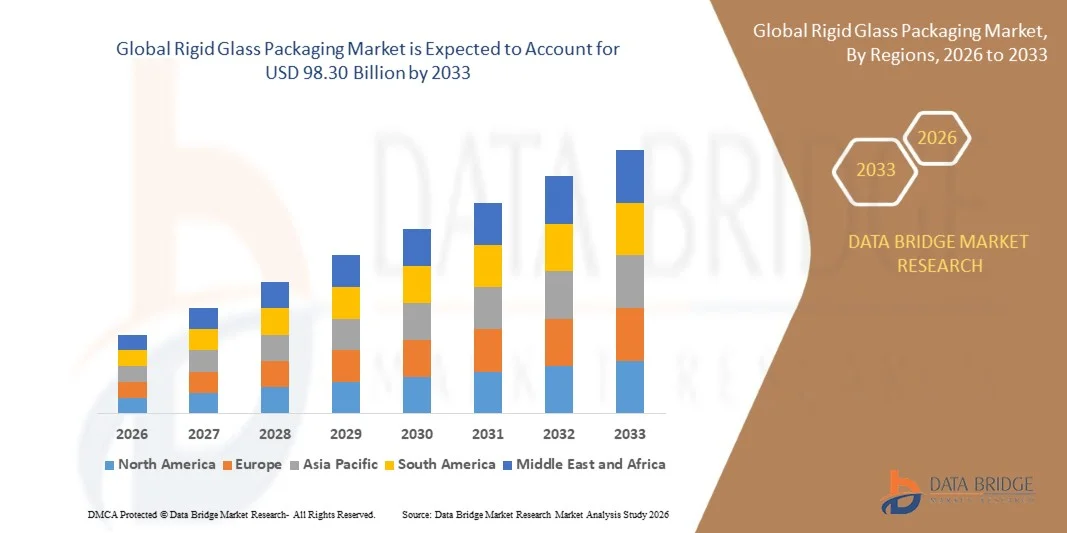
Rigid Glass Packaging Market Size
- The global rigid glass packaging market size was valued at USD 68.30 billion in 2025 and is expected to reach USD 98.30 billion by 2033, at a CAGR of 5.10% during the forecast period
- The market growth is largely fuelled by the rising demand for sustainable, recyclable, and premium packaging solutions across food & beverages, pharmaceuticals, and personal care industries
- Growing preference for chemical-free and non-reactive packaging materials, along with the expanding trend of premiumization in alcoholic beverages such as wine, spirits, and craft beverages, is supporting market expansion
Rigid Glass Packaging Market Analysis
- The rigid glass packaging market is experiencing steady growth as brands prioritize sustainability, product safety, and premium aesthetics to enhance consumer appeal in competitive retail environments
- Demand is strongly influenced by the premium look and barrier properties of glass, which protect product integrity and extend shelf life in sectors such as food, beverages, and pharmaceuticals
- North America dominated the rigid glass packaging market with the largest revenue share in 2025, driven by strong demand for premium, durable, and chemically stable packaging across food, beverages, pharmaceuticals, and cosmetics
- Asia-Pacific region is expected to witness the highest growth rate in the global rigid glass packaging market, driven by expanding food and beverage consumption and increasing investments in glass manufacturing capacity
- The bottles & jars segment held the largest market revenue share in 2025 driven by their extensive usage across food, beverages, pharmaceuticals, and personal care products due to high durability, chemical inertness, and excellent barrier properties. Their widespread adoption is supported by consumer preference for premium packaging and strong compatibility with liquid and semi-liquid products
Report Scope and Rigid Glass Packaging Market Segmentation
|
Attributes |
Rigid Glass Packaging Key Market Insights |
|
Segments Covered |
|
|
Countries Covered |
North America
Europe
Asia-Pacific
Middle East and Africa
South America
|
|
Key Market Players |
|
|
Market Opportunities |
|
|
Value Added Data Infosets |
In addition to the insights on market scenarios such as market value, growth rate, segmentation, geographical coverage, and major players, the market reports curated by the Data Bridge Market Research also include import export analysis, production capacity overview, production consumption analysis, price trend analysis, climate change scenario, supply chain analysis, value chain analysis, raw material/consumables overview, vendor selection criteria, PESTLE Analysis, Porter Analysis, and regulatory framework. |
Rigid Glass Packaging Market Trends
“Rise Of Sustainable And Premium Packaging Solutions”
- The rising demand for eco-friendly, recyclable materials is shifting consumer preference toward rigid glass packaging, driven by its sustainability, chemical resistance, and suitability for repeated use. Brands are increasingly adopting glass formats to align with environmental regulations and reduce plastic dependency, which is strengthening long-term market adoption
- Premiumization in beverages and personal care is accelerating the use of glass to enhance product appeal and brand value. High clarity, premium feel, and protection against contamination make glass packaging a preferred choice for products such as spirits, perfumes, and gourmet foods
- Growing health and wellness awareness is reinforcing demand for glass containers due to their inert nature, ensuring no chemical leaching. This is particularly important for sectors such as nutraceuticals and organic food products where purity and safety drive packaging decisions
- For instance, in 2023, several beverage manufacturers in Europe reported a surge in consumer interest for returnable and refillable glass bottles, driven by sustainability programs and retailer-led circular economy initiatives. This trend encouraged producers to expand returnable glass lines to meet rising environmental expectations
- While sustainability and premium positioning continue to drive glass adoption, long-term success relies on investments in lightweighting technologies, energy-efficient production, and cost-effective recycling networks to fully capitalize on shifting consumer priorities
Rigid Glass Packaging Market Dynamics
Driver
“Growing Demand For Safe, Durable, And Chemically Inert Packaging”
- Increasing concern over chemical migration from plastic alternatives is propelling demand for rigid glass packaging across food, beverages, pharmaceuticals, and cosmetics. Glass offers high durability, exceptional barrier properties, and long shelf-life, making it ideal for products such as sauces, medicines, fragrances, and specialty beverages. This growing preference is further supported by rising consumer awareness of product purity and safety in daily-use items
- Manufacturers are recognizing that glass safeguards product integrity, maintains flavor stability, and protects formulations, which reduces contamination-related losses. As brands adopt clean-label strategies, glass becomes a preferred choice due to its non-reactive nature and premium appeal. This transition is especially prominent among premium FMCG brands seeking to differentiate through quality and packaging aesthetics
- Regulatory efforts and industry standards promoting non-toxic, recyclable packaging formats are reinforcing this shift. Governments and environmental agencies are encouraging the adoption of recyclable materials, pushing companies toward long-term packaging sustainability. This is resulting in increased investment in glass-based solutions across high-volume consumer sectors where compliance and brand reputation are critical
- For instance, in 2022, North American beverage producers reported an increase in glass bottle usage for craft beer and premium alcoholic beverages due to rising consumer demand for safer and aesthetically appealing packaging. Companies also highlighted reduced customer complaints linked to off-flavors or chemical interactions when transitioning to glass formats. This shift has encouraged brewers and distillers to expand glass packaging lines to support brand loyalty
- While safety and durability remain core drivers, expanding production capacity, optimizing logistics, and addressing breakage concerns will be essential for sustaining market growth. Continuous investment in lightweighting technologies and automated handling systems will help reduce transportation challenges. Market players also need to strengthen supply chain networks to ensure uninterrupted distribution of glass products in competitive sectors
Restraint/Challenge
“High Manufacturing Cost And Limited Scalability In Cost-Sensitive Markets”
- The high cost of manufacturing glass containers due to energy-intensive processes poses a challenge for producers, especially in segments where price sensitivity is high. Energy prices, furnace maintenance, and raw material expenses elevate the final product cost, limiting adoption in low-margin categories. This cost burden is particularly noticeable in competitive markets where packaging represents a significant share of product pricing
- Handling, storage, and transportation complexities associated with heavier and more fragile glass containers increase operational costs. Small manufacturers and SMEs often face limitations in adopting glass due to higher breakage rates and supply chain constraints. These challenges further discourage widespread usage, especially in rural or infrastructure-limited regions where logistics efficiency is low
- Price volatility in raw materials such as soda ash and silica sand adds further barriers, particularly in emerging markets where cost efficiency is a priority. Companies operating in such regions often opt for alternative materials such as PET or metal to manage overall packaging budget. This volatility also affects long-term planning and investment decisions for producers aiming to scale operations
- For instance, in 2023, packaging associations in Southeast Asia highlighted that increased furnace fuel costs led to a temporary decline in glass production, pushing several manufacturers to shift toward hybrid packaging solutions. Many producers also reported difficulty in absorbing rising costs without increasing end-product prices. This situation led to growing interest in mixed-material packaging formats to balance cost and performance
- While glass remains a preferred sustainable material, addressing energy consumption, breakage reduction, and cost-efficient production technologies will be vital to overcoming long-term scalability constraints. Adoption of electric furnaces and renewable energy sources can help reduce operational expenses in the long run. Strengthening recycling infrastructure and utilizing cullet more extensively can also support cost stability across the industry
Rigid Glass Packaging Market Scope
The market is segmented on the basis of product, application, color, and capacity
• By Product
On the basis of product, the rigid glass packaging market is segmented into bottles & jars, trays & clamshells, tubs, cups, and pots, pallets, drums & barrels, and crates. The bottles & jars segment held the largest market revenue share in 2025 driven by their extensive usage across food, beverages, pharmaceuticals, and personal care products due to high durability, chemical inertness, and excellent barrier properties. Their widespread adoption is supported by consumer preference for premium packaging and strong compatibility with liquid and semi-liquid products.
The trays & clamshells segment is expected to witness the fastest growth rate from 2026 to 2033 propelled by rising demand for secure, visually appealing, and eco-friendly packaging solutions in bakery, confectionery, and specialty food categories. These formats offer strong product visibility and structural stability, making them increasingly suitable for retail-ready and on-shelf presentation requirements.
• By Application
On the basis of application, the market is categorized into food, beverage, pharmaceuticals & healthcare, personal care & cosmetics, automotive, building & construction, and others. The beverage segment held the largest revenue share in 2025 due to the extensive usage of glass bottles in alcoholic beverages, functional drinks, and premium water products, supported by rising demand for non-toxic and flavor-preserving packaging. The segment benefits from producers’ shift toward high-quality glass formats to enhance brand appeal.
The pharmaceuticals & healthcare segment is expected to register the fastest growth from 2026 to 2033 driven by rising adoption of glass vials, ampoules, and bottles for drug formulation stability, chemical resistance, and long-term shelf-life. Increasing global vaccination drives, expansion of biologics, and greater emphasis on sterile packaging are key contributors to the segment’s rapid growth.
• By Color
On the basis of color, the rigid glass packaging market is segmented into flint and amber. The flint segment accounted for the largest market revenue share in 2025 due to its high transparency, allowing clear product visibility for beverages, food condiments, and cosmetic formulations. Its premium appearance and compatibility with diverse product categories continue to enhance adoption among consumer-focused brands.
The amber segment is projected to grow at the fastest rate from 2026 to 2033 supported by increasing demand for UV-protective packaging across pharmaceuticals, essential oils, and specialty beverages. The segment benefits from its superior light-blocking properties, making it ideal for sensitive formulations that require enhanced protection and long-term stability.
• By Capacity
On the basis of capacity, the market is divided into less than 200 ml, 200–500 ml, 500–1000 ml, and more than 1000 ml. The 200–500 ml segment held the largest market revenue share in 2025 driven by its widespread use in beverages, sauces, cosmetics, and OTC pharmaceuticals where mid-size packaging ensures convenience and controlled consumption. Growing demand for premium and single-serve packaging further supports the segment’s dominance.
The more than 1000 ml segment is expected to record the fastest growth from 2026 to 2033 due to rising usage in bulk food ingredients, household products, and large-format beverage packaging. Increased adoption among industrial users and institutional buyers such as commercial kitchens and food service providers is further accelerating segment expansion.
Rigid Glass Packaging Market Regional Analysis
- North America dominated the rigid glass packaging market with the largest revenue share in 2025, driven by strong demand for premium, durable, and chemically stable packaging across food, beverages, pharmaceuticals, and cosmetics
- Consumers in the region place high value on product purity, sustainability, and safety, which supports the rising shift toward glass containers as an alternative to plastics
- The widespread adoption is further reinforced by stringent quality regulations, high disposable incomes, and the growing preference for recyclable packaging solutions across major industries
U.S. Rigid Glass Packaging Market Insight
The U.S. rigid glass packaging market captured the largest revenue share in 2025 within North America, fuelled by the increasing consumption of premium beverages, specialty foods, and pharmaceutical products requiring high-barrier packaging. Manufacturers are prioritizing glass due to its non-toxic nature, strong brand appeal, and compatibility with sustainability goals. The demand for high-quality glass bottles and jars in sectors such as craft beverages, nutraceuticals, and luxury cosmetics is also contributing to market expansion. Furthermore, the U.S. focus on recycling infrastructure and circular packaging systems continues to support long-term growth in glass usage.
Europe Rigid Glass Packaging Market Insight
The Europe rigid glass packaging market is expected to witness the fastest growth rate from 2026 to 2033, driven by strict environmental regulations promoting recyclable and eco-friendly materials. The rise of sustainable product labeling and the preference for safe, inert packaging across food, beverage, and healthcare sectors are accelerating the adoption of glass. European consumers are increasingly shifting toward premium packaged products, which further boosts demand for aesthetically appealing and durable glass formats. The region is also seeing strong uptake of glass packaging in personal care and specialty beverage applications.
U.K. Rigid Glass Packaging Market Insight
The U.K. rigid glass packaging market is expected to witness the fastest growth rate from 2026 to 2033, supported by the growing emphasis on sustainable packaging, reduction of single-use plastics, and the rising popularity of recyclable materials. The demand for high-quality glass bottles in alcoholic beverages, cosmetics, and gourmet food categories is driving market momentum. In addition, consumer preference for premium, chemically stable packaging and supportive government initiatives aimed at improving recycling systems continue to strengthen market growth.
Germany Rigid Glass Packaging Market Insight
The Germany rigid glass packaging market is expected to witness the fastest growth rate from 2026 to 2033, driven by strong industrial capabilities, high sustainability standards, and advanced manufacturing technologies. Germany’s emphasis on product safety, quality, and environmental responsibility aligns with the increasing adoption of glass containers across pharmaceuticals, food processing, and cosmetics. The integration of energy-efficient production systems and innovative lightweight glass designs is further encouraging expansion in the country’s glass packaging sector.
Asia-Pacific Rigid Glass Packaging Market Insight
The Asia-Pacific rigid glass packaging market is expected to witness the fastest growth rate from 2026 to 2033, propelled by rapid urbanization, rising disposable incomes, and expanding consumption of packaged foods, beverages, and healthcare products. Growing manufacturing capacity, coupled with the presence of large-scale glass producers in countries such as China and India, is enabling wider accessibility and affordability of glass packaging. Increasing awareness regarding product safety and the rising preference for premium packaged goods across APAC are further accelerating demand.
Japan Rigid Glass Packaging Market Insight
The Japan rigid glass packaging market is expected to witness the fastest growth rate from 2026 to 2033 due to strong consumer focus on product purity, premium quality, and long shelf-life. The country’s advanced technological landscape and high standards for packaging safety are promoting the use of glass containers in pharmaceuticals, beverages, and luxury cosmetics. Rising adoption of smart and sustainable packaging initiatives, along with the popularity of high-end bottled beverages, is supporting market growth. In addition, the aging population is contributing to higher demand for secure, contamination-free packaging across healthcare applications.
China Rigid Glass Packaging Market Insight
The China rigid glass packaging market accounted for the largest revenue share in Asia Pacific in 2025, attributed to rapid industrialization, expanding consumer markets, and strong domestic production capabilities. China is one of the world’s largest consumers of packaged beverages, beauty products, and processed foods, all of which heavily rely on rigid glass formats. The government push toward environmentally friendly packaging, coupled with competitive manufacturing costs and rising demand for premium product packaging, is significantly driving market growth across the country.
Rigid Glass Packaging Market Share
The Rigid Glass Packaging industry is primarily led by well-established companies, including:
- Owens-Illinois, Inc. (U.S.)
- Ardagh Group S.A. (U.K.)
- Verallia Group (France)
- Gerresheimer AG (Germany)
- Beatson Clark Ltd. (U.K.)
- Stölzle Glass Group (Austria)
- Vetropack Holding AG (Switzerland)
- Hindustan National Glass & Industries Ltd. (India)
- BA Glass Group (Portugal)
- Bormioli Luigi S.p.A. (Italy)

- Interactive Data Analysis Dashboard
- Company Analysis Dashboard for high growth potential opportunities
- Research Analyst Access for customization & queries
- Competitor Analysis with Interactive dashboard
- Latest News, Updates & Trend analysis
- Harness the Power of Benchmark Analysis for Comprehensive Competitor Tracking
Global Rigid Glass Packaging Market, Supply Chain Analysis and Ecosystem Framework
To support market growth and help clients navigate the impact of geopolitical shifts, DBMR has integrated in-depth supply chain analysis into its Global Rigid Glass Packaging Market research reports. This addition empowers clients to respond effectively to global changes affecting their industries. The supply chain analysis section includes detailed insights such as Global Rigid Glass Packaging Market consumption and production by country, price trend analysis, the impact of tariffs and geopolitical developments, and import and export trends by country and HSN code. It also highlights major suppliers with data on production capacity and company profiles, as well as key importers and exporters. In addition to research, DBMR offers specialized supply chain consulting services backed by over a decade of experience, providing solutions like supplier discovery, supplier risk assessment, price trend analysis, impact evaluation of inflation and trade route changes, and comprehensive market trend analysis.
Data collection and base year analysis are done using data collection modules with large sample sizes. The stage includes obtaining market information or related data through various sources and strategies. It includes examining and planning all the data acquired from the past in advance. It likewise envelops the examination of information inconsistencies seen across different information sources. The market data is analysed and estimated using market statistical and coherent models. Also, market share analysis and key trend analysis are the major success factors in the market report. To know more, please request an analyst call or drop down your inquiry.
The key research methodology used by DBMR research team is data triangulation which involves data mining, analysis of the impact of data variables on the market and primary (industry expert) validation. Data models include Vendor Positioning Grid, Market Time Line Analysis, Market Overview and Guide, Company Positioning Grid, Patent Analysis, Pricing Analysis, Company Market Share Analysis, Standards of Measurement, Global versus Regional and Vendor Share Analysis. To know more about the research methodology, drop in an inquiry to speak to our industry experts.
Data Bridge Market Research is a leader in advanced formative research. We take pride in servicing our existing and new customers with data and analysis that match and suits their goal. The report can be customized to include price trend analysis of target brands understanding the market for additional countries (ask for the list of countries), clinical trial results data, literature review, refurbished market and product base analysis. Market analysis of target competitors can be analyzed from technology-based analysis to market portfolio strategies. We can add as many competitors that you require data about in the format and data style you are looking for. Our team of analysts can also provide you data in crude raw excel files pivot tables (Fact book) or can assist you in creating presentations from the data sets available in the report.













