


Rigid Polyurethane Foams Market Overview
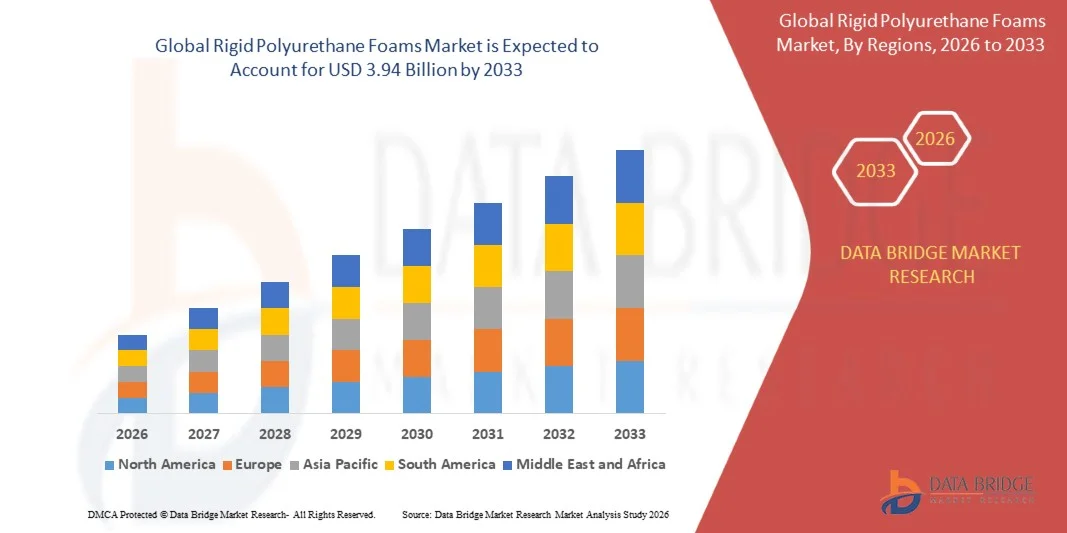
The Rigid Polyurethane Foams Market was valued at USD 2.67 billion in 2025 and is projected to reach USD 3.94 billion by 2033, growing at a CAGR of 5.00% from 2026 to 2033. The market is experiencing steady growth driven by increasing demand for high-performance thermal insulation materials, rising investments in energy-efficient buildings, and expanding applications across the construction, refrigeration, automotive, and industrial sectors.
The growing emphasis on reducing energy consumption, combined with stringent building energy efficiency regulations and increasing adoption of sustainable construction practices, is encouraging manufacturers and end users to utilize rigid polyurethane foams for superior insulation performance. In addition, expanding cold chain infrastructure, rising demand for insulated appliances, and continuous advancements in foam manufacturing technologies are supporting the widespread adoption of rigid polyurethane foams by improving thermal efficiency, structural strength, and long-term durability across residential, commercial, and industrial applications.
Market Size & Forecast
- Global Market Value (2025): USD 2.67 Billion
- Expected Market Value (2033): USD 3.94 Billion
- Forecast CAGR (2026–2033): 5.00%
- Leading Region in 2025: North America
- Fastest Growing Region: Asia-Pacific
Key Market Trends & Insights
- North America dominated the Rigid Polyurethane Foams Market with the largest revenue share of 36.28% in 2025, supported by robust construction activity, stringent building energy-efficiency regulations, widespread adoption of high-performance insulation materials, and strong demand from refrigeration and cold-chain infrastructure.
- The Polyols segment dominated the market with a 56.87% share in 2025, as polyols play a critical role in determining foam structure, density, and insulation performance.
- Asia-Pacific is expected to be the fastest-growing regional market, registering a CAGR of 7.6% from 2026 to 2033, fueled by rapid urbanization, expanding construction activities, increasing investments in cold-chain logistics, and rising demand for energy-efficient buildings across China, India, and Southeast Asia.
- The blocks segment is projected to be the fastest-growing type, registering a CAGR of 7.3% from 2026 to 2033, reflecting increasing utilization in customized insulation products, industrial fabrication, tooling applications, and advanced manufacturing processes.
Report Scope and Rigid Polyurethane Foams Market Segmentation
|
Attributes |
Rigid Polyurethane Foams Key Market Insights |
|
Segments Covered |
|
|
Countries Covered |
North America · U.S. · Canada · Mexico Europe · Germany · France · U.K. · Netherlands · Switzerland · Belgium · Russia · Italy · Spain · Turkey · Rest of Europe Asia-Pacific · China · Japan · India · South Korea · Singapore · Malaysia · Australia · Thailand · Indonesia · Philippines · Rest of Asia-Pacific Middle East and Africa · Saudi Arabia · U.A.E. · South Africa · Egypt · Israel · Rest of Middle East and Africa South America · Brazil · Argentina · Rest of South America |
|
Key Market Players |
|
|
Market Opportunities |
· Rising Demand for Energy-Efficient and Green Buildings · Expanding Cold Chain and Refrigeration Infrastructure · Growth in Automotive and Industrial Lightweighting Applications |
|
Value Added Data Infosets |
In addition to the insights on market scenarios such as market value, growth rate, segmentation, geographical coverage, and major players, the market reports curated by the Data Bridge Market Research also include in-depth expert analysis, geographically represented company-wise production and capacity, network layouts of distributors and partners, detailed and updated price trend analysis and deficit analysis of supply chain and demand. |
Rigid Polyurethane Foams Market Trends
Trend: Rising Demand for Energy-Efficient Insulation and Sustainable Construction Materials
The Rigid Polyurethane Foams Market is witnessing strong growth driven by increasing demand for energy-efficient insulation solutions across construction, cold-chain logistics, and refrigeration industries. Governments worldwide are tightening building energy codes and promoting green construction practices, accelerating the adoption of rigid polyurethane foams due to their superior thermal insulation properties. According to the International Energy Agency (IEA), buildings account for nearly 30% of global energy consumption, with insulation materials playing a key role in reducing heating and cooling losses. Rigid polyurethane foams are increasingly being used in wall insulation, roofing systems, cold storage facilities, and appliance insulation to improve energy efficiency and reduce carbon emissions. In addition, innovations in low-global-warming-potential (GWP) blowing agents and bio-based polyols are further strengthening market sustainability trends.
Rigid Polyurethane Foams Market Dynamics
Key Market Driver: Expanding Cold Chain Infrastructure and Energy-Efficient Refrigeration Demand
The rapid expansion of global cold chain logistics, food preservation systems, and pharmaceutical storage is a major driver of the rigid polyurethane foams market. These foams are widely used in refrigerator panels, freezer insulation systems, and cold rooms due to their excellent thermal resistance, lightweight structure, and durability. Rising demand for frozen food, processed food, and temperature-sensitive pharmaceutical products is significantly increasing investments in cold storage infrastructure, especially in developing economies. In addition, stringent energy efficiency regulations such as the EU Energy Performance of Buildings Directive (EPBD) and similar policies in North America and Asia-Pacific are pushing manufacturers to adopt high-performance insulation materials. The growing construction of smart buildings and green-certified infrastructure is further accelerating market expansion.
Key Restraint/Challenge: Environmental Concerns and Raw Material Price Volatility
Despite strong demand, the rigid polyurethane foams market faces challenges related to environmental concerns and fluctuating raw material prices. Traditional production relies heavily on petrochemical-based polyols and diisocyanates, which are subject to crude oil price volatility and supply chain disruptions. In addition, concerns regarding the environmental impact of blowing agents and end-of-life foam waste disposal are prompting stricter regulatory scrutiny, particularly in Europe and North America. Compliance with evolving environmental standards increases production costs and necessitates continuous investment in sustainable formulations and recycling technologies. Smaller manufacturers may face difficulties in adapting to these regulatory and cost pressures.
Key Market Opportunity: Growth in Green Building Materials and Low-Carbon Foam Technologies
The increasing global focus on sustainability and carbon neutrality presents significant opportunities for the rigid polyurethane foams market. Manufacturers are investing in bio-based polyols, recycled raw materials, and low-GWP blowing agents to develop next-generation insulation solutions. The integration of rigid polyurethane foams in net-zero energy buildings, smart housing projects, and sustainable cold storage systems is expected to create strong long-term demand. For instance, several leading insulation manufacturers in Europe and North America are expanding production of environmentally friendly foam systems to comply with carbon reduction targets. In addition, rapid urbanization in Asia-Pacific, combined with large-scale infrastructure development projects, is expected to generate substantial opportunities for advanced insulation materials across residential, commercial, and industrial applications.
Rigid Polyurethane Foams Market Scope
The Rigid Polyurethane Foams Market is segmented on the basis of type, raw material, application, and end user.
- By Type
On the basis of type, the Rigid Polyurethane Foams Market is segmented into Sheets, Blocks, and Molded. The Sheets segment dominated the market with a 44.21% share in 2025, owing to its extensive use in building insulation, roofing panels, refrigeration systems, and cold storage applications. Sheet foams offer superior thermal insulation, lightweight structure, and ease of installation, making them highly preferred in construction and industrial insulation applications. Growing demand for energy-efficient buildings and cold-chain infrastructure is further strengthening this segment. Increasing adoption in large-scale commercial projects and industrial facilities is also supporting consistent demand. Technological advancements in foam processing have improved sheet uniformity and insulation performance. Rising environmental regulations promoting energy conservation are further boosting adoption. Expanding urban infrastructure development across emerging economies continues to drive market growth. Strong usage in HVAC systems and appliance insulation further enhances segment dominance. Continuous innovation in high-performance foam formulations is improving durability and efficiency. Increasing focus on reducing energy consumption in buildings is accelerating demand. The segment continues to benefit from its versatility across multiple end-use industries.
The Blocks segment is expected to witness the fastest growth at a CAGR of 7.4% from 2026 to 2033, driven by increasing use in customized insulation solutions, tooling applications, and industrial fabrication. Block foams are widely used in aerospace models, prototyping, molds, and specialized engineering applications due to their flexibility and machinability. Rising demand from automotive and industrial design sectors is boosting adoption. Growth in rapid prototyping and digital manufacturing technologies is further supporting expansion. Increasing use in thermal insulation for complex structures is enhancing demand. Expanding applications in sports flooring and infrastructure projects are contributing to growth. Rising investments in advanced manufacturing technologies are supporting market penetration. The material’s adaptability for precision engineering applications is a key growth driver. Growing demand for lightweight structural components is also fueling usage. Increasing use in cold storage and industrial insulation applications is expanding market reach. Continuous innovation in foam density and strength is improving performance. Overall, expanding industrial applications are driving rapid segment growth.
- By Raw Material
On the basis of raw material, the market is segmented into Diisocyanates and Polyols. The Polyols segment dominated the market with a 56.87% share in 2025, as polyols play a critical role in determining foam structure, density, and insulation performance. Their extensive use in construction, refrigeration, automotive, and appliance insulation applications is a key growth driver. Increasing demand for energy-efficient materials is strengthening consumption. Rising construction activities and cold-chain expansion are boosting demand. Technological advancements in polyol formulations are improving thermal resistance and durability. Growing adoption in green building projects is further supporting market expansion. Strong usage in residential and commercial insulation systems is reinforcing dominance. Increasing regulatory focus on energy efficiency is accelerating adoption. Expanding refrigeration and HVAC industries are further driving consumption. Continuous innovation in bio-based polyols is improving sustainability. Growing industrial applications are further strengthening market share. The segment remains central to foam performance and manufacturing efficiency.
The Diisocyanates segment is expected to witness the fastest growth at a CAGR of 7.1% from 2026 to 2033, driven by increasing demand for high-performance polyurethane systems. Diisocyanates are essential in producing rigid foams with superior mechanical strength and thermal stability. Rising usage in automotive lightweighting and insulation applications is fueling demand. Expanding construction activities in emerging economies is supporting consumption growth. Increasing use in cold storage and industrial insulation is accelerating adoption. Technological advancements are improving formulation efficiency and safety. Growth in electric vehicles is further boosting demand for lightweight materials. Rising investments in sustainable building materials are strengthening the segment. Increasing demand from refrigeration and appliance manufacturing is contributing to growth. Regulatory emphasis on energy-efficient materials is also supporting expansion. Continuous industrial innovation is improving application performance. Overall, strong end-use diversification is driving rapid segment growth.
- By Application
On the basis of application, the market is segmented into Medical Imaging Equipment, Nuclear Containers, Refrigerator and Freezer Thermal Insulation Systems, Tooling and Molds, Prototypes and Models, Cold Room, Dance Floors and Sports Flooring, and Others. The Refrigerator and Freezer Thermal Insulation Systems segment dominated the market with a 32.18% share in 2025, driven by rising demand for energy-efficient refrigeration systems and expanding cold-chain logistics globally. Rigid polyurethane foams are widely used due to their excellent thermal insulation and lightweight properties. Increasing consumption of frozen food and pharmaceuticals is boosting demand. Growing global cold storage infrastructure is further supporting market growth. Stringent energy efficiency regulations are accelerating adoption. Expanding e-commerce grocery delivery systems are increasing refrigeration demand. Technological advancements are improving insulation efficiency. Rising urbanization and changing lifestyles are further driving refrigeration equipment usage. Increasing manufacturing of household appliances is supporting segment dominance. Continuous innovation in energy-efficient appliances is enhancing demand. Strong industrial and commercial refrigeration applications further reinforce growth.
The Cold Room segment is expected to witness the fastest growth at a CAGR of 7.6% from 2026 to 2033, driven by rapid expansion of cold-chain logistics and pharmaceutical storage infrastructure. Increasing demand for temperature-sensitive food and drug storage is a key growth driver. Expanding healthcare infrastructure in emerging markets is boosting adoption. Rising global trade in perishable goods is further supporting demand. Government investments in food preservation infrastructure are accelerating growth. Increasing use in logistics warehouses and distribution centers is expanding applications. Technological improvements in insulation systems are enhancing efficiency. Growing adoption in industrial food processing units is further driving demand. Expansion of retail cold storage facilities is supporting market penetration. Rising focus on reducing post-harvest losses is fueling adoption. Increasing construction of modern cold storage facilities is a key trend. Overall, cold-chain expansion is the primary growth driver.
- By End User
On the basis of end user, the market is segmented into Electrical and Electronics, Construction, Consumer Goods, Healthcare, Automotive, Sports, Furniture and Bedding, and Others. The Construction segment dominated the market with a 39.42% share in 2025, driven by increasing demand for energy-efficient insulation materials in residential, commercial, and industrial buildings. Rigid polyurethane foams are widely used in roofing, wall insulation, and structural panels. Rapid urbanization and infrastructure development are boosting demand. Government regulations promoting green buildings are supporting adoption. Rising construction of smart cities is further accelerating usage. Increasing focus on energy savings is strengthening market penetration. Growth in commercial real estate is also contributing significantly. Expanding renovation and retrofitting activities are increasing demand. Technological advancements in insulation materials are improving efficiency. Strong adoption in HVAC systems is reinforcing segment leadership. Increasing sustainability initiatives are further supporting growth.
The Healthcare segment is expected to witness the fastest growth at a CAGR of 7.5% from 2026 to 2033, driven by increasing use in medical equipment insulation, imaging systems, and temperature-controlled storage units. Rising demand for advanced healthcare infrastructure is a key growth factor. Expanding pharmaceutical storage and cold-chain logistics is boosting adoption. Increasing use in MRI and CT scan insulation systems is supporting demand. Growth in hospital construction and modernization projects is accelerating usage. Technological advancements in medical-grade insulation materials are enhancing performance. Rising healthcare investments in emerging economies are supporting expansion. Increasing demand for temperature-sensitive drug storage is further boosting growth. Strong regulatory standards for medical equipment efficiency are driving adoption. Expanding diagnostic infrastructure is contributing to demand. Growing focus on patient care infrastructure is strengthening market penetration. Overall, healthcare applications are emerging as a high-growth segment.
Rigid Polyurethane Foams Market Regional Analysis
North America dominated the Rigid Polyurethane Foams Market and accounted for the largest revenue share of 36.28% in 2025, supported by robust construction activity, stringent building energy-efficiency regulations, widespread adoption of high-performance insulation materials, and strong demand from refrigeration and cold-chain infrastructure. The region also benefits from increasing investments in green buildings, growing adoption of energy-efficient construction practices, and rising use of rigid polyurethane foams in thermal insulation applications across residential, commercial, and industrial sectors.
U.S. Rigid Polyurethane Foams Market Insight
The U.S. rigid polyurethane foams market is witnessing strong growth due to rising construction of energy-efficient buildings, increasing demand for advanced insulation materials, and expanding cold-chain logistics infrastructure. Growing emphasis on reducing energy consumption in buildings, along with strong demand from refrigeration, HVAC systems, and industrial insulation applications, is driving widespread adoption of rigid polyurethane foams across the country.
Europe Rigid Polyurethane Foams Market Insight
The Europe rigid polyurethane foams market remains a major contributor to global revenue, driven by strict energy efficiency regulations, strong focus on sustainable construction, and increasing demand for high-performance insulation materials. Widespread adoption in building insulation, refrigeration systems, and industrial applications continues to support market expansion across the region.
U.K. Rigid Polyurethane Foams Market Insight
The U.K. rigid polyurethane foams market is experiencing steady growth, supported by increasing investments in energy-efficient housing, green building initiatives, and cold storage infrastructure. Rising demand for sustainable insulation materials in construction and refrigeration applications is further contributing to market growth.
Germany Rigid Polyurethane Foams Market Insight
The Germany rigid polyurethane foams market is expanding steadily due to strong construction activity, strict energy efficiency standards, and increasing adoption of advanced insulation materials. The country’s focus on reducing carbon emissions in buildings and industrial systems is driving higher usage of rigid polyurethane foams in thermal insulation applications.
Asia-Pacific Rigid Polyurethane Foams Market Insight
The Asia-Pacific rigid polyurethane foams market is expected to witness the fastest growth, registering a CAGR of 7.6% from 2026 to 2033, fueled by rapid urbanization, expanding construction activities, increasing investments in cold-chain logistics, and rising demand for energy-efficient buildings across China, India, and Southeast Asia. Growing industrialization, rising population, and increasing adoption of modern refrigeration and storage infrastructure are further supporting regional market expansion.
Japan Rigid Polyurethane Foams Market Insight
The Japan rigid polyurethane foams market is witnessing consistent growth due to increasing demand for energy-efficient buildings, advanced refrigeration systems, and high-performance insulation materials. Strong focus on sustainability, coupled with technological advancements in construction materials, is supporting market adoption across residential and commercial applications.
China Rigid Polyurethane Foams Market Insight
The China rigid polyurethane foams market is growing rapidly, driven by expanding construction activity, rapid urbanization, and increasing investments in cold-chain infrastructure and energy-efficient buildings. Strong government support for green buildings, rising demand for refrigeration systems, and large-scale industrial development are significantly boosting market demand, positioning China as one of the fastest-growing markets globally.
Rigid Polyurethane Foams Market Share
The Rigid Polyurethane Foams industry is primarily led by well-established companies, including:
- BASF SE (Germany)
- Covestro AG (Germany)
- Dow Inc. (U.S.)
- Huntsman Corporation (U.S.)
- Recticel NV/SA (Belgium)
- Armacell International S.A. (Luxembourg)
- Kingspan Group plc (Ireland)
- Ravago Group (Belgium)
- Synthesia, a.s. (Czech Republic)
- Sekisui Chemical Co., Ltd. (Japan)
- Wanhua Chemical Group Co., Ltd. (China)
- INEOS Group Holdings S.A. (U.K.)
- Foam Supplies, Inc. (U.S.)
- Zotefoams plc (U.K.)
- Saint-Gobain S.A. (France)
- Borealis AG (Austria)
- Ube Corporation (Japan)
- Tosoh Corporation (Japan)
- Mitsui Chemicals, Inc. (Japan)
- Bayer AG (Germany)
- H.B. Fuller Company (U.S.)
- Carlisle Companies Incorporated (U.S.)
- Synthomer plc (U.K.)
- Nitto Denko Corporation (Japan)
- Kaneka Corporation (Japan)
Latest Developments in Rigid Polyurethane Foams Market
- In January 2021, Covestro AG, a leading global polymer manufacturer, announced the expansion of its polyurethane systems production capacity in China to meet rising demand for energy-efficient building insulation materials. The expansion focused on rigid polyurethane foam systems used in refrigeration and construction insulation applications. The company highlighted increasing demand from Asia-Pacific cold chain logistics and green building projects as key growth drivers. This development strengthened Covestro’s regional footprint in high-growth insulation markets
- In March 2021, BASF SE launched new polyurethane rigid foam solutions under its insulation portfolio aimed at improving energy efficiency in refrigeration and cold storage applications. The new formulations were designed to provide lower thermal conductivity and improved sustainability performance, supporting global demand for energy-saving appliances and cold chain infrastructure. This launch reinforced BASF’s position in sustainable building and appliance insulation solutions
- In July 2022, Huntsman Corporation announced the expansion of its MDI (methylene diphenyl diisocyanate) production capacity in Geismar, Louisiana, to support growing demand for polyurethane foams globally. The expansion was aimed at strengthening supply reliability for rigid polyurethane foam applications in construction, automotive lightweighting, and insulation sectors. The investment aligned with increasing demand for energy-efficient building materials in North America and Europe
- In September 2022, Covestro AG unveiled new climate-neutral polyurethane foam technologies under its “CQ (Circular Intelligence)” initiative. These innovations focused on reducing carbon emissions in rigid foam production and improving recyclability in insulation materials used for refrigerators, freezers, and building panels. The development marked a major step toward circular economy solutions in polyurethane foam manufacturing
- In May 2023, Dow Inc. introduced next-generation rigid polyurethane foam insulation systems designed for refrigeration and cold chain logistics applications. The new solutions offered improved thermal insulation efficiency and reduced greenhouse gas impact. The product launch targeted increasing global demand for energy-efficient cold storage infrastructure, especially in food and pharmaceutical supply chains
- In August 2023, BASF SE expanded its polyurethane production facility in Geismar, Louisiana, to increase output of MDI-based materials used in rigid foam applications. The expansion supported growing demand from the construction, appliance, and automotive industries. The investment also strengthened BASF’s supply chain resilience amid global raw material volatility
- In February 2024, Covestro AG announced the commercialization of partially bio-based rigid polyurethane foam systems for insulation applications in buildings and refrigeration units. These materials were designed to reduce reliance on fossil-based feedstocks while maintaining high thermal insulation performance. The innovation aligned with increasing regulatory pressure for sustainable building materials in Europe and North America
- In October 2024, BASF SE introduced new low-emission polyurethane foam systems optimized for cold storage warehouses and energy-efficient buildings. The product portfolio focused on improving insulation efficiency while reducing carbon footprint across lifecycle stages. This development supported the rapid growth of cold chain logistics and sustainable infrastructure development globally
- In March 2025, Dow Inc. announced further investment in polyurethane systems manufacturing capacity in Europe to support growing demand for rigid foam insulation in construction and appliance sectors. The expansion targeted high-performance insulation materials used in energy-efficient housing and industrial cold storage applications. The move reinforced Dow’s strategic focus on sustainability-driven construction materials

- Interactive Data Analysis Dashboard
- Company Analysis Dashboard for high growth potential opportunities
- Research Analyst Access for customization & queries
- Competitor Analysis with Interactive dashboard
- Latest News, Updates & Trend analysis
- Harness the Power of Benchmark Analysis for Comprehensive Competitor Tracking
Global Rigid Polyurethane Foams Market, Supply Chain Analysis and Ecosystem Framework
To support market growth and help clients navigate the impact of geopolitical shifts, DBMR has integrated in-depth supply chain analysis into its Global Rigid Polyurethane Foams Market research reports. This addition empowers clients to respond effectively to global changes affecting their industries. The supply chain analysis section includes detailed insights such as Global Rigid Polyurethane Foams Market consumption and production by country, price trend analysis, the impact of tariffs and geopolitical developments, and import and export trends by country and HSN code. It also highlights major suppliers with data on production capacity and company profiles, as well as key importers and exporters. In addition to research, DBMR offers specialized supply chain consulting services backed by over a decade of experience, providing solutions like supplier discovery, supplier risk assessment, price trend analysis, impact evaluation of inflation and trade route changes, and comprehensive market trend analysis.
Data collection and base year analysis are done using data collection modules with large sample sizes. The stage includes obtaining market information or related data through various sources and strategies. It includes examining and planning all the data acquired from the past in advance. It likewise envelops the examination of information inconsistencies seen across different information sources. The market data is analysed and estimated using market statistical and coherent models. Also, market share analysis and key trend analysis are the major success factors in the market report. To know more, please request an analyst call or drop down your inquiry.
The key research methodology used by DBMR research team is data triangulation which involves data mining, analysis of the impact of data variables on the market and primary (industry expert) validation. Data models include Vendor Positioning Grid, Market Time Line Analysis, Market Overview and Guide, Company Positioning Grid, Patent Analysis, Pricing Analysis, Company Market Share Analysis, Standards of Measurement, Global versus Regional and Vendor Share Analysis. To know more about the research methodology, drop in an inquiry to speak to our industry experts.
Data Bridge Market Research is a leader in advanced formative research. We take pride in servicing our existing and new customers with data and analysis that match and suits their goal. The report can be customized to include price trend analysis of target brands understanding the market for additional countries (ask for the list of countries), clinical trial results data, literature review, refurbished market and product base analysis. Market analysis of target competitors can be analyzed from technology-based analysis to market portfolio strategies. We can add as many competitors that you require data about in the format and data style you are looking for. Our team of analysts can also provide you data in crude raw excel files pivot tables (Fact book) or can assist you in creating presentations from the data sets available in the report.













