


What is the Risperidone Market Size and Growth Rate?
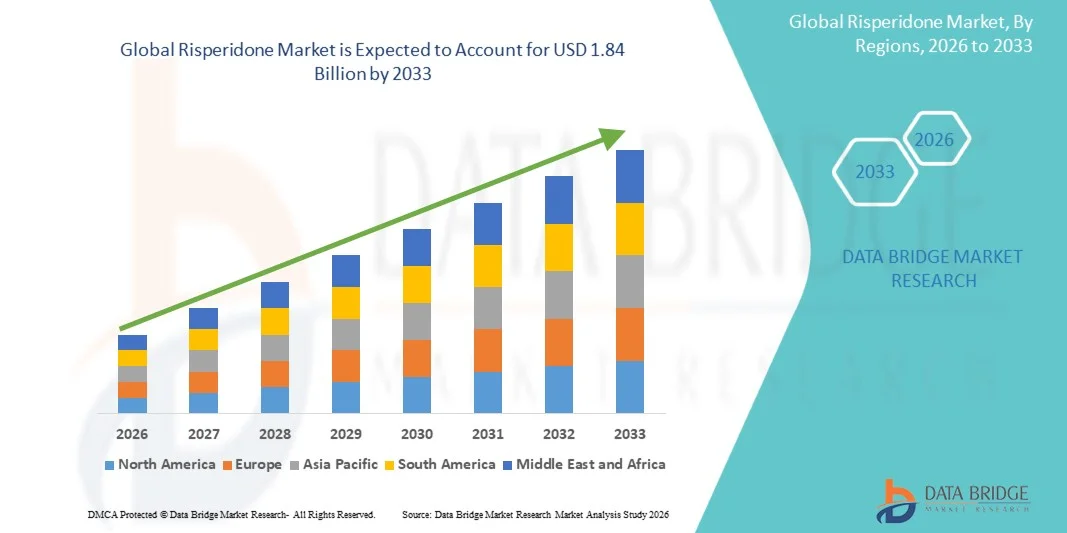
- As per Data Bridge Market Research analysis, the risperidone market was valued at USD 1.28 billion in 2025 and is projected to reach USD 1.84 billion by 2033, growing at a CAGR of 4.6% from 2026 to 2033.
- The market is experiencing steady growth driven by the rising global prevalence of schizophrenia, bipolar disorder, and autism spectrum disorder, growing acceptance of risperidone as a well-tolerated atypical antipsychotic, and expanding adoption of long-acting injectable formulations that improve medication adherence.
- The broadening use of risperidone across pediatric autism-associated irritability, geriatric behavioral disturbances, and treatment-resistant mood disorders, combined with continued patent expiry across major markets, is compelling generic manufacturers to scale production of tablets, oral solutions, and orally disintegrating formulations. Rising clinical confidence in risperidone's favorable efficacy-to-tolerability balance relative to older first-generation antipsychotics continues to support its position as a preferred second-generation therapy across both developed and emerging healthcare systems.
- Continued expansion of long-acting injectable risperidone microsphere formulations is reshaping treatment paradigms for patients with poor oral medication adherence, reducing relapse rates and hospital readmissions while offering healthcare systems a cost-effective pathway to manage chronic psychiatric caseloads over extended dosing intervals.
- Continued global patent expiry of branded risperidone formulations has opened the market to widespread generic competition, driving down treatment costs and expanding patient access across public healthcare systems in both developed and emerging economies.
Market Size & Forecast
- Global Market Value (2025): USD 1.28 Billion
- Expected Market Value (2033): USD 1.84 Billion
- Forecast CAGR (2026–2033): 4.6%
- Leading Region in 2025: North America
- Fastest Growing Region: Asia-Pacific
What are the Major Takeaways of the Risperidone Market?
- North America dominated the global risperidone market with the largest revenue share of 37.85% in 2025, supported by high diagnosis rates of schizophrenia and bipolar disorder and widespread adoption of long-acting injectable therapies.
- Asia-Pacific is expected to be the fastest-growing region at a CAGR of 6.3% from 2026 to 2033, fueled by rising mental health awareness, expanding psychiatric care infrastructure, and increasing generic manufacturing capacity in India and China.
- The tablets segment led the market with a 46.72% share in 2025, driven by ease of administration, patient familiarity, and broad availability across hospital and retail pharmacies.
- The long-acting injectable segment is the fastest-growing formulation type, projected to register a CAGR of 6.8%, reflecting rising clinical preference for extended-release formulations that improve treatment adherence among chronic schizophrenia patients.
- The schizophrenia application segment dominated the application category with a 48.16% revenue share in 2025, led by risperidone's established role as a first-line atypical antipsychotic therapy.
- The generic product type accounted for 71.38% of the market share in 2025, preferred for its cost-effectiveness and broad accessibility following patent expiry in major markets.
- The autism-associated irritability application segment is the fastest-growing indication category, with a CAGR of 6.9%, driven by rising pediatric diagnosis rates and regulatory approvals supporting risperidone use in autism spectrum disorder management.
Report Scope and Risperidone Market Segmentation
|
Attributes |
Risperidone Key Market Insights |
|
Segments Covered |
|
|
Countries Covered |
North America
Europe
Asia-Pacific
Middle East and Africa
South America
|
|
Key Market Players |
|
|
Market Opportunities |
|
|
Value Added Data Infosets |
In addition to the insights on market scenarios such as market value, growth rate, segmentation, geographical coverage, and major players, the market reports curated by the Data Bridge Market Research also include in-depth expert analysis, patient epidemiology, pipeline analysis, pricing analysis, and regulatory framework. |
What is the Key Trend in the Risperidone Market?
- Pharmaceutical manufacturers are increasingly investing in long-acting injectable risperidone microsphere and in-situ depot technologies to improve treatment adherence and reduce relapse rates among patients with chronic schizophrenia and bipolar disorder.
- For instance, in April 2025, Luye Pharma Group expanded distribution of its long-acting injectable risperidone microsphere formulation across additional Asian and European markets, strengthening treatment options for patients requiring extended-interval dosing.
- Rising adoption of risperidone for pediatric autism-associated irritability is enabling clinicians to address behavioral symptoms earlier, supported by growing regulatory approvals and clinical guideline updates recommending its use in younger patient populations.
- Generic manufacturers are expanding their risperidone portfolios across tablets, orally disintegrating tablets, and oral solutions to improve affordability and broaden access for patients across both developed and price-sensitive markets.
- For instance, in January 2025, Teva Pharmaceutical Industries introduced an expanded generic risperidone orally disintegrating tablet line, addressing swallowing difficulties among geriatric and pediatric patient populations.
- As healthcare systems continue to prioritize adherence-focused psychiatric care, the adoption of risperidone, particularly in its long-acting injectable form, is expected to accelerate, reinforcing its role as a preferred second-generation antipsychotic across global markets.
What are the Key Drivers of the Risperidone Market?
- The rising global prevalence of schizophrenia, bipolar disorder, and autism spectrum disorder has significantly increased demand for well-tolerated, clinically established atypical antipsychotic therapies capable of managing both acute and chronic symptoms.
- For instance, in March 2025, Sun Pharmaceutical Industries expanded its generic risperidone manufacturing capacity to meet rising demand for tablets and oral solutions across North America and Asia-Pacific.
- Hospitals, specialty clinics, and public healthcare systems are increasingly incorporating risperidone into first-line treatment protocols due to its favorable balance of efficacy and tolerability relative to older first-generation antipsychotics.
- For instance, in October 2024, Alkermes announced continued clinical and manufacturing investment in its long-acting injectable antipsychotic portfolio, supporting expanded access to extended-release risperidone-based therapies.
- With healthcare systems increasingly prioritizing adherence and relapse prevention in psychiatric care, risperidone will remain indispensable for the treatment of schizophrenia, bipolar disorder, and autism-associated irritability across both developed and emerging markets.
- For instance, in June 2024, Zydus Lifesciences received regulatory approval for an additional generic risperidone tablet strength, expanding its product portfolio to serve broader patient dosing requirements.
Which Factors are Challenging the Growth of the Risperidone Market?
- Risperidone therapy is associated with side effects including weight gain, metabolic changes, and hyperprolactinemia, which can limit long-term treatment compliance and prompt clinicians to consider alternative atypical antipsychotics for certain patient populations.
- These tolerability concerns limit adoption among prescribers managing patients with pre-existing metabolic risk factors and constrain long-term treatment persistence in some patient groups.
- For instance, in September 2024, a regional psychiatric association in Europe highlighted growing clinician caution regarding metabolic monitoring requirements for risperidone and other atypical antipsychotics, influencing prescribing patterns among younger patients.
- The availability of newer atypical antipsychotics with improved metabolic safety profiles continues to restrict growth, particularly in developed markets with broader treatment options and insurance coverage. This preference shift slows market penetration in price-insensitive regions, limiting the expansion of risperidone despite its established efficacy and cost advantages.
- Additionally, intensifying generic price competition following patent expiry is compressing manufacturer margins across major markets, which can discourage continued investment in newer delivery-technology development for this now largely off-patent molecule.
How is the Risperidone Market Segmented?
The risperidone market is segmented on the basis of type, dosage strength, application, route of administration, product type, end user, distribution channel, packaging type, patient age group and sales channel.
- By Type
On the basis of type, the global risperidone market is segmented into tablets, oral solution, orally disintegrating tablets, and long-acting injectable. The tablets segment dominated the market with a 46.72% share in 2025, owing to ease of administration, broad patient familiarity, and widespread availability across hospital and retail pharmacies. These formulations deliver consistent, flexible dosing, making them the preferred choice for both initial titration and long-term outpatient management of psychiatric disorders.
The long-acting injectable segment is projected to register the fastest growth at a CAGR of 6.8% from 2026 to 2033, driven by rising clinical preference for extended-release microsphere and depot formulations that reduce dosing frequency and improve adherence among patients with a history of treatment discontinuation. Advances in sustained-release delivery technology, combined with growing physician confidence in relapse-prevention outcomes, are accelerating segment expansion. The orally disintegrating tablet format also continues to gain traction among pediatric and geriatric patients who have difficulty swallowing conventional tablets, offering a convenient middle ground between oral and injectable delivery.
- By Dosage Strength
On the basis of dosage strength, the global risperidone market is segmented into 0.5 mg, 1 mg, 2 mg, 3 mg, 4 mg, and others. The 2 mg segment led the market with a 27.94% share in 2025, supported by its widespread prescription as a standard maintenance dose for adult schizophrenia and bipolar disorder patients.
The 0.5 mg segment is expected to experience the fastest growth at a CAGR of 6.2% from 2026 to 2033, driven by increasing use of low-strength formulations for pediatric autism-associated irritability and geriatric patients requiring conservative dose titration.
- By Application
On the basis of application, the global risperidone market is segmented into schizophrenia, bipolar disorder, autism-associated irritability, and other psychiatric disorders. The schizophrenia segment dominated the market with a share of 48.16% in 2025 due to its widespread adoption as a first-line atypical antipsychotic therapy, increasing diagnosis rates, and growing integration with long-term psychiatric care protocols. Additionally, rising focus on relapse prevention and adherence-focused treatment further supports the strong adoption of risperidone-based therapy.
The autism-associated irritability segment is anticipated to witness the fastest CAGR of 6.9% from 2026 to 2033, driven by the increasing pediatric diagnosis of autism spectrum disorder and growing regulatory support for early behavioral symptom management. Clinicians are adopting risperidone as a guideline-recommended option for irritability, aggression, and self-injurious behavior. Additionally, the integration of risperidone into structured pediatric treatment protocols is enhancing the accuracy and consistency of autism-related symptom management, further driving segment growth.
- By Route of Administration
On the basis of route of administration, the global risperidone market is segmented into oral and intramuscular. The oral segment dominated the market with a share of 71.53% in 2025 due to its critical role in long-term outpatient management of psychiatric disorders, ease of self-administration, and broad availability across pharmacies. The widespread adoption of tablet, oral-solution, and orally disintegrating formulations for chronic symptom control is driving strong demand for oral therapy.
The intramuscular segment is expected to witness the fastest CAGR of 6.7% from 2026 to 2033, driven by the rising adoption of long-acting injectable formulations for extended-interval dosing in chronic schizophrenia management. Hospitals and outpatient psychiatric clinics are increasingly integrating intramuscular administration into structured adherence programs. Additionally, the growing emphasis on relapse prevention in community mental health settings is further accelerating adoption of this route of administration.
- By Product Type
On the basis of product type, the global risperidone market is segmented into branded and generic. The generic segment dominated the market with a share of 71.38% in 2025 due to its critical role in providing affordable, accessible antipsychotic therapy following widespread patent expiry across major markets. High adoption is driven by the increasing need for cost-effective treatment options, expanded manufacturer availability, and growing institutional procurement of generic formulations. Additionally, growing investment by generic drug makers, government procurement agencies, and public health programs to improve affordability and access is reinforcing the leading position of this segment in the market.
The generic segment is expected to witness the fastest CAGR of 5.4% from 2026 to 2033. This growth is driven by increasing demand for low-cost psychiatric therapies that expand treatment access across public healthcare systems. Growing manufacturing capacity among generic drug producers, along with regulatory support for essential medicines, is improving affordability and supply consistency. Additionally, the adoption of generics in public healthcare procurement programs is further accelerating market expansion.
- By End User
On the basis of end user, the global risperidone market is segmented into hospitals, specialty clinics, homecare settings, and long-term care facilities. The hospitals segment dominated the market with a share of 42.17% in 2025 due to its widespread use in acute psychiatric care, treatment initiation, and inpatient management of schizophrenia and bipolar disorder. Rising adoption of oral and injectable formulations, integrated pharmacy supply chains, and structured psychiatric care protocols is enabling hospitals to enhance treatment consistency, improve patient outcomes, and optimize resource utilization. Additionally, increasing investment by public health systems, hospital networks, and psychiatric care institutions is accelerating adoption and reinforcing this segment's leading position in the market.
The homecare settings segment is expected to witness the fastest CAGR of 6.4% from 2026 to 2033, driven by the increasing adoption of outpatient and home-based psychiatric care models that reduce treatment costs and improve patient quality of life for long-term antipsychotic therapy. These care models enhance medication adherence, reduce hospitalization burden, and allow personalized treatment monitoring, making risperidone therapy more accessible, sustainable, and valuable for chronic disease management.
- By Distribution Channel
On the basis of distribution channel, the global risperidone market is segmented into hospital pharmacies, retail pharmacies, and online pharmacies. The hospital pharmacies segment dominated the market with a share of 44.29% in 2025 due to its widespread adoption in inpatient psychiatric care and treatment initiation, which requires immediate, controlled access to antipsychotic medications. High adoption is supported by public health systems, psychiatric hospitals, and healthcare networks that rely on integrated hospital pharmacy operations to ensure consistency, safety, and measurable treatment outcomes. Additionally, increasing integration with electronic prescribing and inventory-management systems enhances dispensing accuracy and reinforces the dominance of the hospital pharmacies segment.
The online pharmacies segment is expected to witness the fastest CAGR of 6.9% from 2026 to 2033. This growth is primarily driven by the increasing demand for convenient, accessible, and cost-effective medication delivery solutions for chronic psychiatric therapy patients. By offering home delivery and refill-management services, this channel enhances medication adherence, patient convenience, and treatment continuity, making it highly attractive for long-term antipsychotic therapy management and homecare patient populations.
- By Packaging Type
On the basis of packaging type, the global risperidone market is segmented into blister packs, bottles, and pre-filled syringes & vials. The blister packs segment dominated the market with a share of 43.61% in 2025 due to its critical role in ensuring dosage accuracy, product stability, and tamper-evident packaging for oral tablet formulations. Additionally, established partnerships with contract packaging providers, pharmacy distributors, and generic drug manufacturers are expanding reach, improving accessibility, and reinforcing the adoption of blister-packaged risperidone across global markets.
The pre-filled syringes & vials segment is expected to witness the fastest CAGR of 6.8% from 2026 to 2033. This growth is primarily driven by the increasing demand for ready-to-use, sterile long-acting injectable formulations used in hospital and outpatient psychiatric care settings. Manufacturers and healthcare providers are leveraging advanced sterile-fill and pre-filled delivery systems to enhance dosage accuracy, enable safer administration, and support adherence-focused treatment protocols, thereby accelerating adoption across hospital and institutional care applications.
- By Patient Age Group
On the basis of patient age group, the global risperidone market is segmented into adults, geriatric, and pediatric & adolescent. The adults segment dominated the market with a share of 61.84% in 2025 due to its preference among the largest patient population diagnosed with schizophrenia and bipolar disorder requiring long-term antipsychotic management. Additionally, established treatment protocols, broad prescriber familiarity, and extensive clinical usage history are facilitating continued adoption of risperidone among adult patients, while strong healthcare provider networks are improving accessibility, reliability, and trust, further reinforcing this segment's leading market position.
The pediatric & adolescent segment is expected to witness the fastest CAGR of 6.9% from 2026 to 2033, driven by the increasing diagnosis of autism spectrum disorder and growing regulatory support for risperidone use in managing irritability and aggression in younger patients. Healthcare providers offer carefully monitored, weight-based dosing regimens for pediatric patients, while providing enhanced monitoring, dose-titration guidance, and seamless integration with developmental care management, enhancing overall treatment safety and effectiveness.
- By Sales Channel
On the basis of sales channel, the global risperidone market is segmented into prescription-based and institutional procurement. The prescription-based segment dominated the market with a share of 78.92% in 2025 due to its critical role in ensuring appropriate clinical oversight, dosage control, and monitoring for antipsychotic therapy across hospitals, clinics, and retail pharmacies. The widespread presence of regulatory frameworks governing psychiatric medication dispensing facilitates controlled access, localized prescriber support, and timely treatment adjustment. Additionally, collaborations with healthcare providers, pharmacy networks, and regulatory agencies are enhancing product accessibility, reliability, and trust, further reinforcing the leading position of the prescription-based segment in the global market.
The institutional procurement segment is expected to witness the fastest CAGR of 6.1% from 2026 to 2033, driven by growing bulk purchasing of risperidone formulations by public hospital networks, psychiatric care institutions, and government essential-medicine programs. As healthcare systems increasingly centralize procurement to manage costs and ensure supply continuity, institutional channels are becoming an increasingly important route for risperidone distribution, particularly across public healthcare systems in emerging markets.
Which Region Holds the Largest Share of the Risperidone Market?
- North America dominated the risperidone market and accounted for the largest revenue share of 37.85% in 2025, supported by high diagnosis rates of psychiatric disorders, well-established generic and branded drug distribution networks, and the presence of established pharmaceutical manufacturing and healthcare infrastructure.
- The region also benefits from broad insurance coverage for psychiatric medications, high adoption of long-acting injectable therapies, and growing use of risperidone across acute-care, autism-related, and long-term psychiatric treatment applications. Increasing focus on adherence-improving delivery technologies and expanding homecare treatment models continues to strengthen North America's leadership position in the global market.
U.S. Risperidone Market Insight
The U.S. risperidone market benefits from an established treatment base, widespread generic availability, and continuing demand for antipsychotic therapies. Risperidone is used primarily in the management of schizophrenia and bipolar disorder, supporting a stable prescription market. As an off-patent medicine, competition among generic manufacturers places pressure on pricing while improving affordability and access. Market opportunities are increasingly linked to treatment adherence, long-term disease management, and availability of different formulations. Future growth is expected to remain moderate, influenced by prescribing patterns, healthcare policies, and competition from alternative antipsychotics.
Canada Risperidone Market Insight
Canada risperidone market is supported by established demand for antipsychotic treatment, particularly for schizophrenia and bipolar disorder. Health Canada lists multiple marketed generic risperidone products from manufacturers including Apotex, JAMP Pharma, Sandoz, Teva, Mint, and others, indicating a competitive market environment. Recent approvals of additional risperidone products also indicate continued generic market activity. Growing focus on mental-health treatment and cost-effective generic medicines is expected to support market stability, while pricing competition may limit revenue growth.
Asia-Pacific Risperidone Market Insight
The Asia-Pacific risperidone market is supported by increasing awareness and treatment of schizophrenia, bipolar disorder, and other psychiatric conditions. Growing healthcare expenditure, improving access to mental-health services, and expanding pharmaceutical distribution networks are supporting demand across emerging economies. Generic availability and cost-sensitive healthcare systems are encouraging broader adoption, particularly in developing countries. Japan, China, India, South Korea, and Australia represent important markets, while improving diagnosis rates and government initiatives addressing mental-health needs are expected to create further opportunities for risperidone manufacturers and suppliers.
China Risperidone Market Insight
China risperidone market is expanding steadily, supported by rising diagnosis and treatment rates for schizophrenia and related psychiatric conditions, growing domestic generic drug manufacturing, and increasing investments in mental healthcare infrastructure. Hospitals and public health institutions are increasingly utilizing risperidone, including long-acting injectable formulations manufactured by domestic players, for both acute and long-term psychiatric care. Continuous expansion of hospital pharmacy networks, government essential-medicine procurement programs, and rising healthcare access in rural regions are further driving market growth in China.
Japan Risperidone Market Insight
Japan risperidone market is witnessing consistent growth due to rising investments in psychiatric care infrastructure, increasing awareness of mental health conditions, and continued clinical reliance on established atypical antipsychotic therapies for specific patient populations. Hospitals, geriatric care facilities, and research institutes are increasingly adopting risperidone for both schizophrenia management and behavioral symptom control in elderly patients. Moreover, the country's aging population and focus on adherence-friendly treatment options are further contributing to market growth.
Which are the Top Companies in Risperidone Market?
The risperidone industry is primarily led by well-established companies, including:
- Janssen Pharmaceuticals, Inc. (Johnson & Johnson) (U.S.)
- Teva Pharmaceutical Industries Ltd. (Israel)
- Viatris Inc. (U.S.)
- Sun Pharmaceutical Industries Ltd. (India)
- Cipla Ltd. (India)
- Dr. Reddy's Laboratories Ltd. (India)
- Aurobindo Pharma Limited (India)
- Lupin Limited (India)
- Zydus Lifesciences Ltd. (India)
- Alkem Laboratories Ltd. (India)
- Torrent Pharmaceuticals Ltd. (India)
- Intas Pharmaceuticals Ltd. (India)
- Macleods Pharmaceuticals Ltd. (India)
- Ajanta Pharma Ltd. (India)
- Ipca Laboratories Ltd. (India)
- Alembic Pharmaceuticals Ltd. (India)
- Wockhardt Ltd. (India)
- Hikma Pharmaceuticals PLC (U.K.)
- Amneal Pharmaceuticals, Inc. (U.S.)
- Sandoz International GmbH (Germany)
- Zentiva Group, a.s. (Czech Republic)
- Accord Healthcare Limited (U.K.)
- Glenmark Pharmaceuticals Ltd. (India)
- Actavis (a Teva company) (U.S.)
- Rosemont Pharmaceuticals Ltd. (U.K.)
- Panacea Biotec Ltd. (India)
- Micro Labs Limited (India)
- Cadila Pharmaceuticals Ltd. (India)
- Alkermes plc (U.S.)
- Luye Pharma Group Ltd. (China)
- MedinCell S.A. (France)
What are Latest Developments in Risperidone Market?
- In September 2025, Sun Pharmaceutical Industries expanded its generic risperidone manufacturing facility in India to increase production capacity for tablets and orally disintegrating tablets, strengthening its ability to serve growing demand across emerging markets.
- In February 2025, Cipla launched an affordability-focused essential-medicines initiative that included expanded distribution of risperidone formulations across public healthcare centers in South Asia and Sub-Saharan Africa.
- In November 2025, Luye Pharma Group received regulatory approval in an additional Asian market for its long-acting injectable risperidone microsphere formulation, improving treatment-adherence options for hospital and outpatient psychiatric care providers. This development strengthens Luye Pharma's position in the antipsychotic long-acting injectable market by expanding geographic access to extended-release therapy.
- In October 2024, Alkermes expanded its manufacturing capacity for long-acting injectable antipsychotic formulations in North America, improving supply continuity for hospital and community mental health providers.
- In June 2023, Teva Pharmaceutical Industries partnered with a regional distributor network to expand availability of risperidone tablets and oral solutions across underserved markets, combining its generic manufacturing scale with the partner's regional pharmacy distribution capabilities to support broader patient access.
- In March 2023, MedinCell announced continued clinical development progress on its long-acting injectable risperidone formulation utilizing in-situ depot delivery technology, aimed at offering extended dosing intervals with a simplified administration profile for chronic schizophrenia management.

- Interactive Data Analysis Dashboard
- Company Analysis Dashboard for high growth potential opportunities
- Research Analyst Access for customization & queries
- Competitor Analysis with Interactive dashboard
- Latest News, Updates & Trend analysis
- Harness the Power of Benchmark Analysis for Comprehensive Competitor Tracking
Data collection and base year analysis are done using data collection modules with large sample sizes. The stage includes obtaining market information or related data through various sources and strategies. It includes examining and planning all the data acquired from the past in advance. It likewise envelops the examination of information inconsistencies seen across different information sources. The market data is analysed and estimated using market statistical and coherent models. Also, market share analysis and key trend analysis are the major success factors in the market report. To know more, please request an analyst call or drop down your inquiry.
The key research methodology used by DBMR research team is data triangulation which involves data mining, analysis of the impact of data variables on the market and primary (industry expert) validation. Data models include Vendor Positioning Grid, Market Time Line Analysis, Market Overview and Guide, Company Positioning Grid, Patent Analysis, Pricing Analysis, Company Market Share Analysis, Standards of Measurement, Global versus Regional and Vendor Share Analysis. To know more about the research methodology, drop in an inquiry to speak to our industry experts.
Data Bridge Market Research is a leader in advanced formative research. We take pride in servicing our existing and new customers with data and analysis that match and suits their goal. The report can be customized to include price trend analysis of target brands understanding the market for additional countries (ask for the list of countries), clinical trial results data, literature review, refurbished market and product base analysis. Market analysis of target competitors can be analyzed from technology-based analysis to market portfolio strategies. We can add as many competitors that you require data about in the format and data style you are looking for. Our team of analysts can also provide you data in crude raw excel files pivot tables (Fact book) or can assist you in creating presentations from the data sets available in the report.












