


RNA Editing (ADAR-Based) Therapeutics Market Size
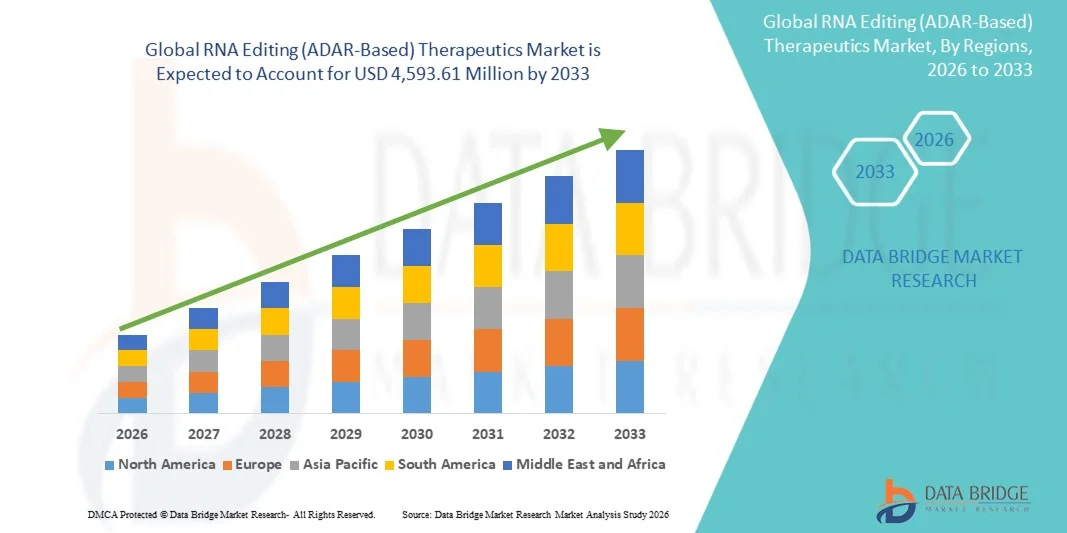
- The global RNA editing (ADAR-based) therapeutics market size was valued at USD 936.00 million in 2025 and is expected to reach USD 4,593.61 million by 2033, at a CAGR of 22.00% during the forecast period
- The market growth is largely fueled by the increasing advancements in RNA editing technologies and the growing focus on precision medicine, leading to expanded research and clinical development activities across genetic and rare diseases
- Furthermore, rising demand for safer and reversible gene-editing alternatives, along with increasing investments by biotechnology and pharmaceutical companies, is establishing ADAR-based RNA editing as a promising next-generation therapeutic approach. These converging factors are accelerating the adoption of RNA editing solutions, thereby significantly boosting the industry's growth
RNA Editing (ADAR-Based) Therapeutics Market Analysis
- RNA editing (ADAR-based) therapeutics, enabling precise and reversible modification of RNA transcripts without altering the underlying DNA, are emerging as transformative tools in modern medicine due to their potential to treat genetic, neurological, and rare diseases with improved safety and specificity
- The escalating demand for RNA editing therapeutics is primarily fueled by rapid advancements in gene-editing technologies, increasing focus on precision medicine, and growing investments in research and clinical pipelines targeting previously untreatable genetic disorders
- North America dominated the RNA editing (ADAR-based) therapeutics market with the largest revenue share of 42.3% in 2025, characterized by strong biotechnology infrastructure, high R&D spending, and the presence of leading industry players, with the U.S. witnessing significant growth in clinical trials and partnerships driven by innovation in RNA-based drug development
- Asia-Pacific is expected to be the fastest growing region in the RNA editing (ADAR-based) therapeutics market during the forecast period due to expanding biotechnology sectors, increasing healthcare investments, and growing support for genomic research initiatives
- Genetic disorders segment dominated the RNA editing (ADAR-based) therapeutics market with a market share of 45.7% in 2025, driven by the increasing focus on correcting disease-causing mutations at the RNA level and the strong pipeline of therapies targeting rare and inherited conditions
Report Scope and RNA Editing (ADAR-Based) Therapeutics Market Segmentation
|
Attributes |
RNA Editing (ADAR-Based) Therapeutics Key Market Insights |
|
Segments Covered |
|
|
Countries Covered |
North America
Europe
Asia-Pacific
Middle East and Africa
South America
|
|
Key Market Players |
|
|
Market Opportunities |
|
|
Value Added Data Infosets |
In addition to the insights on market scenarios such as market value, growth rate, segmentation, geographical coverage, and major players, the market reports curated by the Data Bridge Market Research also include in-depth expert analysis, patient epidemiology, pipeline analysis, pricing analysis, and regulatory framework |
RNA Editing (ADAR-Based) Therapeutics Market Trends
“Advancement in Precision Medicine Through Programmable RNA Editing”
- A significant and accelerating trend in the global RNA editing (ADAR-based) therapeutics market is the growing advancement in precision medicine and programmable RNA editing platforms, enabling highly targeted and reversible correction of disease-causing mutations across a wide range of therapeutic areas
- For instance, companies such as ProQR Therapeutics and Wave Life Sciences are developing ADAR-mediated RNA editing therapies designed to selectively modify RNA transcripts, allowing precise intervention without permanently altering the genome
- Integration of advanced delivery technologies in RNA editing enables improved targeting efficiency and therapeutic outcomes, supporting features such as tissue-specific editing and enhanced stability of RNA molecules during treatment, particularly in liver and central nervous system disorders
- The seamless incorporation of RNA editing platforms with next-generation drug development pipelines facilitates broader applications across genetic, neurological, and rare diseases, allowing researchers to design therapies that can be rapidly adapted to different mutation
- This trend towards more precise, flexible, and safer gene modulation technologies is fundamentally reshaping therapeutic development strategies. Consequently, companies such as Beam Therapeutics are advancing RNA editing approaches with improved specificity and minimized off-target effects for clinical applications
- The demand for RNA editing therapeutics that offer high precision and reversibility is growing rapidly across biotechnology and pharmaceutical sectors, as stakeholders increasingly prioritize safer alternatives to permanent gene-editing technologies
- Growing interest in expanding RNA editing applications beyond rare diseases into more prevalent conditions such as oncology and neurological disorders is further strengthening long-term market potential
RNA Editing (ADAR-Based) Therapeutics Market Dynamics
Driver
“Increasing Demand Driven by Precision Medicine and Genetic Disorder Therapies”
- The increasing demand for targeted and personalized treatment options, coupled with the rapid evolution of precision medicine, is a significant driver for the heightened adoption of RNA editing (ADAR-based) therapeutics
- For instance, in March 2025, Wave Life Sciences announced progress in its RNA editing clinical programs focusing on genetic disorders, highlighting the growing industry emphasis on RNA-based therapeutic innovation
- As healthcare systems increasingly focus on treating the root cause of diseases at the molecular level, RNA editing offers the ability to correct mutations at the transcript level, providing a compelling alternative to traditional gene therapy approaches
- Furthermore, the rising prevalence of rare genetic disorders and the need for safer, reversible treatment options are accelerating the adoption of RNA editing technologies in clinical research and drug development pipelines
- The flexibility of RNA editing platforms, combined with advancements in delivery systems and expanding biotechnology investments, are key factors propelling the adoption of these therapies across multiple disease indications and research settings
- Increasing regulatory support for advanced therapies and orphan drug designations is encouraging faster development and approval pathways for RNA editing therapeutics across key markets
- Rising venture capital funding and strategic investments in RNA-based biotechnology startups are further strengthening research capabilities and accelerating innovation in this field
Restraint/Challenge
“Delivery Complexity and Regulatory Uncertainty Hurdle”
- Challenges related to the efficient and targeted delivery of RNA editing therapeutics, along with evolving regulatory frameworks, pose significant barriers to widespread market adoption. As these therapies rely on precise cellular targeting, limitations in delivery technologies can impact therapeutic effectiveness
- For instance, complexities associated with delivering RNA editing molecules to specific tissues such as the brain have slowed the progress of certain clinical programs, highlighting the need for more advanced and reliable delivery platforms
- Addressing these delivery challenges through innovations in lipid nanoparticles, viral vectors, and conjugate systems is crucial for improving treatment efficacy and patient outcomes in RNA editing therapies
- In addition, the high cost of development and stringent regulatory approval processes for advanced genetic therapies can act as barriers for smaller biotechnology firms and delay market entry of new treatments
- While ongoing advancements are improving feasibility, the need for robust clinical validation, regulatory clarity, and scalable manufacturing processes remains critical for broader commercialization and long-term market growth
- Limited long-term clinical data on safety and durability of RNA editing effects may create hesitation among healthcare providers and regulators regarding widespread therapeutic adoption
- Ethical considerations and evolving guidelines surrounding genetic and RNA-based interventions may further complicate regulatory approvals and public acceptance in certain regions
RNA Editing (ADAR-Based) Therapeutics Market Scope
The market is segmented on the basis of technology, delivery method, application, and end user.
- By Technology
On the basis of technology, the RNA editing (ADAR-based) therapeutics market is segmented into ADAR-mediated RNA Editing, CRISPR-based RNA Editing, Oligonucleotide-based RNA Editing, Enzyme-engineered RNA Editing, and Others. The ADAR-mediated RNA editing segment dominated the market with the largest market revenue share in 2025, driven by its ability to enable precise, site-specific, and reversible RNA modifications without permanently altering the genome. This approach leverages endogenous ADAR enzymes, reducing the risk of off-target effects and improving safety profiles compared to DNA-editing technologies. The increasing number of clinical-stage programs targeting genetic and rare diseases further supports its dominance. In addition, its compatibility with existing delivery platforms such as lipid nanoparticles enhances its translational potential. The growing preference for transient editing solutions in precision medicine also contributes to the widespread adoption of ADAR-mediated technologies.
The CRISPR-based RNA editing segment is anticipated to witness the fastest growth rate from 2026 to 2033, fueled by ongoing advancements in RNA-targeting CRISPR systems such as Cas13. These technologies offer high programmability and scalability, enabling researchers to target a wide range of RNA transcripts with improved efficiency. Increasing research investments and expanding applications in oncology and infectious diseases are further accelerating growth. CRISPR-based approaches also provide flexibility in multiplex editing, allowing simultaneous targeting of multiple RNA sites. The rising number of collaborations between biotechnology firms and academic institutions is expected to drive innovation in this segment.
- By Delivery Method
On the basis of delivery method, the market is segmented into lipid nanoparticles, viral vectors, galnac conjugates, electroporation, and others. The lipid nanoparticles (LNPs) segment dominated the market with the largest revenue share in 2025, driven by their proven effectiveness in delivering RNA-based therapeutics with high efficiency and safety. LNPs enable targeted delivery to specific tissues, particularly the liver, and protect RNA molecules from degradation. Their successful use in mRNA vaccines has accelerated confidence and adoption in RNA editing applications. In addition, LNPs offer scalability in manufacturing and compatibility with various RNA modalities. Continuous improvements in formulation technologies further enhance their therapeutic potential.
The GalNAc conjugates segment is expected to witness the fastest growth rate during the forecast period, driven by their ability to achieve highly targeted delivery to hepatocytes through receptor-mediated uptake. This specificity reduces systemic exposure and enhances therapeutic efficacy, particularly in liver-related genetic disorders. Increasing focus on liver-targeted RNA editing therapies is boosting demand for GalNAc-based delivery systems. Their favorable safety profile and ease of administration compared to viral vectors contribute to their rapid adoption. Ongoing advancements in conjugation chemistry are further expanding their applicability.
- By Application
On the basis of application, the market is segmented into genetic disorders, oncology, neurological disorders, infectious diseases, and others. The genetic disorders segment dominated the market with the largest revenue share of 45.7% in 2025, driven by the strong pipeline of RNA editing therapies targeting rare and inherited diseases. ADAR-based editing is particularly suitable for correcting point mutations at the RNA level, offering a safer alternative to permanent gene editing. Increasing prevalence of rare genetic conditions and growing demand for precision medicine are key factors supporting this dominance. In addition, favorable regulatory pathways for orphan drugs are encouraging development in this segment. The potential to address previously untreatable conditions further enhances its market leadership.
The neurological disorders segment is anticipated to witness the fastest growth rate from 2026 to 2033, fueled by the rising need for effective treatments for complex central nervous system diseases. RNA editing offers the advantage of reversible intervention, which is particularly important in sensitive tissues such as the brain. Advancements in delivery technologies capable of crossing the blood-brain barrier are supporting growth in this segment. Increasing research focus on diseases such as ALS and Huntington’s disease is further driving development. Collaborations between biotech firms and research institutes are accelerating innovation in neurological applications.
- By End User
On the basis of end user, the market is segmented into biotechnology companies, pharmaceutical companies, academic & research institutes, and contract research organizations. The biotechnology companies segment dominated the market with the largest revenue share in 2025, driven by their leading role in innovation and early-stage development of RNA editing technologies. These companies are actively engaged in developing proprietary platforms and advancing clinical pipelines. Strong venture capital funding and strategic partnerships further support their dominance. Their agility in adopting new technologies allows rapid progress in therapeutic development. In addition, biotech firms are at the forefront of translating research into clinical applications.
The pharmaceutical companies segment is expected to witness the fastest growth rate during the forecast period, fueled by increasing investments in RNA-based therapeutics and strategic collaborations with biotech firms. Large pharmaceutical companies are leveraging their resources and global reach to accelerate clinical trials and commercialization. Growing interest in expanding pipelines with next-generation therapies is driving their entry into RNA editing. Partnerships and licensing agreements are enabling access to advanced technologies. Their involvement is expected to significantly enhance market scalability and global adoption.
RNA Editing (ADAR-Based) Therapeutics Market Regional Analysis
- North America dominated the RNA editing (ADAR-based) therapeutics market with the largest revenue share of 42.3% in 2025, characterized by strong biotechnology infrastructure, high R&D spending, and the presence of leading industry players
- Researchers and healthcare stakeholders in the region highly value the precision, reversibility, and safety advantages offered by RNA editing technologies compared to traditional gene-editing approaches
- This widespread adoption is further supported by strong R&D infrastructure, presence of leading biotechnology and pharmaceutical companies, and growing clinical trial activities, establishing RNA editing therapeutics as a promising solution for treating genetic and rare diseases
U.S. RNA Editing (ADAR-Based) Therapeutics Market Insight
The U.S. RNA editing (ADAR-based) therapeutics market captured the largest revenue share of 80% in 2025 within North America, fueled by the rapid advancement of biotechnology innovation and increasing focus on precision medicine. Researchers and healthcare stakeholders are increasingly prioritizing the development of targeted RNA-based therapies for genetic and rare diseases. The growing presence of leading biotechnology firms and strong clinical trial activity further propel the industry. Moreover, increasing collaborations between biotech companies and research institutions, along with supportive regulatory frameworks, are significantly contributing to the market's expansion.
Europe RNA Editing (ADAR-Based) Therapeutics Market Insight
The Europe RNA editing (ADAR-based) therapeutics market is projected to expand at a substantial CAGR throughout the forecast period, primarily driven by strong regulatory support for advanced therapies and increasing investment in genomic research. The rise in chronic and rare diseases, coupled with demand for innovative treatment approaches, is fostering the adoption of RNA editing technologies. European stakeholders are also drawn to the safety and reversibility offered by RNA-based therapies. The region is experiencing notable growth across clinical research and early-stage therapeutic development, with RNA editing being incorporated into precision medicine initiatives and collaborative research programs.
U.K. RNA Editing (ADAR-Based) Therapeutics Market Insight
The U.K. RNA editing (ADAR-based) therapeutics market is anticipated to grow at a noteworthy CAGR during the forecast period, driven by increasing investment in life sciences and a focus on next-generation genetic therapies. In addition, rising interest in personalized medicine and advanced treatment solutions is encouraging both research institutions and biotech firms to adopt RNA editing approaches. The U.K.’s strong academic ecosystem, alongside its robust funding environment, is expected to continue to stimulate market growth.
Germany RNA Editing (ADAR-Based) Therapeutics Market Insight
The Germany RNA editing (ADAR-based) therapeutics market is expected to expand at a considerable CAGR during the forecast period, fueled by increasing emphasis on biomedical innovation and the demand for advanced therapeutic solutions. Germany’s well-established research infrastructure, combined with its focus on technological advancement, promotes the adoption of RNA editing therapies, particularly in clinical and translational research settings. The integration of RNA-based approaches into precision medicine frameworks is also becoming increasingly prevalent, with a strong preference for safe and effective therapeutic options aligning with regulatory standards.
Asia-Pacific RNA Editing (ADAR-Based) Therapeutics Market Insight
The Asia-Pacific RNA editing (ADAR-based) therapeutics market is poised to grow at the fastest CAGR of 23.5% during the forecast period of 2026 to 2033, driven by increasing healthcare investments, expanding biotechnology sectors, and rising focus on genomic research in countries such as China, Japan, and India. The region's growing inclination towards advanced therapeutics, supported by government initiatives promoting biotechnology innovation, is driving the adoption of RNA editing technologies. Furthermore, as APAC emerges as a key hub for clinical research and biopharmaceutical manufacturing, the accessibility and development of RNA editing therapies are expanding across the region.
Japan RNA Editing (ADAR-Based) Therapeutics Market Insight
The Japan RNA editing (ADAR-based) therapeutics market is gaining momentum due to the country’s advanced healthcare infrastructure, rapid technological progress, and demand for innovative treatment solutions. The Japanese market places a significant emphasis on precision medicine, and the adoption of RNA editing is driven by the increasing focus on genetic and neurological diseases. The integration of RNA editing with advanced research platforms is fueling growth. Moreover, Japan's aging population is likely to spur demand for effective and targeted therapeutic solutions in both clinical and research applications.
India RNA Editing (ADAR-Based) Therapeutics Market Insight
The India RNA editing (ADAR-based) therapeutics market accounted for the largest market revenue share in Asia Pacific in 2025, attributed to the country's expanding biotechnology ecosystem, increasing research initiatives, and growing focus on advanced therapeutics. India stands as an emerging market for genomic and RNA-based research, and RNA editing technologies are gaining traction across academic and clinical settings. The push towards biotechnology innovation and increasing government support, alongside the presence of skilled research talent, are key factors propelling the market in India.
RNA Editing (ADAR-Based) Therapeutics Market Share
The RNA Editing (ADAR-Based) Therapeutics industry is primarily led by well-established companies, including:
- ProQR Therapeutics N.V. (Netherlands)
- Wave Life Sciences Ltd. (Singapore)
- Beam Therapeutics Inc. (U.S.)
- Editas Medicine, Inc. (U.S.)
- Shape Therapeutics Inc. (U.S.)
- Locanabio, Inc. (U.S.)
- ADARx Pharmaceuticals, Inc. (U.S.)
- Korro Bio, Inc. (U.S.)
- Eterna Therapeutics Inc. (U.S.)
- Stoke Therapeutics, Inc. (U.S.)
- Scribe Therapeutics Inc. (U.S.)
- Strand Therapeutics, Inc. (U.S.)
- Inscripta, Inc. (U.S.)
- Intellia Therapeutics, Inc. (U.S.)
- Arcturus Therapeutics Holdings Inc. (U.S.)
- Silence Therapeutics plc (U.K.)
- Alnylam Pharmaceuticals, Inc. (U.S.)
- Regeneron Pharmaceuticals, Inc. (U.S.)
- Moderna, Inc. (U.S.)
- Korro Bio, Inc. (U.S.)
What are the Recent Developments in Global RNA Editing (ADAR-Based) Therapeutics Market?
- In April 2026, ProQR Therapeutics announced an update to its RNA editing pipeline, highlighting progress in its Axiomer™ ADAR-based platform and advancing programs targeting diseases such as biliary atresia and metabolic disorders. The company also revealed collaboration efforts with Ginkgo Bioworks to enhance AI-driven discovery and screening capabilities, reinforcing the role of ADAR-mediated RNA editing in developing next-generation therapeutics
- In September 2025, Wave Life Sciences reported updated clinical findings from its RNA editing therapy trial for alpha-1 antitrypsin deficiency, demonstrating that the therapy successfully edited RNA and produced functional protein, although efficacy levels varied. This development highlights continued clinical validation and challenges in optimizing ADAR-based RNA editing therapies
- In January 2025, researchers highlighted that ADAR-mediated RNA editing is emerging as a powerful therapeutic tool for correcting disease-causing mutations at the RNA level without altering DNA, supporting its growing role in personalized medicine and advancing its clinical development across multiple disease areas
- In October 2024, Wave Life Sciences announced early clinical results showing successful RNA editing in human patients with genetic disease, marking one of the first demonstrations of therapeutic RNA editing in humans. The treatment enabled patients to produce previously deficient proteins, representing a major milestone for ADAR-based therapeutic approaches
- In June 2021, Wave Life Sciences announced the first proof-of-concept in vivo preclinical data for its ADAR-mediated RNA editing program targeting alpha-1 antitrypsin deficiency. The study showed restoration of functional protein levels, validating the therapeutic potential of endogenous ADAR enzyme-based editing strategies

- Interactive Data Analysis Dashboard
- Company Analysis Dashboard for high growth potential opportunities
- Research Analyst Access for customization & queries
- Competitor Analysis with Interactive dashboard
- Latest News, Updates & Trend analysis
- Harness the Power of Benchmark Analysis for Comprehensive Competitor Tracking
Data collection and base year analysis are done using data collection modules with large sample sizes. The stage includes obtaining market information or related data through various sources and strategies. It includes examining and planning all the data acquired from the past in advance. It likewise envelops the examination of information inconsistencies seen across different information sources. The market data is analysed and estimated using market statistical and coherent models. Also, market share analysis and key trend analysis are the major success factors in the market report. To know more, please request an analyst call or drop down your inquiry.
The key research methodology used by DBMR research team is data triangulation which involves data mining, analysis of the impact of data variables on the market and primary (industry expert) validation. Data models include Vendor Positioning Grid, Market Time Line Analysis, Market Overview and Guide, Company Positioning Grid, Patent Analysis, Pricing Analysis, Company Market Share Analysis, Standards of Measurement, Global versus Regional and Vendor Share Analysis. To know more about the research methodology, drop in an inquiry to speak to our industry experts.
Data Bridge Market Research is a leader in advanced formative research. We take pride in servicing our existing and new customers with data and analysis that match and suits their goal. The report can be customized to include price trend analysis of target brands understanding the market for additional countries (ask for the list of countries), clinical trial results data, literature review, refurbished market and product base analysis. Market analysis of target competitors can be analyzed from technology-based analysis to market portfolio strategies. We can add as many competitors that you require data about in the format and data style you are looking for. Our team of analysts can also provide you data in crude raw excel files pivot tables (Fact book) or can assist you in creating presentations from the data sets available in the report.












