


Robotic Aseptic Filling Lines Market Overview
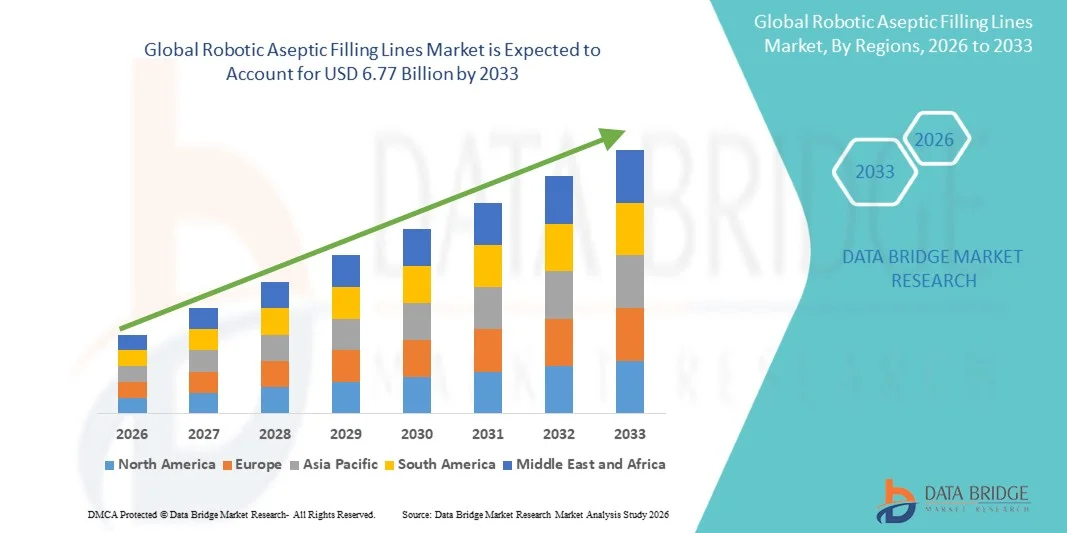
The Robotic Aseptic Filling Lines Market was valued at USD 1.93 billion in 2025 and is projected to reach USD 6.77 billion by 2033, growing at a CAGR of 17.00% from 2026 to 2033. The market is experiencing consistent growth driven by rising demand for automated sterile drug manufacturing solutions, increasing adoption of robotic technologies in pharmaceutical production, and expanding applications across biologics, vaccines, injectable drugs, and advanced therapies.
The growing need to minimize contamination risks, improve filling accuracy, and enhance operational efficiency is compelling pharmaceutical companies, biotechnology firms, and contract manufacturing organizations (CMOs) to adopt robotic aseptic filling lines. Advanced robotic filling systems are replacing conventional manual and semi-automated processes in many manufacturing facilities, offering higher precision, reduced human intervention, improved sterility assurance, and scalable production capabilities for high-value pharmaceutical products.
Key Market Trends & Insights
- North America dominated the Robotic Aseptic Filling Lines Market with the largest revenue share of 36.8% in 2025, supported by the strong presence of pharmaceutical and biotechnology companies, advanced aseptic manufacturing infrastructure, and increasing adoption of robotic automation to improve sterility assurance, production efficiency, and regulatory compliance. Growing investments in biologics, vaccines, and injectable drug manufacturing facilities across the United States and Canada are accelerating demand for robotic filling technologies.
- The fully automated robotic filling systems segment dominated the market with a 5% share in 2025, owing to increasing demand for high-speed sterile drug manufacturing, improved contamination control, reduced human intervention, and enhanced production consistency.
- Asia-Pacific is expected to be the fastest-growing region at a CAGR of 10.2% from 2026 to 2033, fueled by expanding pharmaceutical manufacturing capacity, rising biologics production, increasing outsourcing to CMOs, and growing investments in advanced aseptic processing facilities across China, India, Japan, and South Korea. Government initiatives supporting domestic drug manufacturing and healthcare infrastructure development are further strengthening regional adoption.
- The semi-automated robotic filling systems segment is expected to witness significant growth with a CAGR of 8.7% from 2026 to 2033, driven by increasing adoption among mid-sized pharmaceutical manufacturers and research institutions seeking improved filling accuracy, flexibility, and lower capital investment compared with fully automated solutions. These systems provide a balance between automation benefits and operational control, supporting applications in clinical manufacturing and smaller batch production.
- Pharmaceutical companies dominated the end-user segment with a 42.6% revenue share in 2025, supported by large-scale investments in sterile injectable manufacturing, vaccine production, and biologics development. Leading pharmaceutical manufacturers are increasingly integrating robotic aseptic filling lines to enhance production capacity, reduce contamination risks, and improve compliance with global regulatory requirements.
Market Size & Forecast
- Global Market Value (2025): USD 1.93 Billion
- Expected Market Value (2033): USD 6.77 Billion
- Forecast CAGR (2026–2033): 17.00%
- Leading Region in 2025: North America
- Fastest Growing Region: Asia-Pacific
Report Scope and Robotic Aseptic Filling Lines Market Segmentation
|
Attributes |
Robotic Aseptic Filling Lines Key Market Insights |
|
Segments Covered |
|
|
Countries Covered |
North America · U.S. · Canada · Mexico Europe · Germany · France · U.K. · Netherlands · Switzerland · Belgium · Russia · Italy · Spain · Turkey · Rest of Europe Asia-Pacific · China · Japan · India · South Korea · Singapore · Malaysia · Australia · Thailand · Indonesia · Philippines · Rest of Asia-Pacific Middle East and Africa · Saudi Arabia · U.A.E. · South Africa · Egypt · Israel · Rest of Middle East and Africa South America · Brazil · Argentina · Rest of South America |
|
Key Market Players |
• Syntegon Technology (Germany) |
|
Market Opportunities |
· Expansion of Biologics, Vaccines, and Advanced Therapy Manufacturing · Growing Adoption of Automation and Industry 4.0 Technologies · Rising Demand for Flexible and Small-Batch Manufacturing Solutions |
|
Value Added Data Infosets |
In addition to the insights on market scenarios such as market value, growth rate, segmentation, geographical coverage, and major players, the market reports curated by the Data Bridge Market Research also include in-depth expert analysis, geographically represented company-wise production and capacity, network layouts of distributors and partners, detailed and updated price trend analysis and deficit analysis of supply chain and demand. |
Robotic Aseptic Filling Lines Market Trends
Trend: Increasing Adoption of Robotic Automation in Aseptic Pharmaceutical Manufacturing
The Robotic Aseptic Filling Lines Market is witnessing strong growth due to increasing demand for sterile injectable drugs, biologics, vaccines, and advanced therapies that require highly controlled manufacturing environments. Pharmaceutical and biotechnology companies are increasingly adopting robotic filling systems to minimize human intervention, reduce contamination risks, improve filling accuracy, and enhance production efficiency. The growing shift toward Industry 4.0-based pharmaceutical manufacturing is accelerating the integration of robotics, AI-enabled monitoring, and automated quality control systems in aseptic processing. For instance, the rapid expansion of biologics and vaccine manufacturing capacity after the COVID-19 pandemic has encouraged pharmaceutical companies and contract manufacturers to invest in advanced robotic aseptic filling technologies to support high-volume sterile production while maintaining strict regulatory compliance. Increasing adoption of single-use technologies, flexible filling platforms, and automated inspection systems is further strengthening demand for robotic aseptic filling lines globally.
Robotic Aseptic Filling Lines Market Dynamics
Key Market Driver: Rising Demand for Biologics, Injectable Drugs, and Sterile Manufacturing Automation
The primary driver of the Robotic Aseptic Filling Lines Market is the increasing production of biologics, vaccines, cell and gene therapies, and other complex injectable pharmaceutical products that require advanced aseptic manufacturing solutions. Pharmaceutical manufacturers and contract manufacturing organizations (CMOs) are investing heavily in robotic filling technologies to improve sterility assurance, increase throughput, and meet stringent regulatory requirements from agencies such as the U.S. FDA and European Medicines Agency. For example, the expansion of biologics manufacturing facilities in North America, Europe, and Asia-Pacific has increased demand for automated aseptic filling systems capable of handling sensitive drug formulations with minimal contamination risk. Companies such as Syntegon Technology, Bausch+Ströbel, and IMA Group are developing advanced robotic filling solutions that integrate automation, robotics, and digital monitoring to improve manufacturing reliability. In addition, the growing adoption of personalized medicines and small-batch sterile production is encouraging pharmaceutical companies to implement flexible robotic filling platforms.
Key Restraint/Challenge: High Capital Investment and Complex Integration Requirements of Robotic Aseptic Filling Systems
A major challenge in the Robotic Aseptic Filling Lines Market is the high initial investment required for advanced robotic aseptic manufacturing systems. These platforms involve significant costs related to robotic equipment, cleanroom integration, validation processes, automation software, and maintenance requirements. Small and mid-sized pharmaceutical manufacturers often face difficulties adopting these systems due to high procurement costs and the need for specialized technical expertise. In addition, integrating robotic filling lines with existing pharmaceutical manufacturing infrastructure requires extensive validation, regulatory approvals, and operational adjustments. The increasing complexity of maintaining compliance with Good Manufacturing Practices (GMP) standards and ensuring consistent system performance further adds operational challenges. These factors can limit adoption among smaller organizations and emerging pharmaceutical markets despite growing demand for sterile drug production.
Key Market Opportunity: Integration of Robotics, AI, and Digital Manufacturing Technologies in Aseptic Filling Operations
The integration of robotics, artificial intelligence, and smart manufacturing technologies presents significant growth opportunities for the Robotic Aseptic Filling Lines market. Advanced robotic systems equipped with AI-based monitoring, predictive maintenance, and real-time quality analytics are enabling pharmaceutical manufacturers to optimize production efficiency and reduce operational risks. Companies are increasingly developing intelligent aseptic filling platforms capable of automated handling, precise dosing, environmental monitoring, and data-driven process control. For instance, pharmaceutical manufacturing facilities adopting digital transformation initiatives are integrating robotic filling lines with Manufacturing Execution Systems (MES) and automated inspection technologies to improve traceability and compliance. Furthermore, increasing investments in biologics, cell and gene therapies, and vaccine production facilities across emerging markets such as India, China, and Southeast Asia are creating new opportunities for robotic aseptic filling technology providers. The growing demand for flexible, scalable, and contamination-free manufacturing solutions is expected to support long-term market expansion.
Robotic Aseptic Filling Lines Market Scope
The Robotic Aseptic Filling Lines market is segmented on the basis of filling technology and end user.
By Filling Technology
On the basis of filling technology, the Robotic Aseptic Filling Lines Market is segmented into fully automated robotic filling systems and semi-automated robotic filling systems. The fully automated robotic filling systems segment dominated the market with a 68.5% share in 2025, owing to increasing demand for high-speed sterile drug manufacturing, improved contamination control, reduced human intervention, and enhanced production consistency. These systems are widely adopted by pharmaceutical companies, biotechnology manufacturers, and contract manufacturing organizations (CMOs) for large-scale production of injectable drugs, vaccines, biologics, and advanced therapies. Growing regulatory emphasis on aseptic processing standards, including compliance with GMP requirements, is encouraging manufacturers to replace conventional manual operations with automated robotic solutions. In addition, fully automated systems enable precise filling, automated handling, real-time monitoring, and integration with inspection technologies, improving operational efficiency and reducing batch failures. The expansion of biologics and sterile injectable pipelines globally is further strengthening adoption of fully automated robotic filling platforms.
The semi-automated robotic filling systems segment is expected to witness the fastest growth at a CAGR of 8.7% from 2026 to 2033, driven by increasing adoption among small and mid-sized pharmaceutical manufacturers, research laboratories, and organizations requiring flexible sterile production capabilities. These systems provide a balance between automation benefits and lower capital investment compared with fully automated solutions, making them suitable for clinical trials, small-batch manufacturing, and specialty drug production. Rising demand for personalized medicines, cell and gene therapies, and emerging biologics is increasing the need for adaptable filling technologies. In addition, semi-automated systems allow easier process customization, faster deployment, and efficient handling of varying production volumes, supporting their growing adoption across developing pharmaceutical markets.
By End User
On the basis of end user, the Robotic Aseptic Filling Lines Market is segmented into pharmaceutical companies, biotechnology companies, contract manufacturing organizations (CMOs), and Research & Academic Institutions. The Pharmaceutical Companies segment dominated the market with a 42.6% share in 2025, supported by increasing investments in sterile injectable manufacturing, vaccine production, and biologics development. Pharmaceutical companies are increasingly adopting robotic aseptic filling lines to improve production efficiency, reduce contamination risks, and maintain compliance with stringent regulatory standards. The growing demand for injectable therapies, chronic disease treatments, and complex drug formulations is driving investment in advanced aseptic manufacturing infrastructure. In addition, leading pharmaceutical manufacturers are integrating robotic systems with automated inspection, digital monitoring, and manufacturing execution systems (MES) to improve traceability and operational control.
The contract manufacturing organizations (CMOs) segment is projected to register the fastest growth with a CAGR of 11.1% from 2026 to 2033, driven by rising outsourcing of sterile drug manufacturing and increasing demand for flexible production capacity from pharmaceutical and biotechnology companies. CMOs are expanding their capabilities by investing in robotic aseptic filling technologies to support biologics, vaccines, cell and gene therapies, and specialty injectable products. The increasing complexity of pharmaceutical manufacturing and the need for scalable production solutions are encouraging drug developers to rely on specialized contract manufacturers. In addition, the expansion of pharmaceutical outsourcing in regions such as Asia-Pacific, particularly China and India, is accelerating demand for advanced robotic filling infrastructure.
Robotic Aseptic Filling Lines Market Regional Analysis
North America dominated the Robotic Aseptic Filling Lines Market and accounted for the largest revenue share of 36.8% in 2025, supported by the strong presence of pharmaceutical and biotechnology companies, advanced sterile manufacturing infrastructure, and increasing adoption of robotic automation technologies across fill-finish operations. The region benefits from rising demand for contamination-free production of biologics, vaccines, injectable drugs, and advanced therapies, which is driving investments in automated aseptic filling solutions. The presence of leading pharmaceutical manufacturers, contract manufacturing organizations (CMOs), and technology providers is accelerating the deployment of robotic filling systems to improve production accuracy, reduce human intervention, and enhance regulatory compliance. Furthermore, stringent quality standards imposed by regulatory authorities, including the U.S. FDA, are encouraging manufacturers to adopt advanced robotic systems that provide higher sterility assurance, process consistency, and operational efficiency. Increasing investments in modern pharmaceutical facilities, expansion of biologics manufacturing capacity, and growing adoption of flexible manufacturing platforms are further strengthening North America’s leadership in the Robotic Aseptic Filling Lines Market.
U.S. Robotic Aseptic Filling Lines Market Insight
The U.S. robotic aseptic filling lines market is witnessing strong growth due to increasing investments in pharmaceutical manufacturing automation, biologics production, and advanced sterile drug manufacturing facilities. The country’s strong pharmaceutical ecosystem, presence of major biotechnology companies, and growing demand for vaccines, monoclonal antibodies, and cell & gene therapies are driving adoption of robotic aseptic filling technologies. Pharmaceutical manufacturers are increasingly integrating robotic systems into fill-finish operations to improve throughput, minimize contamination risks, and support high-value drug production. In addition, the expansion of contract manufacturing organizations (CMOs) and increasing focus on flexible, small-batch production are creating strong demand for automated filling solutions. Growing emphasis on regulatory compliance, process validation, and manufacturing efficiency is further accelerating adoption of robotic aseptic filling lines across the U.S. pharmaceutical industry.
Europe Robotic Aseptic Filling Lines Market Insight
The Europe robotic aseptic filling lines market remains a significant contributor to global revenue, driven by strong pharmaceutical manufacturing capabilities, advanced healthcare infrastructure, and increasing adoption of automation in sterile production processes. The region’s growing biologics and biosimilar manufacturing sector is supporting demand for robotic filling systems that enhance sterility control and operational efficiency. European pharmaceutical companies are increasingly investing in automated fill-finish technologies to meet stringent regulatory requirements and improve production scalability. The presence of established pharmaceutical hubs, advanced research facilities, and strong focus on quality-driven manufacturing is supporting market expansion across countries such as Germany, Switzerland, France, and the U.K. In addition, increasing adoption of modular manufacturing facilities and advanced robotic technologies is further strengthening the growth of robotic aseptic filling solutions throughout Europe.
U.K. Robotic Aseptic Filling Lines Market Insight
The U.K. robotic aseptic filling lines market is experiencing steady growth, supported by increasing investments in pharmaceutical automation, biologics manufacturing, and advanced drug production infrastructure. The country’s strong life sciences ecosystem and growing focus on innovative therapies are driving demand for robotic systems that enable precise, sterile, and efficient filling operations. Pharmaceutical companies and research organizations are increasingly adopting automated aseptic technologies to support vaccine manufacturing, injectable drug production, and personalized medicine applications. Furthermore, rising demand for flexible manufacturing solutions, improved contamination control, and reduced manual intervention is encouraging adoption of robotic filling platforms. Government support for life sciences innovation and increasing investment in advanced pharmaceutical manufacturing facilities are positioning the U.K. as an important market for robotic aseptic filling technologies.
Germany Robotic Aseptic Filling Lines Market Insight
The Germany robotic aseptic filling lines market is expanding steadily due to the country’s strong pharmaceutical manufacturing base, advanced engineering capabilities, and increasing adoption of automation technologies. Pharmaceutical companies and contract manufacturers are investing in robotic aseptic filling systems to improve production efficiency, maintain high sterility standards, and support increasing demand for biologics and injectable medicines. Germany’s strong focus on Industry 4.0, smart manufacturing, and digitalized pharmaceutical production is accelerating integration of robotics, artificial intelligence, and real-time monitoring systems into fill-finish operations. In addition, the presence of leading pharmaceutical equipment manufacturers and technology providers is supporting innovation in automated aseptic processing. Growing demand for high-quality drug manufacturing and regulatory compliance is further driving market growth in Germany.
Asia-Pacific Robotic Aseptic Filling Lines Market Insight
The Asia-Pacific robotic aseptic filling lines market is expected to witness rapid growth, expanding at a CAGR of 10.2% from 2026 to 2033, driven by expanding pharmaceutical manufacturing capacity, rising biologics production, increasing outsourcing to CMOs, and growing investments in advanced aseptic processing facilities. Countries such as China, India, Japan, and South Korea are witnessing increased adoption of robotic filling technologies due to rising healthcare demand, pharmaceutical industry expansion, and government initiatives supporting domestic drug manufacturing. The region is benefiting from growing production of vaccines, injectable drugs, biosimilars, and advanced therapies, creating strong demand for automated fill-finish solutions. Increasing modernization of pharmaceutical facilities, rising adoption of Industry 4.0 technologies, and growing focus on improving manufacturing quality and efficiency are further supporting market expansion across Asia-Pacific.
Japan Robotic Aseptic Filling Lines Market Insight
The Japan robotic aseptic filling lines market is witnessing consistent growth due to increasing investments in advanced pharmaceutical manufacturing technologies, automation, and high-quality sterile production systems. Japanese pharmaceutical companies are adopting robotic aseptic filling lines to improve manufacturing precision, reduce contamination risks, and enhance production efficiency for biologics and injectable medicines. The country’s advanced robotics capabilities, strong healthcare infrastructure, and focus on technological innovation are supporting adoption of automated fill-finish systems. Additionally, increasing demand for personalized medicine, regenerative therapies, and advanced biologics is encouraging pharmaceutical manufacturers to implement flexible robotic manufacturing platforms. The growing focus on smart pharmaceutical factories and process optimization is further contributing to market growth in Japan.
China Robotic Aseptic Filling Lines Market Insight
The China Robotic Aseptic Filling Lines market is growing rapidly, driven by expanding pharmaceutical production capacity, increasing biologics manufacturing, and rising investments in advanced aseptic processing technologies. The country is witnessing strong demand for robotic filling systems due to growing vaccine production, injectable drug manufacturing, and increasing adoption of automated pharmaceutical facilities. Government initiatives supporting domestic pharmaceutical innovation, healthcare infrastructure development, and modernization of manufacturing capabilities are accelerating adoption of robotic technologies. In addition, the growth of contract manufacturing organizations (CMOs), increasing foreign investment in pharmaceutical facilities, and rising focus on improving drug quality and production efficiency are strengthening market expansion. China’s growing role as a global pharmaceutical manufacturing hub is positioning it as one of the fastest-growing markets for robotic aseptic filling lines worldwide.
Robotic Aseptic Filling Lines Market Share
The Robotic Aseptic Filling Lines industry is primarily led by well-established companies, including:
• Syntegon Technology (Germany)
• Bausch+Ströbel (Germany)
• IMA Group (Italy)
• OPTIMA packaging group (Germany)
• Vanrx Pharmasystems (Canada)
• Watson-Marlow Fluid Technology Solutions (United Kingdom)
• SP Scientific (U.S.)
• Romaco Group (Germany)
• Groninger (Germany)
• Marchesini Group (Italy)
• Syntegon Filling Technology (Germany)
• IMA Life (Italy)
• Fedegari Autoclavi (Italy)
• Dara Pharmaceutical Packaging (Spain)
• MG2 (Italy)
• Tofflon Science and Technology (China)
• Shibuya Corporation (Japan)
• Nipro Corporation (Japan)
• Gerresheimer (Germany)
• Stevanato Group (Italy)
• IMA Automation (Italy)
• Körber Pharma (Germany)
• SKAN (Switzerland)
• Getinge (Sweden)
• ACIC Pharmaceuticals (India)
• Aseptic Technologies (Belgium)
• Marchesini Group Pharma (Italy)
• NNE (Denmark)
• Grifols (Spain)
• Bharat Bijlee (India)
• Azzur Group (U.S.)
• Mettler-Toledo International (Switzerland)
• Rockwell Automation (U.S.)
• Siemens (Germany)
Latest Developments in Robotic Aseptic Filling Lines Market
- In July 2022, Amaran Biotechnology Inc., a subsidiary of OBI Pharma, announced the completion of its fully automated aseptic filling line and manufacturing facility in Taiwan. The new facility incorporated advanced robotic aseptic filling technology to minimize human intervention, reduce contamination risks, and enhance the safety and quality of high-value biopharmaceutical production. The project strengthened Amaran Biotech’s CDMO capabilities by enabling compliant cGMP manufacturing of advanced pharmaceutical products and supporting the growing demand for automated sterile fill-finish solutions
- In March 2024, Cytiva and White Raven announced the installation of Cytiva’s SA25 Aseptic Filling Workcell at White Raven’s manufacturing facility in Belgium. The robotic aseptic filling system was designed to improve sterile drug production efficiency by reducing operator intervention through an integrated gloveless robotic isolator platform. The system supports flexible filling of vials, syringes, and cartridges, helping CDMOs and pharmaceutical manufacturers improve contamination control, manufacturing flexibility, and GMP readiness for advanced therapies
- In March 2024, Steriline announced advancements in its robotic aseptic filling technologies and showcased its robotic vial filling solutions at INTERPHEX 2024. The company introduced advanced robotic filling platforms utilizing flexible automation and innovative transport technologies to improve precision, reduce mechanical complexity, and support sterile filling operations for vials, syringes, and cartridges. These developments highlight the growing industry shift toward highly flexible robotic systems for pharmaceutical and biotechnology manufacturing applications
- In June 2024, Dalton Pharma Services announced an investment in a fully automated robotic aseptic powder fill-finish line developed by 3P innovation. The new high-speed aseptic filling system was designed to enhance pharmaceutical manufacturing capacity by integrating automated filling, stoppering, capping, and crimping operations within a controlled sterile environment. The investment supports Dalton’s strategy to expand advanced fill-finish capabilities while improving efficiency, compliance, and scalability for pharmaceutical customers
- In September 2024, Steriline announced the launch of its RVFCM11-S robotic vial filling and capping machine for pharmaceutical and advanced therapy applications. The robotic system was designed specifically for cell and gene therapy manufacturing, supporting multiple vial formats and flexible sterile filling operations. The platform incorporated software-based tracking capabilities to improve process monitoring and handling of temperature-sensitive pharmaceutical products, strengthening the adoption of robotic automation in high-value drug manufacturing
- In April 2024, Kindeva Drug Delivery installed Syntegon’s Versynta microBatch filling system at its U.S. facility, marking the first North American installation of the automated aseptic production cell. The robotic fill-finish solution was developed to support small-batch sterile manufacturing with improved flexibility, faster changeovers, and enhanced regulatory compliance. The deployment reflects increasing demand among CDMOs and pharmaceutical manufacturers for compact robotic aseptic filling platforms supporting personalized medicines and complex injectable therapies
- In March 2024, ten23 health announced progress toward GMP operation of its VIVA2 aseptic filling line in Switzerland. The advanced facility included large-scale aseptic filling capabilities for pre-filled syringes, vials, and cartridges, supporting commercial and clinical sterile pharmaceutical manufacturing. The project represented continued investment in next-generation aseptic fill-finish infrastructure to meet rising demand for biologics, injectable medicines, and outsourced pharmaceutical manufacturing services
- In May 2025, Syntegon introduced its SynTiso aseptic filling line designed to address increasing demand for flexible, contamination-controlled pharmaceutical manufacturing. The new platform focused on improving operational efficiency, minimizing operator intervention, and supporting Annex 1 compliance requirements through advanced automation and in-process control technologies. The development reflects the growing adoption of robotic and automated filling systems for vials, syringes, and cartridges across modern pharmaceutical production environments

- Interactive Data Analysis Dashboard
- Company Analysis Dashboard for high growth potential opportunities
- Research Analyst Access for customization & queries
- Competitor Analysis with Interactive dashboard
- Latest News, Updates & Trend analysis
- Harness the Power of Benchmark Analysis for Comprehensive Competitor Tracking
Data collection and base year analysis are done using data collection modules with large sample sizes. The stage includes obtaining market information or related data through various sources and strategies. It includes examining and planning all the data acquired from the past in advance. It likewise envelops the examination of information inconsistencies seen across different information sources. The market data is analysed and estimated using market statistical and coherent models. Also, market share analysis and key trend analysis are the major success factors in the market report. To know more, please request an analyst call or drop down your inquiry.
The key research methodology used by DBMR research team is data triangulation which involves data mining, analysis of the impact of data variables on the market and primary (industry expert) validation. Data models include Vendor Positioning Grid, Market Time Line Analysis, Market Overview and Guide, Company Positioning Grid, Patent Analysis, Pricing Analysis, Company Market Share Analysis, Standards of Measurement, Global versus Regional and Vendor Share Analysis. To know more about the research methodology, drop in an inquiry to speak to our industry experts.
Data Bridge Market Research is a leader in advanced formative research. We take pride in servicing our existing and new customers with data and analysis that match and suits their goal. The report can be customized to include price trend analysis of target brands understanding the market for additional countries (ask for the list of countries), clinical trial results data, literature review, refurbished market and product base analysis. Market analysis of target competitors can be analyzed from technology-based analysis to market portfolio strategies. We can add as many competitors that you require data about in the format and data style you are looking for. Our team of analysts can also provide you data in crude raw excel files pivot tables (Fact book) or can assist you in creating presentations from the data sets available in the report.













