


Robotic Masectomy Market Overview
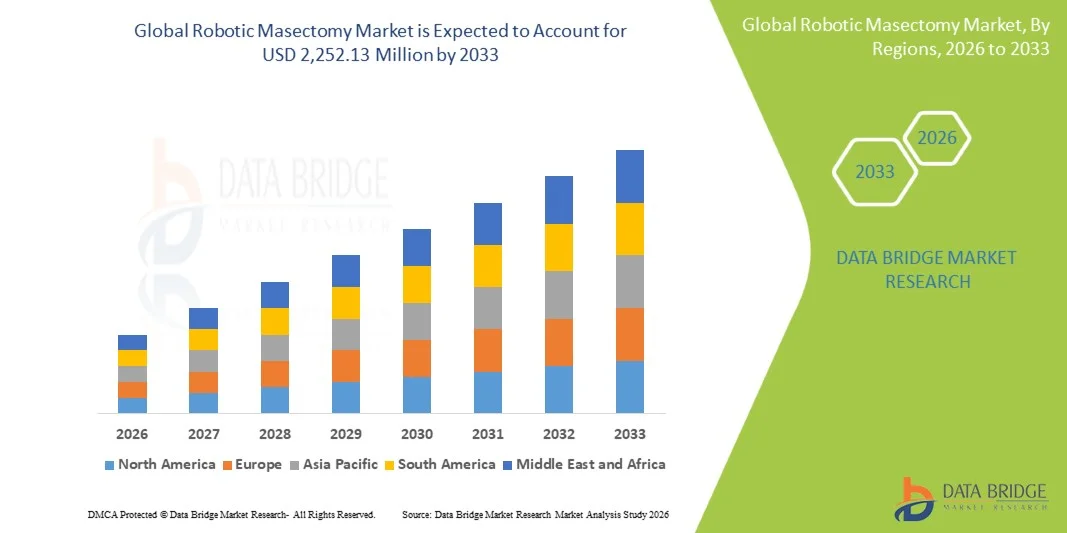
The Robotic Masectomy Market was valued at USD 963.29 million in 2025 and is projected to reach USD 2,252.13 million by 2033, growing at a CAGR of 11.20% from 2026 to 2033. The market is witnessing steady growth driven by the increasing prevalence of breast cancer, rising demand for minimally invasive surgical procedures, and continuous advancements in robotic-assisted surgical technologies.
The growing focus on improved cosmetic outcomes, reduced postoperative complications, and faster patient recovery is encouraging hospitals and cancer care centers to adopt robotic-assisted mastectomy procedures. In addition, increasing investments in healthcare infrastructure, expanding adoption of precision surgical systems, and rising awareness regarding early breast cancer treatment are accelerating market expansion. Robotic-assisted platforms are increasingly being utilized for nipple-sparing mastectomy and reconstructive breast surgeries, offering enhanced surgical precision, improved visualization, and minimally invasive treatment approaches.
Key Market Trends & Insights
- North America dominated the global robotic mastectomy market with the largest revenue share of 38.46% in 2025, supported by the strong presence of advanced healthcare infrastructure, high adoption of robotic-assisted surgical systems, and increasing breast cancer surgeries across the U.S. and Canada.
- The Multi-port Robotic System segment led the market with a 44.18% share in 2025, driven by its extensive clinical adoption, superior surgical flexibility, and high precision during complex breast cancer procedures.
- Asia-Pacific is expected to be the fastest-growing region at a CAGR of 8.1% from 2026 to 2033, fueled by rising healthcare expenditure, growing awareness regarding early breast cancer treatment, and increasing installation of robotic surgical platforms in China, India, and Japan.
- Single-port Robotic System are the fastest-growing type, projected to register a CAGR of 8.3%, reflecting the surge in demand for less invasive surgical approaches and improved cosmetic outcomes.
- The Robotic Systems segment dominated the component category with a 57.83% revenue share in 2025, led by rising installation of robotic-assisted surgical platforms across hospitals and specialized cancer treatment centers.
- Breast Cancer Treatment Surgery accounted for 48.64% of the market, preferred by the increasing global prevalence of breast cancer and rising adoption of robotic-assisted oncology procedures.
- The Instruments & Accessories segment is the fastest-growing component category, with a CAGR of 8.1%, driven by increasing number of robotic-assisted mastectomy procedures performed worldwide.
Market Size & Forecast
- Global Market Value (2025): USD 963.29 Million
- Expected Market Value (2033): USD 2,252.13 Million
- Forecast CAGR (2026–2033): 11.20%
- Leading Region in 2025: North America
- Fastest Growing Region: Asia Pacific
Report Scope and Robotic Masectomy Market Segmentation
|
Attributes |
Robotic Masectomy Key Market Insights |
|
Segments Covered |
|
|
Countries Covered |
North America · U.S. · Canada · Mexico Europe · Germany · France · U.K. · Netherlands · Switzerland · Belgium · Russia · Italy · Spain · Turkey · Rest of Europe Asia-Pacific · China · Japan · India · South Korea · Singapore · Malaysia · Australia · Thailand · Indonesia · Philippines · Rest of Asia-Pacific Middle East and Africa · Saudi Arabia · U.A.E. · South Africa · Egypt · Israel · Rest of Middle East and Africa South America · Brazil · Argentina · Rest of South America |
|
Key Market Players |
· Intuitive Surgical, Inc. (U.S.) · Medtronic (Ireland) · Stryker (U.S.) · Johnson & Johnson Services, Inc. (U.S.) · CMR Surgical Ltd (U.K.) · Asensus Surgical US, Inc. (U.S.) · Zimmer Biomet (U.S.) · Moon Surgical (France) · Vicarious Surgical Inc. (U.S.) · Virtual Incision Corporation (U.S.) · Distalmotion SA (Switzerland) · Meerecompany Inc. (South Korea) · Ronovo Surgical Corp. (China) · Medicaroid Corporation (Japan) · SS Innovations International, Inc. (U.S.) · avateramedical GmbH (Germany) · THINK Surgical, Inc. (U.S.) · Titan Medical Inc. (Canada) · MicroPort Scientific Corporation (China) · Siemens Healthineers AG (Germany) |
|
Market Opportunities |
· Expanding adoption of robotic nipple-sparing mastectomy procedures · Increasing integration of AI-based surgical navigation and real-time imaging technologies · Rising investments in robotic surgical infrastructure across emerging healthcare |
|
Value Added Data Infosets |
In addition to the insights on market scenarios such as market value, growth rate, segmentation, geographical coverage, and major players, the market reports curated by the Data Bridge Market Research also include in-depth expert analysis, patient epidemiology, pipeline analysis, pricing analysis, and regulatory framework. |
Robotic Masectomy Market Trends
Trend: Rising Adoption of Minimally Invasive Breast Cancer Procedures
Hospitals and cancer care centers are increasingly adopting robotic-assisted mastectomy systems to improve surgical precision, reduce visible scarring, and shorten patient recovery time without compromising oncological outcomes. The integration of advanced robotic visualization and articulated surgical instruments enables surgeons to perform nipple-sparing and reconstructive breast procedures with greater dexterity and accuracy. Academic institutions and specialized oncology centers are similarly utilizing robotic platforms to expand minimally invasive breast surgery programs, while AI-assisted imaging technologies create enhanced surgical planning environments that closely support real-world clinical decision-making. For instance, in March 2024, researchers at the European Institute of Oncology reported expanded adoption of robotic nipple-sparing mastectomy procedures to improve cosmetic outcomes and surgical precision in breast cancer treatment programs.
Robotic Masectomy Market Dynamics
Key Market Driver: Growing Demand for Precision-Based Robotic Breast Surgery
The increasing prevalence of breast cancer and rising preference for minimally invasive oncological procedures have created substantial demand for robotic-assisted mastectomy systems that can enhance surgical accuracy, reduce complications, and improve postoperative recovery across complex breast surgeries. Healthcare providers, oncology centers, and surgical institutes are deploying robotic platforms as a core component of advanced cancer treatment programs, reducing hospitalization duration, improving cosmetic outcomes, and strengthening overall procedural efficiency. For instance, in January 2025, Intuitive Surgical highlighted the expanding clinical use of robotic-assisted surgery platforms in minimally invasive oncology procedures, including breast reconstruction and mastectomy-related applications.
Key Restraint/Challenge: High Capital Investment and Limited Skilled Professionals
A significant restraint in the global robotic mastectomy market is the high upfront capital required for robotic surgical systems. Advanced platforms integrate robotic arms, high-definition imaging systems, precision control software, and specialized surgical instruments, demanding substantial investment in procurement, installation, and surgeon training. The total cost of ownership extends to maintenance contracts, software upgrades, and recurring instrument expenses, making adoption difficult for smaller hospitals, regional cancer centers, and healthcare institutions in developing economies.
For instance, in September 2024, American College of Surgeons emphasized the financial and operational challenges associated with expanding robotic-assisted surgical infrastructure across mid-sized healthcare facilities.
Key Market Opportunity: Integration of AI-Assisted Imaging and Surgical Navigation Platforms
The integration of artificial intelligence in robotic mastectomy procedures presents a significant market opportunity. AI-enabled surgical platforms can support real-time tissue visualization, improve surgical pathway planning, and provide enhanced intraoperative guidance during complex breast cancer procedures. The development of image-guided robotic systems and data-driven surgical analytics is further improving clinical efficiency, opening growth opportunities across emerging healthcare markets in Asia-Pacific, Latin America, and the Middle East. For instance, in February 2025, Medtronic announced continued advancements in AI-integrated robotic-assisted surgery technologies designed to improve precision and workflow optimization in minimally invasive procedures.
Robotic Masectomy Market Scope
The robotic masectomy market is segmented on the basis of type, component, surgery type, and application.
- By Type
On the basis of type, the global robotic mastectomy market is segmented into multi-port robotic system and single-port robotic system. The Multi-port Robotic System segment dominated the market with a 44.18% share in 2025, owing to its extensive clinical adoption, superior surgical flexibility, and high precision during complex breast cancer procedures. These systems provide surgeons with enhanced dexterity, multiple instrument access points, and improved visualization capabilities, making them suitable for nipple-sparing and reconstructive surgeries. Hospitals and oncology centers widely prefer multi-port systems due to their established safety profile and broader compatibility with existing robotic surgical platforms. The segment is also benefiting from increasing investments in minimally invasive cancer treatment infrastructure. Continuous advancements in robotic arm articulation and imaging integration are further improving procedural outcomes. Their strong adoption across developed healthcare markets continues to support segment dominance globally.
The Single-port Robotic System segment is projected to register the fastest growth at a CAGR of 8.3% from 2026 to 2033, driven by increasing demand for less invasive surgical approaches and improved cosmetic outcomes. These systems enable surgeons to perform procedures through a single incision, minimizing tissue damage and postoperative scarring. Growing patient preference for faster recovery and reduced hospital stays is significantly accelerating adoption. Technological advancements in compact robotic platforms and flexible instrumentation are further improving surgical efficiency. Rising clinical research activities and expanding approvals for robotic breast surgery applications are also supporting growth. Increasing healthcare investments in advanced minimally invasive surgical technologies are expected to strengthen the segment over the forecast period.
- By Component
On the basis of component, the global robotic mastectomy market is segmented into robotic systems, instruments & accessories, and services & maintenance. The Robotic Systems segment dominated the market with a 57.83% share in 2025, driven by rising installation of robotic-assisted surgical platforms across hospitals and specialized cancer treatment centers. These systems play a critical role in enhancing surgical precision, improving visualization, and supporting minimally invasive breast cancer procedures. Healthcare providers are increasingly investing in robotic infrastructure to improve patient outcomes and strengthen surgical capabilities. The segment is also benefiting from continuous innovation in AI-assisted navigation, imaging integration, and robotic control software. High adoption across developed healthcare markets and academic institutions further contributes to market leadership. Growing preference for technologically advanced oncology procedures continues to support demand for robotic systems globally.
The Instruments & Accessories segment is anticipated to witness the fastest growth at a CAGR of 8.1% from 2026 to 2033, owing to the increasing number of robotic-assisted mastectomy procedures performed worldwide. These products include surgical tools, robotic arms, disposable accessories, and precision instruments required during breast surgeries. Rising procedural volumes are directly increasing recurring demand for replacement and consumable components. Advancements in minimally invasive surgical instruments and improved compatibility with robotic platforms are further supporting market growth. Hospitals are increasingly focusing on upgrading surgical accessories to enhance operational efficiency and patient safety. Expanding adoption of robotic surgery in emerging healthcare markets is also creating strong opportunities for the segment.
- By Surgery Type
On the basis of surgery type, the global robotic mastectomy market is segmented into breast cancer treatment surgery, prophylactic mastectomy, and reconstructive breast surgery. The Breast Cancer Treatment Surgery segment accounted for the largest market share of 48.64% in 2025, supported by the increasing global prevalence of breast cancer and rising adoption of robotic-assisted oncology procedures. Robotic systems are increasingly utilized to improve surgical accuracy, reduce blood loss, and minimize postoperative complications during cancer treatment surgeries. Growing awareness regarding early diagnosis and advanced treatment options is driving patient preference for minimally invasive procedures. Hospitals and oncology centers are also expanding robotic surgery programs to improve treatment efficiency and cosmetic outcomes. Continuous improvements in robotic imaging and navigation technologies are strengthening procedural success rates. Increasing healthcare expenditure on cancer treatment infrastructure further supports the dominance of this segment.
The Reconstructive Breast Surgery segment is expected to register the fastest growth at a CAGR of 8.5% from 2026 to 2033, driven by rising demand for post-mastectomy reconstruction procedures with improved aesthetic outcomes. Robotic-assisted reconstructive surgeries enable greater precision, reduced scarring, and enhanced tissue preservation compared to conventional approaches. Increasing awareness regarding breast reconstruction options and improving patient access to advanced surgical care are supporting segment expansion. Technological advancements in robotic-assisted microsurgery and minimally invasive reconstruction techniques are further improving procedural efficiency. Growing emphasis on patient quality of life and cosmetic satisfaction is accelerating demand globally. Expanding insurance coverage and healthcare investments in reconstructive oncology procedures are also contributing to rapid market growth.
- By Application
On the basis of application, the global robotic mastectomy market is segmented into laparoscopy, orthopedics, and other. The Laparoscopy segment dominated the market with a 52.37% share in 2025, owing to the extensive use of minimally invasive laparoscopic techniques in robotic-assisted breast cancer surgeries. Robotic laparoscopy provides enhanced visualization, improved instrument maneuverability, and greater surgical precision during mastectomy procedures. Surgeons increasingly prefer laparoscopic robotic systems due to reduced patient trauma, shorter recovery periods, and lower risk of complications. Hospitals are also adopting these technologies to improve clinical outcomes and optimize surgical workflow efficiency. Continuous innovation in imaging systems and robotic-assisted laparoscopic instruments is further supporting market growth. Rising demand for minimally invasive oncology procedures continues to reinforce the dominance of this segment globally.
The Other segment is projected to witness the fastest growth at a CAGR of 7.9% from 2026 to 2033, supported by expanding research into advanced robotic-assisted surgical applications beyond conventional laparoscopy. Increasing adoption of hybrid robotic procedures, image-guided interventions, and AI-assisted surgical planning technologies is driving segment development. Healthcare providers are exploring new robotic techniques to improve precision and procedural customization across complex breast surgeries. Advancements in robotic imaging integration and data-driven surgical analytics are further accelerating innovation. Growing clinical trials and academic collaborations focused on next-generation robotic oncology procedures are also contributing to market expansion. Rising investments in experimental robotic surgery technologies are expected to create additional growth opportunities during the forecast period.
Robotic Masectomy Market Regional Analysis
North America dominated the global robotic mastectomy market with the largest revenue share of 38.46% in 2025, supported by the strong presence of advanced healthcare infrastructure, high adoption of robotic-assisted surgical systems, and increasing breast cancer surgeries across the U.S. and Canada. The region also benefits from increasing breast cancer prevalence, strong investments in minimally invasive surgical technologies, and growing use of robotic platforms across oncology, reconstructive surgery, and specialized cancer treatment applications. Rising focus on precision-based surgical procedures and AI-assisted robotic imaging technologies continues to strengthen North America’s leadership position in the global market.
U.S. Robotic Masectomy Market Insight
The U.S. robotic mastectomy market is witnessing strong growth due to rising investments in advanced cancer treatment programs, minimally invasive surgical technologies, and robotic-assisted oncology procedures. The country’s mature healthcare infrastructure, along with increasing adoption of AI-powered robotic surgery platforms and image-guided surgical systems, is driving demand across hospitals, oncology centers, and academic institutions. In addition, growing emphasis on improving surgical precision, reducing postoperative complications, and enhancing cosmetic outcomes is accelerating robotic mastectomy adoption across healthcare providers and specialized breast cancer treatment facilities.
Europe Robotic Mastectomy Market Insight
The Europe robotic mastectomy market remains a major contributor to global revenue, driven by strong healthcare investments, technological innovation, and high demand for advanced minimally invasive surgical solutions. The widespread use of robotic-assisted systems in oncology procedures, reconstructive surgeries, and specialized cancer treatment programs is supporting market expansion across the region. Increasing investments in robotic imaging technologies, coupled with favorable healthcare policies and a highly skilled surgical workforce, continue to enhance the adoption of robotic mastectomy systems throughout Europe.
U.K. Robotic Mastectomy Market Insight
The U.K. robotic mastectomy market is experiencing steady growth, supported by rising adoption of robotic-assisted surgery technologies in oncology treatment and breast reconstruction procedures. Increasing investments in advanced surgical infrastructure and growing demand for precision-based, minimally invasive treatment solutions are contributing to market growth. Furthermore, integration of AI-assisted imaging, robotic navigation systems, and real-time surgical analytics is improving procedural efficiency and patient outcomes, positioning the U.K. as a key innovation hub in the robotic surgery industry.
Germany Robotic Mastectomy Market Insight
The Germany robotic mastectomy market is expanding steadily due to the country’s advanced healthcare infrastructure, strong medical technology capabilities, and increasing adoption of next-generation robotic surgical systems. Hospitals, cancer treatment centers, and research institutes are increasingly utilizing robotic platforms for breast cancer surgeries, reconstructive procedures, and minimally invasive oncology applications. Continuous advancements in robotic imaging, AI-assisted surgical planning, and precision-guided technologies, along with strong government focus on healthcare innovation, are further driving market growth in Germany.
Asia-Pacific Robotic Mastectomy Market Insight
The Asia-Pacific robotic mastectomy market is expected to witness rapid growth, driven by increasing healthcare expenditure, rising breast cancer prevalence, and expanding investments in advanced surgical infrastructure across countries such as China, India, and Japan. Growing awareness regarding minimally invasive cancer treatment, rising adoption of robotic-assisted surgical technologies, and increasing demand for precision-based healthcare solutions are supporting regional market expansion. In addition, the growing presence of specialized oncology centers and medical technology partnerships is accelerating robotic mastectomy adoption across healthcare institutions and academic sectors.
Japan Robotic Mastectomy Market Insight
The Japan robotic mastectomy market is witnessing consistent growth due to rising investments in advanced surgical technologies, oncology innovation, and minimally invasive treatment initiatives. Healthcare providers, academic institutions, and specialized cancer centers are increasingly adopting robotic-assisted surgical systems for breast cancer treatment, reconstructive surgeries, and clinical research purposes. Moreover, increasing integration of AI-assisted imaging technologies and the country’s focus on precision-based healthcare solutions are further contributing to market growth.
China Robotic Mastectomy Market Insight
The China robotic mastectomy market is growing rapidly, driven by expanding healthcare infrastructure, increasing government focus on advanced cancer treatment, and rising adoption of robotic-assisted surgical systems. Growing use of AI-enabled and image-guided robotic platforms across hospitals, oncology centers, and research institutions is significantly boosting market demand. In addition, rising investments in healthcare modernization, increasing awareness regarding minimally invasive breast cancer treatment, and rapid technological advancements are positioning China as one of the fastest-growing markets for robotic mastectomy globally.
Robotic Masectomy Market Share
The robotic masectomy industry is primarily led by well-established companies, including:
- Intuitive Surgical, Inc. (U.S.)
- Medtronic (Ireland)
- Stryker (U.S.)
- Johnson & Johnson Services, Inc. (U.S.)
- CMR Surgical Ltd (U.K.)
- Asensus Surgical US, Inc. (U.S.)
- Zimmer Biomet (U.S.)
- Moon Surgical (France)
- Vicarious Surgical Inc. (U.S.)
- Virtual Incision Corporation (U.S.)
- Distalmotion SA (Switzerland)
- Meerecompany Inc. (South Korea)
- Ronovo Surgical Corp. (China)
- Medicaroid Corporation (Japan)
- SS Innovations International, Inc. (U.S.)
- avateramedical GmbH (Germany)
- THINK Surgical, Inc. (U.S.)
- Titan Medical Inc. (Canada)
- MicroPort Scientific Corporation (China)
- Siemens Healthineers AG (Germany)
Latest Developments in Robotic Masectomy Market
- In July 2025, Springer Nature published a comprehensive review titled “A Brief History and the Current State of Robotic Mastectomy,” evaluating the clinical progress and implementation of robotic nipple-sparing mastectomy procedures. The review discussed advancements in robotic surgical techniques, patient outcomes, procedural safety, and barriers to adoption such as cost and training requirements. Researchers also highlighted the increasing feasibility of robotic breast surgery in modern oncology care. This publication underscores the growing scientific and clinical interest in robotic-assisted mastectomy technologies worldwide
- In January 2025, Medical Dialogues announced that Apollo Cancer Centre successfully performed India’s first robotic nipple-sparing mastectomy combined with TiLoop implant reconstruction. The procedure integrated robotic-assisted surgery with advanced implant reconstruction techniques to improve aesthetic outcomes and reduce surgical trauma. The hospital emphasized the advantages of minimally invasive oncology procedures in enhancing patient recovery and treatment precision. This achievement reflects the expanding role of robotic systems in complex reconstructive breast cancer surgeries
- In January 2025, Scientific Reports published a single-center retrospective study evaluating the use of the Da Vinci SP surgical system in robot-assisted nipple-sparing mastectomy procedures. The study highlighted the safety, feasibility, and improved surgical performance of single-port robotic systems in minimally invasive breast surgery. Researchers emphasized enhanced cosmetic outcomes, reduced incision size, and growing clinical confidence in robotic-assisted mastectomy techniques. This development reflects the increasing integration of advanced robotic technologies into precision-based breast cancer treatment workflows
- In November 2024, Cleveland Clinic Abu Dhabi announced the successful completion of the UAE’s first robotic mastectomy procedure. The surgery introduced minimally invasive robotic-assisted breast cancer treatment options within the region and marked a major advancement in precision oncology care. The hospital highlighted benefits including reduced postoperative pain, smaller incisions, and faster patient recovery. This milestone demonstrates the growing global expansion of robotic-assisted breast surgery programs across advanced healthcare institutions
- In July 2024, Medical Dialogues reported that HCG Manavata Cancer Centre performed the world’s first robotic-assisted nipple-sparing mastectomy using the Versius CMR robotic system. The procedure was conducted on a breast cancer patient to improve cosmetic preservation and surgical precision while maintaining oncological safety. The robotic-assisted approach enabled enhanced dexterity, 3D visualization, and minimally invasive tissue removal. This development highlights the increasing adoption of next-generation robotic platforms in specialized breast cancer surgery applications

- Interactive Data Analysis Dashboard
- Company Analysis Dashboard for high growth potential opportunities
- Research Analyst Access for customization & queries
- Competitor Analysis with Interactive dashboard
- Latest News, Updates & Trend analysis
- Harness the Power of Benchmark Analysis for Comprehensive Competitor Tracking
Data collection and base year analysis are done using data collection modules with large sample sizes. The stage includes obtaining market information or related data through various sources and strategies. It includes examining and planning all the data acquired from the past in advance. It likewise envelops the examination of information inconsistencies seen across different information sources. The market data is analysed and estimated using market statistical and coherent models. Also, market share analysis and key trend analysis are the major success factors in the market report. To know more, please request an analyst call or drop down your inquiry.
The key research methodology used by DBMR research team is data triangulation which involves data mining, analysis of the impact of data variables on the market and primary (industry expert) validation. Data models include Vendor Positioning Grid, Market Time Line Analysis, Market Overview and Guide, Company Positioning Grid, Patent Analysis, Pricing Analysis, Company Market Share Analysis, Standards of Measurement, Global versus Regional and Vendor Share Analysis. To know more about the research methodology, drop in an inquiry to speak to our industry experts.
Data Bridge Market Research is a leader in advanced formative research. We take pride in servicing our existing and new customers with data and analysis that match and suits their goal. The report can be customized to include price trend analysis of target brands understanding the market for additional countries (ask for the list of countries), clinical trial results data, literature review, refurbished market and product base analysis. Market analysis of target competitors can be analyzed from technology-based analysis to market portfolio strategies. We can add as many competitors that you require data about in the format and data style you are looking for. Our team of analysts can also provide you data in crude raw excel files pivot tables (Fact book) or can assist you in creating presentations from the data sets available in the report.













