What Is The Robotic Refueling System Market Size And Growth Rate?
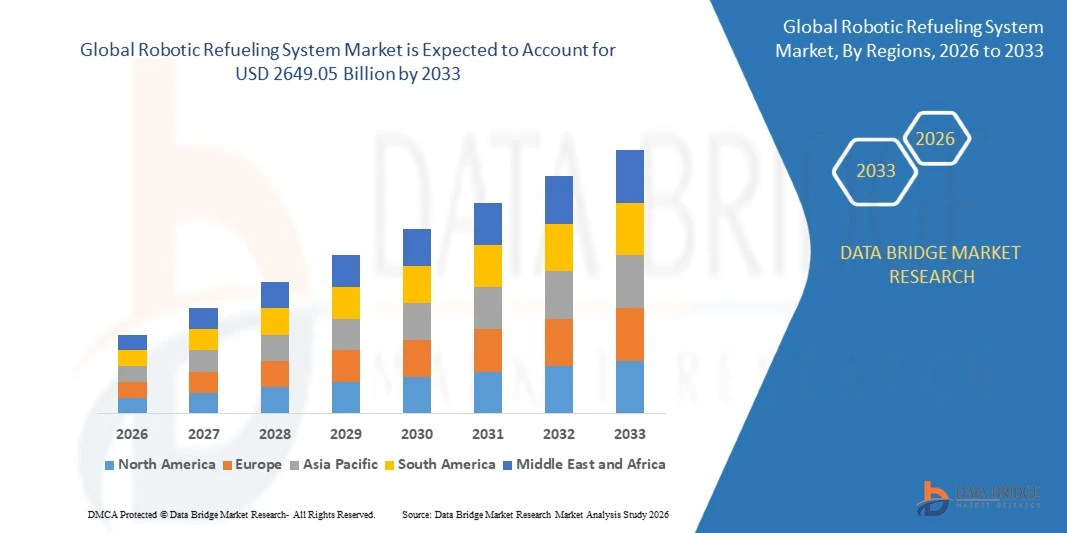
- As per Data Bridge Market Research analysis, the robotic refueling system market was valued at USD 118.30 billion in 2025 and is projected to reach USD 2649.05 billion by 2033, growing at a CAGR of 47.49% from 2026 to 2033.
- The market is expanding due to rising adoption of automation in fueling operations, growing deployment of autonomous and unmanned vehicles in defense, logistics, and commercial transport, increasing demand for contactless and safer refueling, labor cost and workforce safety considerations, advances in robotics, machine vision, and artificial intelligence, and growing investment in smart infrastructure and connected mobility.
- Robotic refueling systems are increasingly being adopted across military bases, airports, fuel stations, industrial sites, mining operations, and commercial fleet depots, supported by growing demand for faster turnaround, reduced human error, improved safety, around-the-clock operation, integration with fleet management software, and compatibility with conventional fuels, hydrogen, and electric vehicle charging.
Market Size & Forecast
- Global Market Value (2025): USD 118.30 billion
- Expected Market Value (2033): USD 2649.05 billion
- Forecast CAGR (2026–2033): 47.49%
- Leading Region in 2025: North America
- Fastest Growing Region: Asia-Pacific
What Are The Major Takeaways Of The Robotic Refueling System Market?
- North America dominated the global robotic refueling system market with a share of 38.00% in 2025, supported by strong defense spending, early adoption of automation, the presence of leading robotics and fueling technology companies, and growing investment in autonomous fleet infrastructure.
- Asia-Pacific is expected to be the fastest-growing regional market at a CAGR of 31.20% from 2026 to 2033, driven by industrial automation, expanding airport and logistics infrastructure, growing electric and autonomous vehicle adoption, and government support for smart infrastructure.
- The fixed systems segment dominated the market by type with a share of 52.00% in 2025, supported by their reliability, high throughput, and suitability for stations, depots, and airports.
- The mobile systems segment is expected to register the fastest growth, at a CAGR of 31.00% from 2026 to 2033, driven by flexible deployment, use in remote sites, and rising demand from autonomous fleets.
- The defense and military segment dominated the application category with a share of 46.00% in 2025, supported by demand for safe, rapid, and unmanned refueling of vehicles, aircraft, and ground fleets.
- The government and defense segment dominated the end user category with a share of 48.00% in 2025, supported by strategic investment in autonomous systems and force-protection requirements.
- Commercial fleet operators are expected to be the fastest-growing end user at a CAGR of 30.00% from 2026 to 2033, supported by the growth of autonomous trucks, delivery fleets, and depot automation.
Report Scope And Robotic Refueling System Market Segmentation
|
Attributes |
Robotic Refueling System Key Market Insights |
|
Segments Covered |
|
|
Countries Covered |
North America
Europe
Asia-Pacific
Middle East and Africa
South America
|
|
Key Market Players |
|
|
Market Opportunities |
|
|
Value Added Data Infosets |
In addition to the market insights such as market value, growth rate, market segments, geographical coverage, market players, and market scenario, the market report curated by the Data Bridge Market Research team includes in-depth expert analysis, import/export analysis, pricing analysis, production consumption analysis, and pestle analysis. |
What Is The Key Trend In The Robotic Refueling System Market?
- Increasing integration of artificial intelligence, machine vision, and IoT monitoring is becoming a major trend in the global robotic refueling system market, as manufacturers develop systems that can identify vehicles, locate fuel ports, and complete refueling with minimal human input. Real-time monitoring, remote diagnostics, and predictive maintenance are improving uptime, safety, and precision across fixed and mobile installations.
- Development of autonomous fleet infrastructure and modular, multi-fuel systems is gaining importance as operators prepare for unmanned vehicles, autonomous trucks, and electrified fleets. Companies are introducing modular and prefabricated stations, mobile robots for remote sites, and systems that can adapt to hydrogen and electric vehicle charging, while dual-arm designs are being explored for higher throughput.
- For instance, Autofuel began operating a fully automated robotic fueling station in Helsinki in 2022, where registered drivers stop at a screen prompt and the robot opens the fuel lid, handles the nozzle, and processes payment automatically. The company has indicated that the system can be adapted for electric vehicles.
- Overall, the robotic refueling system market is increasingly shaped by AI-enabled automation, autonomous fleet infrastructure, modular and mobile deployments, multi-fuel compatibility, and connected monitoring. Robotic refueling system providers are therefore moving toward flexible, interoperable, and software-driven solutions that combine safety and efficiency with seamless integration into fleet and station management systems.
What Are The Key Drivers Of The Robotic Refueling System Market?
- Rising demand for automation, safety, and operational efficiency in fueling is becoming a major growth driver in the global robotic refueling system market, as operators seek to reduce manual intervention, human error, exposure to hazardous fuels, and labor costs. Robotic systems enable faster and more consistent refueling, around-the-clock operation, and reduced vehicle idle time, particularly in remote mining, military, and logistics operations.
- Growth of autonomous and unmanned vehicles and increasing defense and infrastructure investment are gaining importance as fleets that operate without drivers require refueling that does not depend on human operators. Adoption at airports, military sites, commercial fuel stations, and fleet depots, along with smart infrastructure initiatives and growth of electric vehicles, is further widening the application base.
- For instance, in 2024, the U.S. Army awarded a contract for an AI-enabled robotic refueling prototype for its unmanned ground vehicle fleet, highlighting the growing role of defense programs in advancing autonomous refueling technologies.
- Overall, the robotic refueling system market is increasingly shaped by automation, workforce safety, autonomous vehicle adoption, defense modernization, and infrastructure investment. Robotic refueling system providers are therefore moving toward broader application coverage, advanced sensing and software, and partnerships with fleet operators, defense agencies, and fuel retailers.
What Factors Are Challenging The Growth Of The Robotic Refueling System Market?
- High upfront investment and integration complexity are becoming major challenges in the global robotic refueling system market, as setup costs can be significantly higher than those of conventional fueling systems and integration with legacy fuel infrastructure can be difficult. Small and mid-sized station operators in particular may delay adoption because of capital requirements and uncertain payback periods.
- Maintenance needs, technical skill shortages, and safety and regulatory concerns are also restraining growth, as systems require specialized expertise, and risks such as leaks, misalignment, and cybersecurity vulnerabilities in connected equipment must be managed. Variations in fuel standards, vehicle fuel port designs, and regional regulations further complicate standardization and large-scale deployment.
- For instance, in September 2025, Astroscale Japan announced its REFLEX-J satellite refueling demonstration spacecraft, a five-year project with a budget of up to JPY 10.8 billion and an in-orbit demonstration expected around 2029, illustrating the long development timelines and high investment required for advanced robotic refueling technologies.
- Overall, the global robotic refueling system market is increasingly shaped by high capital costs, integration complexity, safety and cybersecurity requirements, and evolving standards. Robotic refueling system providers are therefore moving toward modular, scalable, and standardized designs, leasing and service-based models, and stronger technician training and support.
How Is The Robotic Refueling System Market Segmented?
The global robotic refueling system market is segmented on the basis of type, operation mode, fuel type, application, and end user.
- By Type
On the basis of type, the global robotic refueling system market is segmented into fixed systems, mobile systems, and hybrid systems. The fixed systems segment dominated the market with a share of 52.00% in 2025, supported by their reliability, high throughput, and suitability for stations, depots, and airports.
The mobile systems segment is projected to grow at a CAGR of 31.00% from 2026 to 2033, driven by flexible deployment, use at remote and temporary sites, and rising demand from autonomous fleets.
- By Operation Mode
On the basis of operation mode, the global robotic refueling system market is segmented into fully automated and semi-automated systems. The fully automated segment dominated the market with a share of 64.00% in 2025, supported by demand for unattended operation, safety, and reduced labor dependence.
The semi-automated segment is projected to grow at a CAGR of 29.50% from 2026 to 2033, supported by lower upfront cost, easier integration with existing stations, and gradual automation by cost-sensitive operators.
- By Fuel Type
On the basis of fuel type, the global robotic refueling system market is segmented into diesel, gasoline, hydrogen, electricity, and others. The diesel segment dominated the market with a share of 41.00% in 2025, supported by its use in military, mining, logistics, and heavy vehicle fleets.
The electricity segment is projected to grow at a CAGR of 33.50% from 2026 to 2033, driven by the growth of electric and autonomous fleets and demand for automated charging connection solutions.
- By Application
On the basis of application, the global robotic refueling system market is segmented into defense and military, automotive and transportation, aviation, and industrial and energy. The defense and military segment dominated the market with a share of 46.00% in 2025, supported by demand for safe, rapid, and unmanned refueling of vehicles, aircraft, and ground fleets.
The aviation segment is projected to grow at a CAGR of 29.00% from 2026 to 2033, driven by airport ground-handling automation, aircraft turnaround efficiency, and safety requirements.
- By End User
On the basis of end user, the global robotic refueling system market is segmented into government and defense, industrial enterprises, aviation service providers and airports, and commercial fleet operators. The government and defense segment dominated the market with a share of 48.00% in 2025, supported by strategic investment in autonomous systems and force-protection requirements.
The commercial fleet operators segment is projected to grow at a CAGR of 30.00% from 2026 to 2033, driven by the growth of autonomous trucks, delivery fleets, and depot automation.
Which Region Holds The Largest Share Of The Robotic Refueling System Market?
- North America accounted for the largest share of the global soft covering flooring market, supported by strong demand for carpet and carpet tiles across residential, commercial, hospitality, and office spaces. Market growth is driven by renovation and remodeling activities, increasing investments in commercial infrastructure, and demand for flooring solutions that provide comfort, sound insulation, durability, and aesthetic appeal.
- The U.S. remains a key market within the region, supported by established construction and housing sectors, widespread carpet adoption, and the presence of major flooring manufacturers. Canada also contributes to regional demand through residential construction, renovation projects, and commercial interior development.
North America Robotic Refueling System Market Insight
North America is the largest region in the global robotic refueling system market. The regional market is supported by defense modernization, early adoption of autonomous vehicles, strong robotics and automation capabilities, and growing investment in fleet and airport automation. Increasing interest in unmanned ground vehicles, autonomous trucking, and electric vehicle infrastructure is expected to further support regional growth.
U.S. Robotic Refueling System Market Insight
The U.S. robotic refueling system market is supported by defense programs for unmanned vehicles and aircraft, growing commercial fleet automation, and technology startups developing AI-enabled refueling and charging robots. Military applications, including AI-enabled refueling prototypes for unmanned ground vehicles, are expected to remain a key demand source, while mining, logistics, and airport operations offer additional growth opportunities.
Europe Robotic Refueling System Market Insight
The Europe robotic refueling system market is supported by a strong industrial robotics base, strict workplace safety standards, and the presence of companies such as Rotec Engineering, Fuelmatics, KUKA, and ABB. Growth in automated and staff-free fuel stations, airport ground-handling automation, and the transition toward hydrogen and electric mobility are shaping product development and adoption.
Germany Robotic Refueling System Market Insight
The Germany robotic refueling system market is supported by its advanced industrial automation and automotive sectors, strong engineering capabilities, and the presence of robotics manufacturers such as KUKA and Siemens. Demand is expected to be driven by logistics automation, industrial site refueling, and development of hydrogen and electric vehicle infrastructure, while high investment costs and integration requirements remain important considerations.
Asia-Pacific Robotic Refueling System Market Insight
Asia-Pacific is projected to be the fastest-growing region in the global robotic refueling system market, at a CAGR of 31.20% from 2026 to 2033. The regional market is supported by rapid industrial automation, expanding airport and logistics infrastructure, growth in electric and autonomous vehicles, and government support for smart infrastructure. The presence of leading robot manufacturers in Japan, South Korea, and China is expected to further support regional growth.
China Robotic Refueling System Market Insight
The China robotic refueling system market is expected to witness rapid expansion, supported by large-scale industrial automation, growth of electric and autonomous vehicles, expanding logistics and port infrastructure, and strong domestic robotics development. Demand is expected to increase for automated charging and refueling solutions in fleet depots, mining sites, and smart transport hubs.
Japan Robotic Refueling System Market Insight
The Japan robotic refueling system market is supported by a strong robotics industry, including companies such as FANUC, Yaskawa, and Mitsubishi Electric, and by advanced research in autonomous systems. Interest in refueling automation extends beyond road vehicles to space applications, as shown by Astroscale Japan’s REFLEX-J satellite refueling demonstration mission, while labor shortages are encouraging automation of fueling and servicing tasks.
Which Are The Top Companies In The Robotic Refueling System Market?
The robotic refueling system industry is primarily led by well-established companies, including:
- ABB Ltd. (Switzerland)
- KUKA AG (Germany)
- FANUC Corporation (Japan)
- Mitsubishi Electric Corporation (Japan)
- Yaskawa Electric Corporation (Japan)
- Universal Robots A/S (Denmark)
- Boston Dynamics, Inc. (U.S.)
- Siemens AG (Germany)
- Hyundai Robotics (South Korea)
- Rotec Engineering B.V. (Netherlands)
- Fuelmatics AB (Sweden)
- Autofuel (Denmark)
- Scott Technology Limited (New Zealand)
- Husky Corporation (U.S.)
- Tatsuno Corporation (Japan)
What Are Latest Developments In Robotic Refueling System Market?
- In March 2025, ABB expanded its robotics portfolio with AI-enabled robotic arm solutions, supporting the growing use of intelligent automation in industrial handling and servicing applications.
- In April 2025, Boeing launched a new generation of aerial refueling systems for the U.S. Air Force, reflecting continued investment in advanced and increasingly automated refueling technologies for defense aviation.
- In September 2025, Astroscale Japan announced REFLEX-J, a satellite refueling demonstration spacecraft that combines robotics, computer vision, and fuel transfer, with an in-orbit chemical refueling demonstration in low Earth orbit expected around 2029.
- In September 2025, Galnaftogaz opened a staff-free refueling station in Lviv, Ukraine, demonstrating the growing interest of fuel retailers in unattended and automated station concepts.
- In March 2026, NextNRG launched an AI-driven platform for automated electric vehicle refueling, supporting the move toward intelligent and autonomous energy delivery for vehicle fleets.
- Interactive Data Analysis Dashboard
- Company Analysis Dashboard for high growth potential opportunities
- Research Analyst Access for customization & queries
- Competitor Analysis with Interactive dashboard
- Latest News, Updates & Trend analysis
- Harness the Power of Benchmark Analysis for Comprehensive Competitor Tracking
Data collection and base year analysis are done using data collection modules with large sample sizes. The stage includes obtaining market information or related data through various sources and strategies. It includes examining and planning all the data acquired from the past in advance. It likewise envelops the examination of information inconsistencies seen across different information sources. The market data is analysed and estimated using market statistical and coherent models. Also, market share analysis and key trend analysis are the major success factors in the market report. To know more, please request an analyst call or drop down your inquiry.
The key research methodology used by DBMR research team is data triangulation which involves data mining, analysis of the impact of data variables on the market and primary (industry expert) validation. Data models include Vendor Positioning Grid, Market Time Line Analysis, Market Overview and Guide, Company Positioning Grid, Patent Analysis, Pricing Analysis, Company Market Share Analysis, Standards of Measurement, Global versus Regional and Vendor Share Analysis. To know more about the research methodology, drop in an inquiry to speak to our industry experts.
Data Bridge Market Research is a leader in advanced formative research. We take pride in servicing our existing and new customers with data and analysis that match and suits their goal. The report can be customized to include price trend analysis of target brands understanding the market for additional countries (ask for the list of countries), clinical trial results data, literature review, refurbished market and product base analysis. Market analysis of target competitors can be analyzed from technology-based analysis to market portfolio strategies. We can add as many competitors that you require data about in the format and data style you are looking for. Our team of analysts can also provide you data in crude raw excel files pivot tables (Fact book) or can assist you in creating presentations from the data sets available in the report.