


What is the Robotic Rehabilitation and Exoskeleton Devices Market Size and Growth Rate?
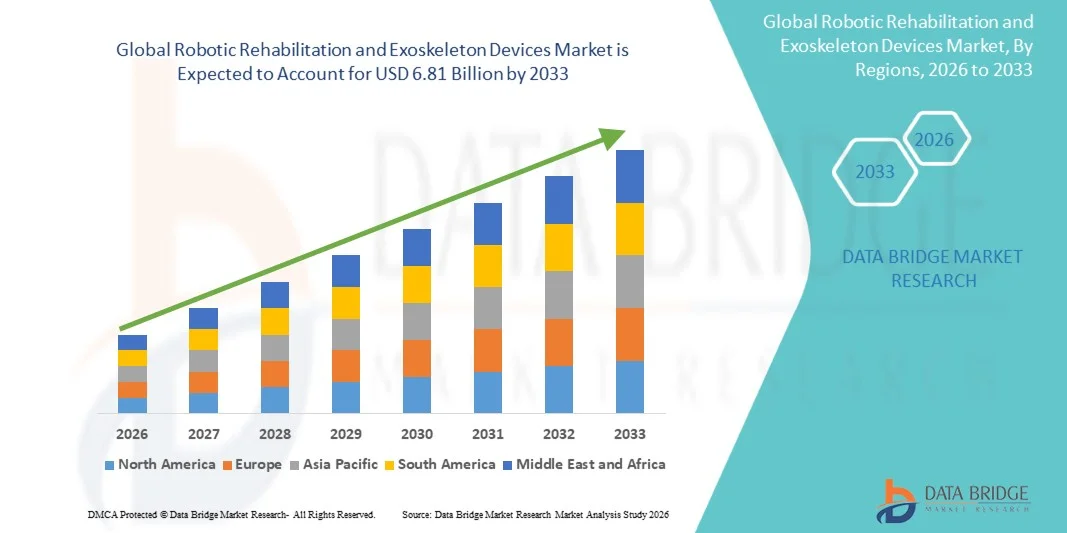
- As per Data Bridge Market Research analysis, the robotic rehabilitation and exoskeleton devices market was valued at USD 2.18 billion in 2025 and is projected to reach USD 6.81 billion by 2033, growing at a CAGR of 15.30% from 2026 to 2033.
- The market is experiencing rapid growth driven by rising global incidence of stroke and spinal cord injury, growing clinical evidence supporting robotic-assisted rehabilitation outcomes over conventional physical therapy, and increasing adoption of wearable exoskeleton devices for both clinical rehabilitation and assistive mobility applications.
- The growing aging population and associated rise in mobility-limiting neurological and orthopedic conditions, combined with increasing healthcare provider emphasis on standardized, measurable rehabilitation protocols, is compelling hospitals and rehabilitation centers to invest in robotic rehabilitation platforms capable of delivering consistent, data-driven therapy sessions. Rising insurance and reimbursement support for robotic-assisted therapy in select markets is further accelerating clinical adoption.
Market Size & Forecast
- Global Market Value (2025): USD 2.18 Billion
- Expected Market Value (2033): USD 6.81 Billion
- Forecast CAGR (2026–2033): 15.30%
- Leading Region in 2025: North America
- Fastest Growing Region: Asia-Pacific
What are the Major Takeaways of the Robotic Rehabilitation and Exoskeleton Devices Market?
- North America dominated the global robotic rehabilitation and exoskeleton devices market with the largest revenue share of 38.64% in 2025, supported by advanced rehabilitation healthcare infrastructure and strong reimbursement support for robotic-assisted therapy.
- Asia-Pacific is expected to be the fastest-growing region at a CAGR of 17.8% from 2026 to 2033, fueled by rising stroke incidence, expanding rehabilitation healthcare infrastructure, and growing domestic exoskeleton manufacturing capacity across Japan, China, and South Korea.
- The exoskeletons product type segment led the market with a 54.72% share in 2025, driven by rising clinical and assistive-mobility adoption of wearable robotic devices for gait training and functional mobility support.
- The lower limb extremity segment is the fastest-growing extremity category, projected to register a CAGR of 17.1%, reflecting rising demand for gait-rehabilitation and mobility-assistance exoskeletons among stroke and spinal cord injury patients.
- The stroke rehabilitation application segment dominated the application category with a 41.83% revenue share in 2025, led by the high global incidence of stroke and strong clinical evidence supporting robotic-assisted upper- and lower-limb therapy.
- The hospitals & rehabilitation centers end user segment accounted for 62.47% of the market share in 2025, preferred for its structured clinical supervision and integration with comprehensive rehabilitation care pathways.
- The AI/machine learning-based control system segment is the fastest-growing control category, with a CAGR of 18.4%, driven by rising adoption of adaptive therapy algorithms that personalize rehabilitation intensity to individual patient progress.
Report Scope and Robotic Rehabilitation and Exoskeleton Devices Market Segmentation
|
Attributes |
Robotic Rehabilitation and Exoskeleton Devices Key Market Insights |
|
Segments Covered |
|
|
Countries Covered |
North America
Europe
Asia-Pacific
Middle East and Africa
South America
|
|
Key Market Players |
|
|
Market Opportunities |
|
|
Value Added Data Infosets |
In addition to the insights on market scenarios such as market value, growth rate, segmentation, geographical coverage, and major players, the market reports curated by the Data Bridge Market Research also include in-depth expert analysis, patient epidemiology, pipeline analysis, pricing analysis, and regulatory framework. |
What is the Key Trend in the Robotic Rehabilitation and Exoskeleton Devices Market?
- Device manufacturers are increasingly integrating AI-driven adaptive control algorithms capable of adjusting therapy resistance and assistance levels in real time based on individual patient movement patterns and recovery progress.
- For instance, in April 2025, Ekso Bionics launched an upgraded exoskeleton platform incorporating adaptive AI-based gait-assistance algorithms, offering rehabilitation clinicians improved therapy personalization for stroke and spinal cord injury patients.
- Rising adoption of lightweight, soft-exoskeleton designs is enabling broader clinical and homecare use by reducing device weight and improving wearer comfort compared to earlier rigid exoskeleton generations.
- Manufacturers are increasingly expanding remote-monitoring and telerehabilitation capabilities within robotic rehabilitation platforms, enabling clinicians to track patient progress and adjust therapy protocols outside traditional clinical settings.
- For instance, in January 2025, Hocoma introduced an expanded telerehabilitation module for its Lokomat platform, enabling clinicians to remotely monitor and adjust gait-training parameters for patients undergoing extended rehabilitation programs.
- As healthcare providers continue to prioritize measurable, personalized, and scalable rehabilitation outcomes, the adoption of robotic rehabilitation and exoskeleton technologies is expected to accelerate, reinforcing their role as a standard component of modern neurological and orthopedic rehabilitation care pathways.
What are the Key Drivers of the Robotic Rehabilitation and Exoskeleton Devices Market?
- Rising global incidence of stroke, spinal cord injury, and neurological disorders, combined with growing clinical evidence supporting robotic-assisted rehabilitation outcomes, has significantly increased demand for advanced robotic rehabilitation platforms.
- For instance, in March 2025, ReWalk Robotics expanded its exoskeleton production capacity in Israel to meet rising demand from rehabilitation centers and homecare customers across North America and Europe.
- Hospitals and rehabilitation centers are increasingly incorporating robotic rehabilitation devices into standard therapy protocols to deliver consistent, high-intensity, and measurable rehabilitation sessions that reduce clinician physical burden compared to manual therapy.
- For instance, in October 2024, Hyundai Motor Company announced an investment in additional medical exoskeleton development capacity to support rising demand from rehabilitation and assistive-mobility applications.
- With healthcare systems increasingly prioritizing standardized, outcome-driven rehabilitation protocols to manage rising neurological and orthopedic patient populations, robotic rehabilitation and exoskeleton devices will remain indispensable across clinical rehabilitation, assistive mobility, and homecare applications worldwide.
Which Factors are Challenging the Growth of the Robotic Rehabilitation and Exoskeleton Devices Market?
- Robotic rehabilitation and exoskeleton devices require significant capital investment for healthcare facilities, including equipment acquisition, clinician training, implementation, and ongoing maintenance. These costs create a substantial financial barrier for smaller rehabilitation centers and providers operating under constrained healthcare budgets.
- High capital costs, combined with limited and inconsistent reimbursement coverage, can restrict adoption and patient access to robotic-assisted rehabilitation, particularly in markets where such technologies are not covered as a distinct reimbursable service.
- For instance, in April 2025, Ekso Bionics reported continued reimbursement challenges for its Ekso Indego Personal exoskeleton under the U.S. Medicare system. The company received reimbursement for its second CMS claim in April 2025, while other claims remained under the appeals process. The company also temporarily placed a hold on selling devices to durable medical equipment suppliers for CMS reimbursement while refining its reimbursement process.
- The combination of high acquisition and maintenance expenses, clinician training requirements, and reimbursement uncertainty continues to constrain broader adoption, particularly among smaller healthcare facilities and in price-sensitive markets. These barriers can slow market penetration beyond well-funded hospitals, academic institutions, and specialized rehabilitation centers despite increasing demand for robotic-assisted rehabilitation technologies.
How is the Robotic Rehabilitation and Exoskeleton Devices Market Segmented?
The robotic rehabilitation and exoskeleton devices market is segmented on the basis of product type, extremity, mobility, technology, application, end user, control system, component, patient age group and distribution channel.
- By Product Type
On the basis of product type, the global robotic rehabilitation and exoskeleton devices market is segmented into exoskeletons, rehabilitation robots (non-wearable), and robotic prosthetics. The exoskeletons segment dominated the market with a 54.72% share in 2025, owing to rising clinical and assistive-mobility adoption of wearable robotic devices for gait training and functional mobility support. These devices deliver direct, wearable rehabilitation and mobility assistance, making them the preferred choice across both clinical and homecare rehabilitation applications.
The rehabilitation robots (non-wearable) segment is projected to register the fastest growth at a CAGR of 16.2% from 2026 to 2033, driven by rising adoption of stationary, high-intensity therapy platforms among rehabilitation centers seeking to deliver structured, repeatable upper- and lower-limb therapy programs. Advances in robotic-assisted therapy protocol standardization, combined with growing clinical evidence supporting outcomes, are accelerating segment expansion.
- By Extremity
On the basis of extremity, the global robotic rehabilitation and exoskeleton devices market is segmented into upper limb, lower limb, and full body. The lower limb segment led the market with a 48.63% share in 2025, supported by high demand for gait-rehabilitation and mobility-assistance devices among stroke and spinal cord injury patients requiring walking-function recovery.
The lower limb segment is also expected to experience the fastest growth at a CAGR of 17.1% from 2026 to 2033, driven by continued expansion of gait-training exoskeleton adoption across both clinical rehabilitation and assistive-mobility applications.
- By Mobility
On the basis of mobility, the global robotic rehabilitation and exoskeleton devices market is segmented into stationary/fixed and mobile/wearable. The stationary/fixed segment dominated the market with a share of 56.84% in 2025 due to its widespread adoption across hospital and rehabilitation-center settings requiring structured, supervised, high-intensity therapy sessions. The widespread integration of stationary robotic rehabilitation platforms into clinical therapy protocols is driving strong demand for this mobility category.
The mobile/wearable segment is expected to witness the fastest CAGR of 17.6% from 2026 to 2033, driven by the rising demand for portable exoskeleton devices supporting both clinical gait training and homecare assistive-mobility applications. Manufacturers are increasingly developing lightweight, battery-powered wearable systems. Additionally, the growing emphasis on extending rehabilitation therapy beyond clinical settings into homecare environments is further accelerating adoption of this mobility category.
- By Technology
On the basis of technology, the global robotic rehabilitation and exoskeleton devices market is segmented into powered (active) and passive (non-powered). The powered (active) segment dominated the market with a share of 78.43% in 2025 due to its critical role in delivering active, motorized assistance for patients with significant mobility impairment requiring substantial rehabilitation or assistive support. Additionally, rising focus on measurable, adjustable therapy-intensity capabilities further supports the strong adoption of powered exoskeleton and rehabilitation robot technology.
The passive (non-powered) segment is anticipated to witness a steady CAGR of 9.8% from 2026 to 2033. This growth is fueled by continued demand for lower-cost, mechanically assisted support devices among patients with milder mobility impairment or in cost-constrained healthcare settings. Manufacturers are adopting passive-support designs to conduct cost-effective, accessible rehabilitation and mobility assistance. Additionally, the integration of passive devices into early-stage rehabilitation protocols is supporting continued segment demand.
- By Application
On the basis of application, the global robotic rehabilitation and exoskeleton devices market is segmented into stroke rehabilitation, spinal cord injury rehabilitation, neurological disorders, orthopedic rehabilitation, and assistive mobility. The stroke rehabilitation segment dominated the market with a share of 41.83% in 2025 due to its critical role in addressing the high global incidence of stroke, increasing demand for standardized upper- and lower-limb therapy protocols, and growing integration with structured rehabilitation care pathways. High adoption is driven by the increasing need for measurable functional-recovery outcomes, integration with clinical rehabilitation programs, and enhanced patient-engagement therapy delivery. Additionally, growing investment by hospitals and rehabilitation centers to improve stroke-recovery outcomes is reinforcing the leading position of this segment in the market.
The spinal cord injury rehabilitation segment is expected to witness the fastest CAGR of 17.4% from 2026 to 2033, driven by increasing clinical adoption of exoskeleton-assisted gait training for spinal cord injury patients seeking to regain or maintain mobility function. Growing clinical evidence supporting exoskeleton-based rehabilitation for this patient population is further accelerating market expansion in this segment.
- By End User
On the basis of end user, the global robotic rehabilitation and exoskeleton devices market is segmented into hospitals & rehabilitation centers, homecare settings, research & academic institutes, and military & defense. The hospitals & rehabilitation centers segment dominated the market with a share of 62.47% in 2025 due to its critical role in providing structured clinical supervision, comprehensive rehabilitation care pathways, and access to trained clinical staff capable of operating robotic rehabilitation equipment. Additionally, established clinical-infrastructure investment capacity, broad rehabilitation-program integration, and extensive patient-throughput requirements are facilitating continued adoption of robotic rehabilitation platforms among hospitals and rehabilitation centers, while strong vendor clinical-support networks are improving accessibility, reliability, and trust, further reinforcing this segment's leading market position.
The homecare settings segment is expected to witness the fastest CAGR of 18.6% from 2026 to 2033, driven by the increasing availability of lightweight, simplified exoskeleton devices designed for supervised or independent home use following initial clinical rehabilitation. Manufacturers are leveraging simplified device interfaces and remote-monitoring capabilities to enhance homecare accessibility, enable continued rehabilitation beyond clinical discharge, and support long-term functional-mobility maintenance, thereby accelerating adoption across the growing homecare rehabilitation segment.
- By Control System
On the basis of control system, the global robotic rehabilitation and exoskeleton devices market is segmented into EMG-based, sensor-based, and AI/machine learning-based. The sensor-based segment dominated the market with a share of 46.72% in 2025 due to its widespread adoption across current-generation exoskeleton and rehabilitation robot platforms utilizing motion, force, and position sensors to guide therapy delivery. The widespread integration of sensor-based control systems across established rehabilitation platforms is driving strong demand for this control-system category.
The AI/machine learning-based segment is expected to witness the fastest CAGR of 18.4% from 2026 to 2033, driven by the rising adoption of adaptive therapy algorithms capable of personalizing rehabilitation intensity and progression to individual patient recovery patterns. Manufacturers are increasingly integrating machine-learning models into device control architecture. Additionally, the growing emphasis on personalized, outcome-optimized rehabilitation protocols is further accelerating adoption of this control-system category.
- By Component
On the basis of component, the global robotic rehabilitation and exoskeleton devices market is segmented into actuators, sensors, control systems & software, and power supply. The actuators segment dominated the market with a share of 38.64% in 2025 due to its critical role in generating the mechanical force required for joint movement assistance and resistance across exoskeleton and rehabilitation robot platforms. Additionally, established actuator-manufacturing infrastructure, broad supplier familiarity, and extensive production-cost optimization are facilitating continued adoption of advanced actuator technology across global rehabilitation device platforms.
The control systems & software segment is expected to witness the fastest CAGR of 17.9% from 2026 to 2033, driven by the increasing sophistication of therapy-personalization algorithms and remote-monitoring software platforms integrated into robotic rehabilitation devices. Manufacturers are leveraging advanced software development to enhance therapy customization, enable data-driven outcome tracking, and support continuous device-performance improvement, thereby accelerating adoption across next-generation rehabilitation platforms.
- By Patient Age Group
On the basis of patient age group, the global robotic rehabilitation and exoskeleton devices market is segmented into pediatric, adult, and geriatric. The adult segment dominated the market with a share of 51.36% in 2025 due to its preference among the largest patient population experiencing stroke, spinal cord injury, and orthopedic conditions requiring robotic-assisted rehabilitation therapy. Additionally, established clinical-protocol development, broad device-sizing standardization, and extensive treatment-outcome data are facilitating continued adoption of robotic rehabilitation devices among adult patients, while strong clinical evidence is improving physician confidence, further reinforcing this segment's leading market position.
The geriatric segment is expected to witness the fastest CAGR of 17.2% from 2026 to 2033, driven by the increasing global aging population and associated rise in stroke, orthopedic, and mobility-limiting conditions among elderly patients. Healthcare providers are increasingly incorporating robotic rehabilitation devices into geriatric care protocols to support functional-mobility recovery and fall-risk reduction, thereby accelerating adoption across the growing elderly patient population.
- By Distribution Channel
On the basis of distribution channel, the global robotic rehabilitation and exoskeleton devices market is segmented into direct sales and distributors. The direct sales segment dominated the market with a share of 68.72% in 2025 due to its critical role in enabling close collaboration between device manufacturers and hospitals or rehabilitation centers requiring extensive clinician training, installation support, and ongoing technical service. Additionally, established long-term service agreements, direct clinical-support relationships, and integrated training programs are facilitating continued adoption of direct-sourced devices among institutional buyers, while strong manufacturer support networks are improving accessibility, reliability, and trust, further reinforcing this segment's leading market position.
The distributors segment is expected to witness the fastest CAGR of 15.9% from 2026 to 2033, driven by the increasing demand from smaller rehabilitation clinics and emerging-market healthcare providers for accessible, regionally supported device sourcing. Distributors offer scalable, cost-effective sourcing solutions for smaller institutional buyers, while providing regional technical support, installation services, and localized training capabilities, enhancing overall market accessibility across diverse healthcare settings.
Which Region Holds the Largest Share of the Robotic Rehabilitation and Exoskeleton Devices Market?
- North America dominated the robotic rehabilitation and exoskeleton devices market and accounted for the largest revenue share of 38.64% in 2025, supported by advanced rehabilitation healthcare infrastructure, strong reimbursement support for robotic-assisted therapy, and the presence of established device manufacturers.
- The region also benefits from extensive clinical research activity supporting robotic rehabilitation efficacy, high adoption of AI-driven therapy personalization technology, and growing use of robotic rehabilitation devices across hospital, homecare, and research applications. Increasing focus on standardized, outcome-driven rehabilitation protocols continues to strengthen North America's leadership position in the global market.
United States Robotic Rehabilitation and Exoskeleton Devices Market Insight
The United States robotic rehabilitation and exoskeleton devices market is growing steadily, driven by high stroke and spinal cord injury incidence, expanding reimbursement support for robotic-assisted rehabilitation therapy, and rising adoption of AI-driven adaptive therapy platforms among leading rehabilitation centers. Growing adoption of lightweight exoskeleton devices across both clinical and homecare rehabilitation settings is significantly boosting market demand. In addition, rising investments in rehabilitation robotics research and development, increasing collaboration between device manufacturers and academic medical centers, and rapid product innovation are positioning the United States as the leading global market for robotic rehabilitation and exoskeleton devices.
Canada Robotic Rehabilitation and Exoskeleton Devices Market Insight
Canada’s robotic rehabilitation and exoskeleton market is expanding rapidly, driven by an aging demographic, rising stroke and spinal cord injury rates, and progressive provincial healthcare integration. Powered lower-extremity devices dominate clinical settings for gait retraining. Growth is further accelerated by AI-driven personalized therapy, real-time sensor feedback, and a expanding shift toward portable, home-based neurorehabilitation. However, adoption speed remains constrained by high capital costs, limited public coverage, and rigorous regulatory pathways across provinces.
Asia-Pacific Robotic Rehabilitation and Exoskeleton Devices Market Insight
The Asia-Pacific robotic rehabilitation and exoskeleton market is the fastest-growing globally, driven by rapid population aging, high stroke incidence, and expanding healthcare infrastructure. China leads regional revenue, while Japan and South Korea drive early commercial adoption. Lower-extremity gait trainers dominate clinical settings, but AI integration, biofeedback, and portable home telerehabilitation are expanding rapidly. High equipment costs and fragmented regional reimbursement frameworks remain key adoption challenges.
Japan Robotic Rehabilitation and Exoskeleton Devices Market Insight
The Japan robotic rehabilitation and exoskeleton devices market is expanding rapidly, supported by the country's rapidly aging population, strong domestic robotics manufacturing capabilities, and increasing government support for assistive and rehabilitation robotics development. Rehabilitation centers and elderly-care facilities are increasingly integrating exoskeleton and robotic rehabilitation devices into standard care protocols. Continuous advancements in domestic robotics technology and rising government support for aging-population healthcare solutions are further driving market growth in Japan.
China Robotic Rehabilitation and Exoskeleton Devices Market Insight
The China robotic rehabilitation and exoskeleton devices market is expanding rapidly, supported by rising stroke incidence, growing healthcare infrastructure investment, and increasing domestic robotics manufacturing capacity. Hospitals and rehabilitation centers are increasingly integrating robotic rehabilitation platforms into standardized therapy programs. Continuous expansion of domestic device-manufacturing infrastructure and rising government support for medical robotics industry development are further driving market growth in China.
Which are the Top Companies in Robotic Rehabilitation and Exoskeleton Devices Market?
The robotic rehabilitation and exoskeleton devices industry is primarily led by well-established companies, including:
- Ekso Bionics Holdings, Inc. (U.S.)
- ReWalk Robotics Ltd. (Israel)
- CYBERDYNE Inc. (Japan)
- Hocoma AG (Switzerland)
- Myomo, Inc. (U.S.)
- Bionik Laboratories Corp. (U.S.)
- Rex Bionics Ltd. (New Zealand)
- Hyundai Motor Company (South Korea)
- Honda Motor Co., Ltd. (Japan)
- Toyota Motor Corporation (Japan)
- Panasonic Corporation (Japan)
- DIH Technology Ltd (Motek Medical) (Netherlands)
- Fourier Intelligence (Singapore)
- Wandercraft SAS (France)
- B-Temia Inc. (Canada)
- US Bionics, Inc. (SuitX) (U.S.)
- German Bionic Systems GmbH (Germany)
- Ottobock SE & Co. KGaA (Germany)
- Parker Hannifin Corporation (U.S.)
- Restorative Therapies, Inc. (U.S.)
- AlterG, Inc. (U.S.)
- Tyromotion GmbH (Austria)
- Reha Technology AG (Switzerland)
- Bioxtreme Ltd. (Israel)
- Aretech LLC (U.S.)
- Gogoa Mobility Robots S.L. (Spain)
What are Latest Developments in Robotic Rehabilitation and Exoskeleton Devices Market?
- In September 2025, Ekso Bionics launched an upgraded lower-limb exoskeleton platform incorporating enhanced AI-based gait-adaptation technology, strengthening its position in the stroke and spinal cord injury rehabilitation market.
- In February 2025, ReWalk Robotics expanded its exoskeleton manufacturing capacity in Israel to support growing demand from rehabilitation centers and homecare customers across North America and Europe.
- In November 2025, CYBERDYNE introduced an upgraded HAL exoskeleton platform incorporating enhanced bioelectrical signal-detection sensors, improving therapy responsiveness for patients with severe mobility impairment. This development strengthens CYBERDYNE's position in the neurological rehabilitation market by offering clinicians improved precision in therapy calibration.
- In October 2024, Hocoma expanded its Lokomat rehabilitation robot product line in Europe to include additional pediatric-sized configurations, improving accessibility for younger patient populations.
- In June 2023, Parker Hannifin partnered with a rehabilitation research institute to co-develop next-generation Indego exoskeleton control algorithms, combining its robotics engineering expertise with the institute's clinical rehabilitation research capabilities to support improved patient outcomes.
- In March 2023, Myomo received regulatory clearance for an expanded upper-limb exoskeleton configuration designed for pediatric stroke and neurological-injury patients, enabling the company to extend robotic-assisted rehabilitation access to younger patient populations previously underserved by adult-sized devices.

- Interactive Data Analysis Dashboard
- Company Analysis Dashboard for high growth potential opportunities
- Research Analyst Access for customization & queries
- Competitor Analysis with Interactive dashboard
- Latest News, Updates & Trend analysis
- Harness the Power of Benchmark Analysis for Comprehensive Competitor Tracking
Data collection and base year analysis are done using data collection modules with large sample sizes. The stage includes obtaining market information or related data through various sources and strategies. It includes examining and planning all the data acquired from the past in advance. It likewise envelops the examination of information inconsistencies seen across different information sources. The market data is analysed and estimated using market statistical and coherent models. Also, market share analysis and key trend analysis are the major success factors in the market report. To know more, please request an analyst call or drop down your inquiry.
The key research methodology used by DBMR research team is data triangulation which involves data mining, analysis of the impact of data variables on the market and primary (industry expert) validation. Data models include Vendor Positioning Grid, Market Time Line Analysis, Market Overview and Guide, Company Positioning Grid, Patent Analysis, Pricing Analysis, Company Market Share Analysis, Standards of Measurement, Global versus Regional and Vendor Share Analysis. To know more about the research methodology, drop in an inquiry to speak to our industry experts.
Data Bridge Market Research is a leader in advanced formative research. We take pride in servicing our existing and new customers with data and analysis that match and suits their goal. The report can be customized to include price trend analysis of target brands understanding the market for additional countries (ask for the list of countries), clinical trial results data, literature review, refurbished market and product base analysis. Market analysis of target competitors can be analyzed from technology-based analysis to market portfolio strategies. We can add as many competitors that you require data about in the format and data style you are looking for. Our team of analysts can also provide you data in crude raw excel files pivot tables (Fact book) or can assist you in creating presentations from the data sets available in the report.













