


Robotic Vial Washing and Filling Machines Market Size
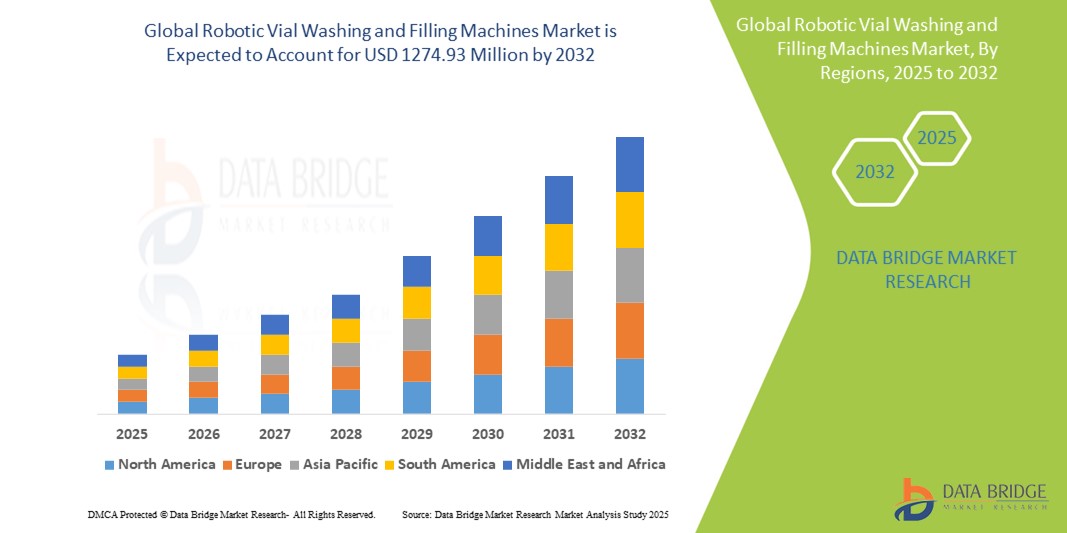
- The global robotic vial washing and filling machines market size was valued at USD 625.93 million in 2024 and is expected to reach USD 1274.93 million by 2032, at a CAGR of 9.30% during the forecast period
- This growth is driven by factors such as the increasing demand for automation in pharmaceutical manufacturing and the need for contamination-free, precise, and efficient vial processing systems
Robotic Vial Washing and Filling Machines Market Analysis
- The robotic vial washing and filling machines market is witnessing steady growth as pharmaceutical companies focus on precision and sterility in production processes. The adoption of automated solutions is enhancing operational efficiency and reducing human error in vial handling and filling systems
- The market is also seeing increased investment from manufacturers to upgrade equipment and integrate smart technologies. This trend reflects a shift toward higher productivity and quality assurance across pharmaceutical manufacturing units
- Asia-Pacific is expected to dominate the robotic vial washing and filling machines market due to its robust pharmaceutical manufacturing base, increasing adoption of automation technologies, and rising demand for injectable drugs, particularly in countries such as China and India
- North America is expected to be the fastest growing region in the Robotic Vial Washing and Filling Machines market during the forecast period due to rapid technological advancements, high healthcare expenditure, and increasing investment by pharmaceutical companies in modernizing production facilities to meet regulatory standards and ensure product safety
- The standalone machines segment is expected to dominate the robotic vial washing and filling machines market with the largest share of 43.6% in 2025 due to its flexibility, lower initial investment costs, and ease of integration in smaller and medium-sized enterprises.
Report Scope and Robotic Vial Washing and Filling Machines Market Segmentation
|
Attributes |
Robotic Vial Washing and Filling Machines Key Market Insights |
|
Segments Covered |
|
|
Countries Covered |
North America
Europe
Asia-Pacific
Middle East and Africa
South America
|
|
Key Market Players |
|
|
Market Opportunities |
|
|
Value Added Data Infosets |
In addition to the insights on market scenarios such as market value, growth rate, segmentation, geographical coverage, and major players, the market reports curated by the Data Bridge Market Research also include depth expert analysis, patient epidemiology, pipeline analysis, pricing analysis, and regulatory framework. |
Robotic Vial Washing and Filling Machines Market Trends
“Integration of Artificial Intelligence and Internet of Things Technologies”
- The integration of artificial intelligence in robotic vial washing and filling machines allows real-time decision-making and automatic error correction, reducing the need for human oversight
- Internet of Things technology enables continuous machine-to-machine communication, improving workflow efficiency and predictive maintenance capabilities
- Smart systems use sensors and AI algorithms to detect anomalies in vial size or fill levels and adjust operations instantly, such as in filling stations where volume precision is crucial
- AI-powered machines help maintain consistent product quality and regulatory compliance by monitoring key parameters such as temperature, pressure, and fluid viscosity throughout the process
- For instances, some pharmaceutical companies use connected robotic systems to minimize product loss during vial transitions, while others leverage AI to optimize filling speed without compromising sterility
Robotic Vial Washing and Filling Machines Market Dynamics
Driver
“Rising Demand for Sterile and Efficient Pharmaceutical Production”
- The growing need for sterile pharmaceutical manufacturing has driven a shift toward robotic vial washing and filling machines, especially in injectable drug production where precision and hygiene are paramount
- For instance, during the global expansion of COVID-19 vaccine production facilities, manufacturers prioritized robotic systems to ensure contamination-free output
- Traditional manual or semi-automated systems often fail to consistently meet sterility standards, making robotic systems more attractive for critical applications
- For instance, major pharmaceutical hubs such as India and Singapore increasingly deploy robotic machines for oncology drug production to maintain strict aseptic conditions
- Robotic machines enhance operational accuracy by minimizing human intervention, which reduces contamination risks and ensures consistent dosage in each vial, crucial for large-scale production of injectable drugs
- The ability to handle large batches under aseptic conditions makes robotic systems ideal for high-value biologics manufacturing, improving reliability and reducing batch failure risks
- Increasing regulatory scrutiny from bodies such as the U.S. FDA and the European Medicines Agency has encouraged pharmaceutical firms to adopt advanced automated solutions that ensure compliance and traceability in their filling processes, particularly during biosimilar approvals
Opportunity
“Rising Demand for Aseptic Processing in Pharmaceutical Manufacturing”
- Rising global emphasis on aseptic manufacturing, especially for injectable drugs and biologics, creates a strong demand for robotic vial washing and filling systems. These machines significantly reduce the risk of contamination by minimizing human intervention
- For instance, the U.S. FDA and EMA have issued stricter aseptic guidelines post-COVID-19, prompting pharma firms to adopt robotic solutions
- The demand for biologics, such as monoclonal antibodies and mRNA-based vaccines, is accelerating, requiring highly sterile and efficient filling lines. Robotic systems provide scalable solutions without compromising product integrity
- For instance, Pfizer and Moderna scaled up COVID-19 vaccine production using advanced aseptic filling technologies
- Robotic systems help pharmaceutical manufacturers meet regulatory expectations (e.g., GMP, FDA, WHO) by offering consistent cleaning and filling performance under sterile conditions. This reduces batch rejection and recalls
- Automation improves precision, reduces labor dependence, and enhances throughput. Robotic machines can handle thousands of vials per hour with minimal downtime, offering substantial ROI in high-volume manufacturing
- Modern robotic vial filling machines are equipped with AI-driven monitoring systems, machine vision, and IoT connectivity, enabling predictive maintenance and real-time quality assurance.
- For instance, companies such as Syntegon and ARxIUM are integrating AI to optimize vial handling and minimize waste
Restraint/Challenge
“High Initial Investment”
- High capital investment and integration costs remain a significant challenge for the robotic vial washing and filling machines market, particularly for small- and medium-sized enterprises
- These machines require a substantial upfront investment, covering not only the equipment but also installation, employee training, and facility upgrades
- For instance, adapting existing facilities to accommodate robotic systems may involve upgrading cleanrooms and ensuring compatibility with power backups and network systems
- The complexity of integrating robotic machines with legacy systems can be time-consuming and costly, requiring custom software and hardware solutions
- Ongoing maintenance and calibration costs, along with the need for skilled personnel to operate and troubleshoot, contribute to the financial strain, which is a barrier for smaller companies seeking to automate their production processes
Robotic Vial Washing and Filling Machines Market Scope
The market is segmented on the basis of machine type, product, mode of operation, end-use industry, and application.
|
Segmentation |
Sub-Segmentation |
|
By Machine Type |
|
|
By Product |
|
|
By Mode of Operation |
|
|
By End-Use Industry |
|
|
By Application |
|
In 2025, the standalone is projected to dominate the market with a largest share in machine type segment
The standalone machines segment is expected to dominate the robotic vial washing and filling machines market with the largest share of 43.6% in 2025 due to its flexibility, lower initial investment costs, and ease of integration in smaller and medium-sized enterprises.
The volumetric is expected to account for the largest share during the forecast period in product market
In 2025, the volumetric segment is expected to dominate the market with the largest market share of 55.5% due to its high precision in material dispensing, ensuring sterility and accuracy, which is critical in the pharmaceutical industry.
Robotic Vial Washing and Filling Machines Market Regional Analysis
“Asia-Pacific Holds the Largest Share in the Robotic Vial Washing and Filling Machines Market”
- Asia-Pacific region is dominating the robotic vial washing and filling machines market due to its rapid industrial growth and increasing pharmaceutical production
- This region has witnessed significant adoption of automated solutions driven by the booming pharmaceutical and biotechnology sectors
- Asia-Pacific leads the market in terms of both manufacturing and demand for robotic vial washing and filling machines
- The region's high pharmaceutical production rate, including vaccines and injectable drugs, boosts the need for efficient and sterile manufacturing processes
- Increasing adoption of automation technologies in emerging economies such as India and China fuels market growth in this region
- The presence of large-scale pharmaceutical companies and contract manufacturing organizations (CMOs) further accelerates the demand for robotic solutions in Asia-Pacific
“North America is Projected to Register the Highest CAGR in the Robotic Vial Washing and Filling Machines Market”
- North America region is the fastest-growing market for robotic vial washing and filling machines, driven by increasing automation in the pharmaceutical industry
- North America’s rapid adoption of advanced manufacturing technologies in pharmaceutical companies drives demand for robotic vial washing and filling machines
- Growing healthcare expenditures in the region contribute to the increasing need for high-quality and efficient pharmaceutical production equipment
Robotic Vial Washing and Filling Machines Market Share
The market competitive landscape provides details by competitor. Details included are company overview, company financials, revenue generated, market potential, investment in research and development, new market initiatives, global presence, production sites and facilities, production capacities, company strengths and weaknesses, product launch, product width and breadth, application dominance. The above data points provided are only related to the companies' focus related to market.
The Major Market Leaders Operating in the Market Are:
- Barry-Wehmiller Companies, Inc. (U.S.)
- Ronchi Mario S.P.A. (Italy)
- KHS Group (Germany)
- Accutek Packaging Equipment Companies, Inc. (U.S.)
- Gea Group Ag (Germany)
- Tetra Laval International S.A. (Switzerland)
- Krones Ag (Germany)
- JBT Corporation (U.S.)
- Coesia S.P.A. (Italy)
- Robert Bosch GmbH (Germany)
- Compass International Corp. Ltd. (China)
- Canadian Armour Ltd. (Canada)

- Interactive Data Analysis Dashboard
- Company Analysis Dashboard for high growth potential opportunities
- Research Analyst Access for customization & queries
- Competitor Analysis with Interactive dashboard
- Latest News, Updates & Trend analysis
- Harness the Power of Benchmark Analysis for Comprehensive Competitor Tracking
Data collection and base year analysis are done using data collection modules with large sample sizes. The stage includes obtaining market information or related data through various sources and strategies. It includes examining and planning all the data acquired from the past in advance. It likewise envelops the examination of information inconsistencies seen across different information sources. The market data is analysed and estimated using market statistical and coherent models. Also, market share analysis and key trend analysis are the major success factors in the market report. To know more, please request an analyst call or drop down your inquiry.
The key research methodology used by DBMR research team is data triangulation which involves data mining, analysis of the impact of data variables on the market and primary (industry expert) validation. Data models include Vendor Positioning Grid, Market Time Line Analysis, Market Overview and Guide, Company Positioning Grid, Patent Analysis, Pricing Analysis, Company Market Share Analysis, Standards of Measurement, Global versus Regional and Vendor Share Analysis. To know more about the research methodology, drop in an inquiry to speak to our industry experts.
Data Bridge Market Research is a leader in advanced formative research. We take pride in servicing our existing and new customers with data and analysis that match and suits their goal. The report can be customized to include price trend analysis of target brands understanding the market for additional countries (ask for the list of countries), clinical trial results data, literature review, refurbished market and product base analysis. Market analysis of target competitors can be analyzed from technology-based analysis to market portfolio strategies. We can add as many competitors that you require data about in the format and data style you are looking for. Our team of analysts can also provide you data in crude raw excel files pivot tables (Fact book) or can assist you in creating presentations from the data sets available in the report.













