


Robotics Market Size
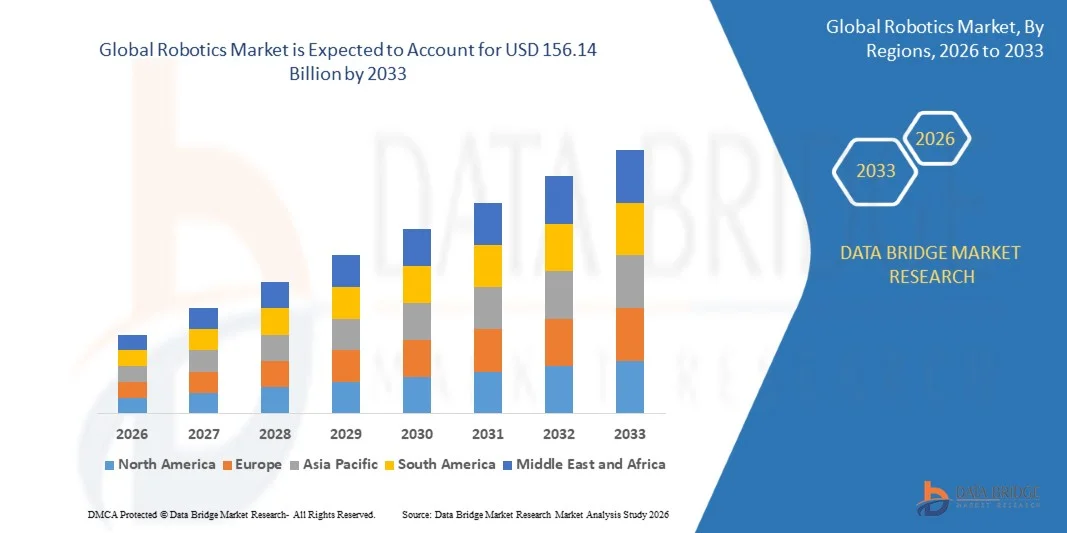
- The global robotics market size was valued at USD 51.4 billion in 2025and is expected to reach USD 156.14 billion by 2033, at a CAGR of 14.9% during the forecast period.
- Market growth is primarily driven by increasing automation across industries, labor shortages, rising demand for precision manufacturing, and rapid advancements in artificial intelligence (AI) and machine learning.
- Additionally, the expansion of Industry 4.0, smart factories, and growing adoption of robots in logistics, healthcare, and service sectors are significantly accelerating market growth.
Robotics Market Analysis
- Robotics systems, which integrate hardware, software, and AI capabilities, are transforming industries by improving productivity, efficiency, and safety
- Demand is increasing due to rising labor costs, need for high-speed operations, and requirement for error-free production processes
- Asia-Pacific dominated the robotics market with the largest revenue share 44% in 2025 due to strong manufacturing ecosystems in China, Japan, and South Korea
- North America is expected to witness significant growth driven by AI integration, warehouse automation, and defense robotics
- The industrial robots segment dominated the market with 67.61% share in 2025 due to widespread adoption in automotive and electronics manufacturing
Report Scope and Robotics Market Segmentation
|
Attributes |
Robotics Key Market Insights |
|
Segments Covered |
|
|
Countries Covered |
North America · U.S. · Canada · Mexico Europe · Germany · France · U.K. · Netherlands · Switzerland · Belgium · Russia · Italy · Spain · Turkey · Rest of Europe Asia-Pacific · China · Japan · India · South Korea · Singapore · Malaysia · Australia · Thailand · Indonesia · Philippines · Rest of Asia-Pacific Middle East and Africa · Saudi Arabia · U.A.E. · South Africa · Egypt · Israel · Rest of Middle East and Africa South America · Brazil · Argentina · Rest of South America |
|
Key Market Players |
|
|
Market Opportunities |
· Expansion of collaborative robots (cobots) in SMEs · Increasing adoption of robotics in healthcare (surgical robots, rehabilitation robots) |
|
Value Added Data Infosets |
In addition to the market insights such as market value, growth rate, market segments, geographical coverage, market players, and market scenario, the market report curated by the Data Bridge Market Research team includes in-depth expert analysis, import/export analysis, pricing analysis, production consumption analysis, and pestle analysis. |
Robotics Market Trends
“Shift Toward AI-Driven and Collaborative Robotics”
- A significant trend in the global robotics market is the increasing integration of artificial intelligence (AI), machine learning, and computer vision into robotic systems
- Collaborative robots (cobots) are gaining traction due to their ability to safely work alongside humans in shared environments
- Autonomous mobile robots (AMRs) are transforming warehouse and logistics operations by enabling efficient material handling and real-time navigation
- Robotics systems are becoming more intelligent, flexible, and capable of performing complex tasks with minimal human intervention
- Cloud robotics and digital twin technologies are enhancing predictive maintenance and operational optimization
- Increasing adoption of robotics in non-industrial sectors such as healthcare, agriculture, and retail is expanding market scope
Robotics Market Dynamics
Driver
“Rising Automation and Industry 4.0 Adoption”
- The increasing adoption of automation across industries such as manufacturing, logistics, healthcare, and electronics is a primary driver accelerating the growth of the global robotics market. Organizations are increasingly deploying robotic systems to enhance productivity, reduce operational costs, and improve process efficiency
- For instance, leading manufacturers are integrating advanced robotic systems into production lines to achieve higher precision, faster cycle times, and consistent product quality, particularly in sectors such as automotive and electronics where accuracy and repeatability are critical
- The growing shortage of skilled labor, especially in developed economies, is further driving the adoption of robotics. Aging populations and declining workforce participation are pushing companies to invest in robotic automation to maintain production levels and ensure business continuity
- Additionally, rising labor costs across both developed and emerging markets are encouraging enterprises to shift toward robotics solutions that offer long-term cost efficiency despite higher initial investments
- The rapid expansion of Industry 4.0 and smart manufacturing ecosystems is significantly boosting demand for robotics. Integration of robotics with technologies such as artificial intelligence (AI), Internet of Things (IoT), machine vision, and cloud computing is enabling real-time monitoring, predictive maintenance, and autonomous decision-making
- The increasing demand for high-speed and error-free operations in industries such as e-commerce and logistics is also contributing to market growth. Autonomous mobile robots (AMRs) and automated guided vehicles (AGVs) are widely deployed in warehouses to streamline material handling and order fulfillment processes
Restraint/Challenge
“High Initial Investment and Technical Complexity”
- The high initial cost associated with the deployment of robotic systems remains one of the most significant barriers to market growth, particularly for small and medium-sized enterprises (SMEs). Costs related to hardware, software, system integration, and infrastructure upgrades can be substantial
- For instance, advanced robotic systems equipped with AI capabilities, sensors, and machine vision technologies require significant capital investment, making them less accessible for cost-sensitive industries and emerging markets
- Integration of robotics into existing legacy systems presents another major challenge. Many organizations face difficulties in aligning new robotic solutions with their current infrastructure, leading to increased implementation time and costs
- The lack of a skilled workforce capable of operating, programming, and maintaining advanced robotic systems is a critical constraint. As robotics technology becomes more sophisticated, the demand for specialized technical expertise continues to grow, creating a talent gap
- Additionally, concerns related to cybersecurity are increasing as robotics systems become more connected through IoT and cloud platforms. Vulnerabilities in connected systems can expose organizations to data breaches and operational disruptions
- Maintenance and operational costs associated with robotics systems can also impact adoption, particularly for companies with limited technical resources
- Resistance to change and concerns about job displacement among the workforce may slow down the adoption of robotics in certain industries, especially in regions with high dependence on manual labor
- Regulatory and compliance challenges, particularly in sectors such as healthcare and defense, can delay the deployment of robotic systems due to stringent safety and approval requirements
Robotics Market Scope
The market is segmented on the basis of type, application, and end-user.
- By type
On the basis of type, the global robotics market is segmented into industrial robots and service robots.
The industrial robots segment dominated the market with the largest revenue share in 2025, driven by their extensive adoption across manufacturing industries such as automotive, electronics, and heavy machinery. Industrial robots are widely used for applications including welding, assembly, painting, material handling, and packaging due to their high precision, speed, and repeatability. Their ability to operate continuously with minimal errors significantly enhances production efficiency and reduces operational costs. Additionally, the integration of advanced technologies such as artificial intelligence (AI), machine vision, and predictive maintenance capabilities is further strengthening the adoption of industrial robots in smart factory environments.
The service robots segment is expected to witness the fastest growth during the forecast period, fueled by increasing demand across non-industrial applications such as healthcare, logistics, agriculture, and domestic use. Service robots, including medical robots, autonomous mobile robots (AMRs), and personal assistance robots, are gaining traction due to their ability to perform complex and repetitive tasks with minimal human intervention. The rising adoption of robotics in healthcare for surgical procedures, rehabilitation, and patient assistance, along with the expansion of e-commerce driving warehouse automation, is significantly accelerating the growth of this segment globally.
- By application
On the basis of application, the robotics market is segmented into manufacturing, logistics & warehousing, healthcare, defense & security, agriculture, and others.
The manufacturing segment dominated the market in 2025, driven by the widespread adoption of industrial robots for automation of production processes. Robotics is extensively used in manufacturing for tasks such as assembly, welding, painting, and material handling, enabling higher efficiency, reduced errors, and improved product quality. The automotive and electronics industries are major contributors to this segment’s dominance due to their high reliance on precision and mass production.
The logistics & warehousing segment is expected to witness the fastest growth during the forecast period, fueled by the rapid expansion of e-commerce and increasing demand for efficient supply chain operations. Robotics solutions such as autonomous mobile robots (AMRs) and automated guided vehicles (AGVs) are widely deployed in warehouses for order picking, sorting, and inventory management, significantly improving operational efficiency and reducing delivery times.
- By end-user
On the basis of end-user, the robotics market is segmented into automotive, electronics, healthcare, logistics & e-commerce, and others.
The automotive segment accounted for the largest market revenue share in 2025, owing to the extensive use of industrial robots in vehicle manufacturing processes such as welding, painting, assembly, and material handling. Robotics enables high precision, consistency, and scalability, making it an essential component of automotive production lines. The increasing adoption of electric vehicles (EVs) and automation in automotive manufacturing is further strengthening the demand for robotics in this segment.
The healthcare segment is expected to witness significant growth during the forecast period, supported by increasing adoption of surgical robots, rehabilitation robots, and robotic-assisted diagnostic systems. Robotics enhances surgical precision, reduces recovery time, and improves patient outcomes, making it a key component of modern healthcare systems.
Robotics Market Regional Analysis
- Asia-Pacific dominated the robotics market with the largest revenue share of 42.44% in 2025, supported by the presence of strong manufacturing hubs, high adoption of industrial automation, and significant investments in robotics technologies across countries such as China, Japan, and South Korea.
- The region benefits from a well-established electronics and automotive manufacturing ecosystem, which extensively utilizes industrial robots for precision production, assembly, and quality control.
- Government initiatives promoting automation and smart manufacturing, along with increasing labor costs and workforce shortages, are accelerating the adoption of robotics across industries.
- The growing presence of leading robotics manufacturers and suppliers in the region further strengthens Asia-Pacific’s dominant position in the global market.
U.S. Robotics Market Insight
The U.S. robotics market captured the largest revenue share in North America in 2025, driven by the increasing adoption of robotics across logistics, healthcare, defense, and manufacturing sectors. Companies are heavily investing in warehouse automation solutions, particularly autonomous mobile robots (AMRs) and robotic picking systems, to improve operational efficiency and meet the growing demand from e-commerce. The integration of artificial intelligence (AI) and machine learning into robotic systems is further enhancing capabilities such as real-time decision-making and predictive maintenance. In addition, strong presence of technology companies, advanced infrastructure, and high R&D investments are significantly contributing to sustained market growth.
U.K. Robotics Market Insight
The U.K. robotics market is expected to grow at a notable CAGR during the forecast period, supported by increasing adoption of automation across manufacturing, healthcare, and logistics sectors. The country is witnessing rising demand for robotics in warehouse automation and supply chain optimization, driven by the growth of e-commerce. Additionally, government initiatives promoting digital transformation and innovation are encouraging the adoption of robotics technologies. The presence of research institutions and startups focusing on AI and robotics is further contributing to market development.
Germany Robotics Market Insight
The Germany robotics market is anticipated to expand at a considerable CAGR during the forecast period, driven by its strong industrial base and leadership in advanced manufacturing technologies. Germany is one of the largest adopters of industrial robots in Europe, particularly in the automotive and engineering sectors. The country’s focus on Industry 4.0, precision engineering, and automation is fostering widespread deployment of robotics systems. Moreover, strong collaboration between industry players, research institutions, and government bodies is accelerating innovation and adoption.
Asia-Pacific Robotics Market Insight
The Asia-Pacific robotics market is poised to grow at the fastest CAGR during the forecast period of 2026 to 2033, driven by rapid industrialization, urbanization, and increasing investments in automation technologies. Countries such as China, Japan, South Korea, and India are witnessing significant growth due to expanding manufacturing activities and rising adoption of robotics across industries. The region’s cost-competitive manufacturing environment and large-scale production capabilities are further boosting demand for industrial robots. Additionally, increasing adoption of robotics in logistics, healthcare, and agriculture is expanding the market scope beyond traditional manufacturing applications.
Japan Robotics Market Insight
The Japan robotics market is gaining momentum due to the country’s strong technological expertise and leadership in robotics innovation. Japan is home to some of the world’s leading robotics manufacturers and has one of the highest robot densities globally. The aging population and shrinking workforce are key factors driving the adoption of robotics across industries, including healthcare and service sectors. The increasing use of robots in elder care, manufacturing, and logistics is further supporting market growth.
India Robotics Market Insight
The India robotics market is expected to witness significant growth during the forecast period, driven by increasing industrial automation, rising adoption of robotics in logistics and e-commerce, and government initiatives promoting manufacturing and digitalization. Programs such as “Make in India” and the expansion of smart factories are encouraging companies to adopt robotics solutions to improve productivity and competitiveness. Additionally, the growing startup ecosystem and increasing investments in AI and automation technologies are contributing to the expansion of the robotics market in India.
Robotics Market Share
The Robotics industry is primarily led by well-established companies, including:
- ABB Ltd. (Switzerland)
- Fanuc Corporation (Japan)
- KUKA AG (Germany)
- Yaskawa Electric Corporation (Japan)
- Mitsubishi Electric Corporation (Japan)
- Omron Corporation (Japan)
- Universal Robots (Denmark)
- iRobot Corporation (U.S.)
- Intuitive Surgical Inc. (U.S.)
- Boston Dynamics (U.S.)
What are the Recent Developments in Global Robotics Market?
- In April 2026, significant advancements in AI-powered robotics were demonstrated as robots achieved human-level performance in complex physical tasks such as sports and dynamic interactions. For instance, advanced robots equipped with real-time vision systems and reinforcement learning algorithms successfully competed with professional athletes, showcasing major progress in perception, decision-making, and physical execution capabilities.
- In March 2026, humanoid robotics reached a major milestone as autonomous robots outperformed human participants in endurance-based events, highlighting rapid improvements in mobility, autonomy, and real-world deployment capabilities. These developments indicate a transition of robotics from experimental prototypes to practical, high-performance systems across industries.
- In January 2026, leading semiconductor and technology firms expanded into robotics by launching dedicated “Physical AI” divisions, focusing on integrating AI with physical robotic systems. This development reflects growing convergence between AI, semiconductors, and robotics, enabling smarter, more adaptive, and energy-efficient robotic systems.
- In February 2026, major companies announced large-scale investments in robotics manufacturing, including plans to develop high-capacity production facilities for humanoid and industrial robots. This indicates a shift toward mass production and commercialization of robotics technologies.
- In December 2025, advancements in collaborative robots (cobots) were introduced with enhanced safety features, improved human-machine interaction, and easier programming capabilities, enabling wider adoption among small and medium-sized enterprises (SMEs).

- Interactive Data Analysis Dashboard
- Company Analysis Dashboard for high growth potential opportunities
- Research Analyst Access for customization & queries
- Competitor Analysis with Interactive dashboard
- Latest News, Updates & Trend analysis
- Harness the Power of Benchmark Analysis for Comprehensive Competitor Tracking
Data collection and base year analysis are done using data collection modules with large sample sizes. The stage includes obtaining market information or related data through various sources and strategies. It includes examining and planning all the data acquired from the past in advance. It likewise envelops the examination of information inconsistencies seen across different information sources. The market data is analysed and estimated using market statistical and coherent models. Also, market share analysis and key trend analysis are the major success factors in the market report. To know more, please request an analyst call or drop down your inquiry.
The key research methodology used by DBMR research team is data triangulation which involves data mining, analysis of the impact of data variables on the market and primary (industry expert) validation. Data models include Vendor Positioning Grid, Market Time Line Analysis, Market Overview and Guide, Company Positioning Grid, Patent Analysis, Pricing Analysis, Company Market Share Analysis, Standards of Measurement, Global versus Regional and Vendor Share Analysis. To know more about the research methodology, drop in an inquiry to speak to our industry experts.
Data Bridge Market Research is a leader in advanced formative research. We take pride in servicing our existing and new customers with data and analysis that match and suits their goal. The report can be customized to include price trend analysis of target brands understanding the market for additional countries (ask for the list of countries), clinical trial results data, literature review, refurbished market and product base analysis. Market analysis of target competitors can be analyzed from technology-based analysis to market portfolio strategies. We can add as many competitors that you require data about in the format and data style you are looking for. Our team of analysts can also provide you data in crude raw excel files pivot tables (Fact book) or can assist you in creating presentations from the data sets available in the report.













