




Global Rodenticides Market
Market Size in USD Billion
CAGR :
% 
 USD
4.55 Billion
USD
7.08 Billion
2025
2033
USD
4.55 Billion
USD
7.08 Billion
2025
2033
 Forecast Period Forecast Period |
2026 –2033 |
 Market Size (Base Year) Market Size (Base Year) |
USD 4.55 Billion |
 Market Size (Forecast Year) Market Size (Forecast Year) |
USD 7.08 Billion |
 CAGR CAGR |
% |
| Major Markets Players |
|
Rodenticides Market Size
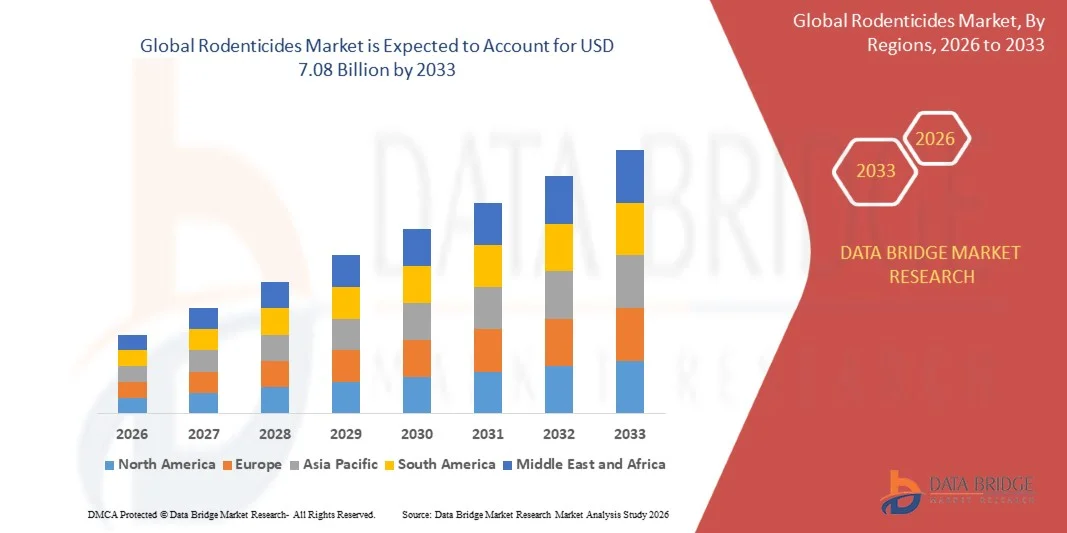
- The global rodenticides market size was valued at USD 4.55 billion in 2025 and is expected to reach USD 7.08 billion by 2033, at a CAGR of 5.70% during the forecast period
- The market growth is largely fueled by increasing rodent infestations across agricultural fields, urban centres, warehouses, and food storage facilities, driven by rapid urbanization, population growth, and expanding food supply chains. Rising concerns over crop losses, food contamination, and property damage are pushing governments and commercial users to adopt effective rodent control solutions, thereby strengthening demand for rodenticides across global markets
- Furthermore, stringent public health regulations and increasing awareness regarding rodent-borne diseases such as leptospirosis, hantavirus, and salmonellosis are accelerating the adoption of professional pest control measures. Growing preference for integrated pest management practices and improved availability of advanced anticoagulant and non-anticoagulant formulations are further supporting market expansion, making rodenticides a critical component of modern pest control strategies
Rodenticides Market Analysis
- Rodenticides are chemical agents used to control or eliminate rodent populations in agricultural, industrial, commercial, and residential environments. These products are available in various formulations such as anticoagulants, non-anticoagulants, pellets, blocks, and powders, designed to suit different application needs and infestation levels across multiple end-use sectors
- The increasing need for efficient crop protection, hygiene maintenance in urban environments, and contamination prevention in food storage systems is primarily driving the demand for rodenticides. Growing adoption by pest control companies and expansion of structured pest management services are further supporting consistent market growth globally
- North America dominated the rodenticides market with a share of 36.10% in 2025, due to stringent public health regulations and strong demand for advanced pest control solutions across agriculture, commercial, and urban environments
- Asia-Pacific is expected to be the fastest growing region in the rodenticides market during the forecast period due to rapid urbanization, expanding agricultural activities, and rising population density in countries such as China, India, and Southeast Asia
- Anticoagulant segment dominated the market with a market share of 76.7% in 2025, due to its long-established effectiveness in controlling rodent populations through delayed-action mechanisms that reduce bait shyness. These products are widely used across agricultural fields, warehouses, and urban sanitation programs due to their broad-spectrum control capability and relatively cost-efficient deployment
Report Scope and Rodenticides Market Segmentation
|
Attributes |
Rodenticides Key Market Insights |
|
Segments Covered |
|
|
Countries Covered |
North America
Europe
Asia-Pacific
Middle East and Africa
South America
|
|
Key Market Players |
|
|
Market Opportunities |
|
|
Value Added Data Infosets |
In addition to the insights on market scenarios such as market value, growth rate, segmentation, geographical coverage, and major players, the market reports curated by the Data Bridge Market Research also include import export analysis, production capacity overview, production consumption analysis, price trend analysis, climate change scenario, supply chain analysis, value chain analysis, raw material/consumables overview, vendor selection criteria, PESTLE Analysis, Porter Analysis, and regulatory framework. |
Rodenticides Market Trends
“Rising Adoption of Integrated Pest Management (IPM) Practices”
- A significant trend in the rodenticides market is the growing shift toward Integrated Pest Management (IPM) practices, driven by the need to reduce chemical dependency while maintaining effective rodent control across agricultural, commercial, and urban environments. This approach is strengthening the use of targeted baiting systems, monitoring tools, and controlled application methods within structured pest management programs
- For instance, BASF and Syngenta are developing rodent control solutions that are increasingly incorporated into IPM programs used in large-scale farming and storage facilities. These solutions support controlled rodent suppression while aligning with sustainability-focused pest management strategies adopted by agricultural operators
- The adoption of IPM is expanding in urban pest control services where municipalities and facility managers are focusing on combining sanitation, exclusion, and selective rodenticide use to reduce environmental impact. This is improving long-term pest control efficiency in densely populated areas while lowering reliance on continuous chemical application
- Agricultural stakeholders are increasingly implementing IPM-based rodent management in grain storage and crop protection systems to reduce post-harvest losses. This is driving demand for smarter rodenticide deployment strategies that minimize resistance development and environmental exposure
- The market is also witnessing rising integration of digital monitoring and bait station technologies that support IPM frameworks by enabling real-time tracking of rodent activity. This is improving precision in rodenticide usage and reducing unnecessary chemical dispersion across sensitive ecosystems
- The continued emphasis on sustainable pest control practices is reinforcing the role of IPM as a key market direction, supporting safer, more efficient, and environmentally aligned rodent management approaches across global end-use industries
Rodenticides Market Dynamics
Driver
“Increasing Rodent Infestations Across Agriculture and Urban Areas”
- The growing prevalence of rodent infestations in agricultural fields, food storage facilities, and urban infrastructure is a major driver of the rodenticides market, as rodents cause significant economic losses through crop damage, contamination, and infrastructure degradation. This rising pressure is increasing demand for effective chemical and bait-based control solutions across multiple end-use sectors
- For instance, Rentokil Initial provides large-scale rodent control services across commercial and urban environments, addressing infestation challenges in food processing units, warehouses, and public infrastructure systems. These services highlight the widespread need for structured rodent management programs in high-risk environments
- Agricultural regions are experiencing higher rodent activity due to changing climatic conditions and expanded grain storage practices, which is increasing post-harvest losses and driving demand for rodenticide products. This is strengthening adoption across farming communities that require reliable pest suppression tools to protect yields
- Urbanization and population density growth are contributing to increased waste generation, which supports rodent population expansion in cities. This is pushing municipalities and facility operators to invest in sustained rodent control measures using advanced baiting and monitoring systems
- The persistent rise in rodent-related health and economic risks continues to reinforce this driver, supporting steady growth in demand for effective and scalable rodent control solutions across both developed and emerging markets
Restraint/Challenge
“Stringent Environmental Regulations Limiting Chemical Usage in Pest Control”
- The rodenticides market is constrained by increasingly strict environmental regulations aimed at reducing ecological and non-target species risks associated with chemical rodent control products. Regulatory authorities are imposing tighter restrictions on active ingredients, dosage levels, and application environments to minimize environmental impact
- For instance, the U.S. Environmental Protection Agency and the European Chemicals Agency have introduced limitations on second-generation anticoagulant rodenticides due to concerns over secondary poisoning of wildlife. These regulatory actions have led manufacturers to reformulate products and shift toward safer alternatives
- Environmental safety concerns related to bioaccumulation and ecosystem disruption are pushing regulatory bodies to enforce stricter compliance standards across agricultural and urban pest control operations. This is increasing the complexity of product approvals and market entry requirements for manufacturers
- Companies such as Bayer Crop Science and BASF are adapting their product portfolios to meet evolving regulatory frameworks by developing lower-toxicity formulations and alternative active ingredients. This transition requires additional investment in research and compliance testing
- The ongoing tightening of environmental regulations continues to challenge market expansion, as manufacturers must balance effectiveness, safety, and compliance while developing next-generation rodent control solutions aligned with global sustainability expectations
Rodenticides Market Scope
The market is segmented on the basis of product, form, and application.
• By Product
On the basis of product, the rodenticides market is segmented into anticoagulant and non-anticoagulant. The anticoagulant segment dominated the largest market revenue share of 76.7% in 2025, supported by its long-established effectiveness in controlling rodent populations through delayed-action mechanisms that reduce bait shyness. These products are widely used across agricultural fields, warehouses, and urban sanitation programs due to their broad-spectrum control capability and relatively cost-efficient deployment. Their long residual activity and compatibility with multiple application environments further strengthen their adoption. Strong regulatory acceptance in several regions has also contributed to sustained market preference.
The non-anticoagulant segment is expected to witness the fastest growth from 2026 to 2033, driven by rising concerns over anticoagulant resistance in rodent populations and increasing demand for faster-acting solutions. This category is gaining traction due to safety considerations related to secondary poisoning risks affecting non-target wildlife. Regulatory pressures encouraging reduced environmental impact pest control solutions are further accelerating adoption. Non-anticoagulant formulations are increasingly preferred in sensitive ecosystems and urban settings where rapid knockdown and controlled toxicity are prioritized. Continuous innovation in active ingredients is supporting broader market expansion.
• By Form
On the basis of form, the rodenticides market is segmented into pellets, block, and powder. The block segment dominated the largest market revenue share in 2025 due to its high durability, resistance to moisture, and suitability for both indoor and outdoor environments. Block formulations are widely deployed in agriculture, warehouses, and urban pest control programs as they provide consistent bait consumption and longer field life. Their ease of placement in bait stations and reduced spillage risk enhances operational efficiency. Strong demand from professional pest control services further reinforces this segment’s dominance.
The powder segment is expected to witness the fastest growth rate from 2026 to 2033, driven by its effectiveness in targeted applications such as burrow treatments and hard-to-reach infestation zones. Powder-based rodenticides allow flexible mixing and application, making them suitable for specialized pest management strategies. Increasing adoption in industrial and sanitation-sensitive environments is supporting segment expansion. Their ability to penetrate confined spaces and deliver rapid exposure to rodents is enhancing demand. Growing emphasis on precision pest control methods is further accelerating growth in this segment.
• By Application
On the basis of application, the rodenticides market is segmented into agriculture, pest control companies, warehouses, urban centres, and household. The agriculture segment dominated the largest market revenue share in 2025, driven by the significant economic losses caused by rodent infestations in crops and stored grains. Rodenticides are extensively used to protect yield quality, reduce post-harvest losses, and maintain food security across farming regions. Large-scale agricultural operations rely on systematic rodent control programs integrated with farm management practices. High dependency on grain storage protection further strengthens this segment’s dominance.
The urban centres segment is expected to witness the fastest growth from 2026 to 2033, supported by rapid urbanization, increasing waste generation, and rising concerns over public health and sanitation. Dense population clusters create favorable conditions for rodent proliferation, increasing demand for structured pest control measures. Municipal authorities and private pest control companies are increasingly deploying rodenticides as part of integrated urban pest management programs. Expansion of residential complexes and commercial infrastructure further contributes to rising usage. Growing awareness of disease transmission risks associated with rodents is accelerating adoption in urban environments.
Rodenticides Market Regional Analysis
- North America dominated the rodenticides market with the largest revenue share of 36.10% in 2025, driven by stringent public health regulations and strong demand for advanced pest control solutions across agriculture, commercial, and urban environments
- The region shows high adoption of integrated pest management practices supported by well-established pest control service providers. Increasing concerns over food safety and contamination in storage facilities and warehouses further strengthen market demand
- High awareness regarding rodent-borne diseases and strict compliance standards continue to support consistent usage of rodenticides across end-user industries, establishing North America as a leading regional market
U.S. Rodenticides Market Insight
The U.S. rodenticides market captured the largest revenue share in North America in 2025, supported by extensive agricultural activities and large-scale food storage infrastructure requiring continuous rodent control measures. Rising urban infestations in densely populated cities are further increasing reliance on professional pest control services. Strong regulatory frameworks governing food safety and public health encourage systematic rodent management practices across residential and commercial sectors. The presence of established pest control companies and widespread availability of advanced rodenticide formulations continue to drive market expansion.
Europe Rodenticides Market Insight
The Europe rodenticides market is projected to expand at a steady CAGR during the forecast period, driven by strict environmental regulations and increasing emphasis on sustainable pest control solutions. Growing concerns regarding hygiene in food processing industries and public infrastructure are encouraging controlled rodent management practices. Urbanization and expansion of commercial facilities are further contributing to demand for rodenticides across the region. The market is also influenced by regulatory restrictions on chemical usage, leading to structured adoption of safer and more efficient rodent control solutions.
U.K. Rodenticides Market Insight
The U.K. rodenticides market is expected to grow at a notable CAGR during the forecast period, driven by rising concerns over urban rodent infestations and increasing demand for hygiene maintenance in residential and commercial spaces. Expanding food retail and hospitality sectors are reinforcing the need for consistent pest control measures. Government-led sanitation programs and awareness campaigns regarding rodent-borne diseases are further supporting market growth. The adoption of professional pest control services is increasing across urban centers, strengthening overall market demand.
Germany Rodenticides Market Insight
The Germany rodenticides market is anticipated to expand at a considerable CAGR during the forecast period, supported by strong regulatory compliance standards and high awareness of environmental safety. Industrial facilities, warehouses, and food processing units are major contributors to demand for rodent control solutions. The country’s focus on precision-based and regulated pest management practices is driving structured adoption of rodenticides. Increasing urban development and emphasis on public hygiene further support steady market growth across both residential and commercial applications.
Asia-Pacific Rodenticides Market Insight
The Asia-Pacific rodenticides market is poised to grow at the fastest CAGR from 2026 to 2033, driven by rapid urbanization, expanding agricultural activities, and rising population density in countries such as China, India, and Southeast Asia. Increasing food production requirements and post-harvest loss concerns are significantly boosting rodenticide usage in agricultural applications. Growing urban infrastructure development and inadequate sanitation systems in some regions are further increasing rodent infestation risks. Expanding pest control service networks and rising awareness of health risks are accelerating adoption across both rural and urban areas.
Japan Rodenticides Market Insight
The Japan rodenticides market is gaining steady momentum due to strict hygiene standards, advanced urban infrastructure, and high demand for controlled pest management solutions. The country’s focus on food safety in retail and hospitality sectors is driving consistent use of rodenticides. Limited space in urban environments increases rodent infestation risks, supporting demand for effective control measures. Technological advancement in pest control methods and structured regulatory frameworks further reinforce market stability.
China Rodenticides Market Insight
The China rodenticides market accounted for the largest market revenue share in Asia-Pacific in 2025, supported by rapid urban expansion, large-scale agricultural production, and increasing adoption of modern pest control practices. Growing food storage and distribution networks are creating sustained demand for rodent management solutions. Rising public health awareness and government-led urban sanitation initiatives are further supporting market expansion. Strong domestic manufacturing capabilities and availability of cost-effective rodenticide products continue to enhance market penetration across both urban and rural regions.
Rodenticides Market Share
The rodenticides industry is primarily led by well-established companies, including:
- BASF SE (Germany)
- Bayer AG (Germany)
- Syngenta AG (Switzerland)
- UPL Limited (India)
- Liphatech Inc. (U.S.)
- JT Eaton & Co. (U.S.)
- Neogen Corporation (U.S.)
- Pelgar International (U.K.)
- SenesTech Inc. (U.S.)
- Bell Laboratories Inc. (U.S.)
- Impex Europa S.L. (Spain)
- Rentokil Initial Plc (U.K.)
- Terminix Global Holdings (U.S.)
- Ecolab Inc. (U.S.)
- Anticimex Group (Sweden)
- Rollins Inc. (U.S.)
- Truly Nolen (U.S.)
- Abell Pest Control (Canada)
Latest Developments in Global Rodenticides Market
- In November 2024, the United States Environmental Protection Agency (EPA) released its final biological evaluation of 11 rodenticides, stating that 88% of endangered species are not expected to face adverse impacts under proposed mitigation measures. This regulatory clarification is significant for the rodenticides market as it provides a more structured compliance pathway for manufacturers while balancing environmental safety concerns. It is expected to support continued product approvals and encourage market stability, particularly for established active ingredients. The decision also reduces regulatory uncertainty, which can help companies plan product development and commercialization strategies more effectively
- In October 2024, BASF Group reported its Q3 financial performance, highlighting improved contributions from its Agricultural Solutions division, which includes rodenticide products, alongside continued investment in advanced formulations such as flocoumafen and cholecalciferol. This development reflects ongoing innovation in high-efficacy rodenticides aimed at addressing resistance issues and improving pest control efficiency. Increased R&D investment by major players strengthens the competitive landscape and supports the introduction of more targeted and sustainable rodent control solutions. It also indicates steady demand from agricultural and professional pest management sectors
- In August 2024, the EPA issued cancellation orders for multiple pesticide registrations and mandated stricter stewardship measures for existing inventory disposal. This action is impacting the rodenticides market by tightening regulatory oversight and pushing manufacturers toward safer, more environmentally responsible product formulations. It is expected to accelerate the shift toward reduced-risk rodenticides and integrated pest management approaches. The development also increases compliance requirements for manufacturers and distributors, influencing operational and product lifecycle strategies across the industry
- In March 2024, Bayer AG’s Capital Markets Day presentation highlighted its strategic plan to launch ten major crop protection products over the next decade, including next-generation rodenticide technologies. This announcement signals strong long-term investment in innovation within pest control solutions, aimed at improving efficacy and addressing resistance challenges. The focus on advanced formulations is expected to enhance Bayer’s competitive position in the global rodenticides market. It also reflects broader industry trends toward sustainable and high-performance agricultural protection products
- In April 2023, Target Specialty Products launched CITO Paste, a fast-acting rodenticide formulated with brodifacoum designed for commercial pest control applications. This product introduction strengthens market growth by offering improved application convenience and rapid rodent elimination in both indoor and outdoor environments. Its compatibility with bait stations and applicators enhances operational efficiency for pest management professionals. Such innovations are driving wider adoption of advanced rodenticide solutions, particularly in commercial and industrial sectors where effective and efficient rodent control is critical
SKU-
Get online access to the report on the World's First Market Intelligence Cloud

- Interactive Data Analysis Dashboard
- Company Analysis Dashboard for high growth potential opportunities
- Research Analyst Access for customization & queries
- Competitor Analysis with Interactive dashboard
- Latest News, Updates & Trend analysis
- Harness the Power of Benchmark Analysis for Comprehensive Competitor Tracking
Global Rodenticides Market, Supply Chain Analysis and Ecosystem Framework
To support market growth and help clients navigate the impact of geopolitical shifts, DBMR has integrated in-depth supply chain analysis into its Global Rodenticides Market research reports. This addition empowers clients to respond effectively to global changes affecting their industries. The supply chain analysis section includes detailed insights such as Global Rodenticides Market consumption and production by country, price trend analysis, the impact of tariffs and geopolitical developments, and import and export trends by country and HSN code. It also highlights major suppliers with data on production capacity and company profiles, as well as key importers and exporters. In addition to research, DBMR offers specialized supply chain consulting services backed by over a decade of experience, providing solutions like supplier discovery, supplier risk assessment, price trend analysis, impact evaluation of inflation and trade route changes, and comprehensive market trend analysis.
Research Methodology
Data collection and base year analysis are done using data collection modules with large sample sizes. The stage includes obtaining market information or related data through various sources and strategies. It includes examining and planning all the data acquired from the past in advance. It likewise envelops the examination of information inconsistencies seen across different information sources. The market data is analysed and estimated using market statistical and coherent models. Also, market share analysis and key trend analysis are the major success factors in the market report. To know more, please request an analyst call or drop down your inquiry.
The key research methodology used by DBMR research team is data triangulation which involves data mining, analysis of the impact of data variables on the market and primary (industry expert) validation. Data models include Vendor Positioning Grid, Market Time Line Analysis, Market Overview and Guide, Company Positioning Grid, Patent Analysis, Pricing Analysis, Company Market Share Analysis, Standards of Measurement, Global versus Regional and Vendor Share Analysis. To know more about the research methodology, drop in an inquiry to speak to our industry experts.
Customization Available
Data Bridge Market Research is a leader in advanced formative research. We take pride in servicing our existing and new customers with data and analysis that match and suits their goal. The report can be customized to include price trend analysis of target brands understanding the market for additional countries (ask for the list of countries), clinical trial results data, literature review, refurbished market and product base analysis. Market analysis of target competitors can be analyzed from technology-based analysis to market portfolio strategies. We can add as many competitors that you require data about in the format and data style you are looking for. Our team of analysts can also provide you data in crude raw excel files pivot tables (Fact book) or can assist you in creating presentations from the data sets available in the report.












