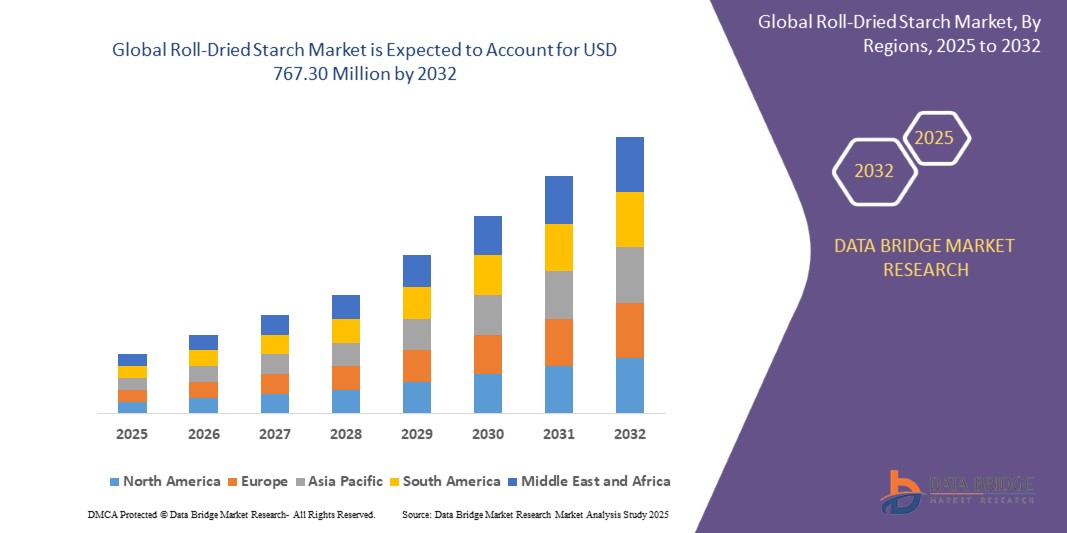
Roll-Dried Starch Market Size
- The global roll-dried starch market size was valued at USD 535.44 million in 2024 and is expected to reach USD 767.30 million by 2032, at a CAGR of 4.6% during the forecast period
- The market growth is largely fueled by the rising demand for processed and convenience foods, increasing use of starches in pharmaceutical and cosmetic formulations, and technological advancements in starch modification processes, enabling enhanced functionality in diverse applications
- Furthermore, growing consumer preference for clean-label, plant-based, and functional food products is driving manufacturers to adopt roll-dried starches with improved stability, texture, and viscosity. These converging factors are accelerating the adoption of roll-dried starch solutions, thereby significantly boosting the industry’s growth
Roll-Dried Starch Market Analysis
- Roll-dried starches are dehydrated starch products processed from corn, potato, tapioca, wheat, or other raw materials, designed to improve water-binding, viscosity, texture, and stability in food, pharmaceutical, and industrial applications
- The escalating demand for roll-dried starch is primarily fueled by the expansion of processed foods, growing use in instant foods, sauces, bakery, beverages, and pharmaceuticals, as well as increasing investments in specialty starches that meet functional, clean-label, and sustainable product requirements
- Asia-Pacific dominated roll-dried starch market with a share of over 45% in 2024, due to rapid growth in the food processing, pharmaceutical, and cosmetic industries, coupled with abundant raw material availability and cost-effective production
- North America is expected to be the fastest growing region in the roll-dried starch market during the forecast period due to rising demand for processed foods, instant food powders, and functional starches in pharmaceuticals and cosmetics
- Corn starch segment dominated the market with a market share of 70.5% in 2024, due to its cost-effectiveness and extensive applications in confectionery, snacks, and convenience foods. Corn starch offers desirable thickening and stabilizing properties, making it highly suitable for instant soups, sauces, and bakery fillings. The growing trend toward ready-to-eat and processed foods, coupled with rising demand from emerging economies, is expected to accelerate the adoption of corn starch in both food and industrial applications
Report Scope and Roll-Dried Starch Market Segmentation
|
Attributes |
Roll-Dried Starch Key Market Insights |
|
Segments Covered |
|
|
Countries Covered |
North America
Europe
Asia-Pacific
Middle East and Africa
South America
|
|
Key Market Players |
|
|
Market Opportunities |
|
|
Value Added Data Infosets |
In addition to the insights on market scenarios such as market value, growth rate, segmentation, geographical coverage, and major players, the market reports curated by the Data Bridge Market Research also include in-depth expert analysis, pricing analysis, brand share analysis, consumer survey, demography analysis, supply chain analysis, value chain analysis, raw material/consumables overview, vendor selection criteria, PESTLE Analysis, Porter Analysis, and regulatory framework. |
Roll-Dried Starch Market Trends
Growing Usage in Industrial Applications
- The roll-dried starch market is experiencing significant growth as demand increases from industrial applications beyond food. Starch is widely used in paper manufacturing, adhesives, textiles, and pharmaceuticals due to its binding, thickening, and stabilizing properties, which enhances its role as a versatile input material
- For instance, Cargill has been expanding its starch portfolio by providing customized roll-dried starches that are designed for both food formulations and industrial purposes such as paper coatings and adhesive binders. This dual application strategy enables the company to meet rising cross-sectoral demand driven by industrial growth
- The rising focus on biodegradable and eco-friendly materials is propelling the use of starch derivatives in industries seeking sustainable alternatives to synthetic chemicals. Roll-dried starch, with its natural and renewable origins, is emerging as an environmentally responsible option for replacing petroleum-based binders and fillers
- The fast-growing textile sector is also a strong contributor, as roll-dried starch is extensively used in textile sizing and finishing processes to enhance strength and durability of fabrics. With clothing demand expanding globally, particularly in emerging markets, the applications for starch in textiles continue to grow
- In addition, the pharmaceutical industry is increasingly adopting starch derivatives for use as excipients in tablets and capsules. Roll-dried starch provides excellent disintegration and binding capabilities, and tailored modifications are opening new opportunities in drug formulation processes
- Advances in chemical modification processes are enabling the production of specialized roll-dried starches with enhanced viscosity, solubility, and film-forming properties. These innovations are expanding industrial applicability in segments such as biodegradable packaging and coating solutions
Roll-Dried Starch Market Dynamics
Driver
Increasing Demand from the Food and Beverage Industry
- The growing demand for convenience foods, bakery products, dairy alternatives, and ready-to-drink beverages is driving adoption of roll-dried starch in the global food and beverage industry. Its functional properties, including thickening, stabilizing, and emulsifying, make it a critical ingredient for product innovation
- For instance, Ingredion Incorporated has developed a wide range of starches tailored for food applications, including roll-dried variants that improve texture in soups, sauces, and instant foods. Their focus on functional food ingredients highlights how starch demand is directly tied to evolving food consumer preferences
- The shift toward gluten-free and clean-label products is also enhancing the role of roll-dried starch in food applications. Products using potato, tapioca, and corn-based starch provide natural alternatives for thickening and stabilizing, addressing consumer aspirations for healthier and transparent ingredient labels
- In addition, the rise of dairy-free and plant-based product categories is creating new opportunities. Roll-dried starch is increasingly incorporated in dairy alternatives such as plant-based yogurts, cheeses, and beverages to replicate consistency and creaminess
- The global expansion of quick-service restaurants and convenience meal solutions is strongly connected to the growth of roll-dried starch adoption. To meet consumer tastes, manufacturers rely on starch to ensure stable texture and shelf life in frozen and processed foods
Restraint/Challenge
Price Volatility of Raw Materials
- One of the major challenges confronting the roll-dried starch market is the price volatility of raw materials such as corn, potato, and tapioca. Since starch extraction is heavily dependent on agricultural outputs, fluctuations in crop yields, weather conditions, and trade disruptions directly impact costs
- For instance, global players such as Tate & Lyle face margin pressures due to unpredictable corn prices, which influence the pricing of starch and starch derivatives. These cost fluctuations create difficulties in long-term planning and affect the competitiveness of roll-dried starch in both food and industrial sectors
- Global supply chain disruptions, including export restrictions on key starch-producing regions, add further uncertainty to pricing. Reliance on a limited number of raw material sources leaves the market vulnerable to external shocks such as geopolitical conflicts and natural disasters
- In addition, increasing demand for raw materials from biofuel production and other competing industries is creating supply pressure, contributing to higher costs for starch producers. This competition for agricultural inputs reduces availability and inflates procurement expenses
- Currency fluctuations and variable tariffs on agricultural products also amplify the instability of raw material pricing. Producers in emerging markets are particularly affected by these swings, which make it difficult to achieve stable cost management across production cycles
Roll-Dried Starch Market Scope
The market is segmented on the basis of type, function, end-use, and sales channel.
• By Type
On the basis of type, the roll-dried starch market is segmented into potato starch, corn starch, wheat flour, maize, and others. The corn starch segment dominated the largest market revenue share of 70.5% in 2024, attributed to its cost-effectiveness and extensive applications in confectionery, snacks, and convenience foods. Corn starch offers desirable thickening and stabilizing properties, making it highly suitable for instant soups, sauces, and bakery fillings. The growing trend toward ready-to-eat and processed foods, coupled with rising demand from emerging economies, is expected to accelerate the adoption of corn starch in both food and industrial applications.
The potato starch segment is anticipated to witness the fastest growth rate from 2025 to 2032, fueled by its superior binding, moisture retention, and texturizing properties that make it a preferred ingredient in bakery products, processed meat, and instant foods. Its neutral flavor and excellent water solubility further enhance its adoption across food and industrial applications. The increasing demand for clean-label and gluten-free ingredients also strengthens the position of potato starch in food and pharmaceutical formulations.
• By Function
On the basis of function, the market is segmented into food thickeners, stabilizers, emulsifiers, texturizers, and improved viscosity and spread. The food thickeners segment accounted for the largest market share in 2024, as roll-dried starch is widely used for enhancing the texture, consistency, and shelf stability of sauces, gravies, soups, and dairy products. Its ability to provide uniform viscosity while maintaining natural flavor and appearance makes it the preferred choice among food processors. Increasing consumer demand for high-quality instant and convenience foods further supports the dominance of this segment.
The texturizers segment is expected to register the fastest CAGR during 2025–2032, driven by the rising use of starch in bakery, confectionery, and extruded snack products. Roll-dried starch delivers smooth, stable, and palatable textures, which improve overall product appeal in ready-to-eat categories. In addition, the growing focus on sensory experience in food innovation and the rising popularity of plant-based products are accelerating demand for texturizing applications of roll-dried starch.
• By End Use
Based on end use, the roll-dried starch market is segmented into food industry, instant desserts, instant food powders, instant pie fillings, instant sauces, extruded snacks, spices and seasonings, cosmetic industry, and pharmaceutical industry. The food industry segment dominated the market in 2024, owing to the widespread use of roll-dried starch in processed foods, bakery, confectionery, and savory applications. The demand is supported by increasing consumption of packaged foods and the need for starch as a multifunctional ingredient to improve product stability, taste, and shelf life. Roll-dried starch also plays a crucial role in catering to the rising demand for clean-label and gluten-free foods.
The instant desserts segment is projected to be the fastest-growing end-use category from 2025 to 2032, driven by the rising popularity of quick-preparation, indulgent food options. Roll-dried starch enhances creaminess, improves texture, and ensures consistent quality in puddings, custards, and mousse mixes. The growth of the dessert market in both developed and emerging regions, combined with the consumer shift toward convenient yet premium products, is expected to fuel strong demand in this segment.
• By Sales Channel
On the basis of sales channel, the market is segmented into online and offline. The offline segment held the largest market share in 2024, as supermarkets, hypermarkets, and specialty stores remain the primary distribution channels for food and industrial starches. Buyers often prefer offline channels due to bulk purchasing, immediate availability, and trust in direct supplier relationships. Strong distribution networks and established partnerships between starch manufacturers and food processors also support the dominance of this segment.
The online segment is anticipated to record the fastest growth during 2025–2032, driven by the rapid expansion of e-commerce platforms and growing preference for digital procurement. Online channels provide wider product visibility, competitive pricing, and convenient doorstep delivery, making them increasingly attractive for both bulk buyers and individual consumers. The rising penetration of B2B and B2C online platforms across developing regions is further boosting the adoption of roll-dried starch through digital sales channels.
Roll-Dried Starch Market Regional Analysis
- Asia-Pacific dominated the roll-dried starch market with the largest revenue share of over 45% in 2024, driven by rapid growth in the food processing, pharmaceutical, and cosmetic industries, coupled with abundant raw material availability and cost-effective production
- The region’s expanding industrial base, increasing investments in starch-based products, and growing exports of processed food and cosmetic ingredients are accelerating market expansion
- The availability of skilled labor, supportive government policies, and rising demand for instant and convenience foods are contributing to increased consumption of roll-dried starch across multiple sectors
China Roll-Dried Starch Market Insight
China held the largest share in the Asia-Pacific roll-dried starch market in 2024, owing to its leading position in corn and potato starch production and strong food and pharmaceutical industries. The country’s efficient manufacturing infrastructure, favorable policies for agricultural and food processing sectors, and extensive export capabilities for starch products are key growth drivers. Rising demand for processed foods and instant food powders further supports market expansion.
India Roll-Dried Starch Market Insight
India is witnessing the fastest growth in the Asia-Pacific region, fueled by increasing consumption of processed and convenience foods, rising pharmaceutical production, and expanding cosmetic and personal care industries. Government initiatives promoting agricultural processing, coupled with growing investments in value-added starch products, are strengthening market demand. In addition, rising exports of starch-based ingredients contribute to rapid market growth.
Europe Roll-Dried Starch Market Insight
The Europe roll-dried starch market is growing steadily, supported by high demand for specialty starches in food, pharmaceutical, and industrial applications. Regulatory compliance, focus on high-purity and modified starch products, and investment in sustainable production methods are driving market expansion. The increasing use of starches in gluten-free, low-calorie, and functional food products further enhances market growth.
Germany Roll-Dried Starch Market Insight
Germany’s roll-dried starch market is driven by its advanced food processing sector, strong chemical and pharmaceutical industries, and emphasis on high-quality starch products. Well-established R&D networks and collaboration between universities and manufacturers are fostering continuous innovation in specialty starches. Demand is particularly high for modified starches used in pharmaceuticals, confectionery, and industrial applications.
U.K. Roll-Dried Starch Market Insight
The U.K. market is supported by a mature food and beverage sector, increasing demand for convenience foods, and growing interest in plant-based and functional ingredients. Investments in R&D, specialty starch formulations, and innovative applications in the pharmaceutical and cosmetic industries are supporting market growth. Focus on sustainability and clean-label products is further enhancing adoption.
North America Roll-Dried Starch Market Insight
North America is projected to grow at the fastest CAGR from 2025 to 2032, driven by rising demand for processed foods, instant food powders, and functional starches in pharmaceuticals and cosmetics. Strong food manufacturing infrastructure, focus on product innovation, and increasing use of modified starches for clean-label and gluten-free products are boosting market expansion.
U.S. Roll-Dried Starch Market Insight
The U.S. accounted for the largest share in the North America market in 2024, underpinned by its robust food and pharmaceutical industries, advanced R&D capabilities, and high consumption of convenience and functional foods. Investments in specialty and modified starch production, regulatory support, and strong distribution networks reinforce the country’s leading position in the region.
Roll-Dried Starch Market Share
The roll-dried starch industry is primarily led by well-established companies, including:
- Cargill (U.S.)
- Tate & Lyle (U.K.)
- Grain Processing (U.S.)
- Karandikars Cashell (India)
- Banpong Tapioca Flour Industrial (Thailnad)
- Galam (Israel)
- Crest Cellulose (India)
- Visco Starch (India)
Latest Developments in Global Roll-Dried Starch Market
- In October 2022, Roquette launched a new line of organic pea ingredients, including organic pea starch and organic pea protein. This expansion strengthened the company’s position in the growing plant-based and organic food sector. By sourcing peas from a dedicated network of organic growers and processing them into high-quality starch and protein ingredients, Roquette addressed rising consumer demand for clean-label and sustainable alternatives. This move diversified the company’s product portfolio and also enabled food manufacturers to develop innovative, functional, and plant-based food products with improved texture, stability, and nutritional profile
- In February 2023, Ingredion invested $50 million in its Cedar Rapids facility in Iowa, USA, to expand and modernize its production of industrial and roll-dried starches. This strategic investment enhanced the facility’s capacity to serve a wide range of applications, including processed foods, bakery products, sauces, and beverages. By upgrading its infrastructure and adopting advanced production technologies, Ingredion positioned itself to meet the growing market demand for functional starches that improve viscosity, stability, and texture in diverse formulations. The expansion also strengthened the company’s competitive edge and ability to supply consistent, high-quality products globally
- In June 2022, Cargill Incorporated invested in specialty roll-dried starches to increase sustainable production. The initiative aimed to enhance production capacity and better meet the demands of the dynamic functional food starch market. By focusing on sustainability, Cargill supported food manufacturers in developing innovative and eco-friendly products while ensuring a reliable supply of high-performance starches. The investment also helped the company maintain its competitive advantage, enabling it to respond quickly to market trends and customer requirements for high-quality, functional starch ingredients
- In July 2021, Tate & Lyle enhanced production at its Koog facility, which operates using 100% renewable electricity. This upgrade improved the company’s ability to manufacture roll-dried starches sustainably while reducing carbon emissions and water usage. The investment allowed Tate & Lyle to meet increasing customer demand for environmentally responsible ingredients without compromising on quality or functionality. It also aligned the company with global sustainability goals, reinforcing its reputation as a leader in eco-conscious production and providing food and beverage manufacturers with sustainable starch solutions for diverse applications

- Interactive Data Analysis Dashboard
- Company Analysis Dashboard for high growth potential opportunities
- Research Analyst Access for customization & queries
- Competitor Analysis with Interactive dashboard
- Latest News, Updates & Trend analysis
- Harness the Power of Benchmark Analysis for Comprehensive Competitor Tracking
Data collection and base year analysis are done using data collection modules with large sample sizes. The stage includes obtaining market information or related data through various sources and strategies. It includes examining and planning all the data acquired from the past in advance. It likewise envelops the examination of information inconsistencies seen across different information sources. The market data is analysed and estimated using market statistical and coherent models. Also, market share analysis and key trend analysis are the major success factors in the market report. To know more, please request an analyst call or drop down your inquiry.
The key research methodology used by DBMR research team is data triangulation which involves data mining, analysis of the impact of data variables on the market and primary (industry expert) validation. Data models include Vendor Positioning Grid, Market Time Line Analysis, Market Overview and Guide, Company Positioning Grid, Patent Analysis, Pricing Analysis, Company Market Share Analysis, Standards of Measurement, Global versus Regional and Vendor Share Analysis. To know more about the research methodology, drop in an inquiry to speak to our industry experts.
Data Bridge Market Research is a leader in advanced formative research. We take pride in servicing our existing and new customers with data and analysis that match and suits their goal. The report can be customized to include price trend analysis of target brands understanding the market for additional countries (ask for the list of countries), clinical trial results data, literature review, refurbished market and product base analysis. Market analysis of target competitors can be analyzed from technology-based analysis to market portfolio strategies. We can add as many competitors that you require data about in the format and data style you are looking for. Our team of analysts can also provide you data in crude raw excel files pivot tables (Fact book) or can assist you in creating presentations from the data sets available in the report.