


What is the Roll to Roll Printing Market Size and Growth Rate?
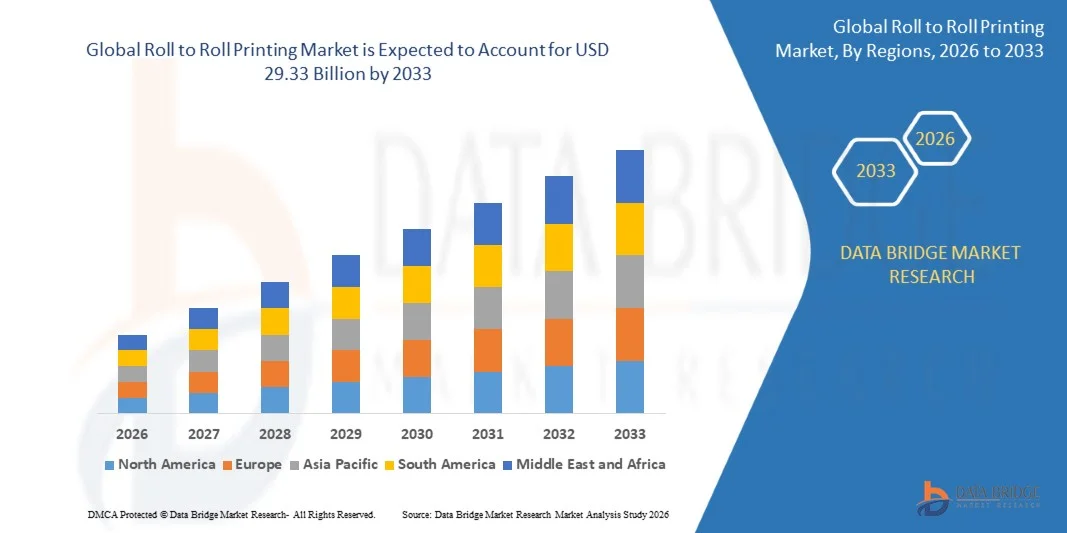
- As per Data Bridge Market Research analysis, the Roll to Roll Printing Market is estimated at USD 15.50 billion in 2025 and is projected to reach USD 29.33 billion by 2033, growing at a CAGR of 8.30% from 2026 to 2033.
- The market is experiencing steady growth driven by rising demand for flexible electronics, advanced packaging solutions, and printed sensors, alongside rapid expansion of end-use industries such as consumer goods, healthcare, and renewable energy.
- The integration of artificial intelligence, IoT, and automation is significantly transforming the roll to roll printing industry, with AI-powered quality inspection, predictive maintenance, and process optimization improving production efficiency and reducing waste. Continued innovation in high-speed inkjet and conductive ink technologies is expected to further expand the addressable market for printed electronics applications.
Market Size & Forecast
- Global Market Value (2025): USD 15.50 Billion
- Expected Market Value (2033): USD 29.33 Billion
- Forecast CAGR (2026–2033): 8.30%
- Leading Region in 2025: Asia-Pacific
- Fastest Growing Region: Asia-Pacific
What are the Major Takeaways of the Roll to Roll Printing Market?
- Asia-Pacific dominated the Roll to Roll Printing Market with the largest revenue share in 2025, supported by a strong regional manufacturing ecosystem and extensive electronics and packaging production capacity.
- Asia-Pacific is also expected to be the fastest-growing region from 2026 to 2033, fueled by rapid advancements in printed electronics technology and increasing demand for high-performance, cost-efficient printing solutions across China, Japan, and South Korea.
- The packaging & labels segment led the application category in 2025, reflecting sustained global demand for cost-efficient, high-volume packaging production.
- The flexible electronics & printed sensors segment is the fastest-growing application, driven by rising demand for lightweight, flexible electronic devices across consumer and healthcare applications.
- The polymer films segment dominated the substrate category in 2025, reflecting its versatility and compatibility with high-speed roll-to-roll printing processes.
- The healthcare segment is the fastest-growing end-use industry, driven by emerging clinical use of roll-to-roll printed biosensors and diagnostic wearables.
- The inkjet segment is the fastest-growing printing technology, reflecting its non-contact printing capability and growing suitability for customized printed electronics.
Report Scope and Roll to Roll Printing Market Segmentation
|
Attributes |
Roll to Roll Printing Key Market Insights |
|
Segments Covered |
|
|
Countries Covered |
North America
Europe
Asia-Pacific
Middle East and Africa
South America
|
|
Key Market Players |
|
|
Market Opportunities |
|
|
Value Added Data Infosets |
In addition to the market insights such as market value, growth rate, market segments, geographical coverage, market players, and market scenario, the market report curated by the Data Bridge Market Research team includes in-depth expert analysis, import/export analysis, pricing analysis, production consumption analysis, and pestle analysis. |
What is the Key Trend in the Roll to Roll Printing Market?
- Leading printing technology companies continue to form strategic collaborations to advance inkjet printing capabilities for flexible electronics and packaging applications.
- In August 2024, Canon and Durst announced a collaboration to develop advanced inkjet printing technologies aimed at enhancing roll-to-roll printing capabilities for flexible electronics and packaging, with the new technologies targeted for integration into next-generation printers and commercial availability in early 2025.
- Manufacturers continue to integrate artificial intelligence and IoT-enabled process controls into roll-to-roll production lines to improve efficiency and reduce material waste.
- During 2025, industry analysis confirmed that AI-powered quality inspection, predictive maintenance, and process optimization technologies were increasingly being integrated into roll-to-roll printing lines, improving production efficiency across packaging and printed electronics manufacturing.
- Growing demand for printed biosensors and diagnostic wearables is driving healthcare-focused innovation within the roll-to-roll printing industry.
- During March2025, industry analysis identified healthcare as the fastest-growing end-use segment for roll-to-roll printing, driven by emerging clinical use of printed biosensors, smart patches, and diagnostic wearables supporting real-time digital health monitoring.
As leading technology providers continue to advance inkjet printing capabilities, AI-enabled process optimization, and healthcare-focused printed electronics innovation, the Roll to Roll Printing Market is expected to sustain steady growth across both established and emerging application areas.
What are the Key Drivers of the Roll to Roll Printing Market?
- Rising global demand for flexible electronics, printed sensors, and advanced packaging solutions continues to drive sustained investment in roll-to-roll printing technology across multiple industries.
- In August 2024, the Canon-Durst collaboration to advance inkjet printing technologies for flexible electronics and packaging reflected the broader industry trend of technology providers investing in higher-precision, higher-speed roll-to-roll printing capabilities to meet rising market demand.
- The rapid expansion of consumer electronics, healthcare, and renewable energy industries continues to create substantial incremental demand for roll-to-roll printed components, including sensors, displays, and photovoltaic cells.
- Growing integration of artificial intelligence and automation into printing production processes continues to improve efficiency, reduce waste, and support scalable, high-volume manufacturing.
- Continued growth in RFID adoption for smart packaging and wearable applications continues to expand the addressable market for roll-to-roll printed electronic components.
With flexible electronics, advanced packaging, and printed sensor applications continuing to expand across consumer, healthcare, and industrial markets, the Roll to Roll Printing Market is expected to remain a durable growth category within the broader printed electronics and packaging landscape.
Which Factors are Challenging the Growth of the Roll to Roll Printing Market?
- High capital costs associated with advanced roll-to-roll printing equipment, particularly for inkjet and conductive ink applications, continue to limit adoption among smaller manufacturers.
- The technical complexity of integrating AI-powered quality inspection and predictive maintenance systems into existing production lines requires substantial engineering investment, creating adoption barriers for manufacturers with legacy equipment.
- Wide variance in market size estimates across industry analysts reflects the inherent difficulty in precisely defining and measuring the roll-to-roll printing category, given its application across highly diverse end-use industries ranging from packaging to advanced printed electronics.
- In June 2024, Koenig & Bauer announced that Match Graphics had invested in a RotaJET high-volume digital printing press for printed décor production in India. The company described the investment as part of a transition toward digital production alongside its existing gravure operations. Such equipment investments illustrate the substantial capital commitment required when manufacturers adopt advanced roll-to-roll digital printing systems.
- Intensifying competition among established printing equipment manufacturers and emerging specialized printed electronics companies continues to pressure pricing and margins across the industry.
- The combination of high capital costs, integration complexity for advanced digital process controls, and intensifying competitive pressure continues to create headwinds for the roll to roll printing market, even as sustained demand for flexible electronics and advanced packaging supports long-term category growth.
How is the Roll to Roll Printing Market Segmented?
The Roll to Roll Printing Market is segmented on the basis of printing technology, substrate, ink type, application, end-use industry, component, and sales channel.
- By Printing Technology
On the basis of printing technology, the Roll to Roll Printing Market is segmented into flexography, gravure, inkjet, offset, and screen printing. The flexography segment dominated the market with a 31.8% share in 2025, owing to its widespread use in high-speed packaging and label printing applications requiring cost-efficient, large-volume production.
The inkjet segment is projected to register the fastest growth, at a CAGR of 10.2% from 2026 to 2033, driven by its non-contact printing capability, scalability, and growing suitability for customized and flexible printed electronics applications such as sensors and photovoltaic cells.
- By Substrate
On the basis of substrate, the Roll to Roll Printing Market is segmented into polymer films, paper, metal foils, textiles, and others. The polymer films segment dominated the market with a 36.5% share in 2025, reflecting its versatility, durability, lightweight characteristics, and compatibility with high-speed roll-to-roll printing processes across packaging, labels, and printed electronics applications.
The metal foils segment is expected to witness the fastest growth, at a CAGR of 9.4% from 2026 to 2033, driven by rising demand for conductive substrates in flexible electronics, energy-storage components, and battery-related applications.
- By Ink Type
On the basis of ink type, the Roll to Roll Printing Market is segmented into solvent-based, water-based, UV-curable, and conductive inks. The UV-curable inks segment dominated the market with a 32.7% share in 2025, owing to its fast-curing properties, durability, high print quality, and growing preference across high-speed production lines.
The conductive inks segment is projected to witness the fastest growth, at a CAGR of 11.1% from 2026 to 2033, driven by rising demand for printed circuits, sensors, antennas, touch interfaces, and flexible electronic components requiring precise electrical conductivity.
- By Application
On the basis of application, the Roll to Roll Printing Market is segmented into flexible electronics & printed sensors, packaging & labels, displays, photovoltaic cells, and smart packaging & RFID. The packaging & labels segment dominated the market with a 42.6% share in 2025, reflecting the continued scale of global demand for high-speed, cost-efficient packaging and label printing across consumer goods industries.
The flexible electronics & printed sensors segment is expected to witness the fastest growth, at a CAGR of 12.3% from 2026 to 2033, driven by rising demand for lightweight and flexible electronic devices across consumer electronics, healthcare, automotive, and industrial applications.
- By End-Use Industry
On the basis of end-use industry, the Roll to Roll Printing Market is segmented into consumer electronics, packaging, healthcare, renewable energy, automotive, and others. The packaging segment dominated the market with a 39.8% share in 2025, driven by sustained global demand for cost-efficient, high-volume packaging and label production across consumer goods industries.
The healthcare segment is projected to witness the fastest growth, at a CAGR of 10.8% from 2026 to 2033, driven by emerging clinical and commercial applications of roll-to-roll printed biosensors, smart patches, diagnostic devices, and wearable components supporting real-time health monitoring.
- By Component
On the basis of component, the Roll to Roll Printing Market is segmented into equipment/machinery, inks & materials, and software & services. The equipment/machinery segment dominated the market with a 48.3% share in 2025, reflecting the substantial capital investment required for roll-to-roll printing lines across packaging, electronics, and specialty printing applications.
The software & services segment is expected to witness the fastest growth, at a CAGR of 9.7% from 2026 to 2033, driven by growing adoption of AI-powered quality inspection, predictive maintenance, production monitoring, workflow automation, and process optimization software.
- By Sales Channel
On the basis of sales channel, the Roll to Roll Printing Market is segmented into direct/OEM and distributors & system integrators. The direct/OEM segment dominated the market with a 67.4% share in 2025, reflecting the technical complexity of roll-to-roll printing lines, which typically require direct engineering collaboration between equipment manufacturers and end users.
The distributors & system integrators segment is projected to witness a comparatively faster growth, at a CAGR of 8.6% from 2026 to 2033, supported by increasing demand for regional installation, equipment integration, technical support, maintenance, and aftermarket services among small and mid-sized manufacturers..
Which Region Holds the Largest Share of the Roll to Roll Printing Market?
- Asia-Pacific dominated the Roll to Roll Printing Market with a market share of 39.03% and accounted for the largest revenue share in 2025, supported by a strong regional manufacturing ecosystem, extensive electronics and packaging production capacity, and rapid advancements in printed electronics technology.
- The region also benefits from competitive domestic manufacturing costs and strong government support for advanced electronics manufacturing. Continued investment in printed electronics research and production capacity is expected to further reinforce Asia-Pacific's leadership position in the global market.
China Roll to Roll Printing Market Insight
The China roll to roll printing market remains supported by the country’s extensive electronics, consumer goods, and packaging manufacturing base, creating substantial demand for high-speed and cost-efficient printing technologies. The presence of a large domestic supply chain for flexible substrates, electronic components, packaging materials, and printing equipment further supports market development. Increasing production of flexible electronics, displays, smart packaging, and printed functional components for both domestic consumption and export markets is also contributing to the adoption of roll-to-roll printing technologies.
Japan Roll to Roll Printing Market Insight
The Japan roll to roll printing market benefits from the country’s advanced manufacturing capabilities and strong presence of technology companies, including Canon, Konica Minolta, Sumitomo Electric, and Fujikura. Japan’s established expertise in precision manufacturing, electronic materials, functional inks, and flexible substrates supports the development of advanced roll-to-roll printing applications. Continued innovation in printed electronics, sensors, displays, and other functional electronic components is further creating opportunities for high-precision roll-to-roll production technologies.
South Korea Roll to Roll Printing Market Insight
The South Korea roll to roll printing market continues to benefit from the country’s advanced electronics manufacturing infrastructure and strong presence across display, semiconductor, battery, and consumer electronics industries. The country’s focus on flexible displays, printed sensors, electronic films, and other lightweight electronic components is supporting demand for scalable roll-to-roll production technologies. Continued investment in next-generation display materials and flexible electronic devices is further strengthening opportunities for roll-to-roll printing across advanced electronics applications.
U.S. Roll to Roll Printing Market Insight
The U.S. roll to roll printing market remains an important innovation center, supported by advanced manufacturing capabilities and companies such as 3M and DuPont. The country also has a strong research ecosystem focused on printed electronics, functional materials, flexible sensors, and advanced manufacturing processes. Increasing development of wearable healthcare devices, flexible electronic components, renewable-energy technologies, and smart packaging is supporting demand for precision roll-to-roll printing systems capable of producing lightweight and functional products at commercial scale.
Germany Roll to Roll Printing Market Insight
The Germany roll to roll printing market benefits from the country’s strong industrial manufacturing, packaging, printing-equipment, and specialty-materials industries. Germany’s established machinery ecosystem supports the development and deployment of high-speed printing and converting technologies for packaging, labels, industrial applications, and functional materials. Continued investment in advanced inks, coatings, flexible substrates, automation, and digital printing technologies is also supporting innovation across roll-to-roll production. The country’s strong position within the European manufacturing and packaging supply chain further contributes to demand for advanced roll-to-roll printing solutions.
Which are the Top Companies in the Roll to Roll Printing Market?
The global roll to roll printing industry is primarily led by well-established printing technology and materials companies, including:
- Canon Inc. (Japan)
- Durst Group AG (Italy)
- Konica Minolta, Inc. (Japan)
- 3M Company (U.S.)
- DuPont de Nemours, Inc. (U.S.)
- Sumitomo Electric Industries, Ltd. (Japan)
- Fujikura Ltd. (Japan)
- E Ink Holdings Inc. (Taiwan)
- Agfa-Gevaert Group (Belgium)
- BASF SE (Germany)
- Molex, LLC (U.S.)
- Nissha Co., Ltd. (Japan)
- Thin Film Electronics ASA (Norway)
- Novacentrix (U.S.)
- Optomec, Inc. (U.S.)
- Applied Ink Solutions (U.S.)
- Enfucell Oy (Finland)
- Vorbeck Materials Corp. (U.S.)
- Multek (U.S.)
- Linxens Group (France)
What are the Latest Developments in the Roll to Roll Printing Market?
- In August 2024, Canon and Durst announced a collaboration to develop advanced inkjet printing technologies aimed at enhancing roll-to-roll printing capabilities for flexible electronics and packaging, with commercial availability of the new technologies targeted for early 2025.
- In March 2025, leading roll-to-roll printing equipment manufacturers continued to integrate AI-powered quality inspection and predictive maintenance capabilities into their production line offerings to reduce waste and improve efficiency.
- In June 2025, industry analysis highlighted growing adoption of roll-to-roll printed biosensors and diagnostic wearables, reflecting expanding healthcare applications for the technology.
- In August 2025, Asia-Pacific equipment manufacturers continued to expand production capacity for roll-to-roll printing systems in response to rising regional demand for flexible electronics and advanced packaging.

- Interactive Data Analysis Dashboard
- Company Analysis Dashboard for high growth potential opportunities
- Research Analyst Access for customization & queries
- Competitor Analysis with Interactive dashboard
- Latest News, Updates & Trend analysis
- Harness the Power of Benchmark Analysis for Comprehensive Competitor Tracking
Data collection and base year analysis are done using data collection modules with large sample sizes. The stage includes obtaining market information or related data through various sources and strategies. It includes examining and planning all the data acquired from the past in advance. It likewise envelops the examination of information inconsistencies seen across different information sources. The market data is analysed and estimated using market statistical and coherent models. Also, market share analysis and key trend analysis are the major success factors in the market report. To know more, please request an analyst call or drop down your inquiry.
The key research methodology used by DBMR research team is data triangulation which involves data mining, analysis of the impact of data variables on the market and primary (industry expert) validation. Data models include Vendor Positioning Grid, Market Time Line Analysis, Market Overview and Guide, Company Positioning Grid, Patent Analysis, Pricing Analysis, Company Market Share Analysis, Standards of Measurement, Global versus Regional and Vendor Share Analysis. To know more about the research methodology, drop in an inquiry to speak to our industry experts.
Data Bridge Market Research is a leader in advanced formative research. We take pride in servicing our existing and new customers with data and analysis that match and suits their goal. The report can be customized to include price trend analysis of target brands understanding the market for additional countries (ask for the list of countries), clinical trial results data, literature review, refurbished market and product base analysis. Market analysis of target competitors can be analyzed from technology-based analysis to market portfolio strategies. We can add as many competitors that you require data about in the format and data style you are looking for. Our team of analysts can also provide you data in crude raw excel files pivot tables (Fact book) or can assist you in creating presentations from the data sets available in the report.













