


Roofing Material Market Overview
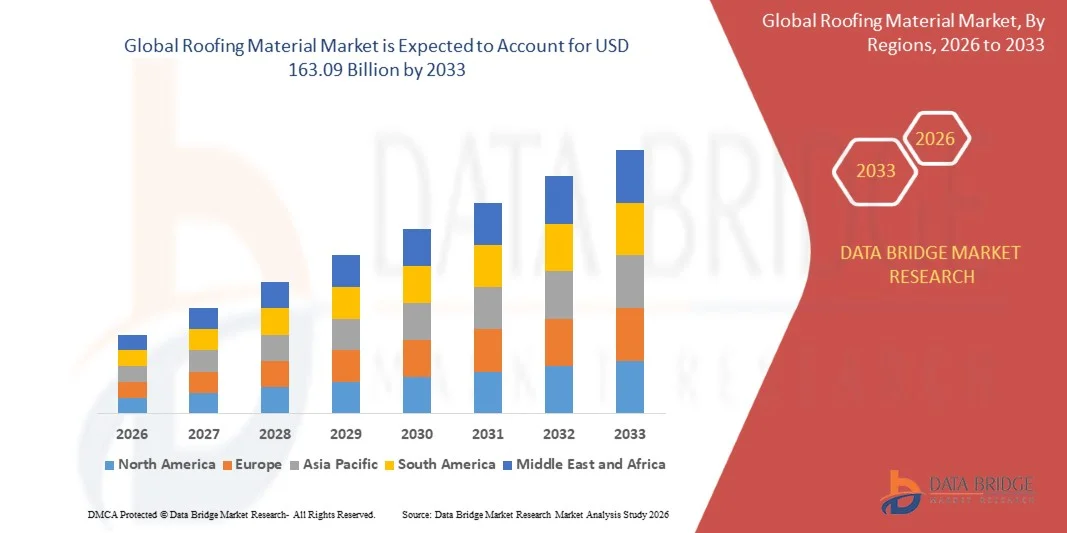
The Roofing Material Market was valued at USD 139.20 billion in 2025 and is projected to reach USD 163.09 billion by 2033, growing at a CAGR of 2.00% from 2026 to 2033. The market is witnessing steady growth driven by increasing residential and commercial construction activities, rising investments in infrastructure development, and growing demand for durable and energy-efficient roofing solutions across developed and emerging economies.
The growing focus on sustainable construction practices and energy conservation is encouraging the adoption of advanced roofing materials such as cool roofs, recycled shingles, metal roofing, and solar-integrated roofing systems. In addition, rapid urbanization, increasing renovation and reroofing activities, and rising awareness regarding weather-resistant and long-lasting roofing products are supporting market expansion across residential, industrial, and commercial sectors.
Key Market Trends & Insights
- North America dominated the roofing material market with the largest revenue share of 36.4% in 2025, supported by strong residential reroofing demand, rising investments in commercial infrastructure, and increasing adoption of energy-efficient roofing systems.
- Asia-Pacific is expected to be the fastest-growing region, recording a CAGR of from 2026 to 2033. Growth is driven by rapid urbanization, expanding housing construction activities, rising disposable incomes, and increasing government investments in infrastructure and smart city development projects across China, India, and Southeast Asia.
- The Materials segment held the largest market revenue share of approximately 71.6% in 2025 driven by extensive usage of asphalt, metal, concrete, clay, and plastic-based roofing products across residential and commercial construction projects. Increasing infrastructure development activities, rising reroofing demand, and growing preference for durable and weather-resistant roofing systems are supporting segment dominance across developed and emerging economies.
- The Chemicals segment is projected to register the fastest growth at a CAGR of 3.1% from 2026 to 2033, driven by increasing adoption of advanced roofing adhesives, coatings, sealants, and waterproofing compounds designed to improve roof durability, insulation, and energy efficiency. Growing demand for reflective roof coatings and environmentally sustainable roofing chemicals is further accelerating segment expansion.
- The Residential segment accounted for the largest market revenue share of nearly 46.9% in 2025 driven by rapid urbanization, rising housing construction activities, and increasing home renovation and reroofing projects globally. Growing demand for affordable, durable, and aesthetically appealing roofing materials across single-family and multi-family housing developments is supporting strong segment growth.
- The Commercial segment is anticipated to witness the fastest growth at a CAGR of 3.4% from 2026 to 2033, supported by rising investments in commercial infrastructure such as office buildings, shopping malls, warehouses, hotels, and healthcare facilities. Increasing adoption of energy-efficient roofing systems and cool roof technologies across commercial construction projects is further contributing to segment expansion.
- The Asphalt Shingles segment held the largest market revenue share of approximately 38.7% in 2025 driven by its cost-effectiveness, ease of installation, wide product availability, and strong demand across residential construction and reroofing applications, particularly in North America. Asphalt shingles continue to remain highly preferred because of their durability, weather resistance, and lower maintenance requirements.
- The Metal Roof segment is projected to register the fastest growth at a CAGR of 4.2% from 2026 to 2033, driven by increasing demand for lightweight, recyclable, and energy-efficient roofing solutions across residential, commercial, and industrial buildings. Rising adoption of metal roofing systems in regions exposed to extreme weather conditions and growing interest in sustainable construction materials are accelerating segment growth globally.
Market Size & Forecast
- Global Market Value (2025): USD 139.20 Billion
- Expected Market Value (2033): USD 163.09 Billion
- Forecast CAGR (2026–2033): 2.00%
- Leading Region in 2025: North America
- Fastest Growing Region: Asia-Pacific
Report Scope and Roofing Material Market Segmentation
|
Attributes |
Roofing Material Key Market Insights |
|
Segments Covered |
· By Type: Materials and Chemicals · By Application: Residential, Non-Residential, Commercial, and Others · By Product: Asphalt Shingles, Concrete and Clay Tile, Tile Roof, Metal Roof, Plastic Roof, Elastomers Roof, and Others |
|
Countries Covered |
North America · U.S. · Canada · Mexico Europe · Germany · France · U.K. · Netherlands · Switzerland · Belgium · Russia · Italy · Spain · Turkey · Rest of Europe Asia-Pacific · China · Japan · India · South Korea · Singapore · Malaysia · Australia · Thailand · Indonesia · Philippines · Rest of Asia-Pacific Middle East and Africa · Saudi Arabia · U.A.E. · South Africa · Egypt · Israel · Rest of Middle East and Africa South America · Brazil · Argentina · Rest of South America |
|
Key Market Players |
• GAF (U.S.) |
|
Market Opportunities |
• Rising Adoption Of Energy-Efficient And Cool Roofing Systems |
|
Value Added Data Infosets |
In addition to the insights on market scenarios such as market value, growth rate, segmentation, geographical coverage, and major players, the market reports curated by the Data Bridge Market Research also include import export analysis, production capacity overview, production consumption analysis, price trend analysis, climate change scenario, supply chain analysis, value chain analysis, raw material/consumables overview, vendor selection criteria, PESTLE Analysis, Porter Analysis, and regulatory framework. |
Roofing Material Market Trends
Trend: Rising Adoption Of Sustainable And Energy-Efficient Roofing Solutions
Increasing focus on green building development, energy conservation, and climate-resilient construction practices across residential, commercial, and industrial sectors is accelerating demand for advanced roofing materials worldwide. Conventional roofing systems often contribute to high indoor heat absorption, increased cooling costs, and faster structural degradation under extreme weather conditions, encouraging builders and property owners to adopt durable and thermally efficient roofing technologies.
Modern construction projects are increasingly integrating cool roofs, reflective coatings, and solar-compatible roofing systems, For instance in urban commercial complexes and smart city infrastructure projects, to reduce heat island effects and improve overall building energy efficiency. In residential applications, metal roofing and recycled shingles are gaining popularity because of their long lifespan, weather resistance, and lower maintenance requirements compared to traditional asphalt roofing systems.
The growing adoption of sustainable construction certifications such as LEED and BREEAM is also encouraging developers to invest in environmentally friendly roofing materials capable of improving insulation and reducing carbon emissions. In addition, governments across North America, Europe, and Asia-Pacific are introducing stricter building energy codes supporting installation of reflective and energy-saving roofing products. Real-world commercial construction projects completed during 2024 in the U.S. and Europe using cool roofing technologies reported building cooling energy savings of nearly 10–15% during peak summer conditions.
Roofing Material Market Dynamics
Key Market Driver: Rapid Growth In Residential And Commercial Construction Activities
Rapid urbanization, increasing infrastructure investments, and rising population growth are significantly increasing demand for residential housing, commercial buildings, warehouses, and industrial facilities worldwide. Roofing materials remain essential components of all construction projects, creating strong and consistent demand for durable, weather-resistant, and cost-efficient roofing systems across developed and emerging economies.
Governments and private developers are actively investing in large-scale housing and infrastructure projects, For instance affordable housing programs and commercial real estate developments in Asia-Pacific and the Middle East, supporting increased consumption of roofing shingles, metal roofing, concrete tiles, and membrane roofing systems. Renovation and reroofing activities across aging residential and commercial buildings in North America and Europe are also contributing to stable market expansion.
In addition, increasing frequency of extreme weather events such as storms, hurricanes, and heavy rainfall is encouraging adoption of impact-resistant and high-performance roofing materials designed for long-term structural protection. Construction industry data from 2024 indicated that global construction output expanded by nearly 4–5%, with residential reroofing demand in the U.S. increasing by around 7% following severe weather-related property damage and insurance-backed reconstruction projects.
Key Restraint/Challenge: Fluctuating Raw Material Prices And High Installation Costs
The roofing material industry remains highly dependent on raw materials such as asphalt, steel, aluminum, clay, cement, and synthetic polymers, whose prices frequently fluctuate because of supply chain disruptions, energy costs, and geopolitical uncertainties. Rising raw material costs directly impact manufacturing expenses and overall roofing system pricing, creating affordability concerns for cost-sensitive residential construction projects.
In addition, installation of advanced roofing systems often requires skilled labor, specialized equipment, and longer project timelines, increasing total construction and maintenance costs for builders and property owners. Premium roofing solutions such as solar roofing systems, insulated panels, and metal roofing products remain expensive compared to conventional roofing materials, limiting adoption in low-income and developing regions.
Supply chain disruptions and transportation cost increases observed during 2024 also affected roofing product availability across several construction markets. Industry assessments indicate that steel and asphalt roofing material prices experienced fluctuations of nearly 8–12% during major supply volatility periods, impacting contractor profit margins and delaying certain infrastructure development projects globally.
Key Market Opportunity: Increasing Adoption Of Green Buildings And Solar Roofing Systems
Growing awareness regarding environmental sustainability, carbon reduction, and energy-efficient building design is creating significant opportunities for advanced roofing technologies integrated with renewable energy and insulation capabilities. Governments and environmental agencies worldwide are promoting green building standards and tax incentives encouraging use of sustainable roofing materials capable of improving energy efficiency and reducing long-term operational costs.
Construction companies and real estate developers are increasingly deploying solar-integrated roofing systems, For instance photovoltaic roof shingles and reflective membrane roofing technologies, to support renewable energy generation and reduce dependence on conventional electricity sources. In commercial buildings, energy-efficient roofing systems are being used to improve indoor temperature regulation and reduce HVAC operating expenses.
In addition, advancements in lightweight composite roofing materials, recycled roofing products, and smart roofing technologies with integrated sensors are opening new growth opportunities across smart cities and modern infrastructure projects. Solar roofing installations completed across residential housing projects in Europe and North America during 2025 demonstrated annual electricity cost reductions of nearly 15–20%, while reflective roofing systems helped reduce rooftop surface temperatures by approximately 20–30°C under high summer exposure conditions.
Roofing Material Market Scope
The market is segmented on the basis of type, application, and product.
- By Type
On the basis of type, the Roofing Material Market is segmented into Materials and Chemicals. The Materials segment held the largest market revenue share of approximately 71.6% in 2025 driven by extensive usage of asphalt, metal, concrete, clay, and plastic-based roofing products across residential and commercial construction projects. Increasing infrastructure development activities, rising reroofing demand, and growing preference for durable and weather-resistant roofing systems are supporting segment dominance across developed and emerging economies.
The Chemicals segment is projected to register the fastest growth at a CAGR of 3.1% from 2026 to 2033, driven by increasing adoption of advanced roofing adhesives, coatings, sealants, and waterproofing compounds designed to improve roof durability, insulation, and energy efficiency. Growing demand for reflective roof coatings and environmentally sustainable roofing chemicals is further accelerating segment expansion.
- By Application
On the basis of application, the Roofing Material Market is segmented into Residential, Non-Residential, Commercial, and Others. The Residential segment accounted for the largest market revenue share of nearly 46.9% in 2025 driven by rapid urbanization, rising housing construction activities, and increasing home renovation and reroofing projects globally. Growing demand for affordable, durable, and aesthetically appealing roofing materials across single-family and multi-family housing developments is supporting strong segment growth.
The Commercial segment is anticipated to witness the fastest growth at a CAGR of 3.4% from 2026 to 2033, supported by rising investments in commercial infrastructure such as office buildings, shopping malls, warehouses, hotels, and healthcare facilities. Increasing adoption of energy-efficient roofing systems and cool roof technologies across commercial construction projects is further contributing to segment expansion.
- By Product
On the basis of product, the Roofing Material Market is segmented into Asphalt Shingles, Concrete and Clay Tile, Tile Roof, Metal Roof, Plastic Roof, Elastomers Roof, and Others. The Asphalt Shingles segment held the largest market revenue share of approximately 38.7% in 2025 driven by its cost-effectiveness, ease of installation, wide product availability, and strong demand across residential construction and reroofing applications, particularly in North America. Asphalt shingles continue to remain highly preferred because of their durability, weather resistance, and lower maintenance requirements.
The Metal Roof segment is projected to register the fastest growth at a CAGR of 4.2% from 2026 to 2033, driven by increasing demand for lightweight, recyclable, and energy-efficient roofing solutions across residential, commercial, and industrial buildings. Rising adoption of metal roofing systems in regions exposed to extreme weather conditions and growing interest in sustainable construction materials are accelerating segment growth globally.
Roofing Material Market Regional Analysis
North America Roofing Material Market Insight
North America dominated the roofing material market with the largest revenue share of 36.4% in 2025, supported by strong residential reroofing demand, rising investments in commercial infrastructure, and increasing adoption of energy-efficient roofing systems. The region is witnessing high demand for asphalt shingles, metal roofing, and reflective roofing materials because of growing awareness regarding weather resistance, energy savings, and long-term durability. Increasing occurrences of hurricanes, storms, and extreme climatic conditions are also encouraging homeowners and businesses to invest in advanced roofing solutions across residential and commercial buildings.
U.S. Roofing Material Market Insight
The U.S. roofing material market captured the largest revenue share in 2025 within North America, fueled by strong housing construction activity, expanding renovation projects, and increasing replacement demand for aging roofing systems. Consumers are increasingly prioritizing durable, impact-resistant, and energy-efficient roofing products capable of withstanding severe weather conditions. Rising adoption of cool roofs, solar-integrated roofing systems, and sustainable construction materials is further driving market growth. Moreover, insurance-backed reroofing projects following storm and hurricane damage continue to support roofing material demand across residential and commercial sectors.
Europe Roofing Material Market Insight
The Europe roofing material market is expected to witness the fastest growth rate from 2026 to 2033, primarily driven by rising focus on sustainable construction, strict energy-efficiency regulations, and increasing renovation of aging infrastructure. The growing adoption of green building standards and environmentally friendly roofing materials is supporting regional market expansion. European countries are increasingly investing in insulated roofing systems, reflective roof coatings, and recyclable roofing materials to improve building efficiency and reduce carbon emissions. Increasing urban redevelopment activities and commercial construction projects are further contributing to roofing material demand across the region.
U.K. Roofing Material Market Insight
The U.K. roofing material market is expected to witness the fastest growth rate from 2026 to 2033, driven by rising residential renovation activities and increasing focus on energy-efficient housing infrastructure. Growing consumer preference for lightweight, weather-resistant, and thermally efficient roofing systems is accelerating market expansion. In addition, increasing government initiatives supporting sustainable construction practices and building insulation upgrades are encouraging adoption of advanced roofing products. The growing popularity of metal roofing and solar-compatible roofing systems is also contributing to market growth across residential and commercial sectors.
Germany Roofing Material Market Insight
The Germany roofing material market is expected to witness the fastest growth rate from 2026 to 2033, fueled by increasing investments in sustainable construction technologies and rising demand for energy-efficient building materials. Germany’s strong emphasis on environmental sustainability and green building standards is promoting adoption of recyclable roofing systems, cool roofs, and insulated roofing materials. The country’s advanced construction sector, combined with rising renovation of older residential and industrial structures, is further supporting market expansion. Increasing integration of rooftop solar systems is also creating demand for durable and solar-compatible roofing solutions.
Asia-Pacific Roofing Material Market Insight
The Asia-Pacific roofing material market is expected to witness the fastest growth rate from 2026 to 2033, supported by rapid urbanization, population growth, and large-scale infrastructure development activities across countries such as China, India, Japan, and Southeast Asian nations. Rising residential construction projects, expanding industrial facilities, and growing government investments in smart cities and transportation infrastructure are driving strong demand for roofing materials across the region. Increasing affordability of modern roofing products and rising awareness regarding durable and weather-resistant construction materials are further accelerating market growth.
Japan Roofing Material Market Insight
The Japan roofing material market is expected to witness the fastest growth rate from 2026 to 2033 due to increasing renovation activities, rising demand for earthquake-resistant construction materials, and strong focus on energy-efficient buildings. Japanese consumers highly prioritize durable, lightweight, and weather-resistant roofing systems capable of withstanding earthquakes, typhoons, and extreme climatic conditions. The growing integration of solar roofing systems and insulated roofing technologies in residential and commercial buildings is further supporting market expansion. In addition, aging infrastructure redevelopment projects are increasing demand for modern roofing materials across urban regions.
China Roofing Material Market Insight
The China roofing material market accounted for the largest market revenue share in Asia-Pacific in 2025, attributed to rapid urbanization, expanding construction activities, and strong government investments in infrastructure and housing projects. China remains one of the world’s largest construction markets, generating substantial demand for asphalt shingles, metal roofs, concrete tiles, and advanced roofing membranes across residential, industrial, and commercial sectors. The country’s growing focus on green buildings, smart cities, and renewable energy integration is also supporting adoption of energy-efficient and solar-compatible roofing systems. Increasing domestic manufacturing capabilities and availability of cost-effective roofing materials are further propelling market growth in China.
Roofing Material Market Share
The Roofing Material industry is primarily led by well-established companies, including:
• GAF (U.S.)
• Atlas Roofing Corporation (U.S.)
• CERTAINTEED (U.S.)
• BMI Group (U.K.)
• Owens Corning (U.S.)
• BMI Group (U.K.)
• Etex Group (Belgium)
• Fletcher Building (New Zealand)
• TAMKO Building Products LLC (U.S.)
• North American Roofing Services, Inc. (U.S.)
• Siam Cement Group (Thailand)
• CSR Limited (Australia)
• SCG (Thailand)
• Saint-Gobain (France)
• Carlisle Companies Inc. (U.S.)
• Johns Manville (U.S.)
Latest Developments in Roofing Material Market
- In February 2026, TAMKO Building Products LLC, product launch, introduced its new HailGuard roofing shingles featuring advanced ImpactCore technology that combines polymer-modified asphalt with enhanced fiberglass mat engineering. The development was aimed at improving roof durability, storm resistance, and long-term structural protection in regions vulnerable to severe weather conditions. The company also introduced the industry’s first hail warranty for asphalt shingles, strengthening customer confidence and competitive differentiation. This launch is expected to accelerate adoption of high-performance impact-resistant roofing systems and support innovation within the residential roofing materials market.
- In November 2023, CertainTeed, LLC, facility expansion, announced the establishment of a new roofing material manufacturing and distribution center in Texas, U.S. The expansion was intended to strengthen the company’s production capabilities and improve supply chain efficiency across the southern U.S. market. The new facility enables faster product delivery, improved customer service, and enhanced regional market penetration amid growing roofing demand. This strategic investment is expected to support construction industry growth and reinforce the company’s competitive position in the North American roofing material market.
- In February 2022, Carlisle Companies Incorporated, acquisition, acquired MBTechnology, Inc. to strengthen its modified bitumen roofing portfolio and expand manufacturing capacity for roofing underlayment products. The acquisition was aimed at enhancing product availability, improving operational efficiency, and broadening the company’s roofing solutions portfolio across commercial and residential applications. This strategic move is expected to support long-term market expansion and strengthen Carlisle’s position in the advanced roofing systems industry.
- In February 2022, Johns Manville, a Berkshire Hathaway company, product innovation, introduced two new products for bituminous roofing systems designed to improve installation productivity and on-site operational efficiency. The launch was focused on helping roofing contractors reduce labor time, simplify roofing installation processes, and improve overall roof system performance. This development is expected to support growing demand for high-performance and labor-efficient roofing solutions across commercial construction projects.
- In January 2022, Owens Corning, acquisition, acquired Natural Polymers LLC to expand its portfolio of spray polyurethane foam insulation solutions for building and construction applications. The acquisition was intended to strengthen Owens Corning’s position in energy-efficient building materials and enhance its capabilities in insulation technologies supporting sustainable construction practices. This development is expected to increase adoption of advanced insulation-integrated roofing systems and reinforce the company’s presence in the construction materials market.
- In December 2021, Cornerstone Building Brands, Inc., acquisition, completed the acquisition of Union Corrugating Company Holdings, Inc., a manufacturer of metal roofing systems, roofing accessories, and related components. The acquisition was aimed at expanding the company’s residential metal roofing product offerings and strengthening its distribution network across growing construction markets. This strategic expansion is expected to support increasing demand for durable and energy-efficient metal roofing systems in residential applications.
- In January 2021, ProVia, product launch, introduced a new metal roofing product line combining the visual appearance of slate and cedar shakes with the strength and durability of galvanized engineered steel roofing systems. The launch was designed to provide homeowners with aesthetically appealing, long-lasting, and weather-resistant roofing alternatives for residential construction projects. This development is expected to support rising consumer preference for premium roofing materials with enhanced durability and lower maintenance requirements.

- Interactive Data Analysis Dashboard
- Company Analysis Dashboard for high growth potential opportunities
- Research Analyst Access for customization & queries
- Competitor Analysis with Interactive dashboard
- Latest News, Updates & Trend analysis
- Harness the Power of Benchmark Analysis for Comprehensive Competitor Tracking
Global Roofing Materials Market, Supply Chain Analysis and Ecosystem Framework
To support market growth and help clients navigate the impact of geopolitical shifts, DBMR has integrated in-depth supply chain analysis into its Global Roofing Materials Market research reports. This addition empowers clients to respond effectively to global changes affecting their industries. The supply chain analysis section includes detailed insights such as Global Roofing Materials Market consumption and production by country, price trend analysis, the impact of tariffs and geopolitical developments, and import and export trends by country and HSN code. It also highlights major suppliers with data on production capacity and company profiles, as well as key importers and exporters. In addition to research, DBMR offers specialized supply chain consulting services backed by over a decade of experience, providing solutions like supplier discovery, supplier risk assessment, price trend analysis, impact evaluation of inflation and trade route changes, and comprehensive market trend analysis.
Data collection and base year analysis are done using data collection modules with large sample sizes. The stage includes obtaining market information or related data through various sources and strategies. It includes examining and planning all the data acquired from the past in advance. It likewise envelops the examination of information inconsistencies seen across different information sources. The market data is analysed and estimated using market statistical and coherent models. Also, market share analysis and key trend analysis are the major success factors in the market report. To know more, please request an analyst call or drop down your inquiry.
The key research methodology used by DBMR research team is data triangulation which involves data mining, analysis of the impact of data variables on the market and primary (industry expert) validation. Data models include Vendor Positioning Grid, Market Time Line Analysis, Market Overview and Guide, Company Positioning Grid, Patent Analysis, Pricing Analysis, Company Market Share Analysis, Standards of Measurement, Global versus Regional and Vendor Share Analysis. To know more about the research methodology, drop in an inquiry to speak to our industry experts.
Data Bridge Market Research is a leader in advanced formative research. We take pride in servicing our existing and new customers with data and analysis that match and suits their goal. The report can be customized to include price trend analysis of target brands understanding the market for additional countries (ask for the list of countries), clinical trial results data, literature review, refurbished market and product base analysis. Market analysis of target competitors can be analyzed from technology-based analysis to market portfolio strategies. We can add as many competitors that you require data about in the format and data style you are looking for. Our team of analysts can also provide you data in crude raw excel files pivot tables (Fact book) or can assist you in creating presentations from the data sets available in the report.













