


What is the Global Room-Temperature-Vulcanizing Silicone Market Size and Growth Rate?
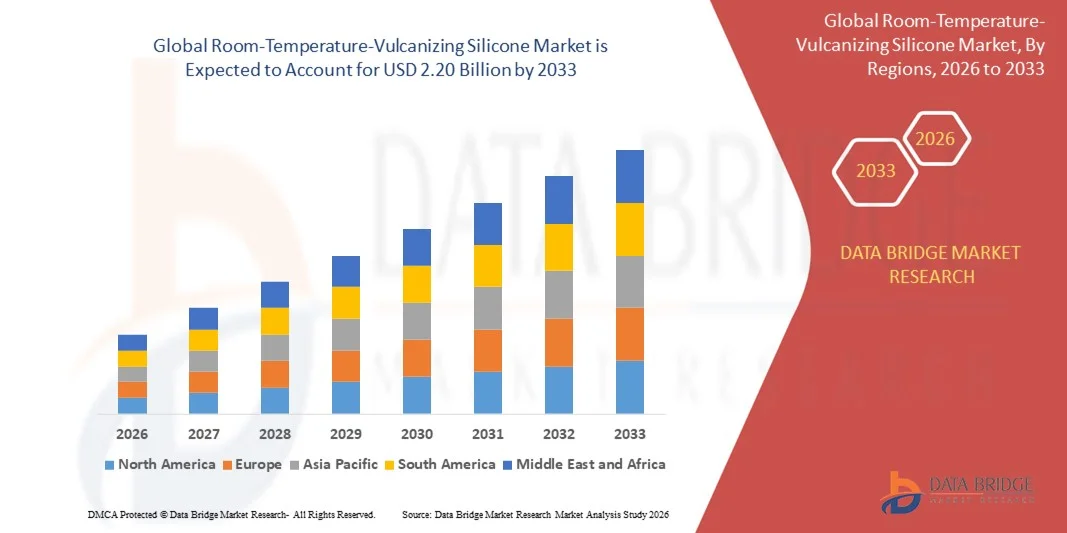
- As per Data Bridge Market Research analysis, the global room-temperature-vulcanizing silicone market size was valued at USD 1.33 billion in 2025 and is expected to reach USD 2.20 billion by 2033, at a CAGR of6.50% during the forecast period
- Rise in the demand for specialized products across end-use industries is the vital factor escalating the market growth, also rise in the intervention of government regulatory bodies across the value chain, rise in the application of silicone in textiles, paper, leather packaging, labels, and airbags, increase in the demand for technical textiles, on account of their use in a broad range of applications including chemical, manufacturing, and medical and rise in the demand for silicone as lubricants in offshore drilling, industrial coatings (paint additives) are the major factors among others driving the room-temperature-vulcanizing silicone market
Market Size & Forecast
- Market Value (2025): USD 1.33 Billion
- Expected Market Value (2033): USD 2.20 Billion
- Forecast CAGR: 6.50%
What are the Major Takeaways of Room-Temperature-Vulcanizing Silicone Market?
- Increase in the technological advancements and modernization in the production techniques and rise in the demand from emerging economies will further create new opportunities for the room-temperature-vulcanizing silicone market
- However, rise in the usage of other sealants such as epoxy and acrylic sealants for various applications is the major factor among others acting as restraints, and will further challenge the growth of room-temperature-vulcanizing silicone market
- Asia-Pacific dominated the room-temperature-vulcanizing silicone market with a 43.2% revenue share in 2025, driven by rapid industrialization, strong electronics and automotive manufacturing ecosystems, and increasing infrastructure development across China, Japan, India, South Korea, and Southeast Asia
- North America is projected to register the fastest CAGR of 10.65% from 2026 to 2033, supported by high adoption of advanced RTV silicones in automotive, aerospace, electronics, and construction applications
- The Elastomers segment dominated the market with a 44.6% share in 2025, owing to their excellent flexibility, mechanical strength, thermal stability, and long-term durability
Report Scope and Room-Temperature-Vulcanizing Silicone Market Segmentation
|
Attributes |
Room-Temperature-Vulcanizing Silicone Key Market Insights |
|
Segments Covered |
|
|
Countries Covered |
North America
Europe
Asia-Pacific
Middle East and Africa
South America
|
|
Key Market Players |
|
|
Market Opportunities |
|
|
Value Added Data Infosets |
In addition to the insights on market scenarios such as market value, growth rate, segmentation, geographical coverage, and major players, the market reports curated by the Data Bridge Market Research also include in-depth expert analysis, pricing analysis, brand share analysis, consumer survey, demography analysis, supply chain analysis, value chain analysis, raw material/consumables overview, vendor selection criteria, PESTLE Analysis, Porter Analysis, and regulatory framework. |
What is the Key Trend in the Room-Temperature-Vulcanizing Silicone Market?
Increasing Shift Toward High-Performance, Easy-to-Apply, and Application-Specific RTV Silicone Solutions
- The room-temperature-vulcanizing silicone market is witnessing growing adoption of single-component and two-component RTV silicones that cure at ambient conditions, reducing processing time and energy consumption
- Manufacturers are introducing high-performance RTV formulations offering enhanced adhesion, flexibility, chemical resistance, and thermal stability for diverse industrial applications
- Rising demand for user-friendly, ready-to-use sealants and adhesives is driving adoption across construction, automotive, electronics, and industrial maintenance sectors
- For instance, companies such as Dow, Wacker Chemie AG, Shin-Etsu Chemical, Momentive, and Elkem have expanded their RTV silicone portfolios with application-specific grades for sealing, potting, gasketing, and encapsulation
- Increasing use of RTV silicones in electronics protection, automotive assembly, and building sealants is accelerating innovation in fast-curing and low-VOC products
- As industries prioritize durability, flexibility, and ease of processing, RTV silicones will remain critical materials for long-term sealing and bonding applications
What are the Key Drivers of Room-Temperature-Vulcanizing Silicone Market?
- Rising demand for flexible, heat-resistant, and weather-durable materials across construction, automotive, electronics, and industrial manufacturing
- For instance, during 2024–2025, major manufacturers such as Dow, BASF, and Wacker Chemie AG enhanced RTV silicone offerings to meet evolving regulatory and performance requirements
- Growing use of RTV silicones in electronics potting, cable insulation, EV components, and LED encapsulation is boosting demand across U.S., Europe, and Asia-Pacific
- Advancements in formulation chemistry, including neutral-cure and low-odor technologies, have improved safety, curing speed, and substrate compatibility
- Rising adoption of electric vehicles, renewable energy systems, and smart construction materials is increasing demand for high-performance RTV silicones
- Supported by expanding industrial activity and infrastructure development, the RTV silicone market is expected to witness steady long-term growth
Which Factor is Challenging the Growth of the Room-Temperature-Vulcanizing Silicone Market?
- High raw material costs, particularly for silicone polymers and specialty additives, impact overall production economics
- For instance, during 2024–2025, volatility in silicon metal prices and supply chain disruptions increased manufacturing costs for several global producers
- Longer curing times compared to heat-cured silicone systems can limit productivity in high-speed manufacturing environments
- Environmental concerns and stringent VOC and chemical regulations pose formulation and compliance challenges
- Competition from alternative sealants and adhesives, such as polyurethanes and acrylics, creates pricing and substitution pressure
- To address these challenges, manufacturers are focusing on cost-optimized formulations, faster-curing technologies, and sustainable silicone chemistry to strengthen market adoption of RTV silicones
How is the Room-Temperature-Vulcanizing Silicone Market Segmented?
The market is segmented on the basis of product and end-use.
- By Product
On the basis of product, the room-temperature-vulcanizing silicone market is segmented into Fluids, Gels, Resins, and Elastomers. The Elastomers segment dominated the market with a 44.6% share in 2025, owing to their excellent flexibility, mechanical strength, thermal stability, and long-term durability. RTV silicone elastomers are widely used in sealing, gasketing, potting, and bonding applications across construction, automotive, and electronics industries. Their ability to withstand extreme temperatures, moisture, vibration, and chemical exposure makes them the preferred choice for structural and protective applications. Strong demand from infrastructure development, vehicle assembly, and electronic encapsulation continues to support segment dominance.
The Gels segment is expected to grow at the fastest CAGR from 2026 to 2033, driven by increasing use in electronics and semiconductor applications. RTV silicone gels offer superior vibration damping, low modulus, and excellent protection for sensitive components, making them ideal for circuit board protection, LED encapsulation, and EV electronics.
- By End-Use
On the basis of end-use, the room-temperature-vulcanizing silicone market is segmented into Electronics, Transportation, and Construction. The Construction segment dominated the market with a 41.2% share in 2025, supported by extensive use of RTV silicones in sealing, waterproofing, glazing, joint filling, and façade applications. Their strong adhesion to diverse substrates, weather resistance, and long service life make them indispensable in residential, commercial, and infrastructure projects. Rapid urbanization, renovation activities, and energy-efficient building initiatives further reinforce demand.
The Electronics segment is projected to grow at the fastest CAGR from 2026 to 2033, driven by rising demand for electronic device protection, miniaturization of components, and growth in EVs, renewable energy systems, and smart devices. RTV silicones are increasingly used for potting, encapsulation, insulation, and thermal management in advanced electronic assemblies.
Which Region Holds the Largest Share of the Room-Temperature-Vulcanizing Silicone Market?
- Asia-Pacific dominated the room-temperature-vulcanizing silicone market with a 43.2% revenue share in 2025, driven by rapid industrialization, strong electronics and automotive manufacturing ecosystems, and increasing infrastructure development across China, Japan, India, South Korea, and Southeast Asia. Rising adoption of EV electronics, consumer electronics, renewable energy, and smart devices continues to fuel demand for RTV silicones in sealing, bonding, and encapsulation applications.
- Leading companies in Asia-Pacific are introducing high-performance elastomers, gels, and resins with application-specific properties for construction, electronics, and automotive industries, strengthening the region’s technological leadership. Continuous investment in industrial automation, smart manufacturing, and sustainable building projects drives long-term market expansion
- Strong manufacturing capacity, cost-competitive production, and supportive government policies further reinforce the region’s market dominance
China Room-Temperature-Vulcanizing Silicone Market
China dominates Asia-Pacific, owing to massive electronics and automotive manufacturing, rising renewable energy installations, and supportive industrial policies. Increasing production of EVs, smart devices, and high-performance electronics drives demand for advanced RTV silicone elastomers, gels, and resins.
Japan Room-Temperature-Vulcanizing Silicone Market
Japan shows steady growth with a focus on high-quality building materials, precision electronics, and automotive applications. Rising adoption of robotics, industrial automation, and EV technology reinforces demand for RTV silicones with high durability, thermal stability, and low-VOC properties.
India Room-Temperature-Vulcanizing Silicone Market
India is emerging as a growth hub, driven by expanding automotive manufacturing, infrastructure projects, and electronics production. Government-backed Make-in-India and smart city initiatives further boost RTV silicone adoption in construction, transport, and industrial applications.
South Korea Room-Temperature-Vulcanizing Silicone Market
South Korea contributes significantly with high demand for advanced EV electronics, high-speed processors, and industrial automation systems. Rapid development of smart factories, consumer electronics, and renewable energy systems drives RTV silicone consumption in sealing, bonding, and encapsulation applications.
North America Room-Temperature-Vulcanizing Silicone Market
North America is projected to register the fastest CAGR of 10.65% from 2026 to 2033, supported by high adoption of advanced RTV silicones in automotive, aerospace, electronics, and construction applications. Rising demand for energy-efficient building materials, EV components, and electronics encapsulation drives adoption across the U.S. and Canada.
U.S. Room-Temperature-Vulcanizing Silicone Market Insight
The U.S. leads North America, driven by strong automotive and aerospace R&D, high penetration of EV electronics, and large-scale construction projects requiring durable sealing solutions. Presence of major chemical and silicone manufacturers, innovation centers, and regulatory compliance initiatives strengthens market growth.
Canada Room-Temperature-Vulcanizing Silicone Market Insight
Canada contributes significantly through increasing infrastructure projects, industrial maintenance, and adoption of advanced sealing and bonding solutions. Government-supported sustainable construction programs, availability of skilled workforce, and rising industrial automation accelerate market penetration.
Which are the Top Companies in Room-Temperature-Vulcanizing Silicone Market?
The room-temperature-vulcanizing silicone industry is primarily led by well-established companies, including:
- Dow (U.S.)
- BASF SE (Germany)
- Eastman Chemical Company (U.S.)
- Huntsman International LLC. (U.S.)
- Saint-Gobain (France)
- SABIC (Saudi Arabia)
- Exxon Mobil Corporation. (U.S.)
- Wacker Chemie AG (Germany)
- Shin-Etsu Chemical Co., Ltd. (Japan)
- Momentive (U.S.)
- GELEST, INC. (U.S.)
- KCC CORPORATION (South Korea)
- Avantor, Inc. (U.S.)
- Elkem ASA (Norway)
- Specialty Silicone Products, Inc. (U.S.)
- KANEKA CORPORATION (Japan)
- Siltech Corporation (Canada)
- CSL Silicones Inc. (Canada)

- Interactive Data Analysis Dashboard
- Company Analysis Dashboard for high growth potential opportunities
- Research Analyst Access for customization & queries
- Competitor Analysis with Interactive dashboard
- Latest News, Updates & Trend analysis
- Harness the Power of Benchmark Analysis for Comprehensive Competitor Tracking
Global Room Temperature Vulcanizing Silicone Market, Supply Chain Analysis and Ecosystem Framework
To support market growth and help clients navigate the impact of geopolitical shifts, DBMR has integrated in-depth supply chain analysis into its Global Room Temperature Vulcanizing Silicone Market research reports. This addition empowers clients to respond effectively to global changes affecting their industries. The supply chain analysis section includes detailed insights such as Global Room Temperature Vulcanizing Silicone Market consumption and production by country, price trend analysis, the impact of tariffs and geopolitical developments, and import and export trends by country and HSN code. It also highlights major suppliers with data on production capacity and company profiles, as well as key importers and exporters. In addition to research, DBMR offers specialized supply chain consulting services backed by over a decade of experience, providing solutions like supplier discovery, supplier risk assessment, price trend analysis, impact evaluation of inflation and trade route changes, and comprehensive market trend analysis.
Data collection and base year analysis are done using data collection modules with large sample sizes. The stage includes obtaining market information or related data through various sources and strategies. It includes examining and planning all the data acquired from the past in advance. It likewise envelops the examination of information inconsistencies seen across different information sources. The market data is analysed and estimated using market statistical and coherent models. Also, market share analysis and key trend analysis are the major success factors in the market report. To know more, please request an analyst call or drop down your inquiry.
The key research methodology used by DBMR research team is data triangulation which involves data mining, analysis of the impact of data variables on the market and primary (industry expert) validation. Data models include Vendor Positioning Grid, Market Time Line Analysis, Market Overview and Guide, Company Positioning Grid, Patent Analysis, Pricing Analysis, Company Market Share Analysis, Standards of Measurement, Global versus Regional and Vendor Share Analysis. To know more about the research methodology, drop in an inquiry to speak to our industry experts.
Data Bridge Market Research is a leader in advanced formative research. We take pride in servicing our existing and new customers with data and analysis that match and suits their goal. The report can be customized to include price trend analysis of target brands understanding the market for additional countries (ask for the list of countries), clinical trial results data, literature review, refurbished market and product base analysis. Market analysis of target competitors can be analyzed from technology-based analysis to market portfolio strategies. We can add as many competitors that you require data about in the format and data style you are looking for. Our team of analysts can also provide you data in crude raw excel files pivot tables (Fact book) or can assist you in creating presentations from the data sets available in the report.













