


Rope Rescue Harness Market Size
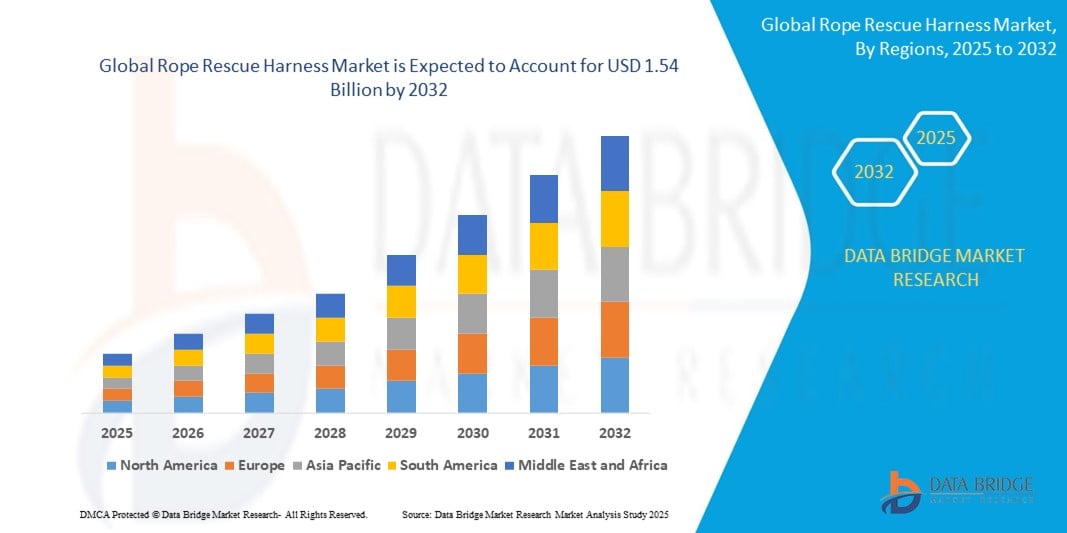
- The global rope rescue harness market size was valued at USD 1.28 billion in 2024 and is expected to reach USD 1.54 billion by 2032, at a CAGR of 2.40% during the forecast period
- The market growth is largely fuelled by the increasing focus on occupational safety regulations across industries such as construction, firefighting, and emergency response, where rope access and vertical rescue operations are common
- Demand is also driven by the rising incidence of natural disasters and industrial accidents, which highlight the need for reliable, certified safety gear including full-body harnesses tailored for rescue scenarios
Rope Rescue Harness Market Analysis
- The market is witnessing steady demand from both developed and developing economies, supported by stricter enforcement of workplace safety standards
- Technological advancements in harness design, such as lightweight materials and ergonomic support structures, are enhancing usability and comfort, thus boosting adoption across extended use cases
- North America dominated the rope rescue harness market with the largest revenue share of 39.27% in 2024, driven by strict occupational safety standards, significant investments in industrial safety gear, and widespread use of rescue harnesses in emergency services, construction, and defense sectors
- Asia-Pacific region is expected to witness the highest growth rate in the global rope rescue harness market, driven by growing adoption of fall protection systems, increased spending on public safety, and rising demand from emerging economies in sectors such as military, civil defense, and construction
- The polyamide segment dominated the market with the largest revenue share in 2024, driven by its exceptional strength-to-weight ratio and resistance to abrasion, UV, and moisture. Widely preferred in rescue operations for its flexibility and durability, polyamide harnesses are known to perform reliably under extreme environmental conditions. Their compatibility with both textile and metallic components further enhances the utility and lifespan of the harness systems
Report Scope and Rope Rescue Harness Market Segmentation
|
Attributes |
Rope Rescue Harness Key Market Insights |
|
Segments Covered |
|
|
Countries Covered |
North America
Europe
Asia-Pacific
Middle East and Africa
South America
|
|
Key Market Players |
|
|
Market Opportunities |
• Expansion of High-Risk Industrial Activities in Emerging Economies |
|
Value Added Data Infosets |
In addition to the insights on market scenarios such as market value, growth rate, segmentation, geographical coverage, and major players, the market reports curated by the Data Bridge Market Research also include in-depth expert analysis, geographically represented company-wise production and capacity, network layouts of distributors and partners, detailed and updated price trend analysis and deficit analysis of supply chain and demand. |
Rope Rescue Harness Market Trends
Increasing Integration of Ergonomics and Lightweight Materials
• The adoption of ergonomic design principles in rope rescue harnesses is rapidly transforming end-user experience, enhancing comfort and mobility for professionals engaged in high-risk rescue operations. Lightweight, body-contouring harnesses reduce fatigue during prolonged missions, contributing to higher efficiency and safety in extreme environments
• Manufacturers are focusing on the development of breathable and moisture-wicking harness padding, driven by the growing demand from rescue professionals operating in variable climates. These advanced textiles and streamlined designs support both summer heat conditions and cold-weather rescue efforts
• The integration of load-distribution technologies such as pivoting waist belts and flexible leg loops is gaining traction, particularly in applications requiring extended suspension. This trend supports improved circulation and reduces pressure points during vertical extractions or confined space entries
• For instance, in 2023, several fire departments across North America adopted new-generation ergonomic rope harnesses for urban search-and-rescue teams, citing improved worker comfort and reduced injury rates compared to older models
• While this trend promotes increased user satisfaction and operational efficiency, manufacturers must continue investing in design innovation and field testing to balance lightweight construction with stringent safety compliance and load-bearing capacity
Rope Rescue Harness Market Dynamics
Driver
Stringent Safety Regulations and Rising Occupational Risk Preparedness
• Global regulatory bodies and occupational safety organizations have implemented rigorous safety standards across industries involving high-altitude or confined space work, significantly boosting demand for certified rescue harnesses. Compliance with ANSI, CE, and OSHA standards is now non-negotiable for procurement in emergency and industrial sectors
• The rising frequency of industrial accidents and natural disasters has heightened awareness around worker protection and rescue preparedness, prompting government and private sector investments in advanced personal protective equipment (PPE) including rope harnesses
• Increased rescue training initiatives and emergency preparedness drills across sectors such as construction, firefighting, and offshore oil and gas have amplified demand for specialized harness systems capable of withstanding diverse physical stress scenarios
• For instance, in 2022, the European Civil Protection and Humanitarian Aid Operations agency rolled out a safety upgrade program requiring certified full-body rescue harnesses for all public sector climbing and rope access responders
• Although growing awareness and safety policies are driving demand, there remains a need to improve procurement accessibility for smaller organizations and develop harnesses that cater to broader body types and occupational scenarios
Restraint/Challenge
High Cost of Advanced Harness Systems and Limited Access in Remote Regions
• The high cost of high-performance rope rescue harnesses embedded with advanced safety features such as fall indicators, modular attachments, and lightweight composites presents affordability challenges for smaller municipalities, volunteer teams, and developing regions
• In many remote or underfunded zones, access to updated and regulation-compliant harnesses is restricted due to inadequate supply chains and a lack of safety education. Rescue teams in these areas often rely on outdated or locally fabricated gear, increasing risks during critical operations
• The need for frequent inspections, certifications, and replacements adds recurring costs that discourage widespread adoption, particularly in budget-constrained sectors. These factors collectively hinder market penetration despite rising global safety concerns
• For instance, in 2023, rescue teams in parts of Southeast Asia reported operational delays due to lack of access to certified harnesses and basic fall protection kits, citing high import duties and fragmented distribution networks
• While innovation in harness design continues, manufacturers and governments must work together to subsidize life-saving gear, streamline global supply chains, and increase awareness on the importance of certified rope rescue harnesses across all operational geographies
Rope Rescue Harness Market Scope
The market is segmented on the basis of material type, product type, application, and end use.
- By Material Type
On the basis of material type, the rope rescue harness market is segmented into polymers, polystyrene, polyamide, polyester, polyurethane, polycarbonate, polypropylene, metals/alloys, steel, stainless steel, and aluminum. The polyamide segment dominated the market with the largest revenue share in 2024, driven by its exceptional strength-to-weight ratio and resistance to abrasion, UV, and moisture. Widely preferred in rescue operations for its flexibility and durability, polyamide harnesses are known to perform reliably under extreme environmental conditions. Their compatibility with both textile and metallic components further enhances the utility and lifespan of the harness systems.
The stainless steel segment is expected to witness the fastest growth rate from 2025 to 2032, owing to its superior strength, corrosion resistance, and suitability for demanding rescue applications such as marine and industrial operations. The growing preference for metal-integrated harnesses in situations requiring maximum safety margins is boosting the adoption of stainless steel-based designs.
- By Product Type
On the basis of product type, the market is segmented into upper body, lower body, and full body. The full body segment held the largest market share in 2024, driven by the increasing focus on safety and the need for complete fall protection across vertical and confined-space rescue missions. Full body harnesses distribute load evenly across shoulders, chest, and thighs, providing superior support and reducing injury risks during suspended operations.
The lower body harness segment is expected to witness the fastest growth rate from 2025 to 2032, particularly in arboriculture and rope access industries. The segment’s lightweight design, enhanced leg mobility, and quick application make it a favored choice in controlled descent and climbing scenarios where upper body restraint is not required.
- By Application
On the basis of application, the rope rescue harness market is segmented into human and non-human. The human segment accounted for the largest share in 2024, as most rescue operations involving fire services, mountain rescue, and industrial safety necessitate personal harness use for trained professionals. These harnesses are designed to offer ergonomic comfort and maximum protection under high-stress conditions.
The non-human segment is expected to witness the fastest growth rate from 2025 to 2032, driven by growing applications in animal rescue and drone-based retrieval systems. This niche but important segment is witnessing innovations tailored for veterinary use, search-and-rescue canines, and cargo retrieval missions.
- By End Use
On the basis of end use, the market is segmented into defense, marine, space rescue, special rescue forces, building and construction, and arboriculture. The special rescue forces segment dominated the market in 2024, supported by increased investments in tactical safety equipment by military and paramilitary units across the globe. The need for mission-critical gear in high-altitude and high-risk environments fuels the adoption of technically advanced rope rescue harnesses in this segment.
The building and construction segment is expected to witness the fastest growth rate from 2025 to 2032, due to stringent occupational safety regulations and rising construction activity worldwide. High-rise construction and maintenance work continues to demand certified fall protection systems, leading to wider deployment of rescue harnesses on worksites.
Rope Rescue Harness Market Regional Analysis
• North America dominated the rope rescue harness market with the largest revenue share of 39.27% in 2024, driven by strict occupational safety standards, significant investments in industrial safety gear, and widespread use of rescue harnesses in emergency services, construction, and defense sectors
• The region’s leadership is further supported by the presence of major market players, advanced rescue training programs, and the integration of ergonomic innovations into safety harness designs
• The growing focus on worker protection, combined with increasing adoption of fall protection equipment across utility, infrastructure, and firefighting sectors, continues to fuel market expansion in both the U.S. and Canada
U.S. Rope Rescue Harness Market Insight
The U.S. rope rescue harness market captured the largest revenue share in 2024 within North America, driven by high demand from emergency responders, military personnel, and industrial safety teams. Rising awareness about fall-related injuries and the implementation of strict workplace safety regulations are driving steady adoption of advanced harness systems. The U.S. market is further supported by strong domestic production, continuous product innovation, and government initiatives that prioritize rescue preparedness and occupational health
Asia-Pacific Rope Rescue Harness Market Insight
The Asia-Pacific rope rescue harness market is expected to witness the fastest growth rate from 2025 to 2032, fueled by rapid industrialization, construction activity, and increasing incidences of natural disasters in countries such as China, India, and Indonesia. Government mandates on worker safety, coupled with the need for improved rescue response, are propelling demand for rope rescue harnesses. Local manufacturing capabilities and growing awareness about safety standards also contribute to the market’s accelerated growth.
Japan Rope Rescue Harness Market Insight
The Japan rope rescue harness market is expected to witness the fastest growth rate from 2025 to 2032, supported by the country’s strong emphasis on disaster preparedness, industrial safety, and advanced rescue operations. Japan's susceptibility to earthquakes and other natural disasters has led to increased investment in emergency response infrastructure, including specialized harness systems for rescue personnel. In addition, growing automation in high-rise construction and the expanding utilities sector are driving demand for high-quality, ergonomic rope rescue harnesses that meet stringent national safety standards.
China Rope Rescue Harness Market Insight
The China rope rescue harness market accounted for the largest revenue share in Asia-Pacific in 2024, driven by the country’s expansive construction sector, infrastructural upgrades, and government-led safety campaigns. Increased focus on protecting workers in high-risk environments, including utility maintenance, firefighting, and mining operations, is bolstering demand for specialized harness equipment. China’s strong domestic manufacturing base ensures availability of cost-effective solutions, promoting wider adoption across both urban and rural areas
Europe Rope Rescue Harness Market Insight
The Europe rope rescue harness market is expected to witness the fastest growth rate from 2025 to 2032, supported by stringent regulatory frameworks and a strong culture of occupational safety. Demand is growing across infrastructure projects, emergency response units, and renewable energy installations such as wind farms. European countries emphasize advanced safety gear, training, and compliance, which is fostering a steady increase in harness deployment across multiple sectors
Germany Rope Rescue Harness Market Insight
The Germany rope rescue harness market is expected to witness the fastest growth rate from 2025 to 2032, driven by the country’s focus on engineering excellence, worker safety, and sustainable construction practices. Adoption is strong across firefighting departments, building maintenance, and industrial sites, where high-performance and precision-designed harnesses are preferred. Supportive government regulations and emphasis on safety certifications further enhance market expansion
U.K. Rope Rescue Harness Market Insight
The U.K. rope rescue harness market is expected to witness the fastest growth rate from 2025 to 2032, fuelled by rising demand from construction, offshore wind energy, and emergency rescue operations. The country's advanced regulatory environment and proactive safety measures have encouraged organizations to invest in quality harness solutions. In addition, increased training for first responders and utility workers is contributing to broader product adoption across public and private sectors
Rope Rescue Harness Market Share
The rope rescue harness industry is primarily led by well-established companies, including:
- Martin Castle Limited (U.K.)
- CMC Rescue, Inc. (U.S.)
- Conterra Inc. (U.S.)
- International Safety Components Ltd. (U.K.)
- KASK S.p.A. (Italy)
- Liberty Mountain (U.S.)
- Petzl (France)
- ROCK EXOTICA LLC (U.S.)
- Metolius Climbing (U.S.)
- Seattle Manufacturing Corporation (U.S.)
- Arco Professional Safety Services Ltd. (U.K.)
- SKYLOTEC (Germany)
- SAR Products (U.S.)
- Scavenger Manufacturing (Pty) Ltd. (South Africa)
- CRESTO GROUP (Sweden)
- RIT Safety Solutions, LLC (U.S.)
- Vertico X-Treme (U.K.)

- Interactive Data Analysis Dashboard
- Company Analysis Dashboard for high growth potential opportunities
- Research Analyst Access for customization & queries
- Competitor Analysis with Interactive dashboard
- Latest News, Updates & Trend analysis
- Harness the Power of Benchmark Analysis for Comprehensive Competitor Tracking
Global Rope Rescue Harness Market, Supply Chain Analysis and Ecosystem Framework
To support market growth and help clients navigate the impact of geopolitical shifts, DBMR has integrated in-depth supply chain analysis into its Global Rope Rescue Harness Market research reports. This addition empowers clients to respond effectively to global changes affecting their industries. The supply chain analysis section includes detailed insights such as Global Rope Rescue Harness Market consumption and production by country, price trend analysis, the impact of tariffs and geopolitical developments, and import and export trends by country and HSN code. It also highlights major suppliers with data on production capacity and company profiles, as well as key importers and exporters. In addition to research, DBMR offers specialized supply chain consulting services backed by over a decade of experience, providing solutions like supplier discovery, supplier risk assessment, price trend analysis, impact evaluation of inflation and trade route changes, and comprehensive market trend analysis.
Data collection and base year analysis are done using data collection modules with large sample sizes. The stage includes obtaining market information or related data through various sources and strategies. It includes examining and planning all the data acquired from the past in advance. It likewise envelops the examination of information inconsistencies seen across different information sources. The market data is analysed and estimated using market statistical and coherent models. Also, market share analysis and key trend analysis are the major success factors in the market report. To know more, please request an analyst call or drop down your inquiry.
The key research methodology used by DBMR research team is data triangulation which involves data mining, analysis of the impact of data variables on the market and primary (industry expert) validation. Data models include Vendor Positioning Grid, Market Time Line Analysis, Market Overview and Guide, Company Positioning Grid, Patent Analysis, Pricing Analysis, Company Market Share Analysis, Standards of Measurement, Global versus Regional and Vendor Share Analysis. To know more about the research methodology, drop in an inquiry to speak to our industry experts.
Data Bridge Market Research is a leader in advanced formative research. We take pride in servicing our existing and new customers with data and analysis that match and suits their goal. The report can be customized to include price trend analysis of target brands understanding the market for additional countries (ask for the list of countries), clinical trial results data, literature review, refurbished market and product base analysis. Market analysis of target competitors can be analyzed from technology-based analysis to market portfolio strategies. We can add as many competitors that you require data about in the format and data style you are looking for. Our team of analysts can also provide you data in crude raw excel files pivot tables (Fact book) or can assist you in creating presentations from the data sets available in the report.













