


What is the Rotogravure Printing Doctor Blade Market Size and Growth Rate?
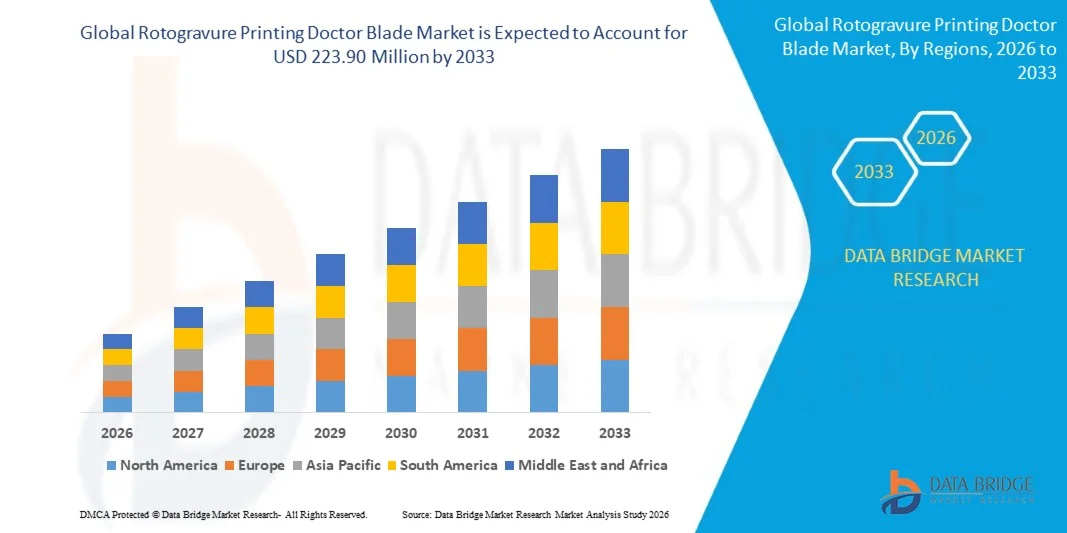
- As per Data Bridge Market Research analysis, the rotogravure printing doctor blade market was valued at USD 178.13 million in 2025 and is projected to reach USD 223.90 million by 2033, growing at a CAGR of 2.90% from 2026 to 2033.
- The market is experiencing steady growth driven by the increasing demand for high-quality printing in packaging, publishing, and decorative materials. Doctor blades play a crucial role in maintaining print quality by ensuring uniform ink application on the printing cylinder, supporting consistent printing performance across high-volume applications.
- The market is also being supported by technological advancements in doctor blade materials, including the development and use of carbon fiber and ceramic materials to improve wear resistance and durability. At the same time, the broader doctor blade industry benefits from demand for rotogravure, flexographic, and offset printing in packaging and publication applications, while advanced blade technologies are being developed to provide smoother, corrosion-resistant, and highly efficient edges.
Market Size & Forecast
- Global Market Value (2025): USD 178.13 Million
- Expected Market Value (2033): USD 223.90 Million
- Forecast CAGR (2026–2033): 2.90%
- Leading Region in 2025: North America
- Fastest Growing Region: Asia Pacific
What are the Major Takeaways of the Rotogravure Printing Doctor Blade Market?
- North America dominated the rotogravure printing doctor blade market with the largest revenue share of 38.7% in 2025, supported by its established printing industry, strong flexible packaging sector, and demand for high-quality printing technologies.
- Asia-Pacific is expected to be the fastest-growing region at a CAGR of 6.0% from 2026 to 2033, fueled by rapid industrialization, expanding packaging demand, and increasing investments in printing technologies across China and India.
- The metal doctor blade segment led the market with a 55% share in 2025, driven by its established use in high-speed printing and precise ink metering.
- Plastic doctor blade is the fastest-growing type, projected to register a CAGR of 4.5%, reflecting the surge in demand for lightweight, economical, and safer blade solutions.
- The flat doctor blade segment dominated the blade design type category with a 35% revenue share in 2025, led by its simple geometry, established manufacturing process, and broad use in conventional printing systems
- Metal accounted for 55% of the market share in 2025, preferred by its high durability, rigidity, precise ink metering, wear resistance, and reliable performance in high-speed rotogravure printing operations.
- The rotogravure printing segment is the fastest-growing application category, with a CAGR of 3.5%, driven by increasing demand for high-quality and high-volume printing, particularly in flexible packaging, labels, and consumer goods packaging.
Report Scope and Rotogravure Printing Doctor Blade Market Segmentation
|
Attributes |
Rotogravure Printing Doctor Blade Key Market Insights |
|
Segments Covered |
|
|
Countries Covered |
North America
Europe
Asia-Pacific
Middle East and Africa
South America
|
|
Key Market Players |
|
|
Market Opportunities |
|
|
Value Added Data Infosets |
In addition to the insights on market scenarios such as market value, growth rate, segmentation, geographical coverage, and major players, the market reports curated by the Data Bridge Market Research also include in-depth expert analysis, geographically represented company-wise production and capacity, network layouts of distributors and partners, detailed and updated price trend analysis and deficit analysis of supply chain and demand. |
What is the Key Trend in the Rotogravure Printing Doctor Blade Market?
- Printing manufacturers are increasingly focusing on precision doctor blade optimization to improve ink metering, reduce print defects, and maintain consistent quality during high-speed rotogravure operations.
- For instance, in March 2024, TKM Group and the University of Wuppertal developed a shape-optimized lamella doctor blade after a three-year research project, targeting more stable line pressure and addressing doctor-blade deflection issues that can cause uncontrolled changes in the print image during gravure printing.
- Advanced process control is becoming increasingly important as doctor blade angle, ink viscosity, and printing conditions directly influence gravure print quality and the uniformity of ink transfer.
- Research has demonstrated that improper doctor blade settings can contribute to voids, streaks, ink splatter, and undesirable printed-dot quality, increasing the importance of precisely controlled blade parameters.
- For instance, in November 2024, Daetwyler Swisstec introduced the newly developed Rototip bevel for its MDC LONGLIFE PRO doctor blade, designed specifically for rotogravure printing to provide maximum precision and improved doctoring quality while addressing the increasing performance requirements of faster and more digitized presses.
- As packaging converters increasingly demand high-quality, consistent printing at high production speeds, manufacturers are expected to continue adopting precision-engineered blades and optimized blade settings to improve print quality and operating efficiency.
What are the Key Drivers of the Rotogravure Printing Doctor Blade Market?
- The rapid expansion of packaging and flexible packaging printing is increasing demand for rotogravure doctor blades, as gravure is widely used for high-quality graphics and long production runs.
- For instance, in April 2025, Shaanxi Beiren showcased its upgraded “PERFECT 4.0” intelligent high-speed rotogravure printing press at CHINAPLAS 2025, featuring a quick-change doctor blade, automatic registration, and digital temperature control for food, pharmaceutical, household chemical, sanitary-material, and label packaging applications.
- Packaging converters are increasingly relying on gravure printing for flexible packaging, labels, cartons, and high-quality graphics, where consistent ink metering and long-run printing performance are critical.
- The growing use of gravure printing for flexible packaging, particularly where high print quality and consistency over long print runs are required, is further strengthening demand for precision doctor blades.
- For instance, in November 2023, TCPL Packaging announced the commissioning of a third Bobst rotogravure press, with the new 8-color press operating at up to 450 meters per minute; the company stated that the expansion was driven by growth in its flexible-packaging business and would increase converting capacity.
- With packaging consumption continuing to expand globally, particularly in Asia-Pacific, increasing gravure printing volumes are expected to sustain demand for doctor blades used for precise and consistent ink metering.
Which Factors are Challenging the Growth of the Rotogravure Printing Doctor Blade Market?
- Doctor blade wear and improper blade loading can increase operating costs and affect print consistency, particularly during high-speed rotogravure production where blade pressure must be carefully controlled.
- For instance, in March 2023, an article published in the Journal of Imaging Science and Technology demonstrated that uneven streaks can occur along the doctor blade and that blade angle and roller pressure require appropriate matching to improve gravure printing precision. This illustrates the sensitivity of print quality to doctor-blade operating conditions and the resulting challenge of maintaining consistent performance.
- Excessive or poorly controlled blade pressure can accelerate blade and cylinder wear, while contaminants in ink can contribute to streaking, blade damage, and surface defects during printing.
- The need for frequent monitoring and replacement of worn blades can increase maintenance requirements, production interruptions, and operating costs, particularly for high-speed converters operating continuously across long production runs
- For instance, in April 2024, TKM Group and the University of Wuppertal identified doctor blade wear, lamella breakage, cylinder wear/chromium damage, and streaking as key problem areas in gravure printing. The companies noted that line pressure generally cannot be kept constant throughout production, making consistent doctoring performance difficult to maintain.
- As converters simultaneously pursue higher press speeds, tighter print-quality tolerances, and lower operating costs, controlling blade wear and maintaining consistent metering performance remains a continuing challenge for rotogravure printing operation
- The need to maintain precise blade angle, loading, and ink conditions creates operational complexity for converters, while blade wear and print defects can increase maintenance requirements, material consumption, downtime, and production costs.
How is the Rotogravure Printing Doctor Blade Market Segmented?
The rotogravure printing doctor blade market is segmented on the basis of type, blade design, material, application, and end-use industry
- By Type
On the basis of type, the rotogravure printing doctor blade market is segmented into metal doctor blades, plastic doctor blades, and composite doctor blades. The metal doctor blade segment dominated the market with an estimated share of 55% in 2025, owing to its established use in high-speed printing and precise ink metering. Metal blades provide the rigidity and edge stability required for consistent contact with printing cylinders. Steel remains widely used because of its compatibility with conventional gravure and flexographic equipment. Their established production infrastructure and availability across printing markets further support their leading position. However, concerns related to wear and cylinder interaction are encouraging interest in alternative materials.
The plastic doctor blade segment is projected to register the fastest growth at an estimated CAGR of 4.5% through the forecast period, supported by demand for lightweight, economical, and safer blade solutions. Plastic blades are an important growth area because polyethylene and polyester blades offer lower weight and smoother operation than conventional alternatives. Plastic materials can also reduce friction and provide advantages in applications requiring gentler blade-to-cylinder interaction. Increasing material innovation is improving their durability and performance.
- By Blade Design
On the basis of blade design, the market is segmented into flat doctor blades, honeycomb doctor blades, V-shaped doctor blades, lamella blades, and other specialized blade designs. The flat doctor blade segment is estimated to account for 35% of the market in 2025, supported by its simple geometry, established manufacturing process, and broad use in conventional printing systems. Flat blades provide a consistent contact edge for removing excess ink from printing cylinders. Their straightforward configuration makes installation, replacement, and maintenance comparatively easy. They remain widely relevant across established printing operations where conventional doctoring performance is sufficient. The large installed base of traditional presses continues to sustain demand for these blades.
The lamella blade segment is expected to be the fastest-growing design category with an estimated CAGR of 5% through the forecast period, driven by demand for improved blade stability and optimized line pressure. Lamella geometry is designed to improve pressure distribution and reduce blade deflection during high-speed printing. Research and industry development have increasingly focused on shape-optimized lamella blades to address variations in line pressure and print quality. The adoption of specialized geometries is becoming more important as printing speeds and quality requirements increase. Advanced blade configurations can also support more consistent ink metering and reduced printing defects. These factors are expected to encourage increasing adoption of lamella and other precision-engineered blade designs.
- By Material
On the basis of material, the market is segmented into plastic, wood, metal, and composite. The metal material segment dominated with an estimated share of 55% in 2025, reflecting the extensive use of steel and other metals in doctor blade manufacturing. Metal materials provide high rigidity, dimensional stability, and an effective scraping edge for ink removal. They are particularly suitable for high-speed printing where consistent blade pressure is required. The mature supply chain and compatibility with existing printing equipment further strengthen their position.
The plastic material segment is projected to grow at the fastest rate at 4.5% CAGR during forecast period supported by rising demand for lightweight and economical alternatives to metal blades. Plastic materials such as polyethylene and polyester are expected to support future doctor blade demand because they are lightweight, economical, and safer to use. Plastic blades can also provide smooth operating characteristics and reduced interaction with printing surfaces. Advances in polymer and nanotechnology-enhanced materials are improving edge quality, durability, and corrosion resistance. The increasing emphasis on lower maintenance and efficient blade handling is further supporting adoption.
- By Application
On the basis of application, the market is segmented into flexographic printing, rotogravure printing, offset printing, and others. The flexographic printing segment dominated the market with 50% share in 2025, driven by extensive use of chambered doctor blade systems in flexographic presses. Flexographic printing is widely used for packaging, labels, flexible materials, and commercial applications. Doctor blades are critical for controlling ink transfer from the anilox roll and maintaining consistent printing quality. The growth of packaging printing therefore directly supports demand for doctor blades.
The rotogravure printing segment is projected to register strong growth at 3.5% CAGR during forecast period supported by increasing demand for high-quality, high-volume printing in flexible packaging, labels, cartons, and decorative applications. Rotogravure printing is particularly suitable for long print runs because of its consistent color reproduction, fine image quality, and efficient printing performance. The expanding use of flexible packaging, particularly for food and beverages, personal care products, and consumer goods, is increasing demand for gravure printing. As printing volumes increase, demand for precision doctor blades that provide uniform ink metering, minimize printing defects, and maintain consistent print quality is expected to strengthen.
- By End Use Industry
On the basis of end-use industry, the market is segmented into food and beverage, personal care, and pharmaceutical. The food and beverage segment dominated with an estimated share of 45% in 2025, supported by extensive use of printed flexible packaging, pouches, labels, and other packaged-food formats. Food and beverage packaging requires high-quality graphics and consistent reproduction during long printing runs. Gravure printing is widely employed where detailed and repeatable print quality is required. Increasing consumption of packaged foods and beverages is therefore supporting demand for printing equipment and consumables. Doctor blades remain essential for controlled ink metering in these applications.
The pharmaceutical segment is expected to be the fastest-growing end-use category, at an estimated CAGR of 5% during forecast period, driven by increasing pharmaceutical production and demand for high-quality printed packaging. Pharmaceutical labels, cartons, blister-related packaging materials, and other printed formats require precise reproduction of product information and regulatory details. Consistent ink transfer is essential for maintaining legibility and print quality. Expansion of pharmaceutical manufacturing in emerging markets is creating additional packaging-printing requirements. Increasing quality and traceability requirements are also supporting investment in reliable printing processes.
Which Region Holds the Largest Share of the Rotogravure Printing Doctor Blade Market?
- North America dominated the rotogravure printing doctor blade market with the largest revenue share of 38.7% in 2025, supported by its established printing industry, strong flexible packaging sector, and demand for high-quality printing technologies
- The region also benefits from advanced printing technologies, strong manufacturing capabilities, and continued investment in flexible packaging and high-performance printing systems. Increasing adoption of precision-engineered doctor blades is supporting better ink control, print consistency, and operational efficiency in demanding printing environments. North American converters are increasingly focused on reducing printing defects, improving blade durability, and maintaining stable performance at high press speeds.
U.S. Rotogravure Printing Doctor Blade Market Insight
The U.S. rotogravure printing doctor blade market is supported by the country’s established packaging-printing industry and continued demand for precision doctoring solutions in high-speed printing operations. The U.S. market is specifically analyzed across metal, plastic, and composite doctor blades and across flexographic, rotogravure, and offset applications in dedicated country research. The strong presence of flexible packaging converters and advanced printing equipment manufacturers continues to support demand for replacement and high-performance blades. The U.S.-based Daetwyler supplied a white carbon-steel lamella doctor blade for gravure printing research evaluating blade-material effects on print performance, demonstrating the continued development and use of advanced doctor-blade solutions in the U.S.
Asia-Pacific Rotogravure Printing Doctor Blade Market Insight
The Asia-Pacific rotogravure printing doctor blade market is expected to witness rapid growth, supported by expanding packaging production, increasing printing activity, and rising demand for efficient doctoring systems across China, India, and other Asian economies. The region is becoming increasingly important for suppliers because packaging manufacturers are investing in modern flexographic and gravure equipment to meet rising consumer-product demand. In June 2024, Convertech Equipment showcased its doctor blade solutions for flexographic and gravure printing at drupa 2024 and stated that “the whole of Asia is growing,” with the company expressing strong confidence in the Asian packaging market. The company also reported that its doctor blades are exported to numerous countries. This reflects growing regional demand for doctor blades and packaging-printing technologies.
Japan Rotogravure Printing Doctor Blade Market Insight
The Japan rotogravure printing doctor blade market is witnessing consistent development, supported by established printing capabilities and demand for high-precision doctoring systems. The dedicated Japan market research tracks metal, plastic, and composite blades and separately evaluates rotogravure printing applications. The market is also increasingly influenced by requirements for improved efficiency, blade durability, and environmentally responsible printing processes. Daetwyler’s MDC LONGLIFE PRO Rototip development highlighted the growing demand for advanced gravure doctor blades capable of delivering maximum precision and improved doctoring quality for modern printing presses. Such developments are relevant to advanced Asian printing markets such as Japan, where high-quality and reliable gravure production remains important.
China Rotogravure Printing Doctor Blade Market Insight
The China rotogravure printing doctor blade market is growing rapidly, driven by the country’s extensive packaging-converting base, increasing adoption of high-speed printing equipment, and expanding demand for high-quality printed packaging. China is separately covered within the Asia-Pacific analysis of dedicated rotogravure printing doctor blade research. In April 2025, Shaanxi Beiren presented its upgraded “PERFECT 4.0” intelligent high-speed gravure printing press, incorporating a quick-change doctor blade and other automated technologies for food, pharmaceutical, household-chemical, sanitary-material, and label-packaging applications. The development demonstrates continued investment in advanced gravure printing equipment and integrated doctor-blade systems in China
U.K. Rotogravure Printing Doctor Blade Market Insight
The U.K. rotogravure printing doctor blade market is experiencing steady development, supported by established printing expertise and the presence of specialized doctor-blade manufacturers. Demand is supported by applications requiring precise ink metering and consistent print quality across high-speed printing processes. In a research study, Esterlam Ltd. of the U.K. supplied an E600 plastic doctor blade with a step-lamella tip for gravure printing experiments, where researchers compared plastic and metal blades under controlled printing conditions. The study used the U.K.-supplied blade to evaluate the influence of blade material on print performance, highlighting continuing development and application of specialized plastic doctor blades.
Germany Rotogravure Printing Doctor Blade Market Insight
The Germany rotogravure printing doctor blade market is expanding steadily, supported by the country’s strong printing-engineering capabilities and development of advanced blade geometries for modern gravure presses. Germany is specifically analyzed as a national market in dedicated rotogravure doctor blade research. In March 2024, TKM Group and the University of Wuppertal announced a shape-optimized lamella doctor blade developed through a three-year research project, addressing the difficulty of maintaining stable line pressure during gravure printing and aiming to reduce printing problems caused by blade deflection. In May 2024, TKM Meyer also received a European patent for the new TKM NEO lamella-tip doctor blade, developed specifically to improve efficiency and print quality in gravure printing.
Which are the Top Companies in Rotogravure Printing Doctor Blade Market?
The rotogravure printing doctor blade industry is primarily led by well-established companies, including:
- Printco Industries (U.S.)
- Harris & Bruno International (U.S.)
- SUN Automation Group (U.S.)
- FLXON Incorporated (U.S.)
- Allison Systems Corporation (U.S.)
- FUJI SHOKO CO., LTD. (Japan)
- PrimeBlade Sweden AB (Sweden)
- Kadant Inc. (U.S.)
- SWEDEV AB (Sweden)
- BOBST SA (Switzerland)
- TRESU A/S (Denmark)
- Daetwyler SwissTec AG (Switzerland)
- AkeBoose GmbH (Germany)
- Röchling SE & Co. KG (Germany)
- Pamarco Inc. (U.S.)
- Esterlam International Ltd (U.K.)
- TKM Meyer GmbH (Germany)
- CBG Acciai S.r.l. (Italy)
- Flexo Concepts (U.S.)
- Tokyo Seisakusho Co., Ltd. (Japan)
What are Latest Developments in Rotogravure Printing Doctor Blade Market?
- In July 2025, Alleima published an update on printing doctor blades, highlighting the increasing performance requirements created by higher printing speeds, finer details, and demand for consistent print quality in gravure and flexographic processes. The company emphasized the use of specialized stainless and carbon steels with high wear resistance, uniform microstructure, tight dimensional tolerances, and consistent straightness to support precise doctor blade contact and reliable ink
- In June 2024, TKM showcased its TKM NEO doctor blade at drupa 2024, presenting the newly developed blade as a solution for stable line printing in gravure applications. The product was developed with the University of Wuppertal and focuses on optimized blade geometry to address deflection and uncontrolled changes in the printed image.
- In May 2024, TKM Meyer introduced the TKM NEO lamella-tip doctor blade, developed in cooperation with the University of Wuppertal for gravure printing. The new geometry was designed to reduce doctor-blade deflection and maintain more stable line pressure, helping improve printing efficiency and quality while reducing problems associated with conventional doctor-blade geometries. TKM Meyer received a European patent for the new blade in April 2024.
- In March 2023, Daetwyler SwissTec launched the MDC Longlife Pro doctor blade, specifically developed for gravure printing applications. The new blade was designed to provide clean and consistent doctoring throughout the print run while operating with minimal contact pressure, helping reduce friction and chrome wear on gravure cylinders. The product was developed to address printing efficiency, cost reduction, and consistent print-quality requirements.
- In August 2022, Daetwyler SwissTec marked 50 years of lamella-edge doctor blade development, highlighting the continued evolution of doctor blade technology for gravure and flexographic printing. The company emphasized that the lamella edge was developed to maintain doctor blade thickness and contact area as the blade wears, supporting consistent print quality, clean wiping, and stable tonal values. The update also highlighted continued research and development into specialized MDC doctor blade coatings and application-specific properties

- Interactive Data Analysis Dashboard
- Company Analysis Dashboard for high growth potential opportunities
- Research Analyst Access for customization & queries
- Competitor Analysis with Interactive dashboard
- Latest News, Updates & Trend analysis
- Harness the Power of Benchmark Analysis for Comprehensive Competitor Tracking
Global Rotogravure Printing Doctor Blade Market, Supply Chain Analysis and Ecosystem Framework
To support market growth and help clients navigate the impact of geopolitical shifts, DBMR has integrated in-depth supply chain analysis into its Global Rotogravure Printing Doctor Blade Market research reports. This addition empowers clients to respond effectively to global changes affecting their industries. The supply chain analysis section includes detailed insights such as Global Rotogravure Printing Doctor Blade Market consumption and production by country, price trend analysis, the impact of tariffs and geopolitical developments, and import and export trends by country and HSN code. It also highlights major suppliers with data on production capacity and company profiles, as well as key importers and exporters. In addition to research, DBMR offers specialized supply chain consulting services backed by over a decade of experience, providing solutions like supplier discovery, supplier risk assessment, price trend analysis, impact evaluation of inflation and trade route changes, and comprehensive market trend analysis.
Data collection and base year analysis are done using data collection modules with large sample sizes. The stage includes obtaining market information or related data through various sources and strategies. It includes examining and planning all the data acquired from the past in advance. It likewise envelops the examination of information inconsistencies seen across different information sources. The market data is analysed and estimated using market statistical and coherent models. Also, market share analysis and key trend analysis are the major success factors in the market report. To know more, please request an analyst call or drop down your inquiry.
The key research methodology used by DBMR research team is data triangulation which involves data mining, analysis of the impact of data variables on the market and primary (industry expert) validation. Data models include Vendor Positioning Grid, Market Time Line Analysis, Market Overview and Guide, Company Positioning Grid, Patent Analysis, Pricing Analysis, Company Market Share Analysis, Standards of Measurement, Global versus Regional and Vendor Share Analysis. To know more about the research methodology, drop in an inquiry to speak to our industry experts.
Data Bridge Market Research is a leader in advanced formative research. We take pride in servicing our existing and new customers with data and analysis that match and suits their goal. The report can be customized to include price trend analysis of target brands understanding the market for additional countries (ask for the list of countries), clinical trial results data, literature review, refurbished market and product base analysis. Market analysis of target competitors can be analyzed from technology-based analysis to market portfolio strategies. We can add as many competitors that you require data about in the format and data style you are looking for. Our team of analysts can also provide you data in crude raw excel files pivot tables (Fact book) or can assist you in creating presentations from the data sets available in the report.













